“PART 2
Daniel did not speak for several seconds.
That silence frightened me more than his words.
Daniel Mercer had been my attorney for eleven years. He had handled property acquisitions while I was deployed, created the holding company that owned most of my investments, reviewed contracts, fought insurance companies, and once called me at three in the morning because a commercial tenant had tried to disappear owing six months of rent.
He did not dramatize.
Ever.
So when he said, “Elena, I found something involving Sarah and your property accounts,” I knew it wasn’t a bookkeeping mistake.
“What did she do?”
“I’m still establishing the full scope.”
“Daniel.”
He exhaled.
“Someone has been attempting to establish ownership interests in two of your properties.”
For a moment, I thought the pain medication had affected my hearing.
“What?”
“Your parents’ house and the lake property.”
The lake property.
I closed my eyes.
Five years earlier, I had bought a cabin in Virginia after my husband, Michael, told me we needed one place in the world where nobody wore a uniform, carried a government phone, or asked what time I would be back.
We had spent exactly twelve weekends there before his death.
I had not visited since.
“Sarah has no ownership interest in either property.”
“I know.”
“Then what exactly are you telling me?”
“There are documents.”
My fingers tightened around the phone.
“What documents?”
“Affidavits. Copies of operating agreements. What appears to be a transfer authorization.”
“Appears?”
“Because the signatures are yours.”
The room went very still.
A machine beside my bed continued beeping.
Somewhere in the corridor, wheels squeaked against polished flooring.
I stared at the ceiling.
“I didn’t sign anything.”
“I know.”
“How do you know?”
“Because one of the documents claims you signed it in Richmond on March fourteenth.”
I remembered March fourteenth.
I had been overseas.
Daniel knew it too.
He continued.
“There are also emails supposedly from you authorizing Sarah to act as a representative of Carter Ridge Holdings.”
My company.
My properties.
My name.
My sister.
The pain in my pelvis suddenly felt distant.
“What was she trying to do?”
“The documents were submitted as part of an attempt to secure financing.”
“Against my properties?”
“Yes.”
“How much?”
Another pause.
“Potentially two-point-eight million dollars.”
I stopped breathing.
Not because I couldn’t afford the loss.
Because someone had looked at my life, my work, the future I was building for my children, and decided it belonged to them.
“Was any money released?”
“Not from the lender I spoke to. Their compliance department flagged discrepancies. But, Elena…”
“What?”
“I don’t think this was their first attempt.”
I looked at the photograph beside my bed.
Leo was laughing with his entire face.
Maya had one fist wrapped around her brother’s sleeve.
Michael had taken that picture fourteen days before the car accident that killed him.
Everything I owned would one day belong to them.
Sarah hadn’t been stealing from me.
She had been stealing from my children.
“Find everything,” I said.
“I already have a forensic accountant reviewing the accounts.”
“And Daniel?”
“Yes?”
“Do not warn them.”
“I wasn’t planning to.”
“If Sarah calls you, you know nothing. If my parents call, the financial changes are administrative. Nothing more.”
“Understood.”
“Preserve every document.”
“Elena—”
“Every email. Every signature. Every access log.”
“I will.”
I ended the call.
Ten seconds later, my mother called again.
I watched her name pulse on the screen.
Mom.
Twenty-four hours earlier, that word still meant something automatic.
Family.
Home.
Obligation.
Now I saw it differently.
A label could survive long after its meaning disappeared.
I declined the call.
Then Sarah texted.
**WHAT DID YOU DO?**
Another message arrived.
**My payment didn’t come through.**
Then:
**Mom’s freaking out because something’s wrong with the car. Call me NOW.**
Not one question about my injuries.
Not one question about the twins.
Not one question about whether I could stand.
I turned the phone facedown.
A nurse named Priya entered a few minutes later.
She had been assigned to me since surgery and had already developed the unimpressed expression of someone accustomed to officers pretending pain was a matter of discipline.
“You’re supposed to be resting.”
“I am resting.”
“You look like you’re planning an invasion.”
“Administrative restructuring.”
She looked at the phone.
“Dangerous?”
“Apparently.”
She adjusted my IV.
“Your children are coming this afternoon.”
That softened something in me immediately.
“Who arranged it?”
“Captain Walsh spoke with family support services. They’ve organized supervised transport.”
Captain Rebecca Walsh had served under me four years earlier.
I had attended her promotion ceremony.
Now she was coordinating diapers and car seats because my actual family considered pickleball more important.
I laughed once.
It hurt my ribs.
Priya frowned.
“Don’t do that.”
“Noted.”
“Also, someone called the nurses’ station claiming to be your mother.”
I turned toward her.
“What did she want?”
“Information about when you’d be discharged.”
“Did you give her anything?”
Priya’s expression became almost offended.
“No.”
“Good.”
“She also asked whether you were capable of making financial decisions.”
That erased the small smile from my face.
“Exact words?”
“Something close to that.”
I reached for my phone.
“What are you doing?”
“Calling Daniel again.”
This time, he answered before the second ring.
“My mother contacted the hospital and asked whether I was capable of making financial decisions.”
Silence.
Then:
“That changes things.”
“I thought you might say that.”
“Elena, listen carefully. Do not sign anything they send you. Do not verbally authorize anything. I’m notifying your financial institutions that you are alive, competent, and represented.”
“Competent.”
“Yes.”
The word sat strangely in the air.
“You think they’re trying to have me declared incapacitated?”
“I think I no longer dismiss that possibility.”
I almost laughed again.
My mother couldn’t give up pickleball for a month.
But she might make time to seize my company.
By noon, Daniel had placed additional restrictions across my major accounts.
My investment manager was notified.
My bank’s fraud division opened a case.
Two property managers changed access credentials.
The corporate registered agent received written instructions that no filings were valid without Daniel’s verification.
At 1:17 p.m., Dad called.
I finally answered.
“Elena.”
His voice was tight.
“Dad.”
“What is going on?”
“I’m recovering.”
“You know what I mean.”
I said nothing.
“Your mother’s car isn’t working.”
“It works.”
“The account is frozen.”
“Then she should stop driving it.”
“What kind of childish stunt is this?”
My pulse remained steady.
Years in command teach you something useful.
The angrier the person across from you becomes, the more valuable silence gets.
Dad filled it.
“Sarah’s payment disappeared too. And your mother received an email saying the country club membership is terminated.”
“That sounds accurate.”
“You can’t just punish everyone because your mother said something you didn’t like.”
“This isn’t punishment.”
“What do you call it?”
“An adjustment.”
“To what?”
“My responsibilities.”
He made a sound of disbelief.
“We’re your family.”
“So are Leo and Maya.”
“That’s different.”
My hand tightened around the blanket.
“How?”
“They’re your children.”
“Exactly.”
He hesitated.
I continued.
“I asked Mom to help them while I’m hospitalized.”
“She was upset.”
“She refused.”
“She didn’t understand how serious this was.”
“I said I was injured during a military operation.”
“You know how your mother gets.”
There it was.
The phrase that had excused decades.
You know how your mother gets.
I had heard versions of it since childhood.
When Mom screamed at me for getting a scholarship because Sarah cried about not winning an art competition.
When Mom refused to attend my commissioning because Sarah had a dance recital the same weekend.
When my first deployment ended and I flew home to discover my parents had gone on a cruise I paid for.
You know how your mother gets.
As if her behavior were weather.
Something no one could control.
Something the rest of us simply had to dress around.
“Dad, whose house are you standing in?”
He stopped.
“What?”
“The house. Whose is it?”
“Ours.”
“No.”
“Elena—”
“Carter Ridge Holdings owns it.”
“You bought it for us.”
“I bought it and allowed you to live there.”
“That was never how we understood the arrangement.”
“The deed is remarkably clear.”
His breathing changed.
A small thing.
But I heard fear enter it.
“Elena, you wouldn’t.”
“Wouldn’t what?”
“Throw your parents out of their home.”
“I haven’t decided anything.”
“Your mother is sixty-eight years old.”
“And yesterday she told her injured daughter to figure it out.”
“That is not the same thing.”
“No. It isn’t.”
He became quieter.
Almost gentle.
That worried me more.
“Elena, you’re under medication. You’ve been through trauma. This isn’t the time to make major decisions.”
I stared at the doorway.
My mother had asked whether I was competent.
Now my father was emphasizing medication and trauma.
Not coincidence.
Strategy.
“Who suggested saying that?”
Silence.
“What?”
“Was it Sarah?”
“I don’t know what you’re talking about.”
“Goodbye, Dad.”
“Elena—”
I ended the call.
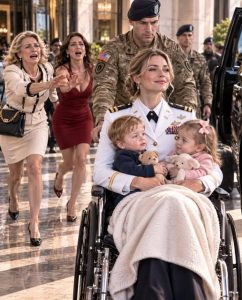
My children arrived twenty minutes later.
Nothing else mattered for a while.
Leo came through the door first in Captain Walsh’s arms, serious and suspicious until he saw me.
Then his face changed.
“Mama!”
The word broke me.
Maya followed with a stuffed rabbit clutched under one arm.
Because of my injuries, I couldn’t scoop them up.
I couldn’t kneel.
I couldn’t let them crawl across my chest.
So the nurses arranged pillows beside me, and Rebecca carefully placed them near enough for me to touch.
Maya pressed her palm against my cheek.
Leo tried to climb onto my bed.
“Easy, buddy.”
He frowned at the braces and tubing.
“Mama hurt?”
“Yes.”
He considered this.
Then he kissed my wrist.
I cried quietly.
Not from pain.
Not even from grief.
From the unbearable relief of holding something that still loved me without calculating its value.
Rebecca stood near the window.
“We can extend the childcare arrangement,” she said. “A few people from the unit volunteered too.”
“You don’t have to do that.”
“We know.”
That nearly broke me again.
My soldiers—people with children, spouses, jobs, and obligations of their own—were volunteering to rearrange their lives.
My mother had protected her pickleball schedule.
Maya fell asleep against my arm.
Leo stared at the television.
Rebecca lowered her voice.
“Ma’am, there’s something else.”
I looked at her.
“Your sister was downstairs.”
Every muscle in my body seemed to tighten.
“When?”
“About fifteen minutes ago.”
“What did she want?”
“She said she was here to take the twins.”
I stared at her.
“She what?”
“She claimed you’d asked her to assume temporary custody.”
Cold spread through me.
“Did she see them?”
“No.”
“Did she touch them?”
“No, ma’am.”
“Where is she now?”
“Security escorted her out.”
I reached for my phone so quickly that pain exploded through my ribs.
Priya hurried toward me.
“Colonel—”
“I’m fine.”
I wasn’t.
But pain had become irrelevant.
I called Daniel.
He answered immediately.
“Sarah tried to take my children.”
His voice changed.
Not surprise.
Recognition.
“Elena, I need to tell you what we found.”
“Now.”
“The forged property documents weren’t the only filings.”
My mouth went dry.
“What else?”
“A petition was drafted regarding temporary guardianship of Leo and Maya.”
The room tilted.
“Drafted?”
“It hasn’t been granted. I’m confirming whether it was ever formally filed.”
“On what grounds?”
“That you are incapacitated, their father is deceased, and Sarah is the most appropriate available relative.”
I looked at my children.
Sleeping.
Safe.
For now.
“She knew I was alive.”
“Yes.”
“She knew I was conscious.”
“Yes.”
“And she came here anyway.”
“Yes.”
Rebecca’s face had hardened.
Daniel continued.
“There’s more.”
Of course there was.
“There’s always more.”
“The guardianship paperwork references financial assets held for the children.”
I closed my eyes.
Michael and I had established trusts shortly after the twins were born.
Not enormous.
But substantial.
Life insurance after his death had increased them considerably.
“Could she access them?”
“Not easily.”
“That’s not what I asked.”
“Potentially, with control over the children and enough supporting documentation, she could attempt it.”
My daughter slept inches from my hand.
For the first time since waking in the hospital, I felt something stronger than betrayal.
Fear.
Not battlefield fear.
That was simple.
You saw danger.
You assessed it.
You acted.
This was worse.
This danger knew my children’s birthdays.
It knew which stuffed animal Maya slept with.
It had held Leo at his baptism.
It called me sister.
“Daniel.”
“Yes?”
“Make sure Sarah cannot get near them.”
“I’m already preparing emergency filings.”
“And my parents?”
“I’m working on that too.”
My phone buzzed.
A text from Sarah.
I opened it.
**You’ve lost your mind.**
Then another.
**I came to HELP.**
Another.
**Mom and Dad are scared of you right now.**
And then:
**You should be careful making decisions when doctors have you drugged up. People might question whether you’re thinking clearly.**
I showed the screen to Daniel through a video call.
He stared at it.
“Do not respond.”
“I wasn’t going to.”
“Screenshot everything.”
“I already did.”
For the first time that day, he smiled faintly.
“There’s the colonel I know.”
By evening, legal notices had been delivered electronically.
Sarah was informed that all consulting arrangements with Carter Ridge Holdings had ended.
My parents received notice terminating permission to use the company vehicle.
The country club confirmed cancellation.
The vacation property reservations my mother had made for the winter were withdrawn.
Then Daniel sent one more document.
A formal notice regarding the house.
Not eviction.
Not yet.
An occupancy review.
Thirty days to provide documentation establishing any legal right to remain on property owned by Carter Ridge Holdings.
They had none.
At 8:43 p.m., Mom called.
I answered.
She was crying.
Not softly.
Dramatically.
“Elena, how could you do this?”
I listened.
“We raised you.”
“Yes.”
“We sacrificed everything.”
I remembered secondhand uniforms because Sarah wanted horseback riding lessons.
I remembered working summer jobs at sixteen while my parents paid for Sarah to attend an expensive performing arts camp.
I remembered sending them money from my first deployment because Dad said the mortgage was behind.
I remembered learning years later that he had used part of it for a golf trip.
“I’m not discussing childhood accounting with you.”
“You’re throwing us into the street!”
“No.”
“That letter—”
“Gives you thirty days to establish your legal claim.”
“You know we don’t have paperwork!”
“Then stop telling people the house belongs to you.”
She stopped crying.
Instantly.
That interested me.
“What has Sarah told you?”
“Don’t bring your sister into this.”
“She brought herself into it.”
“She was trying to help today.”
“By taking my children without permission?”
“She thought you needed rest.”
“Mom.”
“She loves those babies.”
“Mom.”
“She would never hurt them.”
“Did you know about the guardianship petition?”
Silence.
A long one.
I felt my heartbeat slow.
“Mom?”
“She was scared.”
There it was.
Not denial.
Justification.
“You knew.”
“Elena, please understand—”
“You knew.”
“You were seriously injured!”
“I am not unconscious.”
“We didn’t know what would happen.”
“So Sarah prepared to take custody of my children?”
“Temporarily.”
“And their trusts?”
Another silence.
I felt something inside me become perfectly calm.
“Mom, did Sarah tell you about the trusts?”
“I don’t understand financial things.”
“Did. She. Tell. You.”
“She said there would be resources to care for them.”
Resources.
Such a clean word.
Like funds.
Like assets.
Like my children were an acquisition with expenses attached.
“What else did she tell you?”
My mother started crying again.
“Elena, please. Sarah has had such a difficult year.”
I almost admired the consistency.
Even now.
Even here.
Sarah’s difficulties mattered.
Mine were background noise.
“What happened?”
“The boutique left her with debts.”
“I paid those.”
“Not all of them.”
That was new.
“How much?”
“I don’t know.”
“Mom.”
“A lot.”
“How much?”
“I said I don’t know!”
I heard my father in the background.
Then Mom whispered something to him.
I waited.
Finally she said, “Maybe four hundred thousand.”
My eyes closed.
I had paid nearly three hundred thousand dollars eighteen months earlier to close Sarah’s business obligations.
“Four hundred thousand additional?”
“She borrowed.”
“From whom?”
“Elena—”
“From whom?”
“I don’t know.”
I knew she was lying.
Before I could press her, a new message appeared from Daniel.
**DO NOT DISCUSS FINANCES FURTHER. CALL ME IMMEDIATELY.**
I ended the conversation.
“I have to go.”
“Elena, don’t hang up—”
I disconnected.
Daniel answered my call.
“We found the earlier transactions.”
“How bad?”
“Worse than I thought.”
I looked toward the twins. Rebecca had taken them back to temporary housing an hour earlier.
The room suddenly felt empty.
“Tell me.”
“Sarah has been receiving money beyond the consulting payments.”
“From where?”
“An account tied to one of your rental subsidiaries.”
“How?”
“Regular transfers. Small enough individually not to trigger the reporting threshold we established.”
“How much total?”
“Over thirty-one months? Roughly six hundred and forty thousand dollars.”
My stomach tightened.
“Who authorized them?”
“That’s the problem.”
“Daniel.”
“The credentials used belonged to your father.”
I said nothing.
My father had never been an officer of my company.
But years ago, when I was deployed repeatedly, I had given him limited emergency access to one household account.
A convenience.
A gesture of trust.
Apparently trust was simply another asset they had liquidated.
“How did he get access to company accounts?”
“We’re tracing it.”
“Did he transfer the money to Sarah?”
“Not directly. It moved through two accounts first.”
“So they hid it.”
“It appears that way.”
“Why?”
“We don’t know.”
“Her debt?”
“Possibly.”
“Who does she owe?”
Daniel became quiet.
Then he said, “That’s the part I wanted verified before telling you.”
My skin prickled.
“Verified by whom?”
“A private investigator.”
“You hired one?”
“Three hours ago.”
“What did he find?”
“Sarah’s boutique didn’t simply fail because of poor sales.”
I waited.
“She had an investor.”
“That isn’t unusual.”
“No. But this investor apparently provided substantial private loans after the business became insolvent.”
“How substantial?”
“Possibly over a million dollars.”
“To Sarah?”
“Yes.”
“Who?”
“We have a company name. Northstar Meridian.”
I had never heard of it.
“What do they do?”
“On paper? Private lending and distressed asset acquisition.”
“On paper.”
“Yes.”
“And off paper?”
“We’re still investigating.”
I rubbed my forehead.
“Does this connect to my properties?”
“I think Sarah was trying to collateralize your assets to satisfy whoever she owes.”
Everything suddenly aligned.
The transfers.
The forged signatures.
The attempt to gain control over the twins.
The pressure to establish that I was impaired.
My parents were not merely angry that I had turned off the money.
They were terrified.
“Daniel, if they owe these people that much, why didn’t Sarah just ask me?”
“I don’t know.”
But I did.
Because Sarah never asked when she believed she could take.
I had spent my entire adult life solving every family crisis before consequences arrived.
Sarah had learned that disaster was temporary.
Debt disappeared.
Rent got paid.
Businesses failed and someone else absorbed the loss.
Mom and Dad had learned the same lesson.
Elena would handle it.
Until Elena said no.
Then the whole structure collapsed.
The next morning, I received a visitor.
My father.
He looked older than he had three days earlier.
His shirt was wrinkled.
His eyes were bloodshot.
Hospital security remained outside the room.
I did not ask them to leave.
Dad noticed.
“That’s necessary?”
“Yes.”
He pulled a chair closer.
“Elena…”
“Did you transfer money to Sarah?”
His face changed.
Barely.
Enough.
“Your sister needed help.”
“That wasn’t your money.”
“I was going to put it back.”
“With what?”
He looked toward the window.
“How much did you take?”
“I didn’t take anything for myself.”
“That wasn’t the question.”
He swallowed.
“Sarah got mixed up with people.”
“What people?”
“I don’t know.”
“You transferred six hundred forty thousand dollars and don’t know?”
His head snapped toward me.
“You know?”
“Yes.”
He looked suddenly frightened.
Not of me.
Of something else.
“Elena, you need to restart those accounts.”
“No.”
“You don’t understand.”
“Then explain it.”
“She has obligations.”
“To Northstar Meridian?”
His face drained of color.
That was confirmation.
“How do you know that name?”
“Dad.”
“You shouldn’t be digging into this.”
I stared at him.
“You stole from my company.”
“I protected your sister.”
“You forged my authorization?”
“No.”
“Did Sarah?”
He stood.
“I’m not answering that.”
“Sit down.”
Perhaps it was habit.
Perhaps twenty years of hearing command in my voice still meant something.
He sat.
“Why did Sarah try to take my children?”
His hands shook.
“She panicked.”
“About what?”
“Elena, turn the money back on.”
“No.”
“Just for a few weeks.”
“No.”
His voice dropped.
“You don’t understand what happens if she doesn’t pay.”
“Then tell me.”
He looked at the door.
Then the window.
Then me.
“They know about you.”
A chill moved through me.
“Who?”
“The people she owes.”
“What do they know?”
“That you have assets.”
“That isn’t difficult to discover.”
“No.”
His expression told me there was more.
“What else?”
He whispered it.
“They know about the twins.”
For a second, I heard nothing.
Not the machines.
Not the corridor.
Nothing.
“Explain.”
“I don’t know everything.”
“You know enough.”
“Sarah used your name when she borrowed money. She told them you backed her.”
“I didn’t.”
“I know.”
“She forged my guarantee?”
“I think so.”
“And when she couldn’t pay?”
“They started looking at what you owned.”
Rage is usually depicted as heat.
Mine was ice.
Clean.
Sharp.
Useful.
“And you helped her move my money.”
“I was trying to keep everyone safe.”
“You helped her forge documents?”
“No.”
“Did Mom?”
He hesitated.
That hesitation answered me.
I pressed the call button beside my bed.
Dad stood abruptly.
“What are you doing?”
“Ending this conversation.”
“Elena, please.”
A nurse appeared.
I looked at my father.
“You have one chance to tell Daniel everything you know.”
“This is family.”
“No.”
He flinched.
“This was family.”
Security entered.
As they escorted him toward the door, he twisted back toward me.
“Elena!”
I said nothing.
Then he shouted something that stopped everyone in the room.
“You think Michael’s accident was an accident?”
The air vanished.
“Stop.”
Security froze.
Dad’s face collapsed.
Maybe he realized what he had said.
Maybe he had intended to say it all along.
“What did you just say?”
“Elena…”
“My husband died in a car accident.”
“I know.”
“Dad.”
His eyes filled with tears.
“I’m sorry.”
“For what?”
He looked terrified now.
Absolutely terrified.
“Elena, Sarah knew Northstar before Michael died.”
A monitor beside me began sounding faster.
I barely heard it.
“What does Michael have to do with this?”
Dad opened his mouth.
Nothing came out.
Then his phone rang.
He looked at the screen.
Whatever he saw destroyed the remaining color in his face.
He declined the call.
It rang again immediately.
Security moved toward him.
“Show me the phone,” I said.
“Elena, no.”
“Show me.”
He gripped it harder.
Then a message appeared across the lock screen.
I could read it from where I lay.
Only six words.
**YOU WERE TOLD TO STAY QUIET.**
Dad looked at me.
And for the first time in my life, I saw my father look at his own daughter as if being near me might get us both killed.
Then Daniel called.
I answered without taking my eyes off Dad.
“Elena,” he said, breathing hard. “We obtained Northstar Meridian’s incorporation records.”
“And?”
“You need to hear this before you speak to anyone else.”
“Tell me.”
“The company was created seven years ago.”
“That doesn’t mean anything.”
“No. But the registered organizer does.”
My father closed his eyes.
Daniel continued.
“Elena, Northstar Meridian wasn’t founded by a stranger.”
I waited.
“It was founded by Michael’s older brother.”
My dead husband’s brother.
The man who had disappeared from our lives two weeks after Michael’s funeral.
The man I had been told moved overseas because grief had become unbearable.
The man whose name had not been spoken in my family for almost a year.
Thomas Carter.
And suddenly I understood.
This had never started with Sarah’s boutique.
It had never started with my parents.
It had never even started with the money.
Whatever my family had been hiding from me had begun long before my hospital bed.
Long before my twins.
Maybe even before Michael died.
I looked at my father.
“Dad,” I whispered, “what happened to my husband?”
He began to cry.
And this time, there was nothing theatrical about it.
…If you want to know what happened next, please type “YES” and like for more.
”