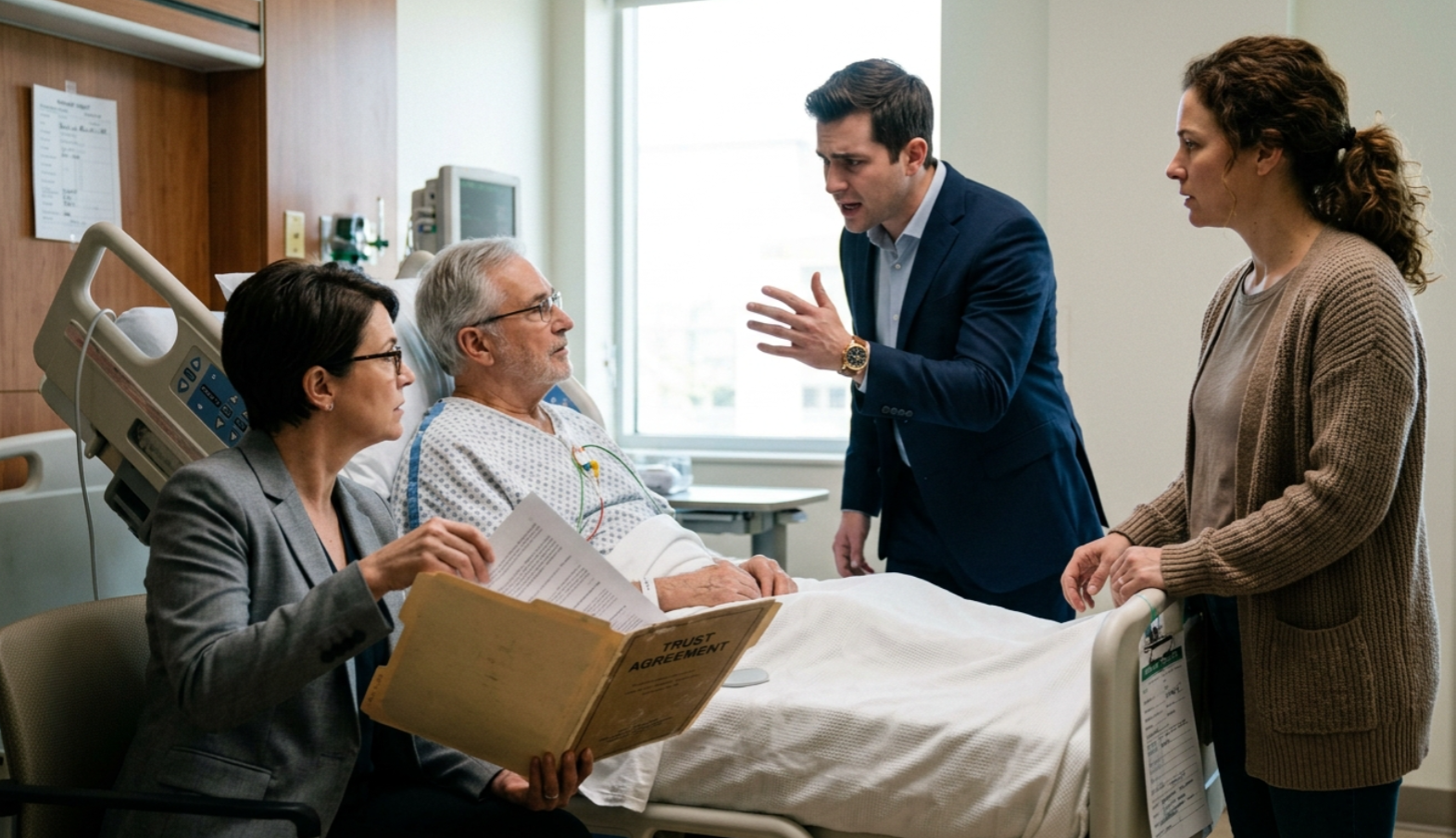
PART 3
I stopped breathing.
The Hale Family Land Preservation Trust.
I hadn’t heard those words in twenty-six years.
I slowly lowered myself into the chair.
Outside the window, a truck passed down the street.
A dog barked somewhere in the neighborhood.
Everything around me continued normally.
But inside my head, the past had just exploded open.
That was the year my father died.
And it was also the year my family had told me I had inherited nothing.
I had been thirty years old.
Freshly married.
Trying to build my equipment business.
My father, William Hale, had owned several pieces of property across Texas, but his estate had been complicated by debts, partnerships, and lawsuits involving one of his former business associates.
I had never understood exactly what happened.
I was simply told that there wasn’t much left.
My older brother, Charles, handled most of the estate.
My mother supported him.
And I was told that the best thing I could do was stop asking questions and focus on my own future.
So I did.
Or at least I tried.
I had never known about a trust.
I certainly hadn’t known about an $8.7 million potential distribution.
I turned the page.
There was another paragraph.
I read it slowly.
The property I had purchased with my own money twenty-eight years ago was apparently connected to land my father had once owned.
Not directly.
Not legally.
But through a series of parcels and easements established before his death.
According to the letter, my father had anticipated that environmental regulations might one day affect the region.
He had placed certain rights into a trust.
Those rights had been dormant for decades.
Until now.
And apparently, I wasn’t the only beneficiary.
There were three names.
Mine.
Preston’s.
And Ruby’s.
I read Ruby’s name twice.
Then I looked at the date.
The trust had been established in 1998.
Ruby hadn’t even been born.
Preston had been seven.
Yet somehow, both of my children were beneficiaries.
I felt dizzy.
I reached for my phone.
Then stopped.
I almost called Preston.
Almost.
But something inside me said not to.
Instead, I called the number at the bottom of the letter.
A woman answered.
“Hale Legal Group.”
“This is Marcus Hale.”
There was a brief pause.
“Mr. Hale?”
“Yes.”
“I’m glad you called.”
My stomach tightened.
“You know who I am?”
“Yes.”
“How?”
“Because we’ve been trying to locate you.”
I looked at the letter again.
“For how long?”
Another pause.
“Eleven years.”
I stood up.
“Eleven?”
“Yes.”
“Why?”
“Because there were documents requiring your signature.”
“What documents?”
“We can’t discuss the details over the phone.”
“Then tell me this. Is the amount in this letter real?”
The woman hesitated.
“The valuation is based on current development projections. The final amount could be higher or lower.”
“But it’s real?”
“Yes.”
I closed my eyes.
“What happens now?”
“Your surgery.”
I opened my eyes.
“What?”
“The attorney handling the trust is aware of your medical situation.”
“How?”
“We were notified by the surgical center because one of the trust conditions may become relevant if something happens to you.”
My heart began pounding.
“What condition?”
“I think you need to speak with him directly.”
“When?”
“He asked me to tell you that he will meet you at the hospital.”
“When?”
“Tomorrow morning.”
I sat back down.
“And his name?”
“Daniel Whitmore.”
The name meant nothing to me.
But before hanging up, I asked one final question.
“Why didn’t anyone tell me about this trust?”
The woman was silent for so long that I knew the answer wasn’t simple.
Finally she said,
“That is one of the things Mr. Whitmore intends to explain.”
Then the call ended.
I didn’t sleep that night.
Not because of the surgery.
Not entirely.
I kept thinking about Ruby.
She had sold her car to give me $3,200.
Three thousand two hundred dollars.
And somewhere in a legal document, my daughter might have a claim to millions.
She had no idea.
Preston had no idea.
Or at least I thought he didn’t.
The next morning, I sat alone in the hospital waiting area.
My surgery was scheduled for later that afternoon.
A nurse had already taken my vitals.
My surgeon had explained the procedure again.
Everything should have been focused on my recovery.
Instead, I kept staring at the hospital entrance.
At 9:15, a tall man in a dark gray suit walked through the doors carrying an old leather briefcase.
He looked around.
Then his eyes landed on me.
“Mr. Hale?”
I stood.
“Yes.”
He extended his hand.
“Daniel Whitmore.”
His handshake was firm but gentle.
He didn’t smile.
Instead, he looked at me carefully.
“I’ve wanted to meet you for a long time.”
I frowned.
“Why?”
“Because your father asked me to.”
My heart stopped.
“My father died twenty-six years ago.”
“I know.”
Daniel sat beside me.
Then he placed the leather briefcase on the table.
“I think it’s time you learned what really happened.”
He opened it.
Inside were old documents.
Very old.
Some were yellowed around the edges.
Others had handwritten notes in the margins.
Daniel pulled out a photograph.
He placed it in front of me.
I recognized my father immediately.
William Hale.
Standing beside a younger Daniel Whitmore.
And beside them was another man.
My brother Charles.
I stared at the photograph.
“When was this taken?”
“1998.”
I swallowed.
“What was my brother doing there?”
Daniel didn’t answer immediately.
Instead, he opened a folder.
“There are three things your father wanted protected.”
He held up one finger.
“His land.”
A second.
“His children’s inheritance.”
Then a third.
“And the truth about why your brother received control of the estate.”
My mouth went dry.
“What truth?”
Daniel looked directly at me.
“Your father didn’t leave you nothing.”
I felt something crack inside me.
“He didn’t?”
“No.”
“Then why was I told that?”
“Because someone changed the documents.”
I stared at him.
“Who?”
Daniel opened another folder.
Before he could answer, a nurse approached.
“Mr. Hale?”
“Yes?”
“Your daughter is here.”
I turned.
Ruby stood at the end of the hallway.
She was wearing the same inexpensive blouse she’d worn the day before.
Her hair was tied back.
And she was carrying a small paper bag.
Probably food.
She smiled when she saw me.
Then she noticed Daniel.
Her smile disappeared.
“Dad?”
I stood.
“Ruby, come here.”
She approached cautiously.
“Who is he?”
I looked at Daniel.
“This is Mr. Whitmore.”
Daniel stood.
“It’s a pleasure to meet you, Ruby.”
She looked confused.
“Have we met?”
“No.”
“But you know my name.”
Daniel glanced at me.
Then back at her.
“Your father has something he needs to tell you.”
I shook my head.
“Not yet.”
Daniel nodded.
“Of course.”
Ruby looked between us.
“Dad, what’s going on?”
I took her hand.
“Nothing you need to worry about before my surgery.”
She frowned.
“That’s not an answer.”
“No.”
I squeezed her fingers.
“But I promise I’ll explain everything.”
She looked at Daniel again.
“Is this about money?”
I froze.
“How did you know?”
“Because nobody in a suit carrying an old briefcase comes to a hospital just to discuss the weather.”
For the first time, Daniel smiled.
“Your father raised a perceptive daughter.”
Ruby looked at me.
“Dad?”
I wanted to tell her everything.
But something stopped me.
Maybe it was fear.
Maybe it was instinct.
Maybe it was the strange feeling that once those words left my mouth, our family would never be the same again.
So I only said,
“After surgery.”
Daniel closed the briefcase.
“That’s probably wise.”
Then his phone rang.
He stepped away to answer it.
I watched him.
Ruby leaned toward me.
“Dad.”
“Yes?”
“Is this why you looked so scared last night?”
I didn’t answer.
She whispered,
“Are we in trouble?”
“No.”
“Then what?”
I looked at her.
“You’re about to find out that your grandfather loved you more than you ever knew.”
She didn’t understand.
But before she could ask another question, Daniel returned.
His expression had changed.
“Mr. Hale.”
“What?”
“We have a problem.”
“What kind?”
“Your son is here.”
My stomach dropped.
“Preston?”
Daniel nodded.
“He just arrived.”
Ruby looked toward the entrance.
A few seconds later, Preston appeared.
He wasn’t dressed like the son who had told his father he couldn’t spare $3,200.
He was wearing a tailored suit.
His expensive watch was visible beneath his cuff.
He walked quickly toward us.
“Dad.”
I stared at him.
“What are you doing here?”
He looked at Daniel.
Then at Ruby.
Then back at me.
“I heard there was an attorney here.”
I felt a chill.
“How?”
He ignored my question.
“Dad, what’s going on?”
Daniel stepped forward.
“Mr. Hale, perhaps we should—”
Preston interrupted.
“Who are you?”
“Daniel Whitmore.”
Preston’s face changed.
Only for a fraction of a second.
But I saw it.
Recognition.
Fear.
Something else.
“You know him,” I said.
Preston looked at me.
“No.”
Daniel quietly opened the old briefcase again.
“Yes, you do.”
Preston’s jaw tightened.
“Dad, we should talk privately.”
“No.”
He stared at me.
“Dad.”
“Not this time.”
Ruby looked confused.
“What’s happening?”
Preston lowered his voice.
“You don’t understand.”
I looked at my son.
“Then explain it.”
He didn’t.
Instead, he asked Daniel,
“Do you still have the original?”
Daniel looked at him.
“Yes.”
“Where?”
“Right here.”
Preston’s face went pale.
Daniel removed a sealed envelope from the folder.
It was covered with handwritten instructions.
Across the front were six words:
To be opened when Marcus is ready.
My name was written beneath it.
My father’s handwriting.
I hadn’t seen it in twenty-six years.
My hands trembled as Daniel placed the envelope in front of me.
I looked at Preston.
He whispered,
“Dad, don’t open that.”
Ruby turned toward him.
“Why?”
Preston said nothing.
I slowly broke the seal.
Inside was a single handwritten letter.
The first line made my heart stop.
Marcus, if you’re reading this, Charles has already lied to you.
I looked up.
Preston had backed away.
And for the first time in my life, I saw genuine fear in my son’s eyes.
I unfolded the letter completely.
And then I read the sentence that changed everything:
“Your brother did not steal your inheritance for himself. He gave it to the person you trusted most.”
PART 4
The sentence seemed to burn through the paper.
“Your brother did not steal your inheritance for himself. He gave it to the person you trusted most.”
I read it again.
My fingers had gone numb.
Across from me, Preston stood perfectly still.
Ruby looked from me to him.
“What does that mean?”
I couldn’t answer.
I looked at Daniel.
“You knew about this?”
“I knew what was in the letter.”
“Then why didn’t you tell me?”
“Because your father instructed me not to.”
I looked down at the handwriting.
My father’s handwriting.
I remembered that hand signing birthday cards, business contracts, checks, Christmas notes.
I remembered the last time I saw it.
My father had been sitting at the kitchen table.
He’d looked tired.
I’d asked him if everything was all right.
He’d smiled and said, “One day you’ll understand why I did what I did.”
I had assumed he was talking about the family business.
Now I wasn’t so sure.
I continued reading.
Marcus,
If you’re reading this, something has happened that I prayed would never happen.
Your brother Charles has control of the estate documents, but he does not have ownership of everything I placed into the trust.
I created a separate arrangement for you and your children.
My eyes stopped on those words.
Your children.
In 1998, Preston had been seven.
Ruby didn’t exist yet.
I continued.
I knew you would build your life differently from Charles. You always wanted to work with your hands. You trusted people too easily. You believed a man’s word mattered even when the world taught you otherwise.
A painful smile appeared on my face.
That sounded exactly like my father.
Then I reached the next paragraph.
I also knew Laurel would eventually become involved.
My smile disappeared.
I looked up.
Laurel.
My wife.
The person I had spent more than thirty years beside.
The woman who had refused to help me with $3,200 because she wanted to protect her retirement.
I looked at Preston.
He wouldn’t meet my eyes.
“Why does Dad’s letter mention Mom?”
Preston finally spoke.
“Maybe you should stop reading.”
I turned toward him.
“Why?”
“Because some things are better left buried.”
Daniel’s expression hardened.
“That was precisely the problem twenty-six years ago.”
Preston glared at him.
“You don’t know what happened.”
“I know exactly what happened.”
“Then tell him.”
Daniel looked at me.
“Your father discovered that Charles had been diverting money from several family accounts.”
I frowned.
“What?”
“He wasn’t stealing millions. Not at first. He was moving money between companies, covering debts, manipulating valuations. Your father discovered it shortly before his death.”
I looked at the letter.
“Then why did Charles control the estate?”
“Because your father died before the investigation was completed.”
I swallowed.
“What about my inheritance?”
Daniel opened another folder.
“Your father had intended to place your share into a protected trust.”
“Why?”
“Because he was worried about your business.”
“My business?”
“He knew you were planning to borrow heavily to expand.”
I nodded slowly.
That was true.
I had been desperate to grow.
My father had warned me against taking on too much debt.
I hadn’t listened.
Daniel continued.
“He wanted your inheritance protected from creditors.”
“So where did it go?”
Daniel looked at Preston.
Then at me.
“That is where Laurel becomes important.”
My chest tightened.
“No.”
Daniel didn’t speak.
“No,” I repeated.
“I don’t understand.”
He removed another document.
“This was the original trust agreement.”
He placed it on the table.
My eyes moved down the page.
Then I saw it.
A beneficiary designation.
Marcus Hale — 50%
Preston Hale — 25%
Ruby Hale — 25%
But beneath those names was another section.
Trust administrator: Laurel Hale.
I stared at it.
“She was the administrator?”
“Yes.”
“Why?”
“Because your father believed she would protect your children.”
I laughed.
It was a bitter, humorless sound.
“She refused to give me $3,200 yesterday.”
Daniel said nothing.
Ruby looked at me.
“Dad…”
I folded the letter.
“I need to speak to Mom.”
Laurel was sitting in the hospital cafeteria when I found her.
She had brought coffee.
She looked surprised to see me.
“You shouldn’t be walking around.”
“I need to ask you something.”
She put down the cup.
“What?”
“Did my father ever give you documents?”
Her face changed.
It was subtle.
But I saw it.
“What documents?”
“About a trust.”
Silence.
“Marcus, you’re stressed.”
“Did he?”
She looked away.
“I don’t know what you’re talking about.”
“Did you know about the Hale Family Land Preservation Trust?”
Her fingers tightened around the coffee cup.
I sat across from her.
“Please don’t lie to me.”
She stared at me.
“I haven’t lied to you.”
“Then tell me the truth.”
She whispered,
“Your father asked me to protect you.”
The words hit harder than I expected.
“You knew?”
“Yes.”
“For twenty-six years?”
“Yes.”
“And you never told me?”
“I couldn’t.”
“Couldn’t?”
“You weren’t supposed to know until the conditions were met.”
“What conditions?”
She looked at me.
Then she began to cry.
“The trust wasn’t supposed to activate until the land restrictions were removed.”
I leaned back.
“And now they have.”
“Yes.”
“So I’m entitled to the money.”
She nodded.
“Not exactly.”
My heart sank.
“What does that mean?”
Laurel wiped her eyes.
“The money isn’t yours alone.”
“I know. Preston and Ruby are beneficiaries.”
“No.”
She shook her head.
“There is another condition.”
“What condition?”
She looked down.
“Your father wanted you to prove something.”
“What?”
“That your children would stand beside you when you needed them.”
I almost laughed.
“That’s why the trust exists?”
“Partly.”
I stared at her.
“Then why did Preston know about it?”
She didn’t answer.
I leaned forward.
“How long has Preston known?”
“Several years.”
My stomach dropped.
“Several?”
“Yes.”
“Who told him?”
Laurel closed her eyes.
“I did.”
The room seemed to tilt.
“You told him?”
“I thought he needed to understand what would happen if something happened to you.”
“And he knew I was struggling financially?”
“Yes.”
“He knew about the trust.”
“Yes.”
“He knew there could be millions waiting for him.”
“Yes.”
“And yesterday, when I called him for $3,200…”
She began crying harder.
“I don’t know what he was thinking.”
I stood.
“No.”
She looked up.
“I know exactly what he was thinking.”
I walked away.
When I returned to my room, Preston was waiting.
Ruby was beside the window.
Daniel stood near the door.
Preston looked at me.
“Dad.”
I didn’t respond.
He stood.
“Can we talk?”
“You knew.”
His face fell.
“I knew about the trust.”
“For years.”
“Yes.”
“You knew there was money.”
“Yes.”
“You knew I needed surgery.”
“I didn’t know you were that close to the deadline.”
“I told you.”
“I thought you would figure it out.”
I stared at him.
“You thought I’d figure it out?”
He rubbed his face.
“Dad, it wasn’t that simple.”
“What wasn’t?”
“The trust has conditions.”
“I know.”
“Then you know I couldn’t just take money from it.”
“I wasn’t asking for money from the trust.”
He looked away.
“I asked my son for $3,200.”
Silence.
Ruby suddenly spoke.
“Preston.”
He turned.
“You knew Dad needed surgery.”
“Yes.”
“And you still said no.”
“I had reasons.”
“What reasons?”
He didn’t answer.
Ruby stepped closer.
“You let me sell my car.”
“Ruby…”
“You knew.”
He looked at her.
“I knew you were helping him.”
“You knew I had almost no savings.”
“I didn’t know you would sell your car.”
“You knew enough.”
Preston’s eyes filled.
“I’m sorry.”
Ruby shook her head.
“No. You’re scared.”
Preston looked at me.
“I am.”
“Why?”
He looked toward Daniel.
“Because Dad is about to learn what Mom did with the trust.”
My heart stopped.
“What did Laurel do?”
Preston swallowed.
“She didn’t protect the money.”
Daniel opened the old folder.
“She transferred it.”
“To whom?”
Preston whispered,
“To Charles.”
The room went silent.
My brother.
Charles.
The man who had told me there was nothing left after our father’s death.
The man who had watched me struggle to keep my business alive.
The man who had encouraged me to sell equipment to pay creditors.
The man who had later stopped answering my calls.
I looked at Daniel.
“Is that true?”
Daniel nodded.
“Your father’s original trust was worth approximately $1.8 million in 1998.”
I stared at him.
“That’s impossible.”
“Adjusted for the investments and property interests attached to it, the assets could have been worth substantially more today.”
“And Laurel gave it to Charles?”
“Not willingly.”
I frowned.
“What does that mean?”
Daniel opened another document.
“She was deceived.”
I looked at him.
“By Charles?”
“Yes.”
“Then why didn’t she tell me?”
Daniel’s expression softened.
“Because she believed she was protecting you.”
I looked toward the door.
Laurel was standing there.
She had followed me.
Her voice was barely audible.
“I thought Charles was going to destroy you.”
I turned.
“What?”
She stepped into the room.
“Your father had left instructions that if you couldn’t maintain the land or the business, Charles would take control temporarily.”
She wiped her eyes.
“Charles told me you were going bankrupt.”
“I was.”
“He said creditors were going to seize everything.”
“They did.”
“He told me the trust money would be safer under his control.”
“And you believed him?”
“Yes.”
“Why?”
“Because he showed me documents.”
Daniel interrupted.
“Forged documents.”
Laurel nodded.
“I didn’t know.”
My anger didn’t disappear.
But it changed.
“You could have told me.”
“I was ashamed.”
“For twenty-six years?”
She nodded.
“I thought I’d destroyed your future.”
I stared at her.
“You did.”
She closed her eyes.
“I know.”
For a moment nobody spoke.
Then Daniel opened the final folder.
“There is something else.”
I looked at him.
“What?”
He pulled out a bank statement.
“Charles didn’t keep the money.”
I frowned.
“What did he do with it?”
Daniel turned the statement toward me.
The account had been opened in 1999.
The beneficiary name was listed clearly.
Hale Family Holdings LLC.
Below it was another name.
Laurel Hale.
I looked at my wife.
She looked terrified.
“I never opened that account.”
Daniel nodded.
“I believe you.”
“Then who did?”
He turned another page.
A signature appeared.
My signature.
Except it wasn’t mine.
I knew immediately.
Someone had forged my name.
I whispered,
“Charles.”
Daniel shook his head.
“No.”
He pointed to the signature.
“Your brother couldn’t have done this.”
“Why not?”
“Because the account was opened eighteen months before the transfer.”
I stared at him.
“Then who?”
Daniel placed one final document on the table.
The beneficiary designation.
The person authorized to control the account.
My name.
My wife’s name.
And a third name.
Preston Hale.
I looked at my son.
His face had gone completely white.
“Preston?”
He didn’t speak.
“Did you know about this account?”
He slowly shook his head.
“No.”
Daniel looked at him.
“That’s what I thought.”
He reached into the folder and removed a small envelope.
“This was found inside your father’s original safe deposit box.”
I opened it.
Inside was a handwritten note.
Only two sentences.
If the money disappears, don’t look for the thief.
Look for the person who benefits when the family stops trusting one another.
I read it again.
Then I looked at everyone in the room.
For twenty-six years, I had believed my family had simply fallen apart because of money.
But suddenly I wondered whether the money had never been the real weapon.
Maybe distrust had been.
And someone had spent decades making sure we turned against each other.
My surgery was only hours away.
Yet I knew now that whatever waited for me after I woke up would be bigger than an operation.
It would be the truth about my family.
And perhaps the truth about the person who had been manipulating all of us from the beginning.
Daniel closed the folder.
“There is one more person we need to speak to.”
“Who?”
He looked toward the hallway.
“Charles Hale.”
I stared at him.
“My brother?”
“Yes.”
“He’s alive?”
Daniel nodded.
“And he has been trying to contact me.”
My heart began pounding.
“Why?”
Daniel’s answer was quiet.
“Because yesterday, after learning your land restrictions had been lifted, Charles filed a legal claim saying the entire property belongs to him.”
PART 5
For a few seconds, nobody moved.
I looked at Daniel.
“Charles filed a claim against my land?”
“Yes.”
“How did he even know the restrictions were lifted?”
Daniel closed the folder.
“Because someone notified him.”
I looked at Laurel.
She shook her head immediately.
“It wasn’t me.”
Then I looked at Preston.
He looked genuinely confused.
“I didn’t tell him.”
Ruby crossed her arms.
“I certainly didn’t.”
Daniel nodded.
“I believe you.”
“Then who did?”
Daniel’s eyes moved toward the hallway.
“That is what we’re going to find out.”
Before I could respond, my surgeon entered the room.
“Mr. Hale, we need to prepare you.”
I looked at Daniel.
“What happens now?”
“You have surgery.”
“And afterward?”
“I’ll be here.”
He picked up the old folder.
“And so will the truth.”
The last thing I remember before anesthesia was Ruby holding my hand.
“Dad?”
I opened my eyes.
“I’m here.”
She squeezed my fingers.
“You’re not alone.”
I smiled.
“Neither are you.”
Then the room faded away.
When I woke up, the first thing I heard was a monitor beeping.
The second thing I felt was pain.
The third thing I saw was Ruby.
She was asleep in a chair beside my bed.
Her head had fallen against the wall.
Her purse was on the floor.
For a moment I simply watched her.
That was my daughter.
The woman who had sold her car so I could have surgery.
The woman who had never asked what she would get in return.
I reached out and touched her hand.
She woke instantly.
“Dad?”
“Hey.”
She smiled and immediately started crying.
“Oh, thank God.”
“I’m okay.”
“You scared me.”
“I know.”
She leaned forward and hugged me carefully.
Then she whispered,
“Preston came back.”
My smile disappeared.
“When?”
“An hour ago.”
“What did he want?”
“He wanted to see you.”
“Did you let him?”
She nodded.
“He’s outside.”
I looked toward the door.
“Send him in.”
A minute later, Preston entered.
He looked different.
Not because of his clothes.
Because the confidence I’d always seen in him was gone.
He stood beside the bed.
“Dad.”
I looked at him.
“Sit.”
He sat.
For several seconds neither of us spoke.
Finally he said,
“I’m sorry.”
I nodded.
“I know.”
“No, you don’t.”
He rubbed his hands together.
“I’ve been carrying this for years.”
“What?”
“Guilt.”
I looked at him.
He swallowed.
“When Mom told me about the trust, I thought I was being protected.”
“Protected from what?”
“From you.”
The words hurt.
“Explain.”
“She said Grandpa had created the trust because you couldn’t manage money.”
I stared at him.
“She told you that?”
“Yes.”
“And you believed her?”
“I was twenty-four.”
“You’re thirty-five now.”
“I know.”
He lowered his head.
“I should have asked questions.”
“Yes.”
“I should have helped you yesterday.”
“Yes.”
He looked up.
“I was afraid.”
“Of what?”
“That if I gave you the money, everyone would think I was trying to get access to the trust.”
I shook my head.
“You were my son. I wasn’t asking you to invest in me.”
His eyes filled.
“I know.”
Then he reached into his jacket.
He pulled out a small envelope.
“I brought this for you.”
I opened it.
Inside was a cashier’s check.
$3,200.
I looked at him.
“I don’t need this anymore.”
“I know.”
“Then why?”
“Because you needed it yesterday.”
He pushed it toward me.
“I want you to have it.”
I stared at the check.
Then I pushed it back.
“Keep it.”
“Dad…”
“Not because I don’t forgive you.”
He looked at me.
“Then why?”
“Because forgiveness isn’t about making you feel better. It’s about making sure we don’t repeat the same mistake.”
He nodded slowly.
I placed my hand on his shoulder.
“If you want to make this right, don’t give me $3,200.”
“What should I do?”
“Stand beside your sister.”
He looked toward Ruby.
“And don’t ever make her prove that she loves you.”
His eyes filled.
“I won’t.”
Ruby stood.
“I’ll give you two some privacy.”
She walked toward the door.
Then stopped.
“Dad?”
“Yes?”
“I sold the Honda.”
I smiled.
“I know.”
“But I haven’t found another car.”
Preston stood.
“I’ll buy you one.”
Ruby turned around.
“No.”
“Ruby—”
“I don’t need a new car.”
“I don’t care.”
She frowned.
“Then what are you doing?”
“I’m fixing what I can.”
She stared at him.
Then slowly nodded.
“Used car.”
“What?”
“I’m not taking some ridiculous luxury SUV.”
He smiled for the first time.
“Used car.”
“Reliable.”
“Reliable.”
“Nothing flashy.”
“Deal.”
For the first time in years, I saw my children standing on the same side.
And I realized my father had been right about something.
Money could divide a family.
But sometimes sacrifice revealed who was willing to hold it together.
The next morning, Daniel returned.
He carried the old folder again.
“The surgery went well,” he said.
“So I heard.”
“And Charles has agreed to meet.”
“Where?”
“In your father’s old office.”
I stared at him.
“My father hasn’t had an office in twenty-six years.”
Daniel smiled slightly.
“Not that one.”
He handed me a key.
“This belonged to your father.”
I recognized it immediately.
A small brass key.
I remembered it hanging from my father’s key ring when I was a boy.
“What does it open?”
“Come with me.”
The building was located about twenty miles away.
It had been abandoned for years.
Dust covered the windows.
The sign outside had almost completely faded.
But when Daniel unlocked the door, I felt something strange.
The smell.
Old wood.
Paper.
Machine oil.
It smelled exactly like my father’s office.
We walked down a narrow hallway.
Daniel stopped in front of a wooden door.
He unlocked it.
Inside was a desk.
A filing cabinet.
An old wall clock.
And a framed photograph of our family.
My father.
My mother.
Charles.
Me.
And, in a smaller photograph placed beside it, Preston and Ruby as children.
I walked toward the desk.
“What is this place?”
“Your father bought it shortly before he died.”
“For what?”
“To store records.”
Daniel opened a drawer.
Inside were dozens of envelopes.
Each one had a date.
They continued all the way to 2014.
“Why 2014?”
Daniel looked at me.
“That’s when the last major transfer occurred.”
I opened the envelope.
Inside was a bank statement.
Then another.
Then another.
Money had been moved between several companies.
But none of the companies belonged to Charles.
They belonged to someone else.
A name appeared repeatedly.
Evelyn Mercer.
I frowned.
“Who is she?”
Daniel looked at me.
“Your father’s former financial adviser.”
I remembered her.
She had attended my father’s funeral.
Then she disappeared from our lives.
“What happened to her?”
“She died three years ago.”
I looked at the documents.
“Then how does she fit into this?”
Daniel pointed to a transfer.
“This account received the original trust funds.”
“And then?”
“It transferred them into another account.”
“Whose?”
Daniel turned the page.
I stopped breathing.
Hale Family Holdings LLC.
The same company.
But there was another name beside it.
Laurel Hale.
I closed my eyes.
“Mom didn’t do this.”
“No.”
Daniel turned another page.
“Someone used her identity.”
“Who?”
He handed me a document.
This time, the signature wasn’t mine.
It wasn’t Laurel’s.
It wasn’t Charles’s.
And it wasn’t Preston’s.
It belonged to someone I had completely forgotten.
My mother’s younger brother.
Thomas Mercer.
I stared at the page.
“My uncle?”
Daniel nodded.
“Your uncle worked with Evelyn Mercer.”
“But he died before all this happened.”
“Correct.”
“Then how could he have signed it?”
“He didn’t.”
Daniel pointed to the date.
The signature had been created after Thomas’s death.
I felt cold.
“So someone forged everyone’s signatures.”
“Yes.”
“Why?”
Daniel looked at me.
“To hide where the money actually went.”
I stared at the documents.
“Where did it go?”
Daniel opened the final file.
“That’s the part your father spent the last year of his life trying to uncover.”
He turned the page.
The money had been moved through a network of holding companies.
Eventually it had been used to purchase land.
Land adjacent to mine.
The same land that would later become enormously valuable after the development restrictions were lifted.
I looked at Daniel.
“Someone knew.”
“Yes.”
“They knew this area would become valuable.”
“Yes.”
“And they wanted control of the surrounding property.”
“Yes.”
“Who?”
Before Daniel could answer, we heard footsteps.
I turned.
Charles stood in the doorway.
He looked older than I remembered.
His hair was almost completely gray.
He held a cane.
For a moment, we simply stared at each other.
Twenty-six years disappeared.
I saw my brother.
Not the enemy.
Not the man who had supposedly stolen my inheritance.
Just my brother.
Charles looked at me.
“Marcus.”
I said nothing.
He walked inside.
“I owe you the truth.”
“You owe me twenty-six years.”
He nodded.
“I know.”
“Did you steal my inheritance?”
“No.”
“Did you lie to me?”
“Yes.”
My jaw tightened.
“Why?”
“Because I was trying to protect you.”
I almost laughed.
“Everyone keeps saying that.”
Charles sat down.
“Your father discovered that the people around him were planning to manipulate the property values.”
“Who?”
“Evelyn and several investors.”
“And you?”
“I was involved.”
That admission shocked me.
“What?”
“I helped them.”
Daniel looked at him.
Charles lowered his head.
“I was young. Ambitious. I thought I could make money.”
“And my father found out.”
“Yes.”
“So why didn’t he expose you?”
“Because I confessed.”
I stared at him.
“He gave me one chance.”
“What chance?”
“To protect the family.”
Charles reached into his coat.
He removed a folded letter.
“I’ve kept this for twenty-six years.”
He handed it to me.
I recognized my father’s handwriting immediately.
Another letter.
I opened it.
Charles,
If you are reading this, you have one opportunity to repair what you damaged.
Marcus must never be told the entire truth while the threat remains.
Protect his land. Protect his children. And when the restrictions are lifted, return everything to Marcus.
I looked at Charles.
“You were supposed to return everything.”
“Yes.”
“Why didn’t you?”
His eyes filled.
“Because I couldn’t.”
“Why?”
“Because someone else took control.”
“Who?”
Charles looked at Daniel.
Then at me.
“Preston.”
I froze.
“What?”
Charles shook his head.
“Not intentionally.”
Daniel immediately interrupted.
“Charles, be precise.”
Charles nodded.
“Preston was used.”
I felt my heart sink.
“By whom?”
Charles whispered,
“Laurel.”
I couldn’t speak.
“No.”
Charles continued.
“Your wife knew about the trust. But she didn’t know what Charles and I had discovered.”
He pointed toward the documents.
“She believed she was protecting Preston.”
“How?”
“She signed documents transferring administrative control to him.”
I looked at Daniel.
He nodded.
“It’s true.”
I felt as though the floor had disappeared.
“So Preston had control of the trust?”
“Only temporarily,” Daniel said.
“Then why was the money gone?”
Charles answered.
“Because Preston was pressured into signing another agreement.”
“By whom?”
Charles looked at me.
“Your wife.”
I shook my head.
“I don’t understand.”
Charles stood.
“Neither did Preston.”
When we returned to the hospital, Laurel was waiting.
She stood beside the window.
She looked at me.
“I know.”
I stopped.
“You know what?”
“You know about the documents.”
“Yes.”
She nodded.
“I was afraid this day would come.”
“Why did you do it?”
She started crying.
“I thought I was saving our family.”
“You destroyed it.”
“I know.”
“You let me struggle for years.”
“I know.”
“You watched me lose my business.”
“I know.”
“You let Ruby sell her car.”
“I didn’t know she would.”
“You knew I was struggling.”
“Yes.”
“Then why didn’t you help me?”
She looked down.
“Because I was afraid that if I gave you money, someone would accuse me of violating the trust.”
“You could have told me.”
“I was ashamed.”
I stepped closer.
“You’ve been ashamed for twenty-six years.”
“Yes.”
“Why didn’t you confess?”
“Because Charles threatened to expose everything.”
I stared at her.
“He threatened you?”
“He said if I told you, the trust would collapse and Preston would lose everything.”
I looked at Preston.
He was standing behind her.
His face was devastated.
“Mom.”
She turned.
“I thought I was protecting you.”
Preston shook his head.
“You should have trusted Dad.”
She began to cry.
“I know.”
There was silence.
Then Daniel spoke.
“The trust can still be restored.”
Laurel looked at him.
“How?”
“The land is now worth far more than the original trust.”
He placed a document on the table.
“Under the original agreement, Marcus receives control.”
I stared at it.
“And my children?”
“Protected beneficiaries.”
I looked at Ruby.
She shook her head.
“I don’t want millions if Dad loses everything.”
I smiled.
“That’s why you deserve to have a choice.”
I looked at Daniel.
“What does the trust require?”
He answered,
“Your father left one final condition.”
“What?”
“You must decide whether to keep the property, sell it, or place it into a new family trust.”
I looked around the room.
For decades, money had controlled our family.
I wasn’t going to let it do that again.
“I want a new trust.”
Daniel nodded.
“What terms?”
I looked at Preston.
Then Ruby.
Then even Laurel.
“The land gets developed.”
Everyone stared at me.
“But nobody gets unrestricted access to the money.”
Daniel smiled.
“Continue.”
“Ruby gets an education and transportation fund.”
Ruby opened her mouth.
“Dad—”
“Not negotiable.”
She smiled through tears.
“Preston gets his share, but he doesn’t control anyone else’s.”
Preston nodded.
“And Mom?”
Laurel looked at me.
I took a breath.
“She gets what the postnuptial agreement says she owns.”
Daniel nodded.
“And the remainder?”
I looked out the window.
“My father spent his life building things.”
I smiled.
“I want part of the money used to build something that lasts.”
Six months later, the first construction crews arrived.
The sixty acres were no longer abandoned land.
A commercial development was underway.
But it wasn’t the kind of development Charles had once imagined.
We sold part of the property.
Another portion was leased.
And a significant section became a community center with a scholarship and vocational training program funded through the new Hale Family Trust.
Ruby became the first person in our family to work there.
She eventually bought another car.
A modest one.
She insisted on paying for it herself.
Preston kept his promise.
He helped her when she needed it, but never tried to control her decisions.
As for Laurel and me, we finally had the conversation we’d avoided for decades.
We decided to separate.
Not with screaming.
Not with lawyers fighting over every chair and silverware.
Just two people admitting that sometimes a marriage can survive legally long after it has ended emotionally.
We divided what belonged to each of us.
And for the first time, there was no secret account between us.
No hidden document.
No quiet resentment.
Just the truth.
A year after my surgery, I stood on the porch of the new community center.
Ruby walked toward me.
“Dad.”
I turned.
She held out a set of keys.
“What are those?”
“Your truck.”
I laughed.
“My truck?”
“You’ve been driving that old thing with the transmission noise for three months.”
“I can fix it.”
“You’ve been saying that for three months.”
She smiled.
“I bought you one.”
I stared at her.
“You didn’t have to.”
“I know.”
She hugged me.
“I wanted to.”
Preston approached carrying two coffees.
“Peace offering.”
I took one.
“What did you do?”
“Nothing.”
I looked at him suspiciously.
He laughed.
“I’m learning.”
We stood together.
My son.
My daughter.
The family I had almost lost.
I looked across the property.
People were walking through the center.
Students were entering classrooms.
Workers were repairing equipment.
Parents were picking up children.
Life.
Real life.
Not money.
Not inheritance.
Not contracts.
Life.
Daniel joined us a few minutes later.
He handed me one final envelope.
I groaned.
“Another letter?”
He smiled.
“This one isn’t from your father.”
I opened it.
It was a copy of the final trust agreement.
At the bottom was a handwritten note from Daniel.
Your father wanted you to know one thing: the greatest inheritance was never the land. It was the chance to choose what kind of family you wanted to become.
I looked at Ruby.
Then Preston.
I thought about the $3,200.
The amount that had seemed enormous when I was lying awake in my bedroom.
The amount that had exposed the difference between people who had money and people who had love.
I had spent my life thinking wealth was measured by what you could afford.
My father had left me millions.
But my daughter had given me everything she had.
And that was worth more than any number printed on a bank statement.
I folded the letter.
Then I looked at my children.
“You know,” I said, “I used to think the worst thing that happened to me was losing my business.”
Preston smiled.
“What changed your mind?”
I looked at Ruby.
“Finding out what I actually had.”
Ruby squeezed my hand.
And for the first time in decades, I didn’t feel like the poorest man in the room.
I felt rich.
Not because of the land.
Not because of the trust.
Not because millions had finally returned to our family.
But because when I needed $3,200, my daughter gave me nearly everything she owned without asking what she would get back.
And sometimes, that is how life reveals the true value of a person.
Not when you have millions to give.
But when you have almost nothing—
and you still choose to give.
PART 6 TITLE: My Father Had Built One Final Test Into the Trust, but the Person Who Passed It Had Never Known She Was Being Tested
For several seconds, nobody moved.
Ruby looked from Daniel to Preston and then to me as though someone had changed languages halfway through the conversation.
“A test?” she said. “What kind of test?”
Daniel removed a thin folder from his briefcase.
“Not the kind William would have called a test.”
“Then don’t call it that,” I said.
He nodded.
“A condition.”
My body still felt heavy from anesthesia, but my mind had become painfully clear.
“What condition?”
Daniel opened the folder to a page covered with legal language and several handwritten amendments.
“William knew the trust might remain dormant for years. Its primary activation depended on changes to land restrictions and development rights. But he included an additional distribution mechanism.”
“For what?”
“To determine how control would be allocated among your descendants.”
Preston sat.
Ruby remained standing.
I looked at Daniel. “Explain it without attorney language.”
He considered that.
“If, during the activation period, you experienced a documented emergency and needed direct financial help, the trustee was required to record which eligible family members voluntarily assisted you without expectation of repayment or knowledge of the trust.”
Ruby’s face went blank.
I stared at him.
“You’re telling me my father planned for me to get sick?”
“No.”
“He planned for me to become desperate.”
“He planned for life to become difficult at some point.”
“That’s a safe bet.”
Daniel accepted the criticism.
“He believed money revealed character most clearly when people thought there was nothing to gain.”
Preston’s face tightened.
Ruby slowly sat.
I understood before Daniel finished.
“The check.”
“Yes.”
“Ruby’s check activated something.”
“It satisfied one of the requirements.”
Ruby shook her head.
“No.”
Daniel looked at her.
“I sold my car because Dad needed surgery. That’s it.”
“I know.”
“I don’t want this turned into some inheritance competition.”
“It wasn’t intended as a competition.”
“It sounds exactly like one.”
Her anger was clean and immediate.
I was proud of her for it.
Daniel continued carefully. “William was not trying to reward a single generous act. He created safeguards because he feared future beneficiaries might learn about the trust and manipulate the circumstances.”
My eyes moved to Preston.
He flinched.
“So anyone who knew about it was disqualified?”
“From certain discretionary control provisions, yes.”
Ruby looked at her brother.
“You knew.”
Preston pressed his palms together.
“Not about this clause.”
“Did Mom?”
Daniel answered.
“She knew there was language concerning emergency assistance. We don’t yet know how much she understood about its present effect.”
I remembered Preston’s words.
Mom told me not to give you money until the trust issue was resolved.
My stomach turned.
“She told him not to help me.”
Daniel did not soften it.
“Yes.”
“Why?”
Preston answered.
“Because she was trying to keep me eligible.”
Ruby stared at him.
He continued before she could speak.
“Mom thought direct financial involvement could complicate my status.”
“You mean if you gave Dad thirty-two hundred dollars, it could look like you were trying to influence the trust.”
“Yes.”
Ruby stood again.
“So instead you let him think you valued renovations more than his surgery.”
“It wasn’t like that.”
“That is literally what happened.”
“I was told the surgery would still happen.”
I looked at him.
“By whom?”
“Mom.”
My pulse monitor accelerated.
A nurse entered, checked the screen, and looked at the four of us.
“Whatever you’re discussing, discuss it more quietly.”
Ruby immediately stepped back.
Daniel waited until the nurse left.
I said, “How did Laurel know the surgery would happen?”
Preston hesitated.
“She said Dad always finds a way.”
It was such a Laurel sentence that I could hear it in her voice.
For years, she had said the same thing whenever I solved a problem at the business.
Marcus always finds a way.
Once it had sounded like confidence.
Now it sounded like permission to leave me alone.
Ruby crossed her arms.
“She didn’t know I would sell my car.”
“No,” Preston said.
“Did she know I had savings?”
“I don’t know.”
“She watched me leave after I said I would handle it.”
“She probably assumed you’d loan him money.”
“With what difference?”
Preston looked at Daniel.
Daniel answered.
“The condition required meaningful sacrifice relative to the person’s circumstances.”
Ruby’s expression became disgusted.
“So if I’d handed Dad money I didn’t need, it wouldn’t count?”
“Not necessarily.”
“That is sick.”
“My father wrote it,” I said.
She immediately softened.
“I’m sorry.”
“Don’t be. It’s strange.”
Daniel closed the folder halfway.
“William came from a generation that viewed inheritance differently. He had watched relatives destroy themselves over assets. He wanted the trust to support people who demonstrated loyalty when no reward was visible.”
“And what happens now?” I asked.
Daniel reopened the folder.
“Because Ruby provided the surgery funds without knowledge of the trust and at personal cost, she becomes the presumptive family protector under the discretionary portion.”
Ruby stared at him.
“I have no idea what that means.”
“It means you receive no immediate authority to spend the trust freely. But major family distributions, future amendments, and certain land decisions cannot occur without your consent once the accounting is finalized.”
She looked horrified.
“I don’t want that.”
“You can decline.”
“I decline.”
“Not today.”
“Why not?”
“Because we do not yet know who else has claims against the trust.”
My attention sharpened.
“Claims?”
Daniel’s gaze went to Preston.
Then back to me.
“There are documents suggesting Preston assigned part of his expected future interest as collateral.”
Ruby whispered something under her breath.
Preston stood.
“I didn’t assign the trust.”
“You assigned whatever inheritance rights you might receive.”
“I was told that was different.”
“It is legally different. Practically, not much.”
I looked at my son.
“How much?”
He said nothing.
“How much, Preston?”
“Dad, the investment collapsed.”
“That wasn’t my question.”
He swallowed.
“One point four million.”
Ruby made a sound of disbelief.
I simply stared.
A memory came to me: Preston asking six years earlier why I never developed the northern edge of my land. I had told him environmental restrictions made it worthless. He had laughed and said old men were always sitting on valuable things without realizing it.
At the time, I thought he meant the land.
Maybe he had meant more.
“You borrowed one point four million dollars against an inheritance I didn’t know existed.”
“I borrowed against my own future estate expectations.”
“From whom?”
“A private lending group.”
“Name.”
He hesitated.
“Hawthorne Capital.”
Daniel immediately straightened.
“That was not in the file.”
Preston realized the mistake.
I saw it happen.
Daniel pulled out his phone.
“Who introduced you to Hawthorne?”
Preston did not answer.
“Who?” Daniel repeated.
“My uncle.”
I felt the room narrow again.
“Charles.”
Preston nodded.
Ruby stared at him.
“You talk to Uncle Charles?”
“Sometimes.”
I could barely form the words.
“You told me you hadn’t seen him in years.”
“I hadn’t physically seen him.”
“You talk to him.”
“Yes.”
“How long?”
Preston rubbed his forehead.
“Since college.”
My son had been speaking to the brother I had been estranged from for more than a decade.
Secretly.
“Why?”
“He reached out.”
“And you never told me.”
“He said you hated him.”
“I didn’t hate him. I stopped trusting him.”
“He said you blamed him for Grandpa’s estate.”
“I barely knew there was an estate to blame him for.”
Daniel was already scrolling through something on his phone.
“Hawthorne Capital was founded by Everett Shaw’s son.”
We all looked at him.
I remembered Everett’s funeral notice. I had ignored it.
“His son?”
“Thomas Shaw.”
Preston sank into the chair.
Ruby whispered, “So the same family has been circling this money since Grandpa died.”
Daniel looked at her.
“That is one interpretation.”
“Do you have a better one?”
“Not yet.”
I asked Preston, “Did Charles send you to Hawthorne because he knew about the trust?”
“He said Grandpa had protected family assets and someday they would become valuable.”
“And you believed him.”
“He showed me documents.”
“Documents you didn’t show me.”
“No.”
I looked away.
Pain spread beneath my bandage, and this time I welcomed it. It was simple. Honest. The body hurting because it had been cut.
Family pain had too many authors.
Daniel put away his phone.
“We need to locate Laurel.”
“Why?” Ruby asked.
“Because if Preston’s loan documents reference trust assets, someone supplied enough information for a lender to believe those assets could eventually be reached.”
“Mom?”
“We don’t know.”
Preston shook his head.
“She wouldn’t.”
“You also said she told you about the trust,” Ruby replied.
“She protected it for years.”
“So you keep saying.”
I asked Daniel, “Can Preston’s lender take anything?”
“Not automatically. William’s protections are unusually strong.”
“Unusually?”
“Bordering on paranoid.”
For the first time all day, I almost laughed.
“That sounds like Dad.”
Daniel’s mouth moved slightly.
“The danger is not seizure. The danger is leverage. If Charles and Hawthorne know the land restrictions have been lifted, they may try to force a settlement before we finish the accounting.”
“Using Preston’s debt.”
“Yes.”
I looked at my son.
His face carried a shame I had rarely seen in him.
“Is that why you came here?”
He hesitated too long.
“Yes.”
Ruby’s eyes hardened.
“You didn’t come because Dad was having surgery.”
“I came for both.”
“What were you going to ask him to sign?”
“Nothing.”
Daniel watched him.
Preston looked away.
I said, “What did Charles tell you to do?”
“He said if Dad received legal papers, I should convince him not to act until everyone could sit down.”
“Everyone meaning Charles.”
“And Mom.”
The room went silent.
“You were supposed to bring us together?”
Preston nodded.
“Where?”
“He didn’t say.”
“When?”
“Today.”
Daniel stood abruptly.
“Give me your phone.”
Preston frowned.
“No.”
“Then show me the last message from Charles.”
“This is private.”
I almost admired Daniel’s patience.
“Your grandfather’s trust may be facing an organized claim tied to your debt, your mother is missing, and your father came out of surgery two hours ago. Privacy is becoming expensive.”
Preston slowly unlocked the phone.
He opened a message thread.
Daniel read the latest message.
His face changed.
“What?”
He turned the screen toward me.
Charles had written at 2:41 p.m.
Do not let Marcus sign anything with Whitmore. Laurel finally agreed to meet. We can finish this tonight.
My fingers tightened around the blanket.
“Where?”
Preston scrolled.
There was another message beneath it.
At the old Hale property.
I looked at Daniel.
“My father’s place?”
“Yes.”
The old ranch had been empty for fifteen years.
I tried to swing my legs off the bed.
Ruby caught my shoulder.
“Absolutely not.”
“I’m going.”
“You had surgery today.”
“My wife is there.”
“Maybe.”
“My brother is there.”
“Probably.”
“And they are discussing my father’s trust.”
Daniel stood.
“You cannot leave the hospital yet.”
“Watch me.”
A nurse entered again, alerted by the monitor.
Ruby pointed at me.
“Please tell him he is not allowed to go anywhere.”
The nurse gave me a look that would have stopped a truck.
“You are not leaving this bed tonight.”
I leaned back, furious.
Daniel picked up his briefcase.
“I can go.”
I looked at him.
“So can I,” Ruby said.
“No.”
She stared at me.
“Dad.”
“You are not walking into a meeting with Charles.”
“And you are?”
“As soon as I can stand.”
“That’s different how?”
“Because I’m your father.”
She almost smiled despite herself.
Daniel intervened.
“I’ll go first.”
Ruby shook her head.
“You’re not going alone.”
Preston stood slowly.
“I’ll take you.”
Everyone looked at him.
He swallowed.
“Charles trusts me.”
I held my son’s gaze.
For the first time since this started, I saw a choice forming in front of him.
Not a decision about money.
A decision about which side of the family lie he intended to stand on.
Daniel closed the briefcase.
“Then we leave now.”
END PART 6
PART 7 TITLE: Preston Led the Attorney to My Father’s Abandoned Ranch, Where Laurel Had Gone to Meet the Brother Who Lied About Everything
Hospitals at night have a way of making time meaningless. Doors opened and closed. Machines sounded. Nurses changed shifts. Somewhere down the hall, a television laughed at something nobody in my room could hear.
Ruby remained with me after Daniel and Preston left.
She tried to pretend she was reading.
Every thirty seconds she checked her phone.
“Anything?”
“No.”
I had asked the question twelve times.
She stopped pretending after the thirteenth.
“You know staring at my phone won’t make them text faster.”
“It might.”
“No, it won’t.”
“It worked when you were sixteen.”
She glanced up.
“When I was sixteen, you took my phone away for three months.”
“Excellent parenting.”
“I bought another one.”
“I know.”
Her mouth opened.
“You knew?”
“Parents usually know more than children think.”
The words settled strangely.
I looked toward the dark window.
“Maybe not always.”
Ruby put the magazine aside.
“You couldn’t have known this.”
“I should have noticed something.”
“Like what?”
“Your mother panicking whenever I talked about selling the land. Charles disappearing. Preston asking strange questions about inheritance. Dad meeting privately with Laurel.”
“You’re taking twenty-six years of random memories and arranging them around something you learned yesterday.”
“That doesn’t mean they were random.”
“No. But it doesn’t mean you were stupid either.”
I looked at my daughter.
She had lost her car that morning and gained theoretical authority over millions by evening. Yet she seemed more concerned about keeping me from blaming myself.
That was exactly why my father’s strange condition had chosen her.
I disliked admitting he might have understood something I had missed.
At nine seventeen, Ruby’s phone rang.
Daniel.
She put it on speaker.
“Where are you?”
“At the ranch.”
I heard wind behind him.
“And?”
“Preston’s inside.”
“With Charles?”
“Yes.”
“Laurel?”
Daniel hesitated.
“She’s here.”
My chest tightened.
“Is she all right?”
“Yes.”
I exhaled.
Ruby sat closer to the phone.
“Then why isn’t she calling Dad?”
“Because the situation is more complicated than we expected.”
I closed my eyes.
“Daniel, I’m developing a hatred for that sentence.”
“I know.”
“Put Laurel on.”
“I can’t.”
“Why?”
“She asked for fifteen minutes.”
“She has had twenty-six years.”
“I told her that.”
“What did she say?”
“She said she wants to bring something out before she speaks to you.”
I sat higher.
“Bring what out?”
“Documents.”
Ruby and I looked at each other.
“From where?”
“The ranch.”
I almost laughed.
“My father hid more papers?”
“Apparently.”
“Where?”
“Laurel knows.”
Of course she did.
Ruby asked, “What about Uncle Charles?”
“He insists he came to prevent Hawthorne from taking control.”
I said, “And you believe him?”
“I believe he believes part of what he’s saying.”
“That is an attorney answer.”
“It is the only responsible one right now.”
I heard a door slam faintly through the call.
Daniel said, “I need to go.”
“Daniel.”
“Yes?”
“Do not let Laurel leave.”
“I won’t.”
The line ended.
Ruby looked at me.
“You’re grinding your teeth.”
“I do that.”
“I know.”
Another hour passed.
At ten twelve, Preston called.
His voice sounded different.
“Dad.”
“What happened?”
“We found the files.”
“What files?”
“Grandpa kept copies of everything.”
I closed my eyes.
“Is your mother there?”
“Yes.”
“Put her on.”
“Dad—”
“Put her on.”
Silence.
Then Laurel’s voice came through.
“Marcus.”
I had known that voice for thirty-two years.
I had heard it laughing in a hospital room when Preston was born, shouting my name across a parking lot when Ruby wandered too close to traffic, whispering beside my father’s coffin that I did not have to be strong for everyone.
Now it sounded like a stranger had borrowed it.
“Where have you been?”
“I’m sorry.”
“Do not start there.”
She breathed slowly.
“You’re right.”
“Why did you leave?”
“Because Charles called.”
“When?”
“This morning.”
“What did he say?”
“That Preston’s lender had moved against him.”
“Why did that require you to vanish while I was in surgery?”
“He said if the trust activation became public, Hawthorne would demand immediate repayment.”
“And?”
“They could ruin Preston.”
I looked at Ruby.
She heard it too.
There it was.
Not the trust.
Not Charles.
Preston.
“You left me in surgery to protect him.”
“No.”
“That’s what you just said.”
“I left because I believed I could resolve the loan before you woke up.”
“With Charles.”
“Yes.”
“The man who lied to me about my father’s estate.”
“I know.”
“The man who pressured you to sign away control.”
“Yes.”
“And you still came.”
“He knows where the original loan guarantees are.”
I rubbed my forehead.
“What did you promise him?”
“Nothing.”
“Laurel.”
“Nothing yet.”
Yet.
The word was an admission.
“What does he want?”
She stayed silent.
“Say it.”
“He wants the family to approve a negotiated distribution.”
Daniel’s voice came faintly in the background.
“Laurel.”
She continued before he could stop her.
“Charles believes if we settle privately, Hawthorne will release Preston’s debt in exchange for a fixed amount.”
“How much?”
“Two million.”
Ruby whispered, “That’s insane.”
I said, “Out of the trust.”
“Yes.”
“So my father protects the property for twenty-six years, Preston secretly borrows against it, and now Charles wants me to surrender two million dollars to clean up the debt.”
“It isn’t that simple.”
I laughed once.
For weeks I had been struggling to cover ordinary expenses. Yesterday I could not pay for surgery. Today my family was discussing two million dollars as if it were a difficult dinner bill.
“Does Preston know?”
“Yes.”
“And what does he want?”
“He says he’ll accept whatever you decide.”
I looked at Ruby.
Neither of us believed that sentence without reservation.
“Why did you hide the trust from me?”
Laurel stopped breathing for a second.
“We need to talk in person.”
“No. We need to start now.”
“Marcus.”
“Why?”
When she answered, her voice was quieter.
“Because I promised your father.”
I did not speak.
“He asked you to lie to me?”
“No.”
“What did he ask?”
“To protect the land until you were safe from the business.”
“My business failed ten years ago.”
“I know.”
“Then why keep hiding it?”
“Because by then Charles had made a second claim.”
“What claim?”
Laurel began to cry.
I had seen my wife cry fewer than a dozen times in our marriage.
That frightened me more than anger.
“What claim?”
“He said the original trust documents had been altered.”
“By whom?”
“Me.”
The room seemed suddenly too bright.
Ruby covered her mouth.
Laurel continued.
“He accused me of adding the future-child provision after your father died.”
“Ruby’s provision.”
“Yes.”
“Did you?”
“No.”
“Then why were you afraid?”
“Because my signature is on the amendment.”
Daniel’s voice became clearer.
“Laurel, stop.”
“No,” she said. “He deserves to hear it from me.”
I waited.
“Your father prepared the amendment before he died. He signed instructions authorizing me to complete the beneficiary update if you had another child. When Ruby was born, I executed it.”
“That sounds legal.”
“It was supposed to be.”
“Supposed to be?”
“Everett Shaw removed one of the original witness pages.”
I closed my eyes.
Without the witness page, Laurel’s amendment could look self-serving.
Especially if she eventually controlled the trust.
“Charles used that against you.”
“For years.”
“He threatened to accuse you of fraud.”
“Yes.”
“And you kept quiet.”
“Yes.”
“For twenty-six years.”
“Yes.”
My anger changed shape.
I still felt betrayed.
But beneath it I began to see the trap.
My father trusted Laurel to protect something.
Charles and Everett understood that control.
They compromised the paperwork.
Then they spent decades making sure she feared exposure.
“Why didn’t you tell me?”
“Because when your business started failing, Charles said any investigation would freeze the trust, expose you to creditor claims, and possibly lead to criminal allegations against me.”
“Did Daniel know?”
“Not all of it.”
Daniel spoke in the background.
“The missing witness page explains several inconsistencies we couldn’t reconcile.”
I looked at Ruby.
“What did you find at the ranch?”
Laurel inhaled.
“Your father’s original witness copy.”
My hand tightened around the phone.
“You found the missing page.”
“Yes.”
“With the signatures?”
“Yes.”
“And it proves you didn’t fabricate the amendment.”
“It appears to.”
Daniel cut in.
“It does more than appear to.”
My chest tightened.
For the first time, I heard relief in Laurel’s breathing.
Then I thought of the surgery.
The check.
The money she refused.
“Why didn’t you help me yesterday?”
Silence again.
“Laurel.”
“I thought the trust was about to activate.”
“That is not an answer.”
“I knew William’s emergency provision could affect the children.”
“So you told Preston not to help.”
“Yes.”
“And you refused too.”
“Yes.”
“Why?”
“Because spouses were excluded from the provision.”
I frowned.
“Then your helping me wouldn’t have affected anything.”
“No.”
The answer was barely audible.
“Then why did you say no?”
Ruby lowered her eyes.
Laurel began crying again.
“Because I was afraid.”
“Of what?”
“If I moved money from our retirement account immediately after the trust notice arrived, Charles could argue I knew activation was imminent and was manipulating the emergency.”
“You could have used ordinary savings.”
“We didn’t have enough.”
“You could have sold something.”
“I know.”
“Ruby sold her car.”
“I know.”
Her voice broke.
That mattered.
Not enough to erase anything.
But it mattered.
“I kept telling myself you would find another option,” she said.
“You mean you told yourself I would survive your silence again.”
She did not defend herself.
A crash sounded faintly through the phone.
Someone shouted.
Daniel said, “Stay here.”
Laurel gasped.
“What happened?” I demanded.
The line filled with footsteps.
Then Preston’s voice shouted somewhere distant.
“Uncle Charles!”
Ruby stood.
“Mom?”
Laurel did not answer.
Daniel returned to the phone.
“Marcus, someone just drove onto the property.”
“Who?”
“I don’t know yet.”
I heard an engine roaring in the background.
Another voice.
Charles.
“He found us.”
Daniel swore.
I had never heard him swear before.
“Who found you?”
Laurel answered this time.
“Thomas Shaw.”
END PART 7
PART 8 TITLE: Thomas Shaw Came for the Missing Witness Page, and My Brother Finally Revealed Why He Had Lied to Me Since Our Father Died
Ruby was already reaching for her shoes before the call ended.
“You’re not going.”
She stared at me.
“Dad, someone just showed up at Grandpa’s ranch looking for legal documents.”
“You’re staying here.”
“And doing what?”
“Making sure I don’t escape.”
“That’s not funny.”
“It wasn’t meant to be.”
She looked toward the door as if calculating how quickly she could reach the parking lot.
I said her name.
“Ruby.”
She stopped.
“If Thomas Shaw is desperate enough to confront them tonight, I don’t want you anywhere near him.”
“You don’t even know what’s happening.”
“Exactly.”
Her phone rang again.
Preston.
She answered on speaker.
“Are you okay?”
“Yes.”
“What happened?”
“Shaw came with two men.”
My chest tightened.
“Police?”
“No.”
“Security?”
“I don’t know.”
“What do they want?”
“The witness page.”
Ruby looked at me.
Of course they did.
The piece of paper that could prove Laurel had lawfully updated the trust and destroy one of the threats used against her for decades.
“Where’s Daniel?”
“With Mom.”
“Charles?”
Preston hesitated.
“Talking to Shaw.”
I almost laughed.
“My brother is negotiating.”
“He says he can handle him.”
“That has gone well historically.”
“Dad, I think Uncle Charles is trying to help.”
Ruby rolled her eyes.
I did not.
Something in Preston’s tone had changed.
“What happened?”
Silence.
“Preston.”
“He told me the truth.”
“Which truth?”
“About Grandpa.”
I gripped the rail of the hospital bed.
“What did he say?”
“He didn’t take the estate because he wanted it.”
“That sounds convenient.”
“I know.”
“Then what?”
“Shaw’s father already controlled Charles’s debts before Grandpa died.”
I closed my eyes.
Everett Shaw.
The adviser.
Always near the family.
Always calm.
Always helpful.
Preston continued.
“Uncle Charles had borrowed money through companies Grandpa didn’t know about. Everett covered the losses, then used the debt to force Charles into moving assets.”
“That doesn’t make your uncle innocent.”
“He says it doesn’t.”
That surprised me.
“What else?”
“Grandpa found out.”
I pictured my father in the final months of his life. Angry. Tired. Meeting privately with Laurel and attorneys.
“He created the trust to keep Everett from reaching everything.”
“Yes.”
“And Charles lied to me after Dad died.”
“Yes.”
“Why?”
Preston exhaled.
“Because Everett threatened to go after you next.”
The room became very quiet.
Ruby sat down.
“How?”
“He knew your business was leveraged. He could have bought your debt, forced liens, taken equipment.”
I remembered those years.
I had believed banks and suppliers were the only danger.
Maybe my father had seen another one.
“Charles protected me?”
Preston was careful.
“He says he tried.”
“That is not the same thing.”
“No.”
“What did it cost him?”
“He signed over voting authority in some family companies.”
“And control of the trust?”
“Part of the administrative chain.”
I thought of Daniel’s earlier description: nominees, temporary custodians, companies that no longer existed.
A maze.
Built first by my father to protect us.
Then twisted by everyone who came after.
“Why stay silent for twenty-six years?”
“Because Everett kept records showing Charles’s fraud.”
“Real records?”
“Yes.”
“So Charles actually did commit fraud.”
“Yes.”
There it was.
Not an innocent man.
Not a simple villain either.
A frightened one who had made criminal choices, then spent decades hiding them.
That sounded more like family than any clean story would have.
“What does Thomas want tonight?”
“The original witness page and a release.”
“What release?”
“He wants Mom to sign a statement saying she executed Ruby’s amendment without valid authorization.”
Ruby stood again.
“If she signs that, what happens to me?”
Preston hesitated.
Daniel’s voice entered the call.
“It could invalidate the amendment and reopen the beneficiary structure.”
“Meaning?”
“Your status as a protected descendant could be challenged.”
Ruby’s face tightened.
“I don’t care about the money.”
Daniel continued.
“It would also create grounds to attack Laurel’s administration of the trust.”
I understood.
“They want to turn her into the fraud.”
“Yes.”
“And in exchange?”
“Thomas says Hawthorne will forgive Preston’s debt.”
Ruby stared at the phone.
Preston did not speak.
I said, “Do not sign anything.”
“We’re not.”
“That means everyone.”
“Yes.”
“Including you.”
“I know.”
His voice carried enough shame that I let the point rest.
Then another voice came onto the line.
Older.
Rougher than I remembered.
“Marcus.”
My chest tightened.
Charles.
Twenty-six years collapsed into one word.
I had imagined speaking to my brother again hundreds of times over the years. In most versions, I was angry. In some, he apologized. In others, I told him exactly what his lies had cost me.
None of those imagined conversations began with me in a hospital bed after surgery while he faced a financial predator at our father’s abandoned ranch.
“What do you want?”
Charles breathed out.
“To tell you I’m sorry.”
“That seems late.”
“It is.”
“Why are you telling me now?”
“Because Shaw’s standing twenty feet away, and I’m tired of being afraid of his family.”
I closed my eyes.
“Did you steal from Dad?”
“Yes.”
Ruby looked at me.
Charles continued.
“Not everything they accused me of. But enough.”
“Did you lie about my inheritance?”
“Yes.”
“Did you tell me there was nothing because Everett threatened you?”
“At first.”
“And later?”
Silence.
“Charles.”
“Later I kept lying because I was ashamed.”
There it was.
The selfish part.
Maybe the most believable one.
“I told myself I was protecting you. After a while, I was protecting myself.”
My throat tightened.
“Dad died thinking what?”
“That I betrayed him.”
“Did you?”
“Yes.”
No excuse.
No legal wording.
Just yes.
I looked toward the ceiling.
“What did he say to you before he died?”
Charles was quiet for so long I thought the call had dropped.
Finally he answered.
“He told me I had one chance left to protect my brother.”
My eyes burned.
Ruby touched my hand.
“Did you?”
“Badly.”
I almost laughed.
It hurt.
Charles continued.
“I helped keep Shaw away from the land. Laurel did most of the real work.”
“And you threatened her.”
“Yes.”
“Why?”
“Because if she told you everything, you would have gone after Everett.”
“You don’t know that.”
“I know you.”
I did not answer.
He was probably right.
At thirty-eight, I would have confronted Everett with no plan and too much pride.
“What happens now?”
“I give Daniel the records I kept.”
Daniel spoke. “All of them.”
Charles ignored him.
“I testify that William authorized Laurel’s amendment.”
“You were there?”
“Yes.”
“Then why was the witness page missing?”
“I took it.”
The confession made Ruby gasp.
I gripped the phone.
“You?”
“Yes.”
“Why?”
“Everett told me to.”
“You let Laurel spend twenty-six years thinking she could be accused of fraud.”
“Yes.”
The anger came back cleanly.
“You coward.”
“Yes.”
He accepted that too.
I had expected excuses.
His agreement made it harder to hate him efficiently.
“What did you do with the page?”
“Hid it here.”
“Why?”
“Because I couldn’t destroy it.”
My father’s ranch.
His house.
His papers.
Charles had hidden proof of the truth inside the place where the lie began.
“What does Shaw think?”
“That Laurel brought the only copy.”
“Did she?”
Charles gave a short laugh.
“No.”
Daniel’s voice sharpened. “Charles.”
“I made copies years ago.”
“You said you didn’t.”
“I lie when I’m nervous.”
“Not helping.”
For the first time since surgery, I smiled despite myself.
Then a new voice entered the background.
Smooth. Controlled.
Thomas Shaw.
“Charles, are you speaking with Marcus?”
The room in the hospital seemed to shrink.
Charles did not answer.
Thomas spoke louder.
“Marcus, you deserve to know what your brother is not telling you.”
I stared at Ruby.
She shook her head as if she could stop the voice through the phone.
Thomas continued.
“The trust is not worth eight point seven million.”
I said nothing.
“That valuation assumes the northern development option clears without competing claims.”
Daniel interrupted.
“Do not discuss legal matters with him.”
Thomas ignored him.
“The real value, if the current development agreement is approved, is closer to thirty-one million.”
Ruby’s eyes widened.
I felt almost nothing.
The numbers had grown too large to mean anything.
Thomas continued.
“Your family has spent twenty-six years fighting over control of an asset none of them properly understood.”
I found my voice.
“What do you want?”
“A rational settlement.”
“You want my wife to sign a false statement.”
“I want disputed documents resolved.”
“By calling them fraudulent.”
“If they are.”
“They aren’t.”
“You haven’t seen the evidence.”
“I have seen enough evidence to know your father threatened mine.”
Thomas’s tone changed.
“My father spent years covering your brother’s mistakes. William Hale then tried to leave him carrying the losses.”
Charles shouted something.
Thomas kept speaking.
“This story has more than one thief in it, Marcus.”
I looked at Daniel’s name on the phone screen.
“Then bring everything to court.”
Silence.
“I’m not signing anything tonight.”
“You may not have a choice.”
“I have a remarkable number of choices for a man who couldn’t pay a hospital bill yesterday.”
Ruby smiled faintly.
Thomas’s voice cooled.
“Preston does not.”
I looked at my daughter.
There it was.
The leverage.
“If Hawthorne calls his loan tomorrow, your son loses his house, his investments, and likely faces litigation over financial representations he made.”
My anger toward Preston did not disappear.
Neither did the fact that he was my son.
Thomas knew exactly where to press.
“Then Preston will deal with the consequences of what he signed.”
Across the connection, silence.
Ruby looked at me sharply.
I continued.
“We are done paying for lies with new lies.”
Preston spoke from somewhere nearby.
“Dad.”
“I’m sorry.”
“For what?”
“What happens next.”
I closed my eyes.
“I am too.”
Thomas’s voice returned.
“Then you are prepared to watch your son lose everything?”
“I watched my daughter sell her car because I needed surgery.”
No one spoke.
“She did it without knowing a dollar was waiting behind the curtain. Preston made decisions believing millions might someday rescue him.”
Ruby squeezed my hand.
“I love them both,” I said. “That does not mean I will pretend those choices were the same.”
Thomas said nothing.
Then Charles whispered, “Marcus.”
“What?”
“Dad would have liked that.”
My throat tightened.
Before I could answer, Daniel spoke urgently.
“Someone called the sheriff.”
Thomas swore in the background.
Engines started outside.
Charles said, “Shaw’s leaving.”
“Let him.”
“No.”
There was sudden movement.
Daniel shouted.
“Charles, stay back.”
A door slammed.
Ruby stood.
“What’s happening?”
Through the phone came footsteps on gravel.
Then Preston yelling.
“Uncle Charles!”
A heavy impact.
The call filled with noise.
I tried to sit up fully.
“Charles?”
Nothing.
“Preston!”
Daniel’s voice came breathless.
“Marcus, stay on the line.”
“What happened?”
“He tried to stop Shaw’s vehicle.”
Ruby covered her mouth.
“Is he hurt?”
A long pause.
Then Charles groaned faintly.
Daniel exhaled.
“He’s conscious.”
I closed my eyes.
“Do not let that idiot die before I get the chance to yell at him.”
Charles’s weak laugh came through the phone.
“Still bossy.”
The sound hit me harder than I expected.
For the first time in twenty-six years, my brother sounded like my brother.
Daniel said deputies were arriving. Thomas’s vehicle had been stopped near the gate. Nobody appeared seriously injured. Laurel was safe. The witness page was safe.
I listened until I believed him.
Then Laurel came back on.
“Marcus?”
“Yes.”
“I’m coming to the hospital.”
“Bring the documents.”
“I will.”
“And Laurel?”
“Yes?”
“Bring the truth.”
Her breathing caught.
“All of it.”
“I will.”
The call ended.
Ruby set her phone down.
For several minutes we said nothing.
Outside, the hospital parking lot glowed under white lights.
I thought about my father building safeguards from his deathbed. Charles stealing, lying, then hiding the evidence he could not bring himself to destroy. Laurel spending decades protecting a trust while allowing fear to become its own kind of betrayal. Preston borrowing against a future he believed would save him.
And Ruby selling an old Honda because her father needed thirty-two hundred dollars.
The money had not created any of them.
It had simply removed the places where they could hide.
A message appeared on Ruby’s phone.
Daniel.
She read it aloud.
“We found another sealed document in William’s ranch safe.”
I turned toward her.
“What document?”
Her eyes moved across the screen.
Then she looked at me.
“It’s addressed to all of his grandchildren.”
I thought of Preston.
Of Ruby.
Of the strange architecture my father had left behind.
“What does it say?”
Ruby shook her head.
“Daniel says he won’t open it without you.”
I leaned back against the pillow.
For once, I agreed.
“Good.”
Ruby sat beside me.
“You’re finally learning patience.”
“Don’t get carried away.”
She laughed.
My side hurt.
My family was in pieces.
My brother had just been knocked into the dirt by a moving vehicle.
My wife was carrying twenty-six years of truth toward my hospital room.
And somewhere inside my father’s old ranch, a letter waited to tell my children what he had seen coming before either of them understood what inheritance could do.
I closed my eyes.
“Wake me when your mother gets here.”
PART 9 TITLE: Laurel Arrived With Twenty-Six Years of Records, but the Letter From My Father Forced Both My Children to Face Themselves
I woke to the sound of paper sliding across a table. For a few seconds I did not know where I was. The room was dark except for the monitor beside my bed and a narrow strip of hallway light beneath the door. Then pain tugged beneath my bandage, the events of the day returned, and I saw Laurel sitting in the chair by the window.
She had changed clothes. Dirt marked one knee of her slacks, and a thin scratch ran along the back of her left hand. Her hair, usually pinned neatly behind her ears, had fallen loose around her face. Three banker’s boxes were stacked against the wall. Daniel stood beside them. Ruby slept curled awkwardly on the couch, still wearing her shoes.
“Laurel.”
She looked up immediately.
“I’m here.”
I glanced toward the door. “Preston?”
“With Charles in the emergency department downstairs.”
“Charles is still here?”
“Daniel insisted he be examined.”
Daniel said, “Your brother appears to have bruised ribs and a badly sprained shoulder. Nothing broken.”
“Disappointing.”
Laurel almost smiled.
The expression vanished quickly.
I pushed myself higher against the pillows. “Did Shaw get away?”
“No,” Daniel said. “Deputies stopped him near the gate. He wasn’t arrested, but statements were taken. His two associates left separately.”
“What happens now?”
“That depends on what the documents show and what Hawthorne does tomorrow.”
I looked at the boxes.
“All that came from Dad’s ranch?”
“Most of it,” Laurel said.
“How long did you know it was there?”
She folded her hands together.
“Some of it, years. Some I only found tonight.”
I studied her face. “Start with what you knew.”
Ruby stirred at the sound of my voice. She sat up, blinked, and rubbed both hands across her face.
“You’re awake.”
“Apparently.”
She noticed Laurel.
The two women looked at each other.
Ruby’s expression was not warm, but neither was it cruel. That was more generosity than I expected after the day she had endured.
Daniel reached for the old leather briefcase.
“Before Laurel explains the files, there’s something we should open.”
He removed the sealed document found in my father’s safe.
The envelope was larger than the letter addressed to me. William Hale had written across the front in black ink:
For Marcus’s children, when money begins speaking louder than family.
Ruby read the sentence over Daniel’s shoulder.
“That sounds cheerful.”
I almost heard my father answering her.
He rarely believed important lessons deserved cheerful packaging.
“Wait for Preston,” I said.
Daniel nodded.
We waited thirty-seven minutes.
I counted because waiting had become one of the only things I could control.
Preston entered first. His tie was gone, his shirt collar open. Charles followed with one arm in a sling provided by the emergency department. I had not seen my brother face-to-face in more than eleven years.
Age had reached him differently. His hair had gone almost completely white, and his face looked thinner than I remembered, the cheeks hollow beneath tired eyes. But the way he carried himself—slightly forward, as if prepared to argue before anyone spoke—was unmistakably Charles.
He stopped at the end of my bed.
“Marcus.”
I looked at the sling.
“You always did need attention.”
His mouth twitched.
“You look terrible.”
“I had surgery. What’s your excuse?”
That produced something close to a laugh.
It lasted only a second.
Then the years between us returned.
Daniel cleared his throat. “We should do this while everyone is here.”
Preston sat beside the wall. Charles remained standing. Laurel stayed near the window. Ruby moved closer to me.
Daniel broke my father’s seal.
Inside were four handwritten pages.
He offered them to me.
I shook my head.
“Read them aloud.”
Nobody objected.
Daniel began.
My father wrote that if his grandchildren were hearing his words, then the protections he had created had finally become relevant. He did not know their names. He did not know how many there would be. He hoped, he wrote, that they would never need to understand the fear that had driven him to separate money from ordinary inheritance.
Then he wrote something that made Preston look down.
Money can rescue a person from a hard season. It can also teach a person to postpone becoming accountable.
Daniel paused.
My father had underlined accountable twice.
Ruby glanced at Preston.
He did not look up.
The letter continued. William explained that he had watched his own sons make opposite mistakes. Charles believed money could fix consequences before anyone discovered them. I believed hard work could fix consequences after everyone else had already warned me.
Charles gave a small, bitter laugh.
“Sounds like him.”
“It does,” I said.
Daniel continued.
My father had not wanted future grandchildren to inherit either habit unquestioned. He therefore designed the trust so that money could not automatically flow toward whoever demanded it first, borrowed against it most aggressively, or presented the loudest emergency.
Ruby whispered, “He really didn’t trust us.”
Charles said quietly, “He didn’t trust anybody.”
Laurel looked at him. “He trusted Marcus.”
Charles shook his head.
“No. He loved Marcus. Different thing.”
The comment hurt because it was probably true.
Daniel turned the page.
William wrote that if one descendant reached for the trust before it was theirs, the others should not pay the price merely to preserve family peace. If another descendant sacrificed something freely for family without expectation of reward, that act should not become permission for everyone else to use them forever.
Ruby’s eyes filled.
I looked at her.
She stared at the floor.
That sentence was not only about money.
It was about the kind of person she had always been.
The one who came early, stayed late, handled emergencies, remembered birthdays, drove people home.
My father had never met her, yet somehow his warning had found her exactly.
Daniel read the next paragraph.
The trust, William wrote, must never become a machine for disguising bad choices as compassion.
Preston finally lifted his head.
“Okay.”
Ruby looked at him.
He stood.
“We get it.”
Daniel lowered the letter.
Preston’s face was red.
“Grandpa predicted I’d screw up. Wonderful. We can all enjoy that.”
“No one said that,” I replied.
“He might as well have written my name.”
“He didn’t know your name.”
“That makes it worse.”
Charles shifted uncomfortably.
Preston looked at me.
“I borrowed money. I was stupid. I believed Uncle Charles when he said the family assets would cover everything someday. I believed Mom when she said the trust was protected. I thought I had time.”
Laurel stood.
“Preston—”
“No, Mom.”
His voice cracked.
“You kept telling me there was something waiting. You told me Grandpa had made sure we would be secure. Then every time I asked for details, you said I wasn’t ready.”
“I was trying to stop you from interfering.”
“You told me enough to make me reckless.”
The accusation struck her visibly.
She sat again.
Preston turned to me.
“And you.”
I waited.
“You spent my entire childhood talking about what you were building. The company. The land. The future. Then the company collapsed. Every time anything went wrong after that, you told us we’d recover because Hales always recover.”
I stared at him.
He continued.
“I thought that meant there was always another move.”
Ruby said softly, “There usually is. That doesn’t mean somebody else pays for it.”
Preston looked at her.
“I know that now.”
The anger left his voice.
Daniel resumed reading.
My father wrote that forgiveness and rescue were not the same. A family could offer the first without guaranteeing the second. He instructed future trustees to preserve each beneficiary’s dignity by allowing them to face the consequences of choices made with full knowledge.
Charles whispered, “He wrote that because of me.”
No one contradicted him.
Daniel reached the final page.
William’s last instruction to his grandchildren was simple. If they ever found themselves measuring love by inheritance shares, stop the distribution until they could sit at the same table without negotiating affection.
Daniel finished.
No one spoke for nearly a minute.
Then Ruby said, “Can I have a copy?”
Daniel nodded.
Preston stared at the envelope.
“So what does that actually change legally?”
It was such a Preston question that Ruby almost smiled.
Daniel replied, “The letter itself is guidance, not the controlling instrument. But the trust incorporates several related restrictions.”
“Meaning?”
“Your one-point-four-million-dollar assignment created exactly the situation William anticipated.”
Preston closed his eyes.
“Can Hawthorne collect from my share?”
“Eventually, perhaps. Not from the protected principal without court involvement.”
“So I’m ruined.”
“No,” I said.
He looked at me.
“You may lose things.”
“That’s ruined.”
“No. Losing your house is awful. Losing investments is awful. Being sued is awful. None of those things are the same as your life being over.”
“You can say that because you have thirty million dollars now.”
The sentence struck the room.
I looked at him.
“I had thirty million dollars yesterday too, apparently. It did not help me pay thirty-two hundred.”
Preston went pale.
Ruby stared at him.
He whispered, “I’m sorry.”
This time there was no argument hidden behind it.
No explanation.
I believed him.
Not enough to solve anything.
Enough to hear it.
Laurel reached for one of the boxes.
“You asked me for the truth.”
She pulled out a thick ledger held closed by an old rubber band.
“This is where it starts.”
She placed it across my knees.
Inside were entries dating back to 1998.
Payments.
Transfers.
Trust expenses.
Legal fees.
Property taxes.
Every line written in Laurel’s precise handwriting.
“You kept records yourself.”
“I didn’t trust Charles.”
Charles gave a short laugh.
“Good instinct.”
She ignored him.
“I didn’t trust Everett either. After William died, I started keeping a second ledger separate from the official account books.”
“For twenty-six years?”
“Yes.”
“Where?”
“Different places.”
“Why not tell me?”
“Because every year I waited made telling you harder.”
That was not a legal explanation.
It was a human one.
I understood it too well.
Laurel opened another folder.
“Then something changed ten years ago.”
She handed Daniel a document.
He read it and frowned.
“What?”
Laurel looked at me.
“The year your business failed, someone tried to buy your debt.”
I remembered Daniel explaining Everett could have done exactly that.
“Everett?”
“No.”
My stomach tightened.
“Charles?”
“No.”
Preston looked toward his mother.
Laurel turned to him.
“Hawthorne.”
The room changed.
Thomas Shaw’s company had tried to purchase my business debt a decade before Preston ever borrowed from them.
Daniel read faster.
“This predates Thomas’s official involvement with the firm.”
Charles moved closer.
“Everett was still running everything then.”
Laurel nodded.
“They offered the bank seventy cents on the dollar for Marcus’s commercial debt.”
I looked at Charles.
“Did you know?”
“No.”
He looked genuinely shaken.
Laurel continued.
“The bank refused because another buyer had already made an offer.”
“Who?”
She looked toward Ruby.
Then at Preston.
Finally back to me.
“I did.”
I stared at her.
“With what money?”
“The retirement account.”
My mind went blank.
“You told me we couldn’t touch retirement when the company failed.”
“I lied.”
“How much?”
“Two hundred eighty thousand dollars.”
Ruby whispered, “Mom.”
Laurel’s eyes never left mine.
“I used almost all of it to buy the most dangerous portion of your debt through a separate company.”
I could barely speak.
“What company?”
She slid another page from the folder.
“Hale Ridge Holdings.”
Daniel’s head snapped up.
“I’ve seen that entity.”
Laurel nodded.
“You thought Charles controlled it.”
Charles stared at her.
“So did I.”
“I controlled it.”
The room remained silent.
I thought of all the years Laurel had worried about retirement. Every dollar she refused to spend. Every vacation we did not take. Every time I accused her of hoarding security.
“You saved the business debt.”
“No,” she said.
“The business was already going to fail. I saved the land from becoming attached to it.”
My anger, which had seemed so simple twenty-four hours earlier, fractured again.
Laurel had lied to me.
Laurel had protected me.
Both were true.
I rubbed my eyes.
“What else?”
Her face tightened.
“There is one more thing.”
Charles looked toward her.
She reached into the final box.
The folder she removed was thin.
Too thin for twenty-six years of financial records.
She placed it on the table instead of handing it to me.
“Everett Shaw did not first learn about your father’s trust through Charles.”
Charles frowned.
“What are you talking about?”
Laurel looked at him.
“He knew before William confronted you.”
“That’s impossible.”
“No.”
She opened the folder.
“Someone inside William’s own legal team gave Everett copies of draft trust documents.”
Daniel went still.
I looked at him.
“You knew?”
“No.”
Laurel pulled out a photocopied billing statement bearing the name of the firm Daniel had once worked for.
One attorney’s initials had been circled in red.
Daniel read them.
His face emptied.
“Where did you get this?”
“William.”
Daniel looked at me.
“My old supervising partner.”
Charles whispered the name before Daniel did.
“Richard Voss.”
I remembered Voss.
He had attended my father’s funeral.
Daniel closed the folder.
“This changes everything.”
“Why?” Ruby asked.
Daniel looked at her.
“Because Richard Voss was the lawyer who certified the trust after William died.”
Laurel nodded.
“And according to William’s private notes, he was also the person feeding Everett Shaw information before it was signed.”
The room went still.
For twenty-six years we had blamed Charles, then Everett, then Laurel, then each other.
But the first leak had come from the one place my father believed protected him.
His own lawyer.
END PART 9
PART 10 TITLE: The First Betrayal Came From My Father’s Own Lawyer, and Daniel Discovered the Trust Had Been Manipulated Before William Was Even Buried
Daniel did not leave immediately.
He sat with Richard Voss’s billing statement in both hands, reading the same lines several times. I watched him do what I had done with the hospital estimate—stare at paper as if persistence might force the numbers to rearrange themselves.
“You worked for him?”
“For nine years.”
Charles lowered himself carefully into a chair.
“You worshipped him.”
Daniel looked at him.
“I respected him.”
“You corrected people when they called you his associate. You said you were his protégé.”
“That was thirty years ago.”
“Doesn’t make it less true.”
Laurel touched one of the boxes.
“William trusted Daniel. He did not trust Voss by the end.”
Daniel’s eyes moved toward her.
“Then why didn’t William tell me?”
“He tried.”
Daniel frowned.
Laurel opened the ledger and removed an old carbon-copy telephone message.
The handwriting belonged to a receptionist.
Call William Hale regarding unauthorized review of draft instruments. Urgent.
Date: six days before my father’s death.
Daniel stared at the note.
“I never received this.”
Laurel said nothing.
“Where did you get it?”
“It was in William’s desk.”
Daniel turned the paper over.
A second notation appeared on the back.
RV handled.
Richard Voss.
Daniel stood.
“He intercepted it.”
“Looks that way,” Charles said.
Daniel walked to the window.
For the first time since I met him, his composure was gone.
I understood the feeling.
We were all discovering that people we had built parts of ourselves around had been lying.
“I need access to the firm archives,” Daniel said.
“Does Voss still practice?” Ruby asked.
“No.”
“Dead?”
“Retired.”
Daniel looked back at us.
“Living in Santa Fe, unless that has changed.”
I asked, “How old?”
“Eighty-one.”
Charles snorted.
“Perfect. Everyone who ruined our lives got old enough to become sympathetic.”
I looked at my brother.
“Not everyone.”
His eyes met mine.
He accepted the blow.
Daniel began stacking papers into his briefcase.
“I need to verify document versions. If Voss leaked drafts before execution, Everett may have structured Charles’s transactions around protections that hadn’t been finalized yet.”
Ruby frowned.
“Explain.”
Daniel paused.
“Imagine William designed a safe. Before he finished building it, Voss handed Everett the blueprint.”
“And Everett used Uncle Charles to move things before Grandpa could lock the door.”
“Exactly.”
Charles stared at the floor.
“I thought Everett was helping me.”
No one answered.
Preston had been silent for several minutes.
Now he asked, “What does that do to Hawthorne’s claim?”
Daniel looked at him.
“Potentially a great deal.”
“Could it invalidate my loan?”
“No. Your loan is separate. You signed those documents yourself.”
Preston nodded once.
He had stopped looking for easy exits.
Daniel continued.
“But Hawthorne’s representations about trust collateral, if they relied on improperly obtained confidential documents, become a different problem.”
“How different?”
“Potential fraud. Tortious interference. Breach of fiduciary duty. Depending on what Voss disclosed and when, perhaps more.”
Charles smiled without humor.
“Everett always liked having lawyers translate robbery into vocabulary.”
Daniel ignored him.
He turned to Laurel.
“Did William leave anything else about Voss?”
“One note.”
She handed him a small folded sheet.
Daniel read silently.
Then he sat again.
“What?”
He passed it to me.
My father’s handwriting covered only half the page.
Richard says I am overreacting. I no longer believe he acts for me alone. If I don’t resolve this before surgery, Marcus must not rely on the probate summary.
I read the final word twice.
“Surgery?”
Laurel nodded.
“Your father was supposed to have a procedure the week after he died.”
I looked at Charles.
“You knew?”
“Yes.”
“Why didn’t I?”
“You were in Houston closing that equipment contract.”
Memory surfaced.
My father had called me twice that week.
I had returned one call.
He asked whether I could come by.
I told him I would visit Sunday.
He died Saturday morning.
For years I had remembered the missed visit as an ordinary regret.
Now it had weight.
“He was trying to tell me.”
Laurel said softly, “Probably.”
I turned the note over.
Nothing else.
My father had died before resolving the betrayal he had discovered.
After his death, Voss certified the estate paperwork.
Charles lied about the assets.
Everett tightened his grip.
Laurel disappeared into silence.
And I went back to work.
The entire structure of my adult life suddenly seemed built around one weekend I had misunderstood.
Ruby reached for my hand.
I let her hold it.
Daniel packed the note.
“I’m going to my office.”
“You haven’t slept,” Laurel said.
“Neither have you.”
“I’ve practiced longer.”
He almost smiled.
Before leaving, he pointed toward Charles and Preston.
“Neither of you speaks to Hawthorne without me present.”
Charles raised his good hand.
“Yes, counselor.”
“I’m serious.”
“So am I.”
Daniel looked at Preston.
“I understand.”
Daniel left.
The room became quieter.
Preston stood by the door.
“I should go home.”
I looked at him.
“Why?”
He hesitated.
“I need to tell Hannah.”
Ruby frowned. “She doesn’t know?”
“Not all of it.”
Hannah was Preston’s wife. I liked her. She taught middle school science, grew tomatoes badly, and had the useful habit of telling Preston when he was being ridiculous.
“How much does she know about the loan?”
“She thinks it was six hundred thousand.”
Ruby muttered, “Good grief.”
Preston winced.
“I kept rolling interest and additional investments into it.”
I asked, “Does your house secure any part?”
“Yes.”
“And Hannah signed?”
“Some documents.”
“Did she know what they meant?”
He looked away.
“That is not an answer.”
“No.”
My chest tightened.
“You let your wife sign documents she didn’t understand.”
“She trusted me.”
Charles whispered, “Careful. That sentence gets expensive.”
Preston turned on him.
“You are not qualified to lecture me.”
“No.”
Charles nodded.
“That’s why you should listen.”
Preston stared at him.
For the first time, neither seemed certain which one was more ashamed.
I said, “Tell Hannah tonight.”
Preston closed his eyes.
“She’ll leave me.”
“Maybe.”
He looked at me.
“I expected you to say she wouldn’t.”
“I don’t know what she’ll do.”
“That’s comforting.”
“I’m not here to comfort you with things I don’t know.”
He looked toward the hospital floor.
Ruby spoke more gently.
“She deserves to choose with the truth.”
Preston glanced at her.
“I know.”
This time I believed that too.
He left.
Charles waited a few minutes, then rose awkwardly.
“I should go before the nurses start charging rent.”
“Sit.”
He stopped.
Laurel and Ruby both looked at me.
I pointed to the chair beside the bed.
Charles lowered himself into it.
For a moment we were boys again in the shape of two old men—one wounded by surgery, one by stupidity.
“Why didn’t you tell me about the debt?”
He knew which debt I meant.
His debt to Everett.
“I thought I could fix it.”
“That sounds familiar.”
He smiled weakly.
“Dad said the same thing.”
“How much did you owe?”
“By the end? Almost four million.”
I stared at him.
“In 1998?”
“Yes.”
“That’s not a mistake.”
“No.”
“What did you do?”
He took a slow breath.
“Real estate partnerships. Commodity positions. Short-term financing. Every time I lost, Everett refinanced through another company.”
“Why?”
“Because I was brilliant.”
Ruby raised an eyebrow.
Charles saw her.
“At least I thought I was.”
I asked, “Did Dad know any of it?”
“Not until the last year.”
“And when he found out?”
“He threatened to report me.”
“Why didn’t he?”
“Because it would have destroyed companies that employed people who had nothing to do with me.”
That sounded like my father.
Practical even when furious.
Charles continued.
“Everett offered him a deal. Dad refused. Then Dad started moving property out of reach.”
“The trust.”
“Yes.”
“And Voss told Everett how.”
“Apparently.”
Charles rubbed his good hand over his face.
“I spent years thinking Dad discovered everything because Everett turned on me. Maybe Everett already knew exactly what Dad knew before I did.”
Laurel said, “He did.”
Charles looked at her.
“You knew that?”
“Not until after William died.”
“Why didn’t you tell me?”
She stared at him.
“You were threatening to accuse me of fraud.”
He nodded.
“Fair.”
I looked between them.
“So after Dad died, why not go to the police?”
Laurel answered first.
“Because Charles had committed crimes.”
Charles did not flinch.
“And Voss controlled the estate certification,” she continued. “Everett controlled the debt documents. I had one newborn, another child later, a husband building a leveraged business, and no idea whom to trust.”
“You could have trusted me.”
Her eyes filled.
“I wanted to.”
“But?”
“You would have gone after them.”
Charles said, “You absolutely would have.”
I looked at both of them.
“Maybe.”
Laurel wiped beneath one eye.
“I thought keeping you ignorant was protecting you.”
“And eventually?”
“Eventually it became easier to maintain the lie than risk admitting how long I’d kept it.”
I nodded.
There it was again.
Not noble.
Not monstrous.
Human weakness that grew roots.
I could understand it without forgiving it yet.
Laurel looked at Ruby.
“I’m sorry about the car.”
Ruby’s mouth tightened.
“I know.”
“No, you don’t. I watched you leave and told myself you would cool down.”
“I didn’t.”
“I know.”
“I sold it before sunrise.”
“I know.”
Laurel’s voice broke.
“I knew when you walked in with that check what I had done.”
Ruby looked away.
“I wasn’t trying to prove anything.”
“That’s what made it worse.”
Silence.
Then Ruby said, “I’m still angry.”
“You should be.”
“But I don’t hate you.”
Laurel covered her mouth.
That was all Ruby offered.
It was enough for that night.
Near dawn, Daniel called.
I put him on speaker.
His voice sounded exhausted and energized at once.
“I found the archived drafts.”
Everyone became alert.
“And?” I asked.
“There are four versions of the trust created in the final six weeks of William’s life.”
“Which one is valid?”
“The final executed version.”
“That sounds obvious.”
“It should be.”
Charles leaned toward the phone.
“What’s wrong?”
Daniel answered.
“The probate file does not contain the final version.”
My stomach tightened.
“What does it contain?”
“Version three.”
Laurel stood.
“Without the emergency protection?”
“Correct.”
Ruby looked confused.
“Why does that matter?”
Daniel replied, “Because the certified court record omitted the strongest protections William added after discovering Everett’s involvement.”
Charles whispered, “Voss.”
“Yes.”
I said, “So Dad signed a final version, and his own attorney filed an older one.”
“That is what it appears.”
“Can you prove it?”
“I have the internal drafting records.”
“But the signed original?”
A pause.
“That’s the problem.”
Laurel looked toward the banker’s boxes.
“We don’t have it.”
Charles swore.
Daniel continued.
“If the signed final instrument is missing, Hawthorne will argue the filed version governs.”
Ruby asked, “What happens then?”
Daniel’s answer was quiet.
“Then Preston’s creditors may have a much stronger claim than we believed.”
I closed my eyes.
“Where was the original kept?”
“According to the firm inventory, William took it personally three days before he died.”
I opened my eyes.
“Home?”
“We don’t know.”
Charles frowned.
“Dad never carried legal papers around.”
Laurel looked suddenly toward the boxes.
“No.”
Her face changed.
“He did once.”
We all turned toward her.
“When?”
“The morning before he died.”
“What happened?”
“He came to our house.”
I stared at her.
“I was in Houston.”
“I know.”
“What did he bring?”
“A metal document case.”
Charles stood too fast and winced.
“What color?”
Laurel looked at him.
“Green.”
My brother went pale.
I knew that case.
So did he.
Our father kept important property deeds inside a dark-green steel box with a brass handle.
After his death, Charles told me it had contained nothing but old insurance policies.
I looked at my brother.
“Where is it?”
Charles did not answer.
“Charles.”
His face collapsed.
“I gave it to Everett.”
END PART 10
PART 11 TITLE: Charles Finally Confessed What He Did With My Father’s Green Document Case, and One Missing Key Pointed Back to My Own House
I wanted to throw something at my brother.
Unfortunately, everything within reach belonged to the hospital.
“You gave Everett the case.”
Charles sat back down.
“Yes.”
“Why?”
“He demanded it.”
“That answer is becoming repetitive.”
“I owed him four million dollars.”
“And apparently that purchased your spine.”
Ruby whispered, “Dad.”
“No. He can hear it.”
Charles nodded.
“He’s right.”
That made me angrier.
“Stop agreeing with me.”
“What do you want me to do?”
“I want you to have made different choices twenty-six years ago.”
His face tightened.
“So do I.”
The sentence ended the argument because there was nowhere useful to go after it.
Laurel leaned toward him.
“What happened to the case?”
“I don’t know.”
“You handed him our only executed trust?”
“I didn’t know what was inside.”
“You knew Dad used that box for deeds.”
“I knew.”
“Then you knew it mattered.”
Charles looked at her.
“Yes.”
Daniel’s voice remained on the phone.
“Charles, tell me exactly when you gave it to Everett.”
“The afternoon after Dad’s funeral.”
“You still had access to William’s house?”
“Yes.”
“Was Voss there?”
“He came earlier.”
“To do what?”
“Collect estate papers.”
Daniel went silent.
Charles continued.
“Everett arrived later. He said there were documents Dad had hidden that belonged to creditors.”
“And you believed him?”
“No.”
I stared at my brother.
“Then why?”
“Because he told me he would turn over the loan records to federal investigators if I refused.”
Ruby shook her head.
“You keep describing choices as if someone else made them.”
Charles looked at her.
“You’re right.”
She seemed almost disappointed that he would not fight.
Daniel asked, “Where did you meet Everett?”
“Dad’s study.”
“What happened?”
“I gave him the case.”
“Locked?”
“Yes.”
“Did he have the key?”
“No.”
My attention sharpened.
“How did he open it?”
“I don’t know.”
“What happened to the key?”
Charles looked at me.
“Dad kept it on his personal ring.”
I remembered that ring.
Three brass keys, one silver house key, a tiny key for his desk drawer, and an old Ford emblem worn smooth.
After his death, Laurel handed me his keys in a small plastic hospital bag.
I had kept them.
Somewhere.
I looked at Laurel.
She understood immediately.
“The drawer.”
“What drawer?”
“At home. Your bedside table.”
Ruby stood.
“You still have Grandpa’s keys?”
“I think so.”
Laurel nodded.
“You do. I saw them last year when I cleaned out old receipts.”
Daniel said, “Do not go looking tonight.”
Ruby stared at the phone.
“Why?”
“Because if the green case still exists and the key becomes relevant, I want chain of custody documented.”
Charles laughed.
“You really are a lawyer.”
“Yes.”
I asked, “What good is a key without the box?”
Daniel answered, “Potentially none. But it may help identify locks, storage records, or photographs.”
Laurel sat.
“Everett had the box.”
“Then Thomas might have it,” Ruby said.
Daniel replied, “Possibly.”
I looked toward Charles.
“Did Everett ever mention it again?”
“Once.”
“When?”
“About five years later.”
“What did he say?”
Charles closed his eyes.
“He said William had been cleverer than we realized.”
“What does that mean?”
“I asked. He wouldn’t explain.”
“Anything else?”
“He asked whether Dad ever kept duplicate keys.”
Ruby looked at me.
The room went still.
“He couldn’t open it.”
Charles nodded slowly.
“Maybe not.”
Daniel’s voice sharpened.
“Why didn’t you tell me this tonight at the ranch?”
“I hadn’t thought about it in twenty years.”
“Try harder.”
Charles frowned.
“There was one other thing.”
I sighed.
“Of course there was.”
“Everett asked where Marcus lived at the time.”
Laurel froze.
“When?”
“Same conversation.”
“What did you tell him?”
“That Marcus had moved to the house on County Road 18.”
Our house.
The one Laurel and I still lived in.
I looked at her.
“Did Everett ever come there?”
She shook her head.
“Not that I remember.”
Charles stared at her.
“He knew the address.”
“Everyone knew the address.”
Ruby said, “Maybe Grandpa left something there.”
I looked toward Laurel.
She seemed to be remembering.
“What?”
She stood slowly.
“When William came over the morning before he died, he brought the green case.”
“You said that.”
“He also went into the garage.”
My pulse quickened.
“For what?”
“He told me he wanted to look at the workbench you had built.”
“That makes no sense.”
“I know.”
My father had seen that workbench dozens of times.
It had been his old workbench.
When he sold his machine shop, he gave it to me.
Heavy oak top. Steel drawers. One leg repaired with a welded brace.
I still used it.
“Did he carry the case into the garage?”
Laurel’s eyes widened.
“No.”
“What?”
“He left it in the kitchen.”
Charles frowned.
“Then what did he take?”
“I don’t know.”
Daniel said, “Laurel, describe exactly what happened.”
She closed her eyes.
“He arrived around eight. He had the green case. He drank coffee. He asked whether Marcus had called. I said yes. Then he told me there were papers he needed me to understand if something happened to him.”
“What papers?”
“He showed me the amendment authority and the temporary trust instructions.”
“The same documents we have?”
“Copies, I think.”
“Then?”
“He put everything away. He asked where Marcus kept the old workbench. I told him the garage.”
“Did you go with him?”
“No.”
“How long was he out there?”
“Ten minutes.”
“What happened when he came back?”
Laurel went still.
“He didn’t have his jacket.”
I stared at her.
“What?”
“He said he got grease on it and left it hanging in the garage.”
I tried to remember that jacket.
Brown canvas. Heavy.
After Dad died, I found one of his jackets hanging from a nail in my garage.
I kept it there for months because I could not bring myself to move it.
Then one day Laurel washed it.
Eventually I donated it.
My stomach dropped.
“Did you check the pockets?”
Laurel shook her head.
“I don’t remember.”
Ruby said, “Maybe he hid the key.”
“No,” I said.
“The key was with his personal effects.”
“Then something else.”
Daniel spoke.
“Possibly another document.”
My father had carried the case.
Gone to my workbench.
Returned without his jacket.
Then died the next morning.
I could feel a memory trying to surface.
Something about that bench.
A drawer I never used.
A sound.
My father complaining that one runner stuck.
“Bottom drawer,” I said.
Everyone looked at me.
“The bench has a false bottom.”
Laurel frowned.
“It does?”
“I forgot.”
Ruby stared.
“How do you forget a secret compartment?”
“Because it isn’t secret. Dad added it when I was a kid to keep carburetor manuals flat. It’s a steel plate beneath the lowest drawer.”
Charles stood.
“I remember that.”
“Could papers fit?”
“A thin envelope.”
My heart began beating faster.
Daniel said, “Nobody touches that bench until I arrive with a witness.”
Ruby was already collecting her purse.
“I’ll go.”
“No,” I said.
She turned.
“Dad.”
“Your mother goes.”
Laurel looked surprised.
I held her gaze.
“You’ve spent twenty-six years protecting papers. You can protect one more drawer.”
Her eyes filled.
“I will.”
Charles said, “I’m going too.”
“No.”
He stared at me.
“You’re staying here.”
“Why?”
“Because I haven’t decided whether I want to forgive you, and I’m not letting you disappear before I do.”
For the first time, his face softened.
“All right.”
Laurel and Ruby left to meet Daniel at the house.
Charles and I remained alone.
The silence between us felt heavier without other people to absorb it.
He looked around the room.
“You remember when Dad broke his wrist fixing that baler?”
“Yes.”
“He refused the cast.”
“He wore it three days.”
“Then cut it off with sheet-metal shears.”
I smiled despite myself.
“He told the doctor it interfered with work.”
Charles laughed, then winced at his ribs.
For a few seconds we had our father back between us.
Not the trust.
Not the crimes.
The man.
Then Charles said, “He loved you more.”
I looked at him.
“That is a childish thing for a seventy-year-old man to say.”
“I’m sixty-eight.”
“You look seventy.”
He laughed again.
Then his expression changed.
“I believed it.”
“What?”
“That he loved you more.”
“Why?”
“You never scared him.”
I almost choked.
“I scared him constantly.”
“Not the same way.”
Charles looked toward the window.
“You failed honestly.”
The sentence landed strangely.
“When your business went under, you lost things everybody could see. I spent my whole life hiding the possibility that I might fail.”
I understood.
Not enough to excuse him.
Enough to recognize him.
“You could have told me.”
“I know.”
“Any year.”
“I know.”
“After Everett died.”
“I know.”
“After Mom died.”
“I know.”
“Stop saying that.”
He nodded.
“Sorry.”
We sat quietly.
Near sunrise, my phone rang.
Ruby.
I answered immediately.
“Did you find something?”
She sounded breathless.
“Yes.”
“What?”
“Daniel pulled the bottom drawer out.”
“And?”
“There was an envelope taped beneath the steel plate.”
My entire body went cold.
“From Dad?”
“Yes.”
“Open it.”
“Daniel already did.”
“What is it?”
Ruby’s voice shook.
“A storage receipt.”
Charles leaned closer.
“For what?”
I repeated the question.
“A safe-deposit facility in Fort Worth.”
Daniel’s voice came faintly through the phone.
“Private vault company. It closed in 2007.”
My heart sank.
“Then it’s gone.”
“No.”
Ruby sounded almost disbelieving.
“There’s a transfer notice attached.”
“To where?”
“After the company closed, unclaimed boxes were moved to successor custody.”
“Who?”
Daniel answered this time.
“First Continental Trust.”
Charles’s face changed.
“What?”
I looked at him.
“You know it?”
He nodded slowly.
“Everett used them.”
Of course he did.
Ruby continued.
“Dad, the receipt has a box number.”
“Whose name?”
“That’s the strange part.”
“What?”
“The registered owner isn’t Grandpa.”
I tightened my grip on the phone.
“Then who?”
“Marcus Hale.”
I stared at Charles.
My father had rented a private vault in my name.
“And the access date?”
Ruby inhaled.
“Two days before he died.”
I closed my eyes.
“Is the account still active?”
Daniel answered.
“We called the successor bank’s emergency archive line.”
“And?”
“The box still exists.”
Charles stood.
My pulse quickened.
“Can I access it?”
“Yes.”
Relief lasted less than one second.
Daniel continued.
“But there’s a second authorized signer.”
I already knew I would hate the answer.
“Who?”
“Richard Voss.”
END PART 11
PART 12 TITLE: The Vault My Father Opened in My Name Contained the Missing Trust, but Richard Voss Had Reached It Just Days Before Us
By nine the next morning, my surgeon had decided I could be discharged if I promised to behave like a man who had undergone surgery instead of a man planning to investigate a twenty-six-year-old financial conspiracy.
I promised.
Ruby laughed when I said it.
Laurel did not.
She knew my promises to rest had historically poor enforcement.
Daniel arranged for us to meet at First Continental Trust shortly after noon. The bank occupied six floors of a stone building downtown. Its lobby smelled faintly of polished wood and coffee. I walked slowly, one hand pressed near my incision, while Ruby hovered close enough to catch me if I stumbled.
“I can walk.”
“I know.”
“Then stop looking at my feet.”
“I’m looking at the floor.”
“Suspiciously.”
Laurel followed a few steps behind carrying the hospital bag. Preston had not come. He was telling Hannah about the loan.
Charles arrived separately.
He wore the sling and sunglasses despite the cloudy sky.
“You look like a retired drug smuggler,” I told him.
“You look like you escaped hospice.”
Ruby groaned.
“Are you both twelve?”
“Emotionally,” Charles said.
Daniel met us at security with a bank officer named Ms. Ortega. She was in her forties, impeccably dressed, and visibly uncomfortable with the unusual attention attached to an archive box.
“Mr. Hale, I need to verify your identification and signature.”
I gave her my driver’s license.
She compared it to an old card pulled from a file.
“That’s my signature?”
“From 1998.”
I studied it.
Younger. Faster. More confident.
“I never signed this.”
Daniel leaned closer.
“Marcus.”
“I mean it.”
Ms. Ortega frowned.
“You’re saying this is not your signature?”
“It looks like mine. But I didn’t open this account.”
Laurel said quietly, “William may have had your signature from other documents.”
Daniel shook his head.
“He could not lawfully execute Marcus’s signature.”
Charles said, “Dad wasn’t above improvisation.”
Daniel gave him a look.
Ms. Ortega lifted both hands.
“I’m going to pause before anyone says something I have to report.”
I smiled despite myself.
She continued.
“The account notes state it was created under a durable custodial authorization.”
Daniel stiffened.
“Show me.”
“I’m not authorized until identity review is complete.”
He looked irritated.
Lawyers dislike being denied documents almost as much as fathers dislike being denied answers.
After another fifteen minutes, Ms. Ortega returned with a supervisor and a thin archive folder.
The authorization bore my father’s signature.
It also bore mine.
Or something very close.
Daniel studied it.
“This signature was copied.”
Ms. Ortega frowned.
“Copied?”
“The pressure is uniform. The ink sits differently.”
“How can you tell?”
“Because I have litigated forged signatures.”
I looked at the page.
“Who notarized it?”
Daniel’s face tightened.
“Richard Voss.”
Charles muttered a curse.
Ms. Ortega closed the folder.
“If fraud is alleged, access may require legal review.”
My stomach dropped.
Daniel raised a hand.
“Before you freeze the box, check the original account instructions.”
She hesitated.
“Please.”
She left again.
Ruby whispered, “If Voss could access it, why would Grandpa put anything important there?”
Laurel answered.
“He trusted Voss when he opened it.”
“That changed before he died.”
“Yes.”
“Then maybe Grandpa moved whatever was inside.”
Charles said, “Or tried to.”
I remembered the receipt beneath the workbench.
Why hide the receipt if the box was empty?
Ms. Ortega returned.
Her expression had changed.
“There is a special instruction.”
Daniel leaned forward.
“What?”
“Mr. William Hale requested that if Marcus Hale presented valid identification in person, access was permitted regardless of custodial signature disputes, provided no court hold existed.”
Daniel smiled for the first time that morning.
“My father anticipated trouble.”
Charles said, “That was his main hobby.”
Ms. Ortega did not share the humor.
“However, there is another issue.”
Of course there was.
“What?”
“The box was accessed eight days ago.”
No one moved.
Daniel spoke first.
“By whom?”
Ms. Ortega looked at the log.
“Richard Voss.”
My chest tightened.
“Eight days?”
“Yes.”
Laurel looked at Daniel.
“Before the trust notice.”
“Before Marcus received it,” Daniel said. “Not before regulatory activation.”
Charles removed his sunglasses.
“Someone told Voss the land restrictions were clearing.”
Ruby whispered, “Hawthorne.”
Possibly.
Or someone else.
Ms. Ortega continued.
“Mr. Voss presented valid legacy credentials and an original access certificate.”
“How long was he in the vault?”
“Twenty-seven minutes.”
“Did he remove anything?”
“We don’t inventory box contents.”
“Cameras?”
“Not inside private access rooms.”
I looked at Daniel.
“He beat us.”
“Maybe.”
The word irritated me.
“What could possibly be good about maybe?”
“He did not close the box.”
Ms. Ortega nodded.
“It remains active.”
I asked, “Can I see it?”
“Yes.”
Only Daniel and I were permitted into the private vault area.
Ruby objected.
Ms. Ortega remained unmoved.
Charles whispered, “I like her.”
We followed her through two controlled doors into a room lined with metal compartments. The air felt cooler there. Every sound carried.
Ms. Ortega stopped before box 614.
She inserted one bank key.
I used the small brass key from my father’s ring.
It fit.
For several seconds I could not turn it.
My father had touched that key.
He had carried it until the day he died.
Daniel placed one hand lightly against the box.
“Take your time.”
I turned.
The lock opened.
Ms. Ortega pulled out a long metal container and carried it to a private viewing room.
Then she left us alone.
I stared at the lid.
“What if it’s empty?”
Daniel sat opposite me.
“Then we keep looking.”
“What if Voss took everything?”
“Then his access becomes evidence.”
I almost laughed.
“You lawyers can turn disappointment into paperwork.”
“It’s one of our few talents.”
I opened the box.
It was not empty.
Inside lay three folders, one photograph, two small envelopes, and a red-bound document fastened with metal prongs.
Daniel inhaled sharply.
“What?”
He reached toward the red document but stopped before touching it.
“That may be the executed trust.”
I lifted it carefully.
The first page read:
Hale Family Land Preservation Trust
Final Restatement and Protective Amendment
Date: September 14, 1998.
Ten days before my father died.
Daniel flipped to the signature page.
William Hale.
Two witnesses.
A notary.
Richard Voss.
“It’s here.”
His voice sounded almost reverent.
“The final executed version?”
“Yes.”
I sat back.
Twenty-six years.
All the arguments, threats, hidden ledgers, missing witness pages, and false probate records.
The document had been sitting in a metal box under my name.
“Why didn’t Voss take it?”
Daniel examined the binding.
“Maybe he couldn’t.”
“What?”
“These metal prongs are sealed.”
I looked closer.
A small strip of brittle red wax crossed the fasteners.
Stamped into it was my father’s old cattle brand.
“If he removed pages, it would show.”
“Yes.”
“Could he have taken the whole thing?”
“He could have.”
“Then why leave it?”
Daniel’s eyes moved toward the other folders.
“Because maybe this isn’t what he came for.”
We opened the first folder.
Copies of bank statements.
Transfers tied to Charles.
Everett Shaw.
Several companies.
Nothing surprising anymore.
The second folder held correspondence between my father and Laurel.
I stopped.
Letters.
Dozens.
Some written before his death.
Some were drafts William never sent.
Daniel started to close it.
“We can review those later.”
“No.”
I took the top page.
My father wrote that he trusted Laurel’s caution but worried fear could become another kind of dishonesty. He instructed her that protecting me did not mean keeping me ignorant forever.
I stopped reading.
Laurel had known.
Not only that she was supposed to protect the trust.
She had been specifically warned not to hide it forever.
My throat tightened.
Daniel said nothing.
The next letter had been written two days before my father died.
Laurel—If Marcus asks directly, tell him the land is protected. Do not let Charles or Everett convince you silence is necessary once I am gone.
I placed the paper down.
All the sympathy I had begun to feel for Laurel did not disappear.
But the shape of her choice changed.
She had not merely misunderstood my father.
She had disobeyed him.
For twenty-six years.
Daniel said quietly, “Marcus.”
“I’m fine.”
“You aren’t.”
“No.”
I folded the letter carefully.
“But I will be.”
The third folder bore Richard Voss’s name.
We opened it.
Inside were copies of confidential billing records, handwritten meeting notes, and a signed memorandum from my father accusing Voss of unauthorized disclosure.
Daniel read in silence.
His face tightened with each page.
Then he reached the final sheet.
“This is why Voss came eight days ago.”
I moved closer.
The page was not from 1998.
It was dated six months earlier.
A typed letter from Richard Voss to Thomas Shaw.
The subject line referenced the Hale trust activation.
“How did Dad have a letter written this year?”
“He didn’t.”
Daniel turned it over.
The copy carried a stamp.
Received by First Continental Trust archive services.
Three weeks ago.
“Someone deposited it into the box.”
“Who?”
He checked the log sheet tucked behind it.
“Anonymous legal courier.”
I frowned.
“Why?”
Daniel read the letter.
Voss warned Thomas that any attempt to enforce Preston’s debt against the trust would expose the altered probate filing. He explicitly stated that the wrong trust version had been certified in 1998 and that Everett Shaw had known.
My pulse quickened.
“Voss admitted it?”
“Yes.”
“Why warn Thomas?”
Daniel kept reading.
“Because Thomas was preparing to proceed anyway.”
The letter became sharper.
Voss wrote that Everett’s original strategy had been containment, not seizure. If Hawthorne tried to take trust assets now, every historical transaction could be reopened.
I thought about Thomas coming to the ranch.
He had not merely wanted two million dollars.
He was trying to stop records from surfacing.
Daniel reached the final paragraph.
His expression changed.
“What?”
He handed it to me.
Richard Voss wrote that one person still possessed enough evidence to prove the entire chain of manipulation.
Not Charles.
Not Laurel.
Not Daniel.
A former accountant named Miriam Cole.
I had never heard the name.
“Who is she?”
Daniel looked stunned.
“I know who she was.”
“Was?”
“She worked for Everett Shaw.”
“When?”
“In 1998.”
“Can we find her?”
Daniel pulled out his phone.
Before he could search, my hand brushed one of the small envelopes.
Miriam Cole was written across the front.
We looked at each other.
I opened it.
Inside was a business card, yellowed with age.
On the back, my father had written:
If Richard fails me, find her. She kept copies.
Beneath it was a telephone number with a Texas area code that no longer existed in that form.
Daniel photographed the card.
The second small envelope contained a single key.
Not a bank key.
A modern-looking brass key with a numbered plastic tag.
“This wasn’t here in 1998,” Daniel said.
“How do you know?”
“The plastic is too new.”
Someone had added it later.
Possibly the same courier.
We searched the box for an explanation.
Nothing.
Then Daniel looked at the photograph.
It showed four people standing outside a small accounting office.
My father.
Everett Shaw.
Richard Voss.
And a woman in her forties I did not recognize.
On the back was one handwritten name.
Miriam.
Daniel stared at it.
“She’s the accountant.”
I looked at the woman’s face.
She stood slightly apart from the men, arms folded, unsmiling.
“What happened to her?”
Daniel searched his phone.
A minute later his expression changed.
“She’s alive.”
“Where?”
“According to a professional licensing archive, she retired sixteen years ago.”
“Where does she live?”
He kept scrolling.
“New Mexico.”
I laughed once.
“What?”
He turned the screen toward me.
Santa Fe.
The same city where Richard Voss lived.
The vault door opened.
Ms. Ortega appeared.
“I’m sorry, gentlemen, but we have a situation.”
Daniel stood.
“What kind?”
“Mr. Richard Voss is downstairs.”
My skin went cold.
“Now?”
“Yes.”
“He’s asking to access this box.”
Daniel looked at the red-bound trust.
Then the Voss letter.
Then me.
“He knows we’re here.”
Ms. Ortega said, “Security has asked whether you want to leave through the private exit.”
I closed the box.
“No.”
Daniel frowned.
“Marcus.”
“I have spent twenty-six years not knowing who was speaking for me.”
I stood slowly, pain pulling at my side.
“I want to hear what Richard Voss says when he has to speak to my face.”
END PART 12
PART 13 TITLE: Richard Voss Walked Into the Bank Expecting Silence, but the Document He Tried to Destroy Had Already Put His Name Everywhere
Daniel wanted security present.
I wanted Richard Voss close enough that I could see his face when he realized the box had been opened without him. After twenty-six years of other people deciding what I should know, I had no interest in being escorted through a private exit while another man stood in the lobby controlling the story. Ms. Ortega reluctantly arranged a conference room on the second floor, with a security officer outside and another bank executive sitting in. Daniel carried the red-bound trust in a locked document pouch.
Voss arrived four minutes later.
Age had reduced him but not softened him. He was thin, straight-backed, and dressed in a gray suit that looked tailored around a body much stronger years earlier. His white hair was combed neatly away from his forehead. A silver-headed cane touched the carpet in measured beats as he entered. He looked first at Daniel, then at me, and finally at the locked pouch.
His expression did not change.
“Marcus Hale.”
“You remember me.”
“I remember your family.”
“That seems to have been profitable.”
Daniel said quietly, “Marcus.”
Voss gave him a tired glance. “Still protecting people from their own mouths, Daniel?”
“I learned that from watching what happened when nobody protected them from yours.”
For the first time, something shifted behind the old man’s eyes.
He sat without being invited.
“What exactly do you believe you found?”
I leaned forward, ignoring the pull beneath my bandage. “You tell me what you came here looking for.”
“I came to access a box on which I remain an authorized signer.”
“You accessed it eight days ago.”
“Yes.”
“What did you take?”
“Nothing.”
Daniel placed a photocopy of the access log on the table.
“You spent twenty-seven minutes inside.”
“I’m old. Everything takes longer.”
“You didn’t come here today because of your age.”
Voss looked toward the document pouch. “I came because the bank notified me that an access event occurred on an account associated with an unresolved fiduciary matter.”
Ms. Ortega immediately interrupted. “The bank did not notify you.”
Voss turned toward her.
The silence that followed was small but useful.
I said, “So somebody else did.”
He rested both hands on his cane.
“This theatrical approach is unnecessary.”
“Twenty-six years of deception feels theatrical from where I’m sitting.”
“You are operating with partial information.”
“That phrase has been keeping my family alive for two days.”
Daniel removed copies of several documents, not the originals, and placed them on the table.
The final trust.
William’s accusation against Voss.
The letter Voss had sent Thomas Shaw six months earlier.
The bank officer watched Richard’s face more carefully with each page.
Voss said nothing until Daniel placed the last one down.
Then he looked at him.
“You opened correspondence that wasn’t addressed to you.”
“It was stored in Marcus’s box.”
“It was deposited there improperly.”
“By whom?”
Voss looked away.
I said, “You already knew it was there.”
“No.”
“You came eight days ago. You left it. Now you’re back.”
“I came to determine whether the box still contained privileged material belonging to the firm.”
“My father’s trust belonged to your firm?”
“No.”
“Then what?”
He sighed.
“You want a confession because you think it will simplify what happened.”
“I want facts.”
“Facts are rarely simple.”
Charles would have laughed if he had been in the room.
I heard his voice anyway.
Daniel said, “Did you give Everett Shaw information from William Hale’s draft trust?”
Voss stared at him.
“Yes.”
No hesitation.
No excuse.
The directness surprised me.
Daniel’s jaw tightened.
“Before William signed the final version?”
“Yes.”
“Why?”
“Because Everett represented entities with legitimate exposure to Charles Hale’s obligations.”
“That did not make him your client.”
“No.”
“You breached William’s confidence.”
“Yes.”
Daniel looked physically struck.
For decades, this man had been part mentor, part professional father to him.
Voss continued as if reciting a chronology.
“William intended to move assets after discovering Charles had concealed liabilities. Everett argued those transfers could amount to fraudulent conveyance.”
“So you warned him,” I said.
“I advised both sides that escalation would destroy the family businesses.”
“You represented my father.”
“I was attempting to prevent a wider collapse.”
“That wasn’t your decision.”
“No.”
Again the admission.
Like Charles, he had reached an age where excuses had become exhausting.
Daniel said, “And the wrong trust version filed after William died?”
Voss finally looked uncomfortable.
“That was not my original intention.”
“What was?”
“To delay enforcement until Charles’s exposure could be resolved.”
“You certified version three.”
“Yes.”
“Knowing version four had been executed.”
“Yes.”
The bank officer shifted in her chair.
Daniel’s voice hardened.
“You filed a document you knew was superseded.”
“I believed temporarily.”
“There is no temporary false filing.”
“I know that now.”
“You knew it then.”
Voss met his eyes.
“Yes.”
I asked, “Did Everett pay you?”
“No.”
“Did Charles?”
“No.”
“Then what did you get?”
Voss looked at me for a long time.
“Control.”
The word was almost too honest.
“I believed William was acting emotionally. Charles was drowning. Everett was applying pressure. Laurel was frightened. You were building a business on borrowed money. I thought if I kept everyone from moving too quickly, I could stabilize it.”
“You decided you knew better than all of us.”
“Yes.”
“And after Dad died?”
“The temporary measures became difficult to unwind.”
I laughed without humor.
“Twenty-six years is difficult.”
He ignored that.
“Everett learned quickly that I had compromised myself. After that, every attempt to correct the record exposed my conduct.”
Daniel whispered, “So you protected the lie.”
“At first I protected the estate.”
“No,” Daniel said. “You protected yourself.”
Voss did not answer.
That silence was the first real confession.
I tapped the letter addressed to Thomas.
“Why warn Shaw six months ago?”
“Because Thomas is more aggressive than his father was.”
“Everett was blackmailing my brother.”
“Everett preferred leverage. Thomas prefers acquisition.”
“You knew Hawthorne intended to use Preston’s debt against the trust.”
“Yes.”
“And you warned him not to.”
“Yes.”
“Why not warn me?”
Voss looked at me.
“Because by then I had no credible way to approach you without exposing everything.”
“That didn’t stop you from going to my vault.”
“I was trying to locate documents.”
“To destroy?”
“No.”
Daniel leaned forward.
“Then what were you looking for?”
Voss looked at the bank officer.
Then at the security camera in the corner.
Finally back to us.
“Miriam Cole’s audit copies.”
The room went still.
“You knew she kept them,” Daniel said.
“I suspected.”
“Where are they?”
“I don’t know.”
I removed the photograph of Miriam from my folder.
Voss stared at it.
His face changed more than it had when we showed him the false filing.
“Where did you get that?”
“My box.”
He closed his eyes.
“My father wrote that she kept copies.”
“He was correct.”
“What copies?”
“Every transfer Everett directed through Charles. Every payment routed through shell companies. Every internal memo linking Hawthorne’s predecessor firms to the estate strategy.”
Daniel sat back.
“That could establish an organized pattern.”
“Yes.”
“And prove the Shaw companies knew they were exploiting improperly obtained information.”
“Yes.”
“Why didn’t Miriam come forward?”
“She did.”
I looked at him.
“When?”
“Nineteen ninety-nine.”
“To whom?”
“Me.”
My fingers tightened against the table.
“And what did you do?”
“I told her the estate dispute was being resolved.”
“It wasn’t.”
“No.”
“You sent her away.”
“I told her formal disclosure could expose confidential client records and trigger litigation.”
Daniel looked disgusted.
“You threatened her professionally.”
“I warned her.”
“You silenced her.”
Voss looked older suddenly.
“Yes.”
I asked, “Where is she now?”
“Santa Fe.”
“We know.”
That startled him.
Daniel watched carefully.
“What does key 317 open?”
Voss’s head snapped toward him.
There.
The first uncontrolled reaction.
“You know what it is.”
He looked toward the door.
The security officer remained outside.
Daniel repeated, “What does it open?”
Voss said nothing.
I leaned forward.
“My father hid a receipt under my workbench. He left the final trust in a box you could access. Someone deposited your letter to Thomas there three weeks ago, along with a key marked 317. You can either explain it now, or we let a court explain your silence later.”
His hand tightened around the cane.
“Miriam did that.”
“You know for certain?”
“No.”
“But you believe it.”
“Yes.”
“What is 317?”
Voss looked at Daniel.
“A storage locker.”
“Where?”
“Santa Fe.”
Daniel immediately reached for his phone.
Voss raised one hand.
“You won’t find it under Miriam’s name.”
“Whose?”
“Mine.”
The answer was so absurd I thought I had misheard.
“Why would she have a key to your locker?”
“Because years ago I gave her a place to store records neither of us wanted Everett to find.”
Daniel stared.
“You helped her preserve evidence?”
“Eventually.”
“Eventually when?”
“After Everett began threatening me too.”
I almost laughed.
Everyone in this story seemed to develop a conscience shortly after becoming vulnerable themselves.
Voss saw the expression on my face.
“You don’t have to respect the reason.”
“I don’t.”
“But the records may still exist.”
“Why didn’t you retrieve them eight days ago?”
“I came for the key.”
“The key was still there.”
“I couldn’t find it.”
“Someone had moved it into a second envelope.”
He closed his eyes briefly.
“Miriam.”
“You keep saying her name like she’s ten steps ahead.”
“She often was.”
Daniel asked, “Did she contact you recently?”
“Two months ago.”
“What did she say?”
“That the Hale matter was moving again.”
“How did she know?”
“She reads land notices. She knew the restrictions had changed.”
“And?”
“She said she had spent twenty-six years waiting to see whether any of us would tell the truth without being forced.”
I looked at Daniel.
That sounded like something my father might have admired.
Voss continued.
“She said if Thomas moved against the trust, she would release everything.”
“So the key appearing in my box was a signal.”
“Probably.”
“Why use my box?”
“Because your father originally intended that box to become the recovery point if the public record was corrupted.”
Daniel looked at him sharply.
“You knew William had planned that?”
“Yes.”
“Then why not tell Marcus?”
Voss’s voice dropped.
“Because every year I waited made telling him harder.”
Laurel had said almost the same words.
For a moment I hated all of them for being so ordinary.
No grand conspiracy could injure as efficiently as fear, pride, and delay.
I sat back.
“Call Miriam.”
Voss shook his head.
“She won’t answer me.”
“Then Daniel calls.”
“She won’t answer him either.”
“Why?”
“Because she doesn’t trust lawyers.”
Charles would have enjoyed that.
“Will she answer me?”
Voss looked at me.
“Yes.”
“How do you know?”
“Because the last thing she said to me was, ‘If Marcus Hale ever asks directly, I’ll tell him everything.’”
I stared at the old man.
My father had told Laurel not to keep me ignorant forever.
Miriam had told Voss she would speak if I asked directly.
Almost everyone in my life had built a system around the assumption that I would remain outside it.
That ended now.
Daniel found a current number.
I called.
It rang five times.
A woman answered.
“Yes?”
“My name is Marcus Hale.”
Silence.
Then a slow breath.
“I wondered whether you would ever call.”
“I only learned your name this morning.”
“I know.”
“You know?”
“Richard told me the box was accessed.”
I looked across the table.
Voss stared at his cane.
“Miriam, I have a key marked 317.”
“Yes.”
“What does it open?”
“My copies.”
“Copies of what?”
“Everything your father wanted protected.”
My throat tightened.
“Can I see them?”
Another pause.
“Yes.”
“When?”
“Today.”
Daniel shook his head immediately. I ignored him.
“Where?”
“The locker is at Cielo Storage on Cerrillos Road.”
“That’s Santa Fe.”
“I’m aware.”
“I’m in Texas after surgery.”
“You sound like William.”
“Meaning?”
“He would have considered that an inconvenience.”
Despite everything, I smiled.
Miriam’s voice softened.
“You don’t need to come today, Marcus. Daniel can send a bonded courier with the key.”
Daniel nodded.
She continued.
“But there is one thing you should hear before anyone opens the locker.”
“What?”
“Your father did not create the trust to make you rich.”
“I figured that out.”
“He created it because he discovered people around him were making choices based on what they expected to inherit.”
I looked toward the red document pouch.
“What’s in locker 317?”
“The proof of what each of them knew and when they knew it.”
“Charles?”
“Yes.”
“Laurel?”
“Yes.”
“Voss?”
“Yes.”
“Everett?”
“Especially Everett.”
I swallowed.
“And Preston?”
“No.”
Relief came strangely.
“Then what else?”
“William left one final instruction.”
“What instruction?”
Miriam was quiet.
“That if the trust ever became active after his death, no distribution should occur until you had been told the full truth about why he chose you as primary beneficiary.”
I stared ahead.
“Why did he?”
“Because Charles had already asked for an advance against his expected inheritance.”
I looked at Voss.
“And?”
“And you had asked William for nothing.”
The answer did not feel triumphant.
It felt sad.
Miriam continued.
“He thought that mattered.”
I closed my eyes.
“He was wrong about plenty.”
“Yes.”
“But not everything.”
“No.”
We arranged for Daniel to send a bonded courier with the key. Miriam would meet them at the storage facility and supervise release.
When I ended the call, Voss looked toward me.
“What now?”
I considered him.
For twenty-six years, Richard Voss had lived inside the assumption that control could replace honesty if the result seemed useful enough.
I understood that temptation better than I wanted to.
“My attorney will decide what needs to be reported.”
Voss looked at Daniel.
Daniel’s expression offered no comfort.
I continued.
“You’re going to give a sworn statement.”
“Yes.”
“You’re going to identify every altered filing.”
“Yes.”
“And if Miriam’s records contradict you?”
“Then believe Miriam.”
That was the first thing he said all morning I trusted completely.
Security escorted him from the bank.
Daniel waited until the door closed.
“You realize his statement could expose Charles too.”
“I know.”
“And Laurel.”
“I know.”
“And depending on the documents, perhaps you in civil proceedings involving the old business.”
“I know.”
Daniel studied me.
“You still want everything released?”
I thought of Ruby selling her car.
Preston hiding a loan from Hannah.
Laurel hiding instructions from me.
Charles hiding behind Everett.
Voss hiding behind professional judgment.
Every shortcut had required another secret.
“Yes.”
Daniel nodded once.
“Good.”
Not praise.
Agreement.
I stood slowly.
Pain pulled through my side.
On the way out, I stopped beside the vault corridor.
For decades my father’s final trust had rested behind steel while the family around it distorted itself trying to control something most of us did not even know existed.
The document had never been the dangerous thing.
The expectation of it had been.
And by the time we reached the lobby, a message from the courier service was already waiting on Daniel’s phone.
Pickup confirmed.
Locker 317 would be opened before evening.
END PART 13
PART 14 TITLE: Locker 317 Contained the Record Everyone Feared, and Preston Had to Choose Between Losing Everything and Becoming Another Man Who Lied
Daniel received the first photographs from Santa Fe shortly after six that evening. I was back home by then, installed under protest in my own recliner with medication on the side table, a blanket over my legs, and Ruby behaving like a prison guard who had completed nursing school through intimidation.
Laurel stayed in the kitchen.
Not far away.
Not close either.
Charles sat at the dining table because none of us had figured out where else an estranged brother belonged after returning with a sling, a confession, and twenty-six years of damage. Preston had gone home to speak with Hannah and had not called.
When Daniel arrived, he placed a hard case on the table.
“Miriam released twelve boxes.”
Ruby stared.
“Twelve?”
“And two external drives.”
Charles rubbed his forehead.
“She really kept everything.”
Daniel looked at him.
“She appears to have kept originals whenever Everett told her to destroy copies.”
“Smart woman.”
“Terrified woman.”
Charles nodded.
“Yes.”
Daniel opened the hard case and removed several certified packets the courier had flown back immediately. The rest would arrive under secure transport the next morning.
“This is enough to establish the basic chain.”
Laurel came closer.
“Which chain?”
“Everett Shaw’s financial control over Charles, the improper disclosure from Voss, the false probate certification, and Hawthorne’s later reliance on those same records.”
My eyes moved toward Charles.
He looked exhausted.
Daniel continued.
“Miriam also preserved contemporaneous notes of meetings.”
Charles muttered, “That’s bad.”
“For you?”
“For everyone.”
Daniel opened the first packet.
The top page documented a meeting held thirteen days before my father died.
Present: William Hale, Everett Shaw, Richard Voss, Charles Hale, Miriam Cole.
I stared at my brother.
“You never mentioned a meeting.”
“I hoped it wasn’t in there.”
Ruby looked at him.
“That is not encouraging.”
Daniel read from Miriam’s handwritten summary.
William confronted Charles about concealed obligations totaling just under four million dollars. Everett proposed resolving them through transfer of development interests and future land proceeds. William refused. Voss advised delay. Charles asked whether Marcus’s expected inheritance could be pledged instead.
The room went completely still.
I looked at my brother.
He did not raise his eyes.
“You tried to pledge my inheritance.”
“Yes.”
Not rescue me.
Not protect me.
Not at first.
Charles had been willing to sacrifice my share before our father died.
The truth hurt differently because I had started to rebuild some image of him as a coward who had eventually tried to help.
He had been worse before he became better.
Daniel continued.
William ended the meeting after telling Charles, in Miriam’s notes, that he would not use one son’s future to purchase another son’s escape.
Charles rubbed his eyes.
“I remember.”
“What happened after?”
“Dad told me to leave.”
“And?”
“I begged Everett to fix it.”
“You mean hide it.”
“Yes.”
Laurel sat down.
Daniel opened another record.
Two days later, Charles signed assignments transferring voting rights in several companies to Everett-controlled entities. The documents did not legally reach my protected land, but they created the leverage Everett used after Dad died.
Then came a second surprise.
A payment from Everett’s company to Richard Voss.
Daniel stared at the number.
Voss had told us he was never paid.
Twenty-five thousand dollars.
In 1998, that was not incidental.
Charles whistled softly.
“So the old man lied after all.”
Daniel’s face hardened.
“The payment description says consulting review.”
Laurel said, “Maybe legitimate.”
Daniel shook his head.
“The date is one day after the false trust version was certified.”
Nobody defended Voss.
Daniel placed the page aside.
“Miriam also wrote a memorandum after William’s death.”
He read silently first.
Then looked at me.
“What?”
“She believed William anticipated Voss might alter the filing.”
“How?”
“He instructed her to compare the court record against the sealed copy if anything happened to him.”
“The vault copy.”
“Yes.”
“Did she?”
“She tried.”
“What stopped her?”
“Voss told her the sealed copy was privileged and unavailable.”
I laughed bitterly.
“He controlled both doors.”
“For a while.”
Daniel reached another page.
“Miriam independently obtained version three from the court. She knew it was wrong.”
“Did she tell Laurel?”
“No.”
Laurel looked surprised.
“Why not?”
Daniel read the note.
“Miriam considered you compromised because Charles was already threatening you over the beneficiary amendment.”
Laurel sat back.
“So she trusted nobody.”
“She trusted William.”
“He was dead.”
“Yes.”
That, perhaps, was the central problem.
Every person trusted the dead man more than the living people around him.
My phone rang.
Preston.
I answered.
“Dad.”
His voice sounded empty.
“How did it go?”
“Hannah knows.”
I waited.
“She asked me to leave.”
Ruby looked toward the phone.
“For tonight?”
“She didn’t say.”
I closed my eyes.
“I’m sorry.”
“She cried for an hour.”
I had no useful words.
Preston continued.
“She asked whether I ever planned to tell her if the investment had recovered.”
“What did you say?”
“The truth.”
“What was it?”
“No.”
Ruby looked down.
Preston swallowed audibly.
“I was only going to tell her if I had to.”
There are moments when a parent feels the instinct to protect a child physically, no matter their age.
Then there are moments when protection would only repeat the problem.
I said, “Where are you?”
“In my car.”
“Come here.”
“I don’t know if I can.”
“Come anyway.”
He arrived forty minutes later.
Hannah had apparently packed a bag for him and placed it beside the garage.
He entered carrying it like a man arriving at a hotel he did not want to visit.
Charles shifted in his chair.
Preston saw the documents.
“Locker 317?”
“Yes.”
He sat.
Daniel explained what had been confirmed.
When he reached Everett’s records, Preston interrupted.
“Does any of that help with Hawthorne?”
“Probably.”
“How much?”
“Enough that they may prefer settlement.”
Preston leaned forward.
“What kind?”
Daniel watched him carefully.
“Hawthorne is exposed if Miriam’s records establish that its predecessor entities benefited from stolen confidential material and knowingly relied on a false probate structure.”
“So my loan could disappear.”
“No.”
Preston’s face fell.
Daniel continued.
“Your loan is enforceable against you unless separate fraud occurred in its creation.”
“But they used trust information.”
“To persuade themselves you had future value. That does not erase what you signed.”
Preston leaned back.
“Then what changes?”
“We gain leverage to prevent them reaching protected trust assets.”
“So I still lose everything.”
“Possibly.”
He laughed once.
“Great.”
Ruby’s eyes narrowed.
Preston immediately corrected himself.
“I know. Consequences.”
Nobody spoke.
He rubbed both hands over his face.
“I’m trying.”
“I know,” I said.
Daniel closed the packet.
“There is another option.”
Preston looked up quickly.
Too quickly.
Daniel noticed.
“A negotiated settlement using Preston’s future distributable share once it becomes legally available.”
I said, “No.”
Everyone looked at me.
Preston’s face closed.
Daniel remained calm.
“I’m describing the option, not recommending it.”
“My father’s letter was clear.”
“Marcus—”
“If we promise trust money now to clean up Preston’s loan, we are doing exactly what Dad warned about.”
Preston stood.
“So that’s it?”
“I didn’t say that.”
“It sounds like it.”
“You can sell assets.”
“I will.”
“You can negotiate the loan personally.”
“I will.”
“You can restructure whatever remains.”
“With what income?”
“I don’t know.”
His voice rose.
“You’re sitting on thirty-one million dollars.”
Laurel whispered, “Preston.”
“No. Everybody keeps pretending that number isn’t real.”
I stood despite Ruby’s protest.
Pain shot through my side.
I used it.
“You think I don’t understand what that money could do?”
“Then help me.”
“I am helping you.”
“By letting Hawthorne take my house?”
“By refusing to teach you that every decision disappears when enough family money shows up.”
He stared at me.
“This is punishment.”
“No.”
“It feels like it.”
“Consequences usually do.”
His face hardened.
For one dangerous second I saw exactly how another Charles could begin.
Not through greed alone.
Through humiliation.
Fear.
The belief that rescue had been unfairly withheld.
I softened my voice.
“Preston, sit down.”
He did not.
“Please.”
That word reached him.
He sat.
I lowered myself carefully.
“I’m not abandoning you.”
“Looks similar.”
“I will pay for independent counsel for you. Not your debt. Counsel.”
He looked at Daniel.
“Someone not connected to the trust?”
“Yes.”
“I will help you find a place to live if the house is taken.”
His jaw tightened.
“I’ll help Hannah too if she needs it.”
He looked away.
“I will not write Hawthorne a check for one point four million dollars.”
Silence.
“I will not use Ruby’s consent to convert the trust into a cleanup fund.”
Ruby said nothing, but her eyes filled.
“And I will not pretend losing property means losing your family.”
Preston stared at his hands.
“What if Hannah never takes me back?”
“I don’t know.”
“What if I lose my job?”
“I don’t know.”
“What if I’m sued for more than I can repay?”
“Then you deal with it one piece at a time.”
He looked at me.
“How?”
“The same way everyone deals with things when there isn’t a secret trust waiting.”
He almost smiled.
Almost.
Then Daniel’s phone buzzed.
He read the message.
“Hawthorne wants a meeting.”
“When?”
“Tomorrow morning.”
“With whom?”
“Marcus, Preston, Charles, and me.”
Charles groaned.
“I’m flattered.”
Daniel continued.
“Thomas is offering to release any claim against the trust if Preston acknowledges the personal debt and agrees to a revised repayment.”
Preston leaned forward.
“What terms?”
“They haven’t sent them.”
“That sounds better.”
Daniel looked at him.
“Do not get hopeful yet.”
Charles nodded.
“Thomas only offers something after he has measured what it costs him not to.”
Daniel’s phone buzzed again.
This time his expression changed.
“What?”
“Miriam sent one more file.”
He opened it.
A scanned handwritten page appeared.
Not from Everett.
Not William.
Laurel.
She went pale.
“What is that?”
Daniel enlarged the image.
It was dated fourteen years earlier.
A letter addressed to Miriam.
Laurel stood.
“I wrote that.”
I looked at her.
“You knew Miriam?”
“Once.”
“Once?”
“She contacted me after your business failed.”
My anger rose.
“You told me you didn’t know she had records.”
“I didn’t.”
Daniel read the first lines.
Laurel had written that she believed Everett’s people were again trying to reach Marcus through his business debts. She asked Miriam whether any documents existed that could stop them.
Miriam’s handwritten reply appeared beneath.
Yes. But Marcus must be told first.
I looked at Laurel.
“You had another chance.”
She began to cry.
“Yes.”
“And?”
“I didn’t take it.”
“Why?”
“Because you were losing the company. You barely slept. You were ashamed. I thought if I told you your father had left millions tied up where you couldn’t use them, it would destroy you.”
“You decided for me again.”
“Yes.”
Her honesty did not reduce the wound.
I walked toward the window.
Fourteen years ago.
Not twenty-six.
She could no longer hide behind shock after my father’s death.
She had chosen silence again as a middle-aged woman.
I looked back.
“Were there more chances?”
She wiped her face.
“Yes.”
“How many?”
“I don’t know.”
“That many?”
She nodded.
Ruby stared at her mother.
“Mom.”
Laurel looked at her.
“I kept believing there would be a better time.”
Ruby’s voice broke.
“There was never going to be a good time.”
“I know.”
Preston said quietly, “You told me enough.”
Everyone turned.
He continued.
“You didn’t tell Dad because you thought he couldn’t handle it. But you told me just enough to make me think I had money coming.”
Laurel covered her mouth.
Preston looked at me.
“And I used that to justify every bad choice.”
No one answered.
He stood again.
This time there was no anger.
“I’m going to meet Hawthorne tomorrow.”
Daniel nodded.
“With counsel.”
“Yes.”
“And I’m not asking the trust to pay.”
I searched his face.
“You’re sure?”
“No.”
That was the most honest thing he had said.
“I want you to pay it. I want the whole problem gone. I want Hannah to call and tell me to come home. I want to wake up six months ago.”
His eyes filled.
“But I know what happens if you rescue me now.”
Charles looked down.
Preston glanced at him.
“I become him.”
Charles accepted the sentence without protest.
Preston shook his head.
“No offense.”
“Some taken.”
Ruby laughed through tears.
The tension broke just enough for all of us to breathe.
Daniel gathered the documents.
“There is one final item from Miriam.”
I almost asked him to save it.
Then I remembered what postponement had done to this family.
“Read it.”
He opened a scanned note in William’s handwriting.
It had been found in Miriam’s private file, dated three days before my father died.
If Marcus ever learns all of this, tell him I am sorry I made protection so complicated that frightened people could mistake secrecy for duty.
My throat tightened.
The room disappeared for a moment.
Daniel continued.
Tell him the land is his to decide, not mine. He owes me nothing for preserving it. He owes his children only the truth.
Ruby reached for my hand.
Across the room, Preston lowered his head.
Laurel wept without hiding it.
And for the first time since that hospital billing desk, I understood what my father had actually left me.
Not thirty-one million dollars.
A decision he had failed to make cleanly himself.
Whether money would continue controlling the family after the truth finally reached us.
Tomorrow morning, Hawthorne would put a price on ending the fight.
This time, we would hear the price without letting it decide who we became.
END PART 14
PART 15 TITLE: When the Final Numbers Were Placed on the Table, I Chose What My Father’s Money Would Fix—and What It Never Could
Thomas Shaw arrived with two attorneys and no visible anger.
That concerned me more than his behavior at the ranch.
We met in Daniel’s conference room the next morning. Preston sat beside independent counsel Daniel had arranged. Charles occupied the far end with his sling and a cup of coffee he complained was too weak. Ruby came because the trust required her consent for any family settlement affecting protected assets. Laurel asked whether she should attend.
I told her yes.
Not because I trusted her again.
Because we were finished having important conversations in rooms where someone was missing.
Thomas placed a proposal on the table.
Hawthorne would relinquish every present and future claim against the Hale trust and related land interests. It would acknowledge that trust assets had not been valid collateral for Preston’s loan. It would also agree not to contest the final restated trust.
In return, Preston would recognize a personal balance of nine hundred ten thousand dollars after liquidation of pledged investments.
His house would be sold unless he refinanced independently.
Hawthorne would release him from the remaining disputed fees and penalties.
No trust money.
No two-million-dollar payoff.
No admission by Hawthorne regarding Everett’s historical conduct.
Daniel read every page twice.
Thomas watched me.
“This is a practical resolution.”
Charles murmured, “You sound like your father.”
Thomas’s jaw tightened.
Charles smiled into his coffee.
I asked Daniel, “Does this stop the historical investigation?”
“No.”
Thomas interrupted. “It resolves Hawthorne’s civil exposure in this matter.”
“Does it stop us from reporting Voss?”
“No,” Daniel said.
“Everett’s records?”
“Everett is dead.”
“That wasn’t my question.”
“No. The underlying evidence remains usable where relevant.”
Thomas leaned back.
“You can spend the next ten years litigating dead men’s decisions if you want.”
I looked at him.
“Maybe.”
“You could also close this.”
“That sounds like what everyone told my father.”
Thomas said nothing.
Preston’s lawyer whispered to him.
My son listened.
Then looked at me.
“I’ll take it.”
Thomas almost smiled.
Preston continued.
“If my attorney approves the final language.”
His lawyer nodded.
“I’ll lose the house.”
“Yes,” Thomas said.
“My investments.”
“Most.”
“And then we’re done.”
“Assuming compliance.”
Preston looked toward Hannah’s empty chair, though she had never been invited.
“Send it to counsel.”
Thomas gathered nothing yet.
He turned to me.
“And the trust?”
“What about it?”
“You understand the development agreement requires decisive action.”
“I do.”
“You have thirty-one million dollars in projected value sitting behind land that still needs infrastructure approval, environmental signoff, and financing.”
“Yes.”
“You could lose a significant portion by delaying.”
“Then I lose it.”
His expression changed slightly.
“You don’t mean that.”
“I spent one day unable to find thirty-two hundred dollars. I think I can survive being worth less than thirty-one million.”
Ruby smiled.
Thomas did not.
Daniel slid another document across the table.
“What’s that?” Thomas asked.
“A notice preserving all claims related to the 1998 estate interference.”
Thomas read the first line.
His face cooled.
“You said you wanted resolution.”
“I want accurate records,” I said.
“You gain nothing by attacking my father’s memory.”
“This isn’t about memory.”
“It certainly feels personal.”
“It is personal.”
He looked at me.
“So you plan to sue?”
Daniel answered.
“We plan to preserve options.”
I added, “And turn over what should have been turned over twenty-six years ago.”
Thomas stared at Charles.
My brother raised his coffee.
“Accountability. New family hobby.”
Thomas left without another word.
The room relaxed only after the elevator doors closed.
Preston signed nothing that morning.
His attorney took the proposal.
That mattered.
Two days earlier, he would have signed quickly if he thought it preserved his lifestyle.
Now he asked questions.
What assets would be sold?
What liabilities remained?
Could Hannah be removed from guarantees she had signed without understanding the full exposure?
Could the house sale be structured to protect her equity?
For the first time, he was not asking how to escape.
He was asking how to take responsibility without dragging someone else down with him.
I noticed.
I did not tell him.
Some changes need time before praise.
The trust accounting took six weeks.
During that period, the apparent thirty-one-million-dollar value settled lower after development costs, taxes, environmental reserves, and disputed easement adjustments.
The final appraised net value was a little over twenty-three million.
That still sounded ridiculous to me.
I kept the hospital statement showing $3,200 on my desk.
Not as revenge.
As scale.
The trust gave me primary beneficial control subject to Ruby’s protector authority and the safeguards my father had written. Preston retained a beneficiary interest, but distributions to him would remain restricted while his personal creditor settlement was unresolved.
Ruby refused any immediate distribution beyond reimbursement for the Honda.
I insisted.
She resisted.
I bought her another used car anyway.
Nothing extravagant.
She inspected it for twenty minutes, complained that I had overpaid, then hugged me in the dealership parking lot.
“That’s not interest,” I told her.
“It better not be.”
“It’s transportation.”
“Fine.”
“Also, I paid cash.”
She rolled her eyes.
Preston sold his house.
Hannah stayed with her sister for nearly three months.
She did not leave the marriage immediately, but she did not return simply because Preston apologized.
He rented a small apartment near work.
The first time I visited, he seemed embarrassed by the place.
One bedroom.
Secondhand sofa.
Dining table from a discount store.
I looked around.
“Nice.”
He stared at me.
“You owned a three-bedroom house with a pool.”
“Yes.”
“And this is nice?”
“It’s honest.”
That quieted him.
He began paying Hawthorne under the negotiated agreement after his investments were liquidated. His employer kept him, though he lost access to certain financial responsibilities during an internal review.
He hated that.
I considered it fortunate.
Hannah eventually agreed to counseling with him.
Not reconciliation.
Counseling.
Preston learned there was a difference.
Charles gave sworn testimony.
His admissions exposed conduct that could still create civil problems despite the age of the events. Some criminal statutes had long expired. Others were irrelevant because key actors were dead. But reputations and court records do not have the same expiration dates.
He asked Daniel whether telling the truth so late counted for anything.
Daniel said, “Legally or morally?”
Charles replied, “See? This is why people hate lawyers.”
He moved back to Texas.
Not near me.
Near enough.
We started with breakfast once every two weeks.
At first we talked about weather, sports, old equipment, anything except our father.
Then one morning Charles brought the original watch Dad gave him when he turned twenty-one.
“I thought Everett had taken this,” I said.
“He tried.”
Charles smiled.
“This was one thing I didn’t give him.”
I held it.
The leather strap was cracked.
The watch no longer ran.
“You kept it all these years.”
“Yes.”
“Why?”
He looked out the diner window.
“Because I needed proof there was a version of me Dad loved before I became someone he couldn’t trust.”
I gave it back.
“You were always both.”
He looked at me.
“So were you.”
That was probably the closest we would come to forgiving each other that morning.
Richard Voss gave three sworn statements.
The payment uncovered in Miriam’s records destroyed his claim that he had never received money linked to Everett. He admitted the “consulting” payment created a conflict he concealed.
Daniel reported the matter to the appropriate authorities and bar officials.
Voss resigned from the last advisory boards he still served on.
He sent me a letter.
I did not open it for two weeks.
When I finally did, it contained no defense.
Only an apology.
He wrote that he had confused being the smartest person in the room with having the right to control everyone in it.
I kept the letter.
Not because I forgave him.
Because the sentence was useful.
Miriam Cole came to Texas in November.
She was eighty-two, small, sharp-eyed, and completely unimpressed by the attention her records had received.
We met at my father’s ranch.
She walked slowly through his old study.
“He was difficult,” she said.
“That runs in the family.”
“He liked you.”
“So people keep telling me now.”
She looked at me.
“He worried about you.”
“That I believe.”
“He worried you would measure your worth by whether your business succeeded.”
I looked through the window toward the dry pasture.
“He wasn’t wrong.”
“No.”
“Did he know he was dying?”
“Not exactly.”
“Then why prepare so much?”
Miriam smiled.
“Because your father believed disaster was always three signatures away.”
That sounded right.
Before she left, she handed me one final photocopy she had kept separate from the legal boxes.
A note from Dad.
Not about the trust.
Not Charles.
Not Everett.
Me.
Marcus will think losing the business means he failed. Someone tell him land can sit empty for years and still be land.
I read it alone.
Then again.
For a man who had spent years planning financial protections, my father understood surprisingly little about how difficult his secrecy would make everything.
But he had understood me.
That mattered.
Laurel and I had the hardest ending.
Money could not solve that.
Neither could Dad’s notes.
For nearly three decades, she had slept beside me while carrying truths she believed she had good reasons to hide. Some reasons had been real. Charles had threatened her. Everett had been dangerous financially. Voss had corrupted the legal process. My business was unstable.
But after those dangers passed, she kept choosing silence.
Again and again.
Protection became habit.
Habit became deception.
The fact that she had saved the land did not erase that.
Neither did the fact that she had secretly used nearly all her retirement money to protect my debt years earlier.
We began counseling.
I hated the first session.
Laurel hated the second.
By the fourth, we stopped treating the counselor like a referee.
One evening months later, we sat at the dining table where she had once placed those retirement statements between us.
“I still don’t know if I trust you,” I said.
She nodded.
“I know.”
“I believe you love me.”
Her eyes filled.
“That makes it harder.”
“I know.”
I looked at her.
“You don’t get to say that as an answer forever.”
She almost smiled.
“Fair.”
I did not promise to stay.
She did not ask me to.
That was the first honest thing we had done together in a long time.
The trust’s largest decision concerned the land.
Developers wanted most of the northern acreage.
Selling everything would have produced the highest immediate return.
I declined.
Thomas Shaw would have called that sentimental.
Maybe it was.
I sold enough development rights to fund taxes, legal costs, reserves, and conservative investments.
I kept the old ranch.
I kept my sixty acres.
And I placed a portion of the property into a separate family structure that could not be borrowed against casually by any beneficiary.
Ruby read every page before consenting.
Dad would have liked her.
That thought hurt.
The remaining trust created something none of us expected.
Not private luxury.
A fund for medical emergencies, education, and housing assistance within the family, governed by clear rules and independent administration.
No secret tests.
No hidden triggers.
No one had to sell a car to prove loyalty.
I insisted on that sentence being reflected in the structure even if lawyers did not write it quite that way.
The fund paid me back first.
Not Ruby.
Me.
Three thousand two hundred dollars.
I wrote her a check anyway.
She tore it in half.
“You already bought me a car.”
“I said I’d pay you back.”
“You did.”
“Not the surgery money.”
She pointed at my chest.
“You’re alive.”
I stopped arguing.
Preston received no emergency distribution for Hawthorne.
A year later, after making every payment on time and completing the sale of remaining investments, the trust administrator approved a small distribution for a professional retraining program he wanted to take.
He called me before accepting it.
“Does this count as rescue?”
“No.”
“How do you know?”
“Because you didn’t ask me.”
He laughed.
“Grandpa would turn that into a four-page rule.”
“He probably already did.”
Ruby became the most reluctant protector of a multimillion-dollar trust in Texas.
That was precisely why she was good at it.
At meetings she asked annoying questions.
Why does this expense exist?
Who benefits?
What happens if the investment fails?
Why is this document forty pages long if the idea is simple?
Daniel once whispered to me, “Your father would have loved her.”
I said, “Don’t tell her. She’ll start charging.”
The surgery healed.
The scar remained.
Some mornings it still pulled when I bent the wrong way.
I did not mind.
It reminded me of the strangest twenty-four hours of my life: needing $3,200, being refused by the people I expected to help, receiving it from the person who could least afford it, and opening a door my father had locked twenty-six years earlier.
I used to think the story began when Preston refused me.
It didn’t.
It began decades earlier when Charles was afraid to admit he had failed.
When Voss believed he could manage other people’s truth.
When Everett learned fear was more useful than ownership.
When Laurel confused silence with protection.
When my father built a trust so complicated that everyone believed secrecy was part of the inheritance.
And when I accepted too easily the explanation that there was nothing left for me.
The money did not expose bad people and good people.
That would have been easier.
It exposed people.
Charles had betrayed us and later preserved evidence.
Laurel had lied and protected me.
Preston had acted selfishly and then accepted consequences.
Ruby had been generous, but even she had to learn that generosity could not become a permanent obligation.
I had been proud, impulsive, trusting, and sometimes too eager to solve problems alone.
My father had seen much of that.
He had not seen everything.
No parent does.
On the anniversary of William Hale’s death, the five of us met at the ranch.
Me.
Laurel.
Charles.
Preston.
Ruby.
Hannah did not come, though she and Preston were slowly trying again.
We carried an old wooden table onto the porch because the dining room still smelled of dust.
Charles brought barbecue.
Ruby brought too much dessert.
Preston brought nothing.
Then looked horrified when everyone noticed.
“I forgot.”
Ruby smiled.
“Character growth has limits.”
Even Laurel laughed.
Near sunset, I brought out Dad’s final letter to his grandchildren.
I did not read it.
We had all heard enough voices from the dead.
Instead, I placed the hospital statement beside it.
Three thousand two hundred dollars.
Preston stared at the number.
“I hate that piece of paper.”
“I know.”
Ruby leaned back.
“You should frame it.”
Laurel shook her head.
“Please don’t.”
Charles said, “I’ll buy the frame.”
For a few minutes, we laughed.
Not because everything had been repaired.
It hadn’t.
Some betrayals change relationships permanently.
Some apologies arrive too late to restore what existed before them.
Some forgiveness comes in pieces.
That evening, pieces were enough.
After everyone left, I remained on the porch.
The land stretched dark beneath the last light.
Worth millions, according to appraisers.
Worth something else to me.
I thought of my father telling me a man ought to keep one piece of earth where he could stand without asking permission.
For most of my life, I had believed he meant ownership.
Maybe he meant something larger.
A place where no debt, inheritance, secret, or person could tell you what your life was worth.
I folded the hospital statement and slipped it behind Dad’s letter.
Then I locked neither one away.
END PART 15