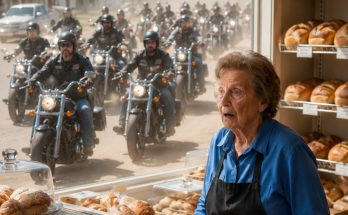
The first vibration reached Eleanor Whitaker through the soles of her shoes. She was standing behind the counter of Willow Hearth Bakery with a tray of pecan rolls balanced against one hip when the floor gave a faint shiver beneath her. A teaspoon resting beside the espresso machine moved against its saucer with a delicate metallic tick. Eleanor stopped. Outside, Maple Glen was still wearing its early-morning quiet, and no delivery truck was due for another hour.
She waited, listening. The old refrigerator hummed behind her. A rack of cooling bread clicked softly as the metal contracted. Somewhere in the wall, the furnace coughed awake. Then the vibration returned, stronger this time, followed by a sound so low and distant she first mistook it for thunder.
Eleanor glanced toward the windows. The sky above Main Street was a clean autumn blue without enough cloud to hide a sparrow. Whatever was coming had nothing to do with weather.
At sixty-six, she no longer hurried simply because something unexpected happened. Years of burns, broken mixers, spoiled deliveries, grief, taxes, customers arriving ten minutes after closing, and one memorable plumbing disaster had taught her that panic rarely improved a situation. She set the tray down, wiped her fingers on her apron, and crossed the bakery slowly.
Willow Hearth had occupied the same narrow brick storefront for nearly twenty-five years. The display window bowed slightly with age. The wooden frame around it bore two small dents Daniel had made while installing it because he had refused to admit that measuring twice was useful advice. Eleanor could still point to both marks without looking.
Her fingertips landed on that frame as the distant rumble deepened.
Across the street, Ed Mercer stepped out of the hardware store carrying a broom. He looked east, stopped sweeping, and remained perfectly still. Two doors down, Marjorie Bell emerged from the florist with a bucket of yellow chrysanthemums pressed against her apron. A pickup slowing for the traffic light did not continue when the signal changed.
Eleanor followed their gaze.
At first she saw only sunlight flashing against chrome at the far end of Main Street. Then the motorcycles rounded the bend.
There were enough of them that the road seemed to change shape around their arrival. They came in a disciplined line, not racing and not weaving, each rider keeping careful distance from the next. The combined sound rolled between Maple Glen’s brick buildings and shook loose a flock of pigeons from the courthouse roof.
Eleanor’s hand tightened around the window frame.
Maple Glen, Indiana, had never been especially talented at surprises. The grocery store closed at eight whether customers liked it or not. The town council still argued every December about the same Christmas decorations. People knew which houses handed out full-size candy bars on Halloween and which families kept their porch lights off. Strangers were noticed before they had found a parking space.
Ninety-seven motorcycles were impossible not to notice.
Eleanor did not know the number immediately. She began counting because her mind needed something ordinary to do.
Seven passed the pharmacy.
Twelve crossed Walnut Street.
Twenty-five rolled beneath the hanging flower baskets the merchants’ association replaced every spring.
At forty, Eleanor stopped pretending this was a group passing through on the highway.
At fifty-six, people began coming outside.
A woman from the insurance office stood beside Ed Mercer with her phone forgotten in her hand. Three employees from the grocery store gathered near the curb. Someone opened an upstairs apartment window. Children waiting for the school bus abandoned their bench and crowded toward the corner until their driver leaned on the horn.
The motorcycles kept coming.
Eleanor counted seventy-three.
Eighty-one.
Eighty-nine.
She became aware that she was holding her breath.
Ninety-four.
Ninety-five.
Ninety-six.
The final motorcycle turned onto Main Street, and Eleanor whispered, “Ninety-seven.”
The number meant nothing to her. That should have been reassuring. Instead an old unease moved under her ribs, not fear exactly, but recognition without an object. Something about the measured pace of the riders, the deliberate formation, and the fact that none of them appeared interested in any building except the one at which Eleanor stood made the morning feel arranged.
The lead rider slowed in front of Willow Hearth.
So did everyone behind him.
Eleanor heard brakes compress, engines drop into heavy idles, boots touch pavement. The procession filled nearly every legal parking space on the block and several that existed only in the imagination of people who intended to stay briefly. Main Street became a corridor of motorcycles stretching from the bakery past the bank and nearly to the courthouse square.
Nobody entered the bakery.
That bothered Eleanor more than if they had.
She remained behind the glass while the riders sat astride their machines. Helmets concealed faces. Leather jackets carried patches she could not read from inside. Some riders were broad and gray-haired. Others were younger. At least a dozen were women. One motorcycle had a small American flag fixed behind the seat, snapping gently in the exhaust-warmed air.
The lead rider shut off his engine.
One by one, the others followed.
The resulting silence dropped so suddenly that Eleanor could hear the bakery clock.
Six thirty-seven.
Seven minutes earlier, she had been deciding whether the cinnamon glaze needed another spoonful of milk.
Now nearly a hundred strangers were standing outside her door.
A bell sounded behind Eleanor as Ruth Caldwell, Maple Glen’s retired librarian, entered from the side street and stopped after two steps.
“Ellie,” Ruth whispered.
Eleanor did not turn. “Morning.”
“Do you know those people?”
“No.”
“That didn’t sound convincing.”
“It wasn’t meant to.”
Ruth came closer to the window. She was seventy-two and possessed the particular confidence of a woman who had spent four decades telling teenagers they could not eat potato chips near library computers. Very little frightened her. Even she became quiet as the riders began removing their helmets.
“What would ninety-seven motorcyclists want with a bakery?” Ruth asked.
“Coffee?”
Ruth looked at her.
Eleanor sighed. “Probably not coffee.”
The lead rider remained seated longer than the others. He wore a dark jacket without the abundance of embroidered patches many of the others had. His gloves were worn pale along the knuckles. When he finally swung one boot over the motorcycle and stood, Eleanor noticed two things.
He was tall.
And he was looking directly at her.
Not through the window. Not at the pastry case. Not at the sign above the door.
At her.
Eleanor’s stomach tightened.
For no sensible reason, she saw snow.
The image came so clearly that she briefly lost sight of Main Street. Snow against a dark window. Flour on her hands. Daniel’s empty coat hook. A knock before sunrise.
She blinked, and autumn returned.
The stranger removed his gloves and tucked them beneath one arm. His hair was dark with gray beginning at the temples. He looked to be in his late thirties, perhaps forty. There was nothing threatening in his posture. If anything, he appeared nervous.
That was stranger still.
Behind him, the other riders waited.
Eleanor turned from the window and reached beneath the counter for her phone.
Ruth noticed. “Calling the sheriff?”
“I haven’t decided.”
“Harold’s already outside.”
Eleanor glanced again and saw Sheriff Harold Price standing beside his cruiser at the far end of the block. He had one hand resting against the driver’s door, but he had not drawn his weapon or approached the riders. Eleanor had known Harold since he was a boy who bought doughnuts with lawn-mowing money. If he believed there was immediate danger, he would not be standing there scratching his chin.
That knowledge steadied her.
She put the phone down.
“Ellie.”
“Yes?”
Ruth lowered her voice. “You went white when that man took off his helmet.”
“I’m sixty-six. I’m allowed to change colors unexpectedly.”
“I’m serious.”
“So am I.”
The lead rider began walking toward the bakery.
A path opened behind him without anyone giving an instruction.
Eleanor watched his face as he approached. Nothing about the shape of it was familiar. The strong jaw, the lines beside his eyes, the short beard—none stirred recognition.
Then he came closer.
His eyes did.
Eleanor stepped backward hard enough that her hip touched the counter.
Ruth caught her elbow. “What?”
“I don’t know.”
But that was not completely true.
She knew those eyes belonged to a memory she had spent years keeping folded away like an old letter.
The stranger climbed the shallow step in front of Willow Hearth.
His gaze moved over the painted bakery name, the brass handle, the faded corner of the OPEN sign. He reached toward the door, then stopped with his fingers inches from the glass.
Eleanor saw his throat move.
He looked almost as though he needed courage to enter.
Twenty-one years collapsed into a single heartbeat.
Eleanor remembered another figure standing outside that same door, though the shoulders had been narrower then, the clothes cheaper, the weather merciless.
No, she thought.
It could not be.
The stranger finally opened the door.
The brass bell Daniel had installed rang once.
Every person in the bakery went silent.
The man stepped inside, removed his sunglasses, and looked across the room at Eleanor with an expression she could not name.
Then, behind him, all ninety-six riders remained outside and waited.
Click here to continue reading: PART 2: The Riders Stopped Outside Willow Hearth Bakery, and One Stranger Spoke of a Winter Eleanor Had Never Truly Left Behind
Ninety-Seven Engines Rolled Into Maple Glen at Dawn, and Eleanor Whitaker Knew the Morning Had Come Looking for Her
Part 1 of 15