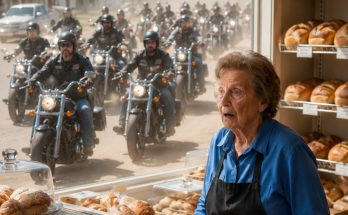
Ninety-seven motorcyclists could not fit inside Willow Hearth Bakery.
They tried anyway.
Within fifteen minutes every chair was occupied. Riders stood along the walls, leaned against counters, crowded the narrow space beside the pastry case, and spilled onto the sidewalk holding coffee in mismatched mugs because Eleanor ran out of paper cups first.
The people of Maple Glen joined them.
By eight o’clock, nobody seemed to remember that an hour earlier the town had regarded the motorcycles like an invading force.
Ed Mercer and Nate Fowler were arguing pleasantly about torque.
Marjorie had given away every chrysanthemum in her bucket.
Sheriff Price drank coffee beside Aaron while asking about the electrical company.
Three children were being photographed on motorcycles whose owners had made them promise not to touch anything shiny.
Eleanor stood behind the counter and watched the impossible become ordinary.
“Mom.”
Caroline appeared beside her carrying an empty pastry tray.
“What?”
“We’re out of cinnamon rolls.”
“No, we aren’t.”
Caroline pointed at the case.
“We visibly are.”
“There are two trays proofing in back.”
“Those were for this afternoon.”
“It appears this afternoon has been cancelled.”
Caroline laughed.
Eleanor pushed through the swinging kitchen door.
The familiar heat met her.
For a moment she stood alone beside the worktable.
Noise from the bakery came through the wall as a low, living murmur.
Twenty-one years earlier, this kitchen had held only Eleanor and a frightened boy trying to understand why eight fallen loaves did not mean he had to leave.
Now the boy had returned with enough people to fill the building beyond capacity.
The thought became too large.
Eleanor put both hands flat on the worktable.
The surface had been refinished twice, but she knew the old scratches beneath the varnish.
One had come from Daniel opening a box with a knife he had been specifically told not to use on the table.
Another from Caroline dropping a metal mixing bowl when she was twelve.
Somewhere near the far edge was a gouge left by Cole moving the prep table when the bread hit the floor.
Eleanor had never repaired that one completely.
She had told herself the damage was too minor to bother with.
Perhaps that had not been the reason.
The kitchen door swung open.
Mason entered carrying three empty coffee pots.
“I was told to find more.”
“By whom?”
“Ruth.”
“You obey Ruth quickly.”
“She scares me.”
“Good instincts.”
Mason placed the pots beside the sink.
For a moment neither spoke.
The room felt smaller with him in it.
Not because of his size.
Because she could see both versions of him at once.
He glanced toward the place where the old storage-room door had once been before Eleanor remodeled the back hallway years later.
“It changed.”
“Some.”
“The room’s gone?”
“It’s dry storage now. We knocked part of the wall out.”
Mason nodded.
He walked closer.
“The heater?”
“Finally died.”
“Violently?”
“Very.”
He smiled.
“I always thought it would.”
Eleanor opened a cabinet and reached for coffee.
“You should have come back sooner to check.”
Mason’s smile disappeared.
“I know.”
Eleanor turned.
There it was again.
The guilt.
She had been angry for twenty-one years.
She had earned some of that anger.
But she did not want him carrying it for another twenty-one.
“Mason.”
“Yes?”
“You were a boy when you left.”
“I still made the choice.”
“Yes.”
“I promised I’d come back.”
“And you did.”
“Twenty-one years later.”
“Apparently punctuality still needs work.”
His mouth moved.
Eleanor continued before he could apologize.
“You don’t owe me those years.”
He looked at her.
“I wondered about you.”
“I know.”
“I was angry.”
“I know.”
“I had entire arguments with you while shaping bread.”
“That sounds unpleasant.”
“I won most of them.”
He smiled.
Eleanor leaned against the counter.
“But I will not turn your return into another reason for you to punish yourself.”
Mason’s eyes lowered.
“You built a life.”
“With help.”
“Everyone does, whether they admit it or not.”
He looked toward the front.
“Luis used to say something similar.”
“I definitely like Luis.”
“You would fight constantly.”
“Then I would like him enormously.”
They stood in comfortable silence.
Mason picked up one of the coffee pots.
“Can I ask you something?”
“You have been for twenty-one years.”
“Did you really keep the forty-one dollars the whole time?”
“Yes.”
“Why?”
“I told you. I was angry.”
“No.”
He knew her too well.
Eleanor sighed.
“Because spending it felt wrong.”
“Why?”
“It was proof.”
“Of what?”
“That you had been here.”
The honesty surprised them both.
Eleanor looked away.
“After Daniel died, I developed a bad habit of keeping objects because people had touched them.”
Mason’s eyes moved toward Daniel’s cardigan, still hanging from a hook in the office doorway though Eleanor no longer wore it often.
She continued.
“Your note was paper. The money was money. But together they were evidence that I had not invented those weeks because I needed someone to need me.”
Mason set down the pot.
“You didn’t imagine me.”
“I know that now.”
“You knew it then.”
“Grief makes knowledge unreliable.”
Mason nodded as though he understood that more than she had expected.
He moved toward the worktable.
“Did helping me help you?”
Eleanor considered the question carefully.
“Yes.”
Mason looked almost troubled.
She smiled.
“That does not make it less real.”
He remained quiet.
“I think people get strange about kindness,” Eleanor said. “They want it to come from some perfectly pure place where the giver needs nothing.”
Mason listened.
“I was lonely. You were hungry. I needed a reason to come downstairs. You needed somewhere warm.”
She shrugged.
“Both things were true.”
Mason looked at the old worktable.
“So I helped you too.”
“You gave me someone to argue with before sunrise.”
“That sounds less inspiring.”
“It was very useful.”
He laughed.
Ruth shouted from the front.
“Mason! Coffee!”
He called back, “Working on it!”
Eleanor pointed toward the machine.
“You heard the librarian.”
They made coffee together.
Mason still measured correctly.
Eleanor noticed.
He noticed her noticing.
“Ratios.”
“Good.”
When they returned to the front, the bakery had somehow become even more crowded.
Doreen—or Marjorie, as half the town insisted on calling her depending on when they had first met her—had brought folding chairs.
Ed’s employees carried in a card table.
Someone had opened the side window to let out heat.
A rider from Muncie was explaining a transmission problem to the woman from the insurance office, who appeared sincerely interested.
Eleanor found this more alarming than the motorcycles.
Ruth had placed a donation jar near the coffee machine.
Eleanor removed it.
“What are you doing?”
“People want to pay.”
“They can buy something tomorrow.”
“You’re giving away the bakery.”
“For one morning.”
Ruth raised an eyebrow.
“Possibly.”
Eleanor looked across the room.
Keisha was speaking to Caroline.
Aaron had found Sheriff Price’s deputy and was explaining an apprenticeship program.
Miguel sat with Mr. Hanley, apparently discussing literacy tutoring.
Nate had produced photographs of rebuilt motorcycles from somewhere.
Nobody was performing gratitude.
Nobody was lined up to thank Eleanor in a ceremonial procession.
They were simply being together.
She preferred it that way.
At eight twenty, the second batch of cinnamon rolls came out.
Mason tried to carry the tray.
Eleanor slapped his hand away.
“I’m thirty-seven.”
“You dropped the last important tray I gave you.”
“That was twenty-one years ago.”
“Trust rebuilds slowly.”
He laughed.
Eleanor carried it herself.
The rolls disappeared in under four minutes.
At eight thirty-five, she gave up charging for anything.
Caroline objected on business grounds for approximately thirty seconds, then began handing out pastries herself.
Eleanor made another pot of coffee.
Then another.
At some point she realized Mason had disappeared.
She found him outside beside his motorcycle with a young rider Eleanor had not met.
The rider could not have been more than twenty-two.
He was thin and kept tugging at the cuffs of his jacket.
Mason listened while the young man spoke.
Eleanor stopped inside the doorway.
She could not hear the conversation.
She did not need to.
The posture was familiar.
The young rider was apologizing for something.
Mason answered.
The young man shook his head.
Mason said something else.
Then, without touching him, Mason stood there while the younger man stared at the pavement and gathered himself.
Eleanor felt the past travel forward.
Not copied.
Not recreated.
Adapted.
When Mason returned, she did not ask what the conversation had been about.
He gave her a grateful look.
Apparently he remembered that too.
By nine o’clock, Willow Hearth held more people than Eleanor could remember seeing inside it since Daniel’s memorial.
That memory arrived without warning.
The same tables had once been covered with casseroles.
The same walls had contained voices lowered out of respect.
People had come because something ended.
Today they had come because something continued.
Eleanor went behind the register.
Her hand rested on the drawer.
She had already shown Mason the note.
But showing it and returning it were different things.
For twenty-one years she had believed it belonged with her.
Now she was not sure.
She opened the drawer.
Receipt tape.
Old calculator.
Pens.
Plastic sleeve.
Forty-one dollars.
She lifted the note out.
Mason was standing near the window.
“Mason.”
He turned.
Something in her face made him cross the room immediately.
Eleanor held out the folded paper.
He stopped.
“No.”
“Yes.”
“That’s yours.”
“You wrote it.”
“For you.”
“And I kept it for you long enough.”
Mason stared at the note.
“I don’t want to take it.”
“That is unfortunate.”
“Mrs. Whitaker—”
“Mason.”
He smiled weakly.
She placed the folded paper in his hand.
His fingers closed around it.
For several seconds he did not open it.
Then he unfolded the first crease.
The room around them continued moving.
Coffee poured.
People laughed.
A chair scraped.
The brass bell rang.
Mason opened the final fold.
His eyes moved to the first line.
He stopped.
Eleanor saw the exact moment the thirty-seven-year-old man encountered the sixteen-year-old who had written those words.
Mason turned away.
He faced the wall beside the pastry case.
One hand covered his mouth.
Nobody interrupted him.
Eleanor watched his shoulders rise.
Once.
Twice.
The same way they had twenty-one years earlier when she told him he mattered.
She moved beside him.
Not touching.
Just there.
After a long while, Mason whispered, “I really thought I’d come back in a year.”
Eleanor smiled through tears.
“You were always terrible at scheduling.”
He laughed into his hand.
Then he looked at the note again.
“I wrote that I’d show you it mattered.”
“You did.”
His eyes lifted.
Eleanor gestured toward the bakery.
Toward Keisha.
Aaron.
Miguel.
Devon.
Nate.
The teachers.
The counselors.
The riders.
The townspeople.
“You’ve been showing me all morning.”
Mason folded the paper carefully.
This time he placed it inside his own jacket.
Eleanor felt the absence of it immediately.
The drawer beneath the register was lighter now.
So was she.
Outside, the motorcycles flashed beneath the October sun.
Inside, Mason Caldwell carried his own promise again.
And Eleanor realized she no longer needed the paper to prove the boy had survived.
He was standing beside her.
Click here to continue reading: PART 15: Eleanor’s Final Condition Was Simple: No One Would Enter Their Doors Hungry, and No One Would Have to Earn the Right to Eat
Ninety-Seven Engines Rolled Into Maple Glen at Dawn, and Eleanor Whitaker Knew the Morning Had Come Looking for Her
Part 14 of 15