PART ONE
The hardest punch I ever took did not land on a battlefield, though I had stood on plenty of ground where the air itself seemed to burn.
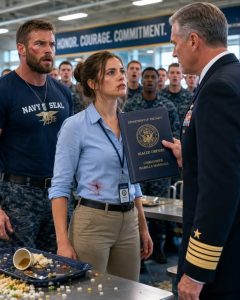
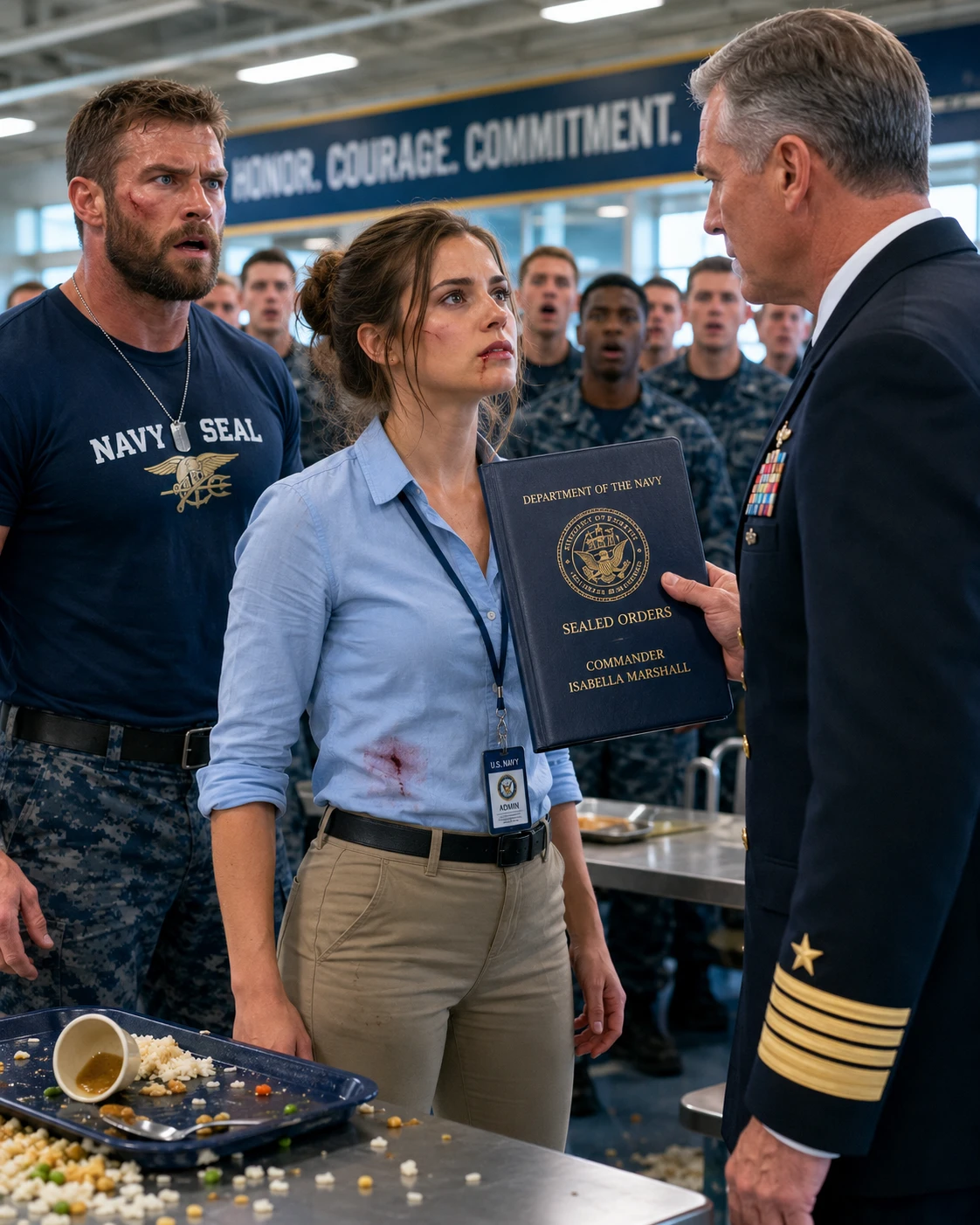
It landed in a Navy mess hall at 0713 on a gray Thursday morning, beneath humming fluorescent lights, in front of seventy-eight recruits who had not yet learned that courage was not the same thing as noise. It landed with the ugly, wet sound of knuckles against ribs, hard enough to fold me sideways and send my breakfast tray exploding across the tile. Peas rolled under tables. Rice scattered like pale gravel. Coffee splashed across my sleeve and ran warm down my wrist.
For one full second, no one breathed.
Then Chief Walker Reed laughed.
He was the kind of man people described before they described the room he entered. Tall, carved from muscle and discipline, with a jaw that looked made for recruiting posters and a reputation polished brighter than the medals on his chest. Men admired him before they knew him. Young recruits feared him because they had been told fear was respect. Officers tolerated him because heroes are sometimes allowed to become storms as long as they keep winning wars.
He stood over me that morning with his hands loose at his sides, his polished boots planted on the wrong side of a red boundary line painted across the floor.
That detail mattered.
Pain spread through my ribs in a hot white sheet. Blood filled my mouth where my tooth had cut the inside of my cheek. My right knee struck the tile, and for an instant I was aware of absurd things—the smell of powdered eggs, the squeak of a chair leg, the tiny tremor in a recruit’s hand as he held a carton of milk halfway to his lips.
“Didn’t know they let office girls eat with warfighters now,” Reed said.
A few recruits looked down at their trays, ashamed of hearing it and more ashamed of being relieved it had not been said to them. The instructors froze with the practiced stillness of men who had already decided the safest response was no response at all. The corpsman by the juice machine shifted one foot, then stopped himself.
Fear has a strange way of turning good people into furniture.
Reed bent closer. “Pick it up.”
I looked at the food on the floor. Then at the blood on my hand. Then at his boots.
Six inches past the line.
The red line separated recruit traffic from the instructor lane. It was a simple safety marking, ordinary enough that almost nobody noticed it. But I had spent a lifetime noticing things ordinary people did not. Scuff marks. Breathing patterns. A knee that rotated half an inch too slowly. A fist clenched not from anger, but from previous injury.
“Pick it up,” Reed repeated.
Somewhere behind him, a young recruit whispered, “Oh, no…”
I rose slowly. My ribs screamed, but my face stayed calm. Four seconds in. Hold two. Six seconds out. A breathing rhythm an old master chief named Elias Boone had taught me decades earlier in a place where fear had teeth.
“Don’t fight the room, Mara,” Boone used to tell me. “Read it. Rooms always confess before people do.”
So I read it.
Seventy-eight recruits. Nine instructors. One corpsman. Three cameras. Four exits. Two wet-floor signs stacked by the south wall. One cracked tile beneath table twelve. One SEAL with a famous name and a dangerous hunger to be seen as untouchable.
Reed stepped closer. “You got something to say?”
I wiped my lip with my thumb. “Yes.”
The mess hall seemed to lean toward us.
“You drop your right shoulder before you throw a punch.”
His smile weakened. “What?”
“And your left knee still favors an old ligament injury. You hide it well on pavement. Not so well on tile.”
A chair creaked.
Reed’s jaw tightened. “You think you’re funny?”
“No.” I looked at his hand. “Your knuckles are swollen. Not from training. Impact trauma. Recent.”
His eyes flickered. Not much. Just enough.
The instructors exchanged looks now. Not brave looks, not yet. But curious ones. Worried ones.
Reed laughed too loudly. “You think you’re some kind of investigator?”
“No,” I said. “I just pay attention.”
He took another step. “Lady, you have no idea who you’re talking to.”
That was the tragedy of men like Walker Reed. They believed reputation was the same thing as identity. They thought the stories told about them could protect them from the truth of what they had become.
Before he could speak again, the mess hall doors opened.
The sound was not dramatic. Just metal hinges. A rubber seal. Morning air slipping into a crowded room.
But every spine in the mess hall straightened.
Admiral Richard Bennett entered with four senior officers and a young legal commander carrying a black folder sealed with red tape. Bennett was in his early sixties, lean and silver-haired, with the quiet gravity of a man who did not need to raise his voice because his life had already done the shouting for him.
Every recruit snapped upright.
Every instructor saluted.
Chief Walker Reed turned clean and sharp, suddenly all discipline.
“Sir!”
Admiral Bennett did not answer him.
His eyes moved across the room—the food on the floor, the blood on my mouth, Reed’s boots beyond the red line, the cameras, the witnesses, the silence. Then he saw me.
At first came confusion.
Then recognition.
Real recognition.
Not the kind given to a face from a file, but the kind a man gives to a ghost who has finally stepped out of the fog.
He walked toward me.
The room held its breath.
Reed looked puzzled. Then irritated. Then, slowly, afraid.
Bennett stopped in front of me. His voice, when it came, was soft enough that everyone had to strain to hear it.
“Captain Mara Ellison.”
The color drained from Reed’s face.
Bennett lowered his chin. “I was told you arrived quietly.”
“I did, Admiral.”
His eyes dropped to the blood on my lip. “Apparently not quietly enough.”
A murmur moved through the mess hall.
Captain.
Not civilian.
Not office girl.
Captain.
But even that was not the real secret.
The legal commander stepped forward and handed Admiral Bennett the sealed folder. Bennett broke the tape with his thumb.
Chief Reed’s confidence was leaking out of him now, drop by drop.
“Chief Reed,” Bennett said without looking at him, “remain exactly where you are.”
Reed swallowed. “Sir, there’s been a misunderstanding.”
“I’m certain there has.”
I watched Reed’s hands. The right one flexed. The knuckles were worse than I’d first thought. Fresh swelling. Skin split near the ring finger. He had hit someone before me, probably within the last forty-eight hours.
Bennett turned a page inside the folder.
“Captain Ellison,” he said, “before we proceed, do you require medical attention?”
“No, sir.”
My ribs disagreed, but my work had never waited for comfort.
Reed blinked. “Work?”
Bennett finally turned to him.
The admiral’s expression was not anger. Anger is often too generous. His face held something colder.
“Chief Walker Reed, effective immediately, you are relieved of instructional authority pending investigation under sealed command review.”
The mess hall gasped.
Reed stiffened. “Sir, with respect, on what grounds?”
Bennett lifted the folder.
“On the grounds that Captain Mara Ellison is not here as staff support. She is here under direct appointment from Naval Inspector General Command. She is the lead investigator into misconduct, intimidation, falsified injury reports, and the unexplained death of Seaman Apprentice Caleb Voss.”
The room went utterly still.
At a table near the back, a recruit dropped his fork.
Reed did not look at me then. He looked at the folder.
And for the first time since I had entered that mess hall, Walker Reed looked less like a king and more like a man standing at the edge of a grave he had forgotten to cover.
PART TWO
Three weeks before Chief Reed hit me, Caleb Voss’s mother mailed me a photograph.
It arrived in a plain envelope, no return address, the kind people use when they have already been ignored by every official channel and are afraid hope itself might get them punished. Inside was a picture of a boy in dress whites, too young to understand how young he looked. He had freckles across his nose, ears slightly too large for his head, and a smile that belonged at a county fair, not on a military casualty report.
Behind the photograph was a note written in blue ink.
Please. My son was not weak.
That was all.
I sat at my kitchen table in Norfolk, wearing an old robe, listening to rain tick against the windows. My left hand trembled around the note. Not because of age, though I was fifty-seven and my bones reminded me daily that time collects its debts. It trembled because mothers have a way of writing pain that goes straight through rank, procedure, and all the armor a person builds to survive a long career.
Caleb Voss had died during a nighttime endurance exercise at Naval Training Center Harrowgate. Officially, it was an accident. Dehydration. Disorientation. Collapse near a drainage ravine. The report was neat, efficient, and bloodless.
Too neat.
I had spent thirty-one years in uniform, though not all of them in places anyone was allowed to discuss. I had interrogated warlords who smiled over tea. I had questioned contractors who sold bad armor to good men. I had sat across from admirals, senators, widows, cowards, and liars. The truth rarely announced itself. More often, it coughed behind a polished sentence.
Caleb’s report coughed.
There were gaps in the timeline. Witness statements that sounded rehearsed. Medical notes revised twice. A missing training video from the west obstacle course camera. Three recruits transferred within twenty-four hours of giving initial statements. A corpsman who signed a report and then requested emergency leave the next morning.
And standing in the middle of it all, shining like a monument, was Chief Walker Reed.
Decorated SEAL. Silver Star. Two Bronze Stars. Public speaker. Fundraising darling. Survivor of a classified operation in the Gulf of Aden that had made him famous enough to be useful and wounded enough to be protected.
When I first asked Admiral Bennett for access, he sat behind his desk for a long time without speaking.
“You know what happens if you’re wrong,” he said finally.
“Yes.”
“And if you’re right?”
“That depends on how many people helped him.”
Bennett looked toward the window. Outside, the flag snapped in a hard wind.
“Mara, Reed is not just popular. He’s symbolic.”
“So was the Titanic.”
That earned the smallest of smiles.
He opened a drawer and removed a sealed authorization packet.
“I can give you seven days undercover,” he said. “No uniform. No rank displayed. Civilian support cover. You’ll observe. You’ll listen. You’ll identify who knew what.”
“Seven days is enough.”
“No,” Bennett said. “It’s not. But it’s all I can protect before questions start arriving from men who prefer heroes uncomplicated.”
He slid the packet across the desk.
I did not touch it yet.
“What are you not telling me?” I asked.
Bennett’s eyes sharpened. He had always disliked how well I read him.
“There’s another name in the file,” he said.
“Whose?”
He hesitated.
“Elias Boone.”
For a moment the room slipped away.
Master Chief Elias Boone had been my first real mentor, the man who taught me how to breathe through fear and hear the lie beneath the words. He had pulled me out of a burning vehicle in Panama when I was twenty-six and too stubborn to admit I was bleeding. Later, when I became an investigator, he sent me a card every year on my birthday with the same sentence written inside.
Rooms confess before people do.
“What does Boone have to do with Caleb Voss?” I asked.
“We don’t know. His name appears in an old appendix connected to Operation Glass Lantern.”
I stared at him.
Glass Lantern.
The words were supposed to be buried.
Bennett folded his hands. “You remember Walker Reed’s famous rescue mission?”
“I remember what the public was told.”
“And what do you remember that the public wasn’t told?”
I looked down at Caleb’s photograph.
“I remember Elias Boone came home from that operation silent. I remember two men died and one man became a legend. I remember Boone retired six months later and refused every award connected to it.”
Bennett nodded slowly.
“Boone died last winter,” he said. “Before he died, he mailed a locked evidence pouch to the Inspector General’s office. It was misfiled. We found it two weeks after Caleb Voss died.”
“What was in it?”
“A list of names. Reed’s was one of them. Caleb Voss’s father was another.”
That was how the past returned—not as thunder, but as paperwork.
Caleb’s father, Lieutenant Aaron Voss, had died in Operation Glass Lantern eighteen years earlier. Officially, he had been killed by hostile fire while saving Walker Reed’s team. His widow received a folded flag. His son grew up with a photograph and a story.
Now that son was dead too.
And Walker Reed had been the last instructor to see him alive.
When I arrived at Harrowgate undercover, the base greeted me the way institutions greet outsiders they have decided not to respect. A clerk gave me a temporary badge with my name misspelled. An instructor asked if I knew how to find the copy room. Two recruits apologized after bumping into me because they assumed I was someone’s aunt visiting the wrong building.
That suited me fine.
Invisibility is not weakness. In the right hands, it is a blade.
For six days I watched.
I watched Reed speak to recruits like a preacher and punish them like property. I watched instructors laugh too late at his jokes. I watched young men and women shrink when he walked past, then call it respect because fear is easier to justify when it wears a uniform.
I watched a recruit named Danny Phelps hide a limp.
I watched another, Alicia Moreno, flinch when Reed placed a hand on her shoulder.
I watched the corpsman by the juice machine—Petty Officer Sikes—avoid looking toward the west obstacle course.
At night, I sat in a temporary office that smelled of dust and old printer toner, building a wall of names and times. Caleb’s last known route. Reed’s unauthorized presence. Camera outages. Injury reports. Transfer orders. Boone’s list. Operation Glass Lantern.
The pattern emerged slowly, then all at once.
Walker Reed had not merely abused recruits.
He had been searching for something.
Or someone.
Caleb Voss had not died because he was weak.
He had died because he had asked the wrong question about his father.
On my sixth night, I found a note slipped beneath my door.
Stop digging, Captain.
No signature.
No threat needed.
The next morning, I went to the mess hall wearing a plain navy blouse, sensible shoes, and the temporary badge of a woman no one thought mattered.
Chief Walker Reed took the bait before I reached the coffee.
PART THREE
After Admiral Bennett announced the investigation, the mess hall did not erupt. Real shock is quieter than people imagine.
It makes people sit very still while their minds rearrange the furniture of reality.
Chief Reed’s mouth opened once, then closed. The young recruits looked from him to me as if watching a statue crack. Petty Officer Sikes, the corpsman near the juice machine, went pale enough that I thought he might faint.
Bennett turned to the instructors. “No one leaves until statements are taken.”
One instructor, Lieutenant Graves, stepped forward. “Admiral, with respect, perhaps we should move this out of the recruits’ area.”
“With respect,” Bennett replied, “this room has carried enough secrets.”
That silenced him.
I pressed my hand against my ribs and walked toward a table near the wall. A recruit stood quickly and offered me his chair. He could not have been more than nineteen. His name tape read HOLLIS. His eyes were wet with embarrassment, anger, and the terrible relief of seeing a bully stopped by someone else.
“Thank you,” I said.
He nodded. “Ma’am, are you really a captain?”
“I am.”
He swallowed. “Then why did you let him hit you?”
It was a fair question. It was also the question every frightened person asks of someone who survives abuse without immediately striking back.
I sat slowly. “Because sometimes the room needs to show you what it has been pretending not to see.”
His face changed. He understood more than I wished he did.
Security arrived. Reed was not handcuffed; men like him are rarely humiliated in the first hour. Instead, two military police officers stood near him while Bennett ordered the mess hall cameras secured.
Reed found his voice then.
“This is insane,” he said. “I disciplined a civilian who violated training space.”
“You punched a woman holding a tray,” I said.
“You provoked me.”
I looked at the peas still scattered near his boots. “By eating breakfast?”
A few recruits lowered their heads to hide their expressions.
Reed’s face hardened. “You don’t know what you’re playing with.”
“No,” I said. “I know exactly what I’m playing with. That’s why you’re scared.”
His eyes flashed.
There it was. Not guilt. Not yet. Rage at being seen.
Admiral Bennett ordered a temporary command post established in the administrative wing. By 0900, I had been examined by medical, taped at the ribs, and given the familiar advice to rest. By 0915, I was in an interview room with Recruit Alicia Moreno.
She sat across from me with both hands wrapped around a paper cup of water. Her dark hair was pulled so tight beneath her cap that her temples looked sore.
“You’re not in trouble,” I told her.
“That’s what people say before trouble changes clothes.”
I liked her immediately.
“How old are you, Moreno?”
“Twenty-two.”
“Why Navy?”
“My grandfather. Vietnam. Brown-water Navy. He used to say the Navy taught him how to be afraid and keep moving.”
“That’s a good lesson.”
“He died last spring.” She looked into the cup. “I thought coming here would make him proud.”
“Would it?”
Her jaw trembled. “Not if he saw what we let happen.”
I waited.
People do not give truth because you demand it. They give it when silence becomes heavier than fear.
Alicia took a breath.
“Caleb found something,” she said.
“What?”
“I don’t know exactly. He had this old letter from his dad. He carried it folded inside his Bible. He said his father wrote it before some mission overseas, and one line never made sense to him.”
“What line?”
She closed her eyes, remembering.
“If the lantern breaks, don’t trust the man who brings the light.”
The sentence moved through me like cold water.
Glass Lantern.
“Did Caleb ask Chief Reed about it?”
Alicia nodded.
“When?”
“The night before he died. After evening formation. Caleb asked him if he knew Aaron Voss. Chief Reed smiled and said everybody knew heroes. But his face…” She shook her head. “His face was wrong.”
“What happened during the exercise?”
“Chief Reed changed Caleb’s lane. Put him on the west course alone. Said he needed to toughen up.”
“Was that authorized?”
“No.”
“Who saw it?”
Her lips pressed together.
“Moreno.”
“Everybody,” she whispered. “Everybody saw.”
The words sat between us.
Everybody saw.
No sentence in military life is more damning.
I interviewed Danny Phelps next. Then Hollis. Then two others. Their accounts differed in small human ways, which meant they were probably real. Caleb had been singled out for weeks. Extra drills. Mockery. Sleep disruption. Threats disguised as mentorship. Reed called it “shaping.” The recruits called it survival.
The instructors called it tradition.
By late afternoon, Petty Officer Sikes asked for a lawyer.
That told me more than his silence.
At 1800, I found Admiral Bennett alone in the corridor, staring at the wall display of Harrowgate’s decorated alumni. Walker Reed’s portrait hung in the center, smiling beneath perfect lighting.
“Moreno gave us motive,” I said.
Bennett did not turn. “And Sikes?”
“He’s close to breaking.”
“Good.”
“No,” I said quietly. “Not good. Necessary.”
Bennett looked at me then. His face had aged since morning.
“You always did hate victory when it came too late.”
“I’ve delivered too many folded flags.”
He nodded.
For a while, neither of us spoke.
Then he said, “There’s something else.”
I studied him. “You’ve been saying that a lot lately.”
He reached inside his jacket and removed a small envelope.
“This was inside Boone’s evidence pouch. It was addressed to you personally.”
My name was written across the front in Elias Boone’s sharp, slanted hand.
Mara.
My throat tightened.
I waited until I was alone to open it.
Inside was one page.
Mara,
If you are reading this, then I failed to fix what I helped break. I told myself silence protected the Navy. That was a lie. Silence protected cowards, including me.
Glass Lantern was not what they said. Aaron Voss did not die saving Reed. Aaron died trying to stop him.
Reed found a cache of smuggled money tied to a contractor network. Aaron wanted to report it. Reed wanted to use it. There was a fight. I arrived too late. Reed shot Aaron and blamed enemy fire. I helped write the report because two wounded men needed extraction, and Reed convinced me the truth would destroy families, careers, and the mission.
I have lived eighteen years inside that moment.
There is one witness Reed never knew survived.
You.
I stared at the word until it blurred.
You.
My hands went cold.
Behind my ribs, pain bloomed deeper than any punch.
I remembered fire. Smoke. A younger version of myself strapped into a transport helicopter after an intelligence handoff gone wrong. Elias Boone leaning over me, saying, “Stay awake, Mara.” I remembered a man’s voice shouting through gunfire. I remembered a flare of light.
But trauma is a thief. It steals rooms and returns them years later with the furniture rearranged.
I had been attached to Glass Lantern as a junior intelligence officer. I knew that. I had always known that. But my injuries left gaps, and official debriefings filled those gaps with neat sentences.
Aaron Voss died under fire.
Walker Reed saved three lives.
Elias Boone confirmed the report.
I had signed a statement I did not remember giving.
Now Boone was telling me I had witnessed a murder buried inside a legend.
And Caleb Voss, eighteen years later, had died for asking why his father’s last letter sounded like a warning.
PART FOUR
Petty Officer Sikes broke at 2140.
He did not cry at first. He sat in the interview room with his lawyer beside him, staring at his own hands as if they belonged to a stranger. He was forty-three, with tired eyes and a wedding ring that had worn a pale groove into his finger. Men like Sikes do not usually begin as villains. More often, they begin as men who tell themselves one small compromise will save someone else pain.
Then the compromise grows teeth.
“Chief Reed brought Caleb in after the exercise,” Sikes said. “He was alive.”
My pen stopped.
Across the table, Admiral Bennett went still.
Sikes swallowed. “Barely. Dehydrated, bruised, confused. He kept saying, ‘I know what he did. I know what he did to my dad.’ Reed told me Caleb had fallen. Told me to write it as training collapse.”
“And you did.”
Sikes nodded.
“Why?”
His eyes filled now.
“Because Reed said Caleb would recover. He said if I made noise, I’d ruin the program, ruin my pension, ruin my family. Then Caleb started seizing.” Sikes pressed a hand to his mouth. “I wanted to call emergency transport. Reed said no. He said the boy was faking. Then Caleb stopped breathing.”
The room felt smaller.
“What did Reed do?”
“He waited.” Sikes closed his eyes. “He stood there and waited until there was no fixing it. Then he told me exactly what to write.”
Bennett’s voice was iron. “Where is the original medical log?”
Sikes looked at me.
“I kept a copy.”
There are moments when justice does not roar. It simply opens a drawer.
Sikes had hidden the original log inside the backing of a framed family photograph in his quarters. It documented Caleb’s arrival at the infirmary ninety-two minutes before the official report claimed he was found near the ravine. It noted bruising consistent with restraint. It recorded Caleb’s final words.
He killed my father.
By midnight, Walker Reed was confined pending charges.
By morning, the base had changed.
Not publicly. Not yet. Institutions are slow to admit infection. But everyone felt the shift. Recruits stood straighter, not out of fear, but because something poisonous had been named. Instructors avoided the hallways. The portrait of Reed remained on the alumni wall, but someone had turned the light above it off.
Alicia Moreno found me outside the chapel near dawn.
“You should be in medical,” she said.
“So should half this base.”
She almost smiled.
The sky was just beginning to pale. A flag snapped above us. Somewhere, a bugle played morning colors, thin and mournful.
“Did Caleb suffer?” she asked.
I had been asked that question by mothers, brothers, wives, and once by a seven-year-old girl holding a stuffed rabbit. It never became easier.
“Yes,” I said. “But he was not alone in the way that matters now. People are finally standing with him.”
“That doesn’t bring him back.”
“No.”
She looked angry at my honesty, then grateful for it.
“My grandfather used to say the country is only as honorable as the people willing to correct it.”
“Your grandfather was a wise man.”
“He also cheated at cards.”
“The two often go together.”
She laughed once, then covered her mouth as if laughter were disloyal to the dead.
I thought of Caleb’s mother. The photograph. The note.
Please. My son was not weak.
“No,” I whispered. “He wasn’t.”
Reed’s first formal confrontation came that afternoon in a secured hearing room. He wore dress blues and the wounded dignity of a man already planning his defense. His lawyer, a sharp civilian with silver cufflinks, sat beside him. Admiral Bennett presided. I was there as lead investigator.
Reed did not look at Bennett.
He looked at me.
“You’re enjoying this,” he said.
“No.”
“You think taking me down makes you righteous?”
“I think the dead deserve accuracy.”
His mouth twisted. “You have no idea what war asks of men.”
I leaned forward. “War asks everything. That does not give you permission to steal more.”
For a moment, the mask slipped.
“You people sit in offices and judge split-second choices.”
“I was at Glass Lantern.”
The room changed.
Reed’s lawyer turned sharply.
Reed’s face emptied.
I continued, each word deliberate.
“I was there the night Aaron Voss died.”
Reed stared at me as if seeing not my present face, lined by age and grief and thirty-one years of service, but the younger woman half-conscious under smoke and rotor wash.
“You don’t remember,” he said.
It was the wrong answer.
Bennett heard it too.
Reed realized his mistake and recovered. “I mean, your injuries—”
“I remember enough.”
But that was not true.
Not yet.
That night, I returned to the old Glass Lantern files. Photographs. Maps. Redacted statements. Medical evacuation records. Boone’s testimony. My testimony.
Then I found the audio.
It was buried in a degraded field recorder file recovered from my damaged gear. For eighteen years, no one had been able to clean it enough to use. Technology had improved. Boone’s pouch included a restored transcript.
I listened alone.
Static.
Gunfire.
Men shouting.
My younger voice, breathless: “Lieutenant Voss, don’t—”
Another voice. Aaron Voss.
“He’s stealing it, Boone! Reed’s selling us out!”
Then Walker Reed.
“You don’t know when to shut up.”
A shot.
A scream.
My scream.
More static.
Then a sound that made my skin turn cold.
A baby crying.
I stopped the recording.
There had been no baby in the official report.
No civilian child. No dependent. No local family. No mention anywhere.
I played it again.
A baby crying beneath gunfire.
Then my own voice, weak but clear.
“Take the child. Boone, take the child.”
The room tilted.
A memory tore open.
Smoke. Heat. Aaron Voss falling. Reed turning with his weapon. Boone dragging me behind a wall. A woman on the ground reaching toward a bundle wrapped in a blue cloth. My arms closing around a crying infant. Boone shouting that extraction was coming. Me pressing the baby against my chest while blood ran into my eye.
Then nothing.
I woke eighteen years ago in a hospital with a concussion, shrapnel wounds, and a report already written.
No one ever told me about the baby.
At 0200, I called Bennett.
“There was a child at Glass Lantern,” I said.
Silence.
Then Bennett said, “Come to my office.”
When I arrived, he looked as if he had not slept in days.
“There’s more,” I said.
“I know.”
The words struck harder than Reed’s fist.
“What do you mean, you know?”
Bennett did not sit behind his desk. Perhaps he knew he did not deserve the protection of furniture.
“Boone told me shortly before he died.”
“And you kept it from me?”
“I was trying to verify it.”
“Don’t insult me, Richard.”
He flinched at the use of his first name.
I stepped closer. “Who was the child?”
Bennett’s face collapsed inward, just slightly. Enough.
“Mara—”
“Who was the child?”
He opened a folder with trembling hands.
Inside was a photograph of a young woman in Navy recruit gear.
Dark hair. Steady eyes. A face I had looked at across an interview table.
Alicia Moreno.
PART FIVE
Some truths arrive like lightning. Others sit beside you all along, waiting for you to turn your head.
Alicia Moreno was the baby from Glass Lantern.
She had been found in my arms during extraction and entered into a classified humanitarian relocation program because the operation involved contractors, smuggling networks, and local informants whose surviving families were at risk. Her birth records were sealed. She was placed with an American family in New Mexico. Her adoptive grandfather, the Vietnam veteran she loved so dearly, had known only that she came from danger and needed a country big enough to let her begin again.
But Elias Boone knew.
Admiral Bennett knew, eventually.
And Walker Reed, according to Boone’s final notes, had spent years trying to find out whether the child survived.
Not because he cared.
Because the child’s mother had been the courier carrying proof of his betrayal.
Alicia had inherited more than a life. She had inherited a secret.
“Does she know?” I asked Bennett.
“No.”
My anger was so calm it frightened even me.
“You let her enlist at the same command where Reed was stationed?”
“I didn’t place her there. Her application triggered a sealed identity flag after she arrived. I was notified three weeks ago.”
“And you didn’t remove her?”
“If I pulled her suddenly, Reed might realize who she was.”
I stared at him. “So you used her as bait.”
“No,” he said, but the word had no strength.
I thought of Alicia sitting across from me with her hands around a paper cup, saying trouble changes clothes.
“She is not a file,” I said.
“I know.”
“No. You forgot.”
By morning, the case had become larger than Caleb Voss, larger than Walker Reed, larger even than Glass Lantern. It had become a map of institutional cowardice stretching across eighteen years. Contractors. Smuggling money. Falsified battlefield reports. Protected careers. Dead men turned into myths. Survivors turned into paperwork.
And at the center were three children of the same buried crime.
Caleb Voss, who died trying to clear his father’s name.
Alicia Moreno, who lived without knowing why her existence threatened powerful men.
And the younger version of myself, who had been told what to remember until memory obeyed.
I found Alicia in the training library, reading alone at a corner table. Sunlight fell across her open notebook. She looked up when I entered.
“You look like someone died,” she said.
“Someone did. A long time ago. And we are still finding the bodies.”
Her smile faded.
I sat across from her.
There is no gentle way to hand a person her own hidden life. People pretend truth sets you free. Sometimes it breaks the lock and the door and the house around it.
“Alicia,” I said, “I need to tell you something about Glass Lantern.”
She listened without interrupting.
At first, confusion. Then disbelief. Then a stillness so complete it seemed older than she was.
When I told her about the baby, her lips parted.
When I told her she was the baby, she stood and walked to the window.
Outside, recruits crossed the courtyard in formation. Young voices called cadence into the morning air.
“My grandfather knew?” she asked.
“He knew you were adopted from dangerous circumstances. Not the details.”
“My parents?”
“Your adoptive parents were given limited information. Enough to protect you. Not enough to answer you.”
She laughed once, bitterly.
“All my life I thought I didn’t know where I came from because someone had abandoned me.”
“No.”
I stood slowly, my ribs protesting.
“Your mother died trying to protect evidence. Aaron Voss died trying to expose Reed. Boone lived long enough to leave a trail. Caleb died following it.”
“And me?” she whispered.
“You lived.”
Her shoulders shook.
I wanted to comfort her. Instead, I gave her the dignity of not rushing her grief.
After a long time, she turned around.
“Does Reed know?”
“Not yet.”
Her eyes hardened. “Then let him.”
The final hearing before formal charges was held at 1600. Reed had been advised to remain silent, but arrogance is an addiction, and he was in withdrawal. He sat with his lawyer, his face composed, his medals bright, his entire life arranged on his chest as evidence for the defense.
Admiral Bennett opened the session.
I presented the original medical log. Sikes’s statement. The recruit testimonies. The restored Glass Lantern audio. Boone’s letter. The contractor money trail. The altered reports.
Reed said nothing.
Then Alicia entered.
He noticed her the way predators notice movement at the edge of grass.
At first she was only another recruit. Then Bennett placed her photograph from the sealed identity file on the table beside an image captured eighteen years earlier by a damaged helmet camera: a baby wrapped in blue cloth, held against my bloodstained uniform.
Reed leaned forward.
His eyes changed.
There are confessions spoken by the body before the mouth catches up.
“No,” he whispered.
Alicia stood beside me, pale but steady.
“Yes,” I said. “She survived.”
Reed’s lawyer gripped his arm. “Chief, do not speak.”
But Reed was no longer in the hearing room. He was back in the smoke and fire of Glass Lantern, back in the moment before the lie became a legend.
“She was dead,” he said.
The room froze.
His lawyer closed his eyes.
I felt Alicia inhale beside me.
Reed looked at her, then at me, and something in him cracked—not remorse, not exactly, but the fury of a man whose carefully buried past had climbed out of the earth wearing a recruit’s uniform.
“She was supposed to be dead,” he said.
Alicia did not flinch.
“My mother?” she asked.
Reed’s face twisted.
“She should have stayed out of things.”
The sentence landed like a verdict.
Admiral Bennett rose.
“That is enough.”
But Alicia stepped forward.
“No, Admiral. Let him finish. Men like him always think the last word belongs to them.”
Reed stared at her.
“You have her eyes,” he said.
Alicia’s voice was steady, though tears ran down her face. “Then I hope that is the last thing you see when you remember what you did.”
Walker Reed was removed from the room moments later.
This time, he was handcuffed.
News of the charges spread slowly at first, then everywhere. The Navy did what institutions do when shame becomes public: it promised transparency, appointed panels, removed portraits, renamed awards, and spoke solemnly of lessons learned. Some of that mattered. Some of it was theater. I had lived long enough to know the difference and still fight for the part that mattered.
Caleb Voss’s mother came to Harrowgate two weeks later.
She was a small woman named Ruth with silver hair, a straight back, and eyes that had already spent all their softness. She brought Caleb’s photograph with her, the same one she had mailed to me.
We met in the chapel.
For a while, she simply held my hands.
“Did he know?” she asked.
“That his father was brave?”
She nodded.
“Yes,” I said. “And he was brave too.”
Her face folded, but she did not make a sound. Some grief is too deep for noise.
Alicia attended Caleb’s memorial. So did Danny Phelps, Hollis, and seventy-six other recruits. Petty Officer Sikes came in dress uniform without ribbons. He stood at the back, weeping silently. I did not forgive him. Forgiveness was not mine to give. But I watched him stand there, and I understood that guilt had finally become heavier than fear.
Admiral Bennett spoke last.
He did not defend the Navy. That was wise.
Instead, he said, “Honor is not the absence of failure. Honor is what remains when failure is dragged into the light and no longer allowed to command the room.”
When the service ended, Alicia found me outside.
“What happens to me now?” she asked.
“What do you want to happen?”
She looked across the parade field. Recruits were moving through afternoon drill, their voices rising and falling like waves.
“I wanted the Navy because I thought it would give me a past,” she said. “Now I have one, and it hurts.”
“Most real pasts do.”
“Do I stay?”
“That is your choice.”
She studied me. “What would you do?”
At fifty-seven, I had learned to distrust easy advice. Especially from people who had survived long enough to confuse survival with wisdom.
“I would not let Walker Reed decide what any room means to me,” I said.
Months passed.
Reed’s court-martial became the kind of story people argued about in diners, barbershops, veterans’ halls, and living rooms where old men sat beneath folded flags and wondered what else had been hidden from them in the name of morale. He was convicted on multiple charges connected to Caleb’s death, abuse of authority, falsification of records, and obstruction. The Glass Lantern crimes triggered federal prosecutions that reached beyond him.
Some men who had called him a hero began saying they had always suspected something.
That is another thing age teaches you: cowards often revise themselves after danger passes.
I retired the following spring.
Not because I was tired of service, but because service had changed shape. I no longer wanted a badge, an office, or sealed orders. I wanted mornings where coffee tasted like coffee instead of strategy. I wanted to plant tomatoes badly and read books without scanning exits. I wanted, perhaps foolishly, to believe the next generation might do better with the truth than mine had.
On my last day, a package arrived.
No return address.
Inside was Elias Boone’s old brass compass.
Beneath it was a final note in Boone’s handwriting, one Bennett claimed he had found among the last unopened materials from the evidence pouch.
Mara,
A compass does not tell you the road will be clean. It only refuses to lie about north.
You were never the witness I was protecting.
You were the reason I finally told the truth.
I turned the compass over.
There, scratched into the brass so faintly I almost missed it, were three initials.
A.V.
M.E.
A.M.
Aaron Voss.
Mara Ellison.
Alicia Moreno.
And under them, a date.
Not the date of Glass Lantern.
A date seven months before.
I sat down slowly.
For a long moment, the world became very quiet.
I checked the old files again. Then the medical records. Then a sealed appendix I had not been cleared to view until after retirement. Piece by piece, the impossible arranged itself into fact.
Alicia had not been a random child from the operation.
Her mother, the courier, had not been carrying another woman’s baby.
The child in the blue cloth had been born during a covert protection effort months before Glass Lantern. Her birth mother had died using an alias. Her father had been listed as unknown to protect the mission.
But Boone had known.
Aaron Voss had known.
And, before my injuries, I had known too.
Alicia Moreno was my daughter.
Not by blood.
By choice.
I had arranged her protection before the operation went bad. I had signed the first guardianship papers under a classified identity, intending to adopt her once the contractor network was exposed. Then Glass Lantern burned, Aaron died, the courier died, Reed became a hero, Boone lied, and my shattered memory allowed the Navy to bury not only a crime, but a child I had promised to raise.
The room tilted, but I did not fall.
Three days later, I drove to Harrowgate.
Alicia was graduating.
She crossed the stage in dress whites, chin high, shoulders square, her grandfather’s courage in her spine and her mother’s eyes looking straight ahead. When her name was called, applause rose from the hall.
Recruit Alicia Moreno.
No.
Seaman Alicia Moreno.
After the ceremony, she found me near the back, where I had been standing alone with Boone’s compass in my pocket.
“You came,” she said.
“I said I would.”
She smiled. “You also said you were retired.”
“Retired people still own cars.”
Her smile faded when she saw my face.
“What is it?”
I took out the compass and placed it in her hand.
Then I told her.
Not quickly. Not dramatically. Truth that large deserves to be carried carefully.
I told her about the guardianship papers. About the alias. About my missing memory. About the promise I had made to a dying woman and forgotten only because men with power found my forgetting useful.
Alicia looked at the compass for a long time.
People walked around us, laughing, crying, taking photographs. Families embraced their graduates. Somewhere nearby, a father shouted, “That’s my girl!” and the words nearly broke me.
Finally, Alicia said, “So you were supposed to be my mother?”
My throat closed.
“I was supposed to protect you.”
“That’s not what I asked.”
I looked at her then. Really looked.
At the life I had carried through fire and lost to secrecy.
At the young woman who had survived without me.
At the daughter I had mourned without knowing I was mourning.
“Yes,” I whispered. “I was supposed to be your mother.”
She nodded once.
Then she stepped forward and wrapped her arms around me.
The pain in my ribs was long gone by then, but something deeper cracked open. I held her like a woman holding both the past and the future, both grief and mercy, both the child stolen by silence and the woman returned by truth.
“I don’t know how to do this,” she said against my shoulder.
“Neither do I.”
She laughed through tears. “That’s not very reassuring.”
“No,” I said. “But it’s honest.”
Above us, the afternoon light poured through the high windows of the graduation hall. It struck the brass compass in Alicia’s hand, and for one bright second, the needle flashed.
North.
Not clean.
Not easy.
But true.
And after all those years of sealed orders, buried reports, and rooms full of frightened silence, true was enough.