
PART 1
The first thing Colonel Emily Carter noticed was the laughter coming from inside her house.
Not birdsong. Not the soft hush of Lake Whitman moving against the dock. Not the wind slipping through the pines the way it always did when evening came down slow and golden over the water.
Laughter.
Loud, careless, unfamiliar laughter.
Emily sat for a moment in the driver’s seat of her dusty gray SUV, one hand still resting on the steering wheel, her duffel bag on the passenger seat beside her. She had driven almost six hours on coffee, discipline, and the fragile hope of seventy-two quiet hours before returning to active duty. Three days. That was all she had asked of the world. Three days without orders, encrypted calls, reports, aircraft engines, or the tight faces of young soldiers waiting for her decisions.
Three days to be nobody’s commander.
Just Emily.
But now there were pickup trucks parked crookedly across her gravel driveway. A folding cooler sat on her porch. Someone had dragged two lawn chairs onto the grass and left soda cans beside the steps. Through the wide front windows, Emily could see children running across the living room rug she had bought in Vermont. A man she did not know had his boots propped on her coffee table.
For a long second, she did not move.
Then she turned off the engine.
The lake house had never been fancy. That was why she loved it. It had cedar siding, blue shutters faded by sun, a stone chimney, and a wraparound porch that faced the water. Four years earlier, she had bought it quietly after her second major deployment bonus cleared. She had signed the papers alone, then stood on the empty porch that evening and cried—not from sadness, but because for the first time in years, something in her life belonged only to her.
Every board, every curtain, every chipped coffee mug in that house had been chosen by her.
It was the only place in America where she could breathe without checking exits.
Emily opened the SUV door, lifted her duffel, and walked toward the porch.
The front door was open.
Inside, the smell hit her first: grilled meat, beer, sunscreen, perfume, and something sugary burning in the oven. Her neat living room had become a gathering hall. Suitcases leaned against the wall. Kids chased each other between the couch and fireplace. An older woman drank coffee from Emily’s favorite blue mug—the one with the hairline crack in the handle. A teenage boy was rummaging through her bookshelf as if it were a thrift store bin.
Then Ryan appeared in the doorway.
Ryan Mitchell, her brother-in-law, was broad in the shoulders, loud in the mouth, and always seemed to take up more room than he deserved. He wore a golf shirt stretched tight over his stomach and sunglasses perched on his head even though he was indoors.
He stared at Emily for half a second before his mouth twisted into a grin.
“Well, well,” he said loudly enough for the room to hear. “What is this freeloader doing here?”
Several heads turned.
Emily blinked once.
“Excuse me?”
Ryan stepped forward, blocking her entrance. “You heard me. We’re having a family reunion. Nobody invited you.”
Emily looked past him into her own living room. “Ryan, this is my house.”
He laughed, sharp and ugly. “Jessica said we could use it.”
At the sound of her sister’s name, Emily’s gaze moved toward the kitchen.
Jessica stood beside the island, one hand resting on the counter, her face pale but stubborn. She was Emily’s older sister by four years, though lately she seemed older by twenty. Life had made Jessica tired, and resentment had made her careless. She avoided Emily’s eyes.
“Jessica,” Emily said quietly, “can we talk?”
Jessica sighed as though Emily had interrupted something important. “I honestly didn’t think you’d make it home.”
“I told you I was coming.”
“You’re always somewhere,” Jessica said. “Training. Travel. Whatever it is you do.”
A few people chuckled.
Emily felt the old familiar curtain drop inside her. The one she used when people underestimated her. When men talked over her in briefing rooms. When families cried and soldiers bled and somebody still needed to think clearly.
“You could have asked,” Emily said.
Ryan folded his arms. “There are almost twenty of us. You’re one person. Just drive back to wherever you came from.”
A little silence opened around them.
Emily noticed everything.
Jessica’s lowered eyes.
Ryan’s smirk.
The children slowing down to watch.
Ryan’s father sipping coffee from her mug.
Her own heart beating once, twice, steady as a drum in the distance.
For years, she had given Jessica money when the mortgage ran thin. She had paid for emergency dental work for one nephew and school supplies for the other. She had never said no when Jessica called crying at midnight. She had spent leave days babysitting, repairing broken shelves, sitting through awkward family dinners where Ryan made jokes about her “mysterious government job.”
This was her reward.
Emily shifted the duffel strap on her shoulder.
“All right,” she said.
Ryan’s grin widened. “Finally. Somebody’s using common sense.”
Emily nodded slowly. “Just so we’re clear. You are ordering me to leave my own property?”
“Exactly.”
“And Jessica,” Emily said, turning her eyes toward her sister, “you agree?”
Jessica swallowed. “It’s only one weekend, Emily.”
The words landed harder than Ryan’s insult.
Emily nodded once.
“Enjoy your vacation.”
She turned and walked back down the porch steps.
Behind her, someone laughed again.
But Emily Carter did not look back.
PART 2
The parking area beneath the oak trees was less than half a mile from the lake house.
Emily pulled in beside an old fishing trail, turned off the SUV, and sat in the stillness. Through the trees, she could just see a sliver of her roofline and the shimmer of lake water beyond it. The world looked peaceful from a distance. That was the cruel thing about distance. It made trespass look like comfort. It made betrayal look like a family gathering.
She took one breath.
Then another.
Her hands did not shake.
That was what people misunderstood about anger. Real anger, the kind born from years of swallowing humiliation, did not always shout. Sometimes it became very quiet. Sometimes it sharpened the world until every detail looked carved in glass.
Emily pulled out her phone and called her attorney.
Marianne Whitfield answered on the third ring. She was seventy-two, sharp as winter, and had handled the purchase of the lake house years earlier.
“Emily?” Marianne said. “Aren’t you supposed to be resting?”
“That was the plan.”
A pause. “Tell me.”
Emily did.
She told it plainly, without drama, because drama wasted energy. She explained that her sister had given unauthorized access to Ryan and his relatives, that nearly twenty people were inside, that she had been ordered off the property, and that she wanted the matter handled legally and immediately.
Marianne did not interrupt.
When Emily finished, the older woman inhaled slowly.
“Do you want them removed?”
“Yes.”
“Do you want charges pursued?”
Emily looked through the windshield at the trees. A squirrel darted along a branch, free and quick.
“I want documentation first,” she said. “Every possible piece of it.”
“That sounds like you.”
Emily almost smiled. “I learned from the best.”
“You learned from pain,” Marianne said softly. “There’s a difference.”
Emily closed her eyes for half a second.
Marianne continued, businesslike again. “I’ll notify local counsel and prepare a formal trespass notice. Your property management company still has the emergency access file?”
“Yes.”
“Call them next. Have them document occupancy, vehicles, damage, and entry status. Do not confront anyone alone.”
Emily looked down at her boots, still dusty from travel. “I wasn’t planning to.”
After hanging up, she called the property management company. The manager, Bill Dawson, was a retired sheriff’s deputy with a voice like gravel and a habit of calling everyone “ma’am,” even people half his age.
“Colonel Carter,” he said when she explained, “I’ll head there personally.”
“Bring a witness,” Emily said.
“Yes, ma’am.”
“And cameras.”
“Already thinking it.”
Her final call was not to the police.
It was to Lieutenant Colonel Grant Hayes, the senior duty officer at her command.
He answered with the alertness of a man who knew late calls were rarely casual. “Carter?”
“I need a military vehicle sent to my civilian residence.”
There was a brief silence. “Is this a security issue?”
“Potentially. Unauthorized individuals are occupying the residence. My personal documents are secured, but I need official presence for identification and removal of sensitive items if necessary.”
Grant’s tone changed immediately. “Are you safe?”
“Yes.”
“Location?”
She gave it.
“I’ll dispatch Sergeant Major Lewis with two personnel. Marked vehicle?”
“Yes,” Emily said. “Official.”
Grant understood more than she said. He had served with her long enough to hear the silence beneath words.
“Family?” he asked.
Emily looked toward the lake house.
“Yes.”
Grant exhaled. “Understood.”
After the call ended, Emily sat alone in the SUV.
For years, secrecy had been a wall between her and her family. Not because she was ashamed of her service, but because some doors, once opened, let danger through. Her mother had died believing Emily worked in logistics for a federal agency. Her father, before the stroke took most of his speech, had only known that his youngest daughter served her country in some serious, quiet way.
Jessica had known the least because Jessica had wanted to know the least.
It was easier for her to imagine Emily as selfish, absent, strange.
It was easier to resent a mystery than respect a sacrifice.
Emily’s phone buzzed.
A text from Jessica.
“Where did you go? Ryan says don’t make this weird.”
Emily stared at the message.
Then another came.
“You always do this. You show up and make everyone uncomfortable.”
Emily typed nothing.
Instead, she opened her dashboard camera app and saved the footage of the driveway, the vehicles, Ryan at the door, his words clearly audible.
Then she waited.
Twenty minutes later, a black SUV turned into the parking area behind her. Bill Dawson stepped out with a camera hanging from his neck and a younger employee at his side.
“You all right, ma’am?” Bill asked.
Emily stepped out. “I am.”
Bill studied her face. He had known enough veterans to recognize controlled fury.
“Want us to approach first?”
“No,” Emily said. “We’ll wait for one more vehicle.”
The words had barely left her mouth when the low sound of an engine rolled down the road.
A dark green military vehicle appeared beyond the trees.
It slowed near the lake house driveway.
Then turned in.
Emily watched Ryan’s family through the distant windows as heads began to move toward the glass.
The reunion had just changed shape.
PART 3
Sergeant Major Thomas Lewis was sixty-one years old, square-jawed, silver-haired, and built like a man carved from old oak. He had served long enough to see arrogance in every uniform and every living room. Nothing surprised him much anymore.
But when he stepped from the military vehicle in Emily Carter’s driveway, even he looked at the chaos around the lake house and muttered, “Lord have mercy.”
Two uniformed soldiers climbed out behind him.
Ryan came onto the porch first, irritated rather than afraid. He had a paper plate in one hand and barbecue sauce on his thumb.
“Can I help you?” he called.
Sergeant Major Lewis removed his sunglasses slowly. “We’re here for Colonel Carter.”
The porch went quiet.
Ryan frowned. “Who?”
At that moment, Emily walked up the driveway with Bill Dawson and the property management employee behind her.
Ryan saw her and rolled his eyes. “You called the army? Are you serious?”
Emily stopped at the bottom of the steps.
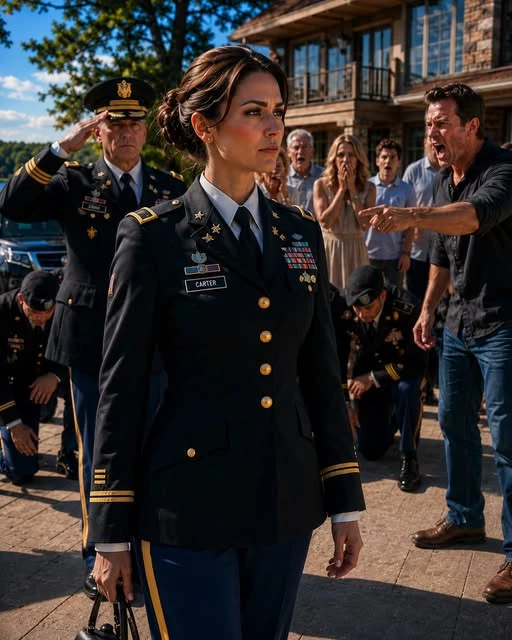
Sergeant Major Lewis turned to her and saluted.
“Colonel Carter.”
The silence that followed was complete.
Not quiet.
Complete.
Even the children seemed to freeze in place.
Emily returned the salute with crisp precision.
“Sergeant Major.”
Ryan stared at her.
Jessica appeared behind him in the doorway, one hand pressed to her chest. Her eyes flicked from Emily to the uniformed soldiers and back again.
“Emily?” she whispered.
Ryan laughed once, uncertainly. “What is this? Some kind of joke?”
Sergeant Major Lewis turned his head slowly toward him. “Sir, I would advise you to choose your next words carefully.”
Ryan flushed. Men like Ryan hated being warned calmly. It gave them no wall to push against.
“This is a family matter,” Ryan snapped.
“No,” Marianne Whitfield’s voice called from behind them.
Everyone turned.
A silver sedan had pulled up behind the military vehicle. Marianne stepped out wearing a navy suit, pearl earrings, and the expression of a woman who had ended stronger men with paperwork.
“This,” she said, walking forward with a folder in her hand, “is a property matter.”
Ryan’s father came to the doorway. “Now hold on. Jessica said this place was available.”
Marianne looked at him. “Available to whom?”
“To family.”
Emily said nothing.
Marianne opened the folder. “The owner of record is Emily Anne Carter. No rental agreement exists. No written permission was granted to any person currently occupying the residence, with the exception of Jessica Carter Mitchell having limited emergency key access.”
Jessica’s face drained of color.
Ryan looked back at her. “You said it was fine.”
Jessica’s lips parted, but no sound came out.
Marianne continued, “That key was not transferable. The property management company has documented unauthorized occupancy. Vehicles are being photographed. Interior condition will be recorded. You will leave the premises immediately.”
Ryan stepped down one stair. “You can’t just throw out an entire family.”
Emily finally spoke.
“I already left when you told me to.”
Ryan’s eyes darted toward the watching relatives. His pride was bleeding in public now, and everyone could see it.
“You never told us you were some colonel,” he said.
Emily’s voice remained level. “You never asked who I was before calling me a parasite in my own doorway.”
The words struck harder because she did not raise them.
Jessica stepped out beside Ryan. “Emily, please. Can we talk inside?”
Emily looked at her sister for a long moment.
“No.”
Jessica flinched.
The older sister Emily remembered from childhood had once tied her shoes, braided her hair badly, and scared away a neighborhood boy who made fun of her glasses. That sister had been brave. Protective. Fierce.
This woman looked smaller.
Not because life had hurt her.
Because she had allowed envy to rot the places where love should have lived.
“Emily,” Jessica said, her voice cracking, “I didn’t know it would become this.”
“You knew I was coming.”
Jessica looked down. “Ryan said you probably wouldn’t.”
“And that was enough?”
Ryan snapped, “Don’t blame her. You’re never around. You don’t have a family, you don’t have kids, you don’t know what it’s like to need space.”
Emily’s eyes hardened.
Sergeant Major Lewis shifted subtly, but she lifted one finger, stopping him.
“You’re right,” Emily said. “I don’t have children. I don’t have a husband. I don’t have the kind of life you measure in school plays and holiday photos.”
Ryan smirked, thinking he had won something.
Emily continued.
“I have soldiers who called me ma’am while trying not to die. I have folded flags in my memory. I have letters in my desk from mothers who wanted to know if their sons were brave at the end.”
The porch had gone silent again.
Emily’s voice softened, but not with weakness.
“So no, Ryan. I don’t know your life. But you never bothered to know mine.”
Ryan’s mother began gathering her purse.
One by one, the relatives seemed to understand that this was not a misunderstanding. It was exposure.
Bill Dawson moved toward the doorway. “We’ll need everyone to collect belongings and exit. We’ll supervise.”
Ryan looked desperate now. “Jessica, say something.”
Jessica looked at Emily.
For the first time that day, she met her sister’s eyes.
“I’m sorry,” she said.
Emily waited.
Jessica swallowed. “I’m sorry I got caught.”
The words came out before Jessica seemed to realize what she had said.
Emily’s face did not change.
But something inside her closed.
PART 4
It took forty-three minutes for Ryan’s family to leave the lake house.
Emily knew because she counted.
She stood near the driveway while relatives carried suitcases, coolers, blankets, and bags of groceries out the front door. Some apologized. Some avoided her eyes. One elderly aunt touched Emily’s arm and said, “Honey, we really didn’t know.” Emily believed her.
Ryan did not apologize.
He slammed the tailgate of his truck hard enough to make a child cry.
Jessica moved through the house last, collecting her sons’ jackets and a plastic container of cupcakes. She looked smaller with every trip.
When the final vehicle pulled away, dust rising behind it, the lake house stood open and wounded.
Emily entered slowly.
The damage was not catastrophic, but it was intimate.
Mud on the rug.
Scratches on the coffee table.
Wet towels on her bedroom floor.
Someone had opened the locked cabinet in the hallway, though the sensitive contents were stored elsewhere. A framed photograph of Emily and her father had been knocked facedown on the side table. In the kitchen, her favorite blue mug sat cracked completely through.
Jessica stood beside the island.
Ryan had left her behind.
That fact did not escape either sister.
Marianne and Bill moved quietly through the rooms, documenting everything. Sergeant Major Lewis remained near the porch, giving Emily privacy without abandoning her.
For a while, neither sister spoke.
Then Jessica said, “I didn’t think you cared about the house that much.”
Emily looked at the lake through the window. “That’s not true.”
Jessica’s mouth trembled. “Fine. I didn’t want to think you cared.”
Emily turned. “Why?”
Jessica laughed weakly, wiping at her face. “Because then I’d have to admit you built something beautiful without me.”
The answer was so honest that Emily had no reply.
Jessica leaned against the counter. “Do you know what it was like after Mom got sick? You were gone. Dad needed appointments. Bills came in. Ryan lost his job twice. Everyone asked where you were.”
“I sent money.”
“I know.”
“I called when I could.”
“I know.”
Emily’s voice tightened. “Then why did you let them believe I abandoned you?”
Jessica’s eyes filled. “Because if I told them you were helping, then I had to admit I still needed my little sister.”
The words hung between them, old and sad.
Emily remembered Jessica at seventeen, fearless and beautiful, driving them both to the lake in their father’s rusted truck. She remembered Jessica singing with the windows down. She remembered thinking her sister knew everything.
How strange, Emily thought, to become adults and discover everyone had been frightened the whole time.
Jessica whispered, “Ryan hates that you have things he doesn’t. He says you act superior.”
“I barely speak to him.”
“That’s enough for Ryan.”
Emily’s expression darkened. “Did he tell you to give him the keys?”
Jessica nodded.
“And you did.”
“Yes.”
“Why?”
Jessica looked toward the living room, where sunlight lay across the rug like a bandage. “Because I was tired of fighting him.”
Emily felt a tiredness of her own then. A deep, old exhaustion that had nothing to do with lack of sleep.
“Jessica,” she said, “you didn’t just avoid a fight with your husband. You handed him my home and stood silent while he humiliated me.”
Jessica covered her mouth.
“I know.”
“No,” Emily said. “I don’t think you do.”
Marianne appeared at the doorway. “Emily, may I speak with you outside?”
Emily followed her onto the porch.
The lake shimmered beyond the trees. For one aching second, Emily wished she could rewind the day. Arrive earlier. Call first. Hear Jessica confess before strangers filled the house. But time, like command, only moved forward.
Marianne handed her a document.
“There’s something else.”
Emily looked down.
It was not about the trespassing.
It was a financial record.
Jessica’s name appeared several times. So did Ryan’s.
Emily’s brow furrowed. “What is this?”
“When you bought the house,” Marianne said carefully, “you asked me to set up an emergency maintenance account. Property taxes, repairs, storm damage, that sort of thing.”
“I remember.”
“Over the past eighteen months, several withdrawal attempts were made.”
Emily’s eyes lifted.
Marianne continued, “Most failed. Two did not.”
Emily’s throat went still.
“How?”
“Someone used Jessica’s emergency access credentials and answered verification questions.”
Emily looked through the window at her sister.
Marianne’s voice softened. “The total is just under nineteen thousand dollars.”
For the first time all day, Emily felt the ground shift beneath her.
Not because of the money.
Because of the questions.
The verification questions had not been simple. They had been personal. Childhood street. Father’s middle name. The name of Emily’s first dog.
Jessica would know them.
But so would only one other person.
Their father.
And he had not spoken clearly in nearly six years.
Emily looked at Marianne. “When was the last withdrawal?”
“Three weeks ago.”
Emily’s blood went cold.
Three weeks ago, Jessica had told Emily that Dad’s care facility needed an urgent payment.
Emily had wired the money immediately.
PART 5
Emily asked Jessica one question.
“Where is Dad’s money?”
Jessica stared at her from across the kitchen, color draining from her face so quickly that Emily had her answer before words came.
Marianne stood near the doorway. Sergeant Major Lewis remained outside, but Emily knew he could hear enough if needed. Bill and his employee had withdrawn to the porch.
Jessica gripped the counter. “Emily—”
“Where is Dad’s money?”
“It’s complicated.”
“No,” Emily said. “It’s simple. Three weeks ago you called me crying. You said Dad’s care facility needed payment by Monday. I sent twelve thousand dollars.”
Jessica began to cry. “I meant to put it back.”
Emily’s voice dropped. “Put what back?”
Jessica shook her head. “Ryan had debts.”
The house seemed to darken around Emily.
“What debts?”
“Cards. Loans. Some men he knew from work. I don’t know all of it.”
“You used Dad’s care money?”
“He said we’d lose the house.”
“You used Dad’s care money?”
Jessica sobbed. “Yes.”
Emily stepped back as if her sister had raised a hand.
Their father, Daniel Carter, had once been the kind of man who fixed everything. Lawn mowers. Broken toys. Bad moods. He had taught Emily to fish from the dock when she was nine and told her, “A person’s word is the roof they live under. Keep it strong.” After his stroke, language had abandoned him in pieces. Some days he could say Emily’s name. Some days he only squeezed her hand.
And Jessica had stolen from him.
Emily reached for her phone.
Jessica panicked. “Please don’t call anyone.”
“I’m calling the facility.”
“No, Emily, please.”
Emily looked at her sister with something worse than anger.
Disbelief.
The care facility answered after two rings. Emily identified herself, gave the security code, and asked for the billing office. While she waited, Jessica slid down onto a kitchen chair and wept into her hands.
When the administrator came on the line, Emily put the phone on speaker.
“This is Colonel Emily Carter,” she said. “I’m calling regarding Daniel Carter’s account.”
The woman on the other end hesitated. “Colonel Carter, I’m glad you called. We’ve been trying to reach the family representative.”
Emily looked at Jessica.
“Why?”
“There was a request submitted to transfer Mr. Carter to a lower-level care facility out of county.”
Emily’s heart stopped.
Jessica lifted her head.
Emily spoke very slowly. “Who submitted it?”
“Jessica Mitchell.”
Jessica whispered, “I can explain.”
Emily’s fingers tightened around the phone. “Was the transfer approved?”
“It was scheduled for tomorrow morning.”
For a moment, Emily heard nothing but the lake wind outside.
Tomorrow morning.
While Ryan’s family played vacation in her house, her father was being moved from the only facility that understood his condition because Jessica had emptied the money and hidden the truth.
Emily ended the call.
The silence afterward was terrible.
Jessica stood unsteadily. “Ryan said Dad didn’t know where he was anyway.”
Emily’s eyes burned. “Say that again.”
Jessica covered her mouth, horrified by her own words.
Emily stepped closer. “Dad knows. Maybe not every word. Maybe not every day. But he knows kindness. He knows familiar voices. He knows when someone holds his hand.”
Jessica whispered, “I was drowning.”
“And you pulled him under with you.”
The sentence broke something open.
Jessica collapsed into sobs—not pretty tears, not defensive ones, but the ugly kind that comes when a person finally sees the wreckage they have made.
“I hated you,” she admitted. “Not all the time. But enough. You were gone and still somehow better than me. Stronger. Calmer. Everyone forgave your absence because it sounded important, even when they didn’t know what it was. I stayed, and I became the bitter one.”
Emily listened, but compassion felt far away.
Jessica looked up. “Ryan told me if I let his family use the house, he’d stop threatening to leave.”
“And did he?”
Jessica gave a broken laugh. “He left me here.”
Outside, the sun was dropping.
Emily walked to the window.
At the dock, the water moved gently against the posts. Her father had helped her choose this house, though he had never seen it after she bought it. She had shown him photographs in his room. He had touched the picture of the porch and managed one word.
“Peace.”
Emily turned back.
Here was the twist life had prepared for her: Ryan had not been the true invader.
He was only loud enough to distract from the quieter betrayal.
Her sister had not merely given away a weekend.
She had nearly sold their father’s dignity for one more month of a bad marriage.
Marianne entered softly. “Emily?”
Emily’s face had changed. It was no longer the face of a wounded sister. It was the face of a commander making decisions that would hurt, but had to be made.
“Call the facility,” Emily said. “Cancel the transfer. I’ll cover the account directly from now on, with myself as sole financial contact.”
Jessica closed her eyes.
“Prepare a civil claim for the stolen funds,” Emily continued. “Include Ryan if records support it.”
Marianne nodded.
Jessica whispered, “Are you pressing charges?”
Emily looked at her sister.
For a long time, she said nothing.
Then she answered, “Not today.”
Jessica broke down with relief.
Emily held up one hand. “Don’t mistake that for forgiveness.”
Jessica froze.
“I’m giving you one chance to tell the truth voluntarily. To Dad’s facility. To the bank. To the family. To your sons, in words they can understand when the time is right. You will enter counseling. You will separate your finances from Ryan. And you will never again have access to my property, my accounts, or Dad’s care decisions.”
Jessica nodded through tears.
“If you lie once,” Emily said, “I will let the law do what it was made to do.”
“I understand.”
But the story did not end there.
Because just then, an engine roared back into the driveway.
Ryan’s truck.
He jumped out, red-faced and furious, waving his phone. “You think you can embarrass me in front of my family?”
Sergeant Major Lewis stepped between him and the porch.
Ryan pointed past him at Emily. “This isn’t over.”
Emily walked out slowly.
“No,” she said. “It isn’t.”
Ryan sneered. “You military people think a title makes you untouchable?”
Emily looked at him with almost pity. “No. Accountability does.”
Ryan laughed. “You don’t have anything on me.”
Marianne stepped onto the porch behind Emily. “Actually, Mr. Mitchell, we may have bank records, unauthorized withdrawals, possible elder exploitation, and witness statements.”
Ryan’s face changed.
Just for a second.
But Emily saw it.
So did Jessica.
Jessica stood in the doorway, pale and shaking. For the first time in years, she looked not at Ryan, but through him.
“You told me it was temporary,” she said.
Ryan snapped, “Shut up, Jess.”
Emily’s voice cut through the air. “Don’t speak to her that way on my property.”
Ryan turned toward her. “Your property? You really think this house makes you better than us?”
“No,” Emily said. “But it did reveal you.”
Police arrived twelve minutes later, called by Bill Dawson after Ryan refused to leave the driveway. This time, Emily did not stop the process. Ryan shouted until the officers warned him. Then he went quiet when Marianne handed over the first set of documents.
Jessica watched him being questioned beside his truck.
There was no triumph in her face.
Only grief.
Later, after statements were taken and Ryan was gone, the lake house finally became quiet.
Not peaceful.
Not yet.
But quiet.
Emily stood on the porch as darkness settled over the water. Jessica came to stand a few feet away.
“I don’t expect you to forgive me,” Jessica said.
“Good.”
Jessica nodded, accepting the blow.
Emily stared at the lake. “I expected Ryan to be cruel. I did not expect you to be silent.”
Jessica’s tears started again. “I know.”
Emily reached into her pocket and pulled out the cracked blue mug. She had found it in the sink, broken clean through.
“Dad gave me this,” she said.
Jessica covered her mouth.
“I know.”
Emily set it on the porch railing.
For a while, they stood shoulder to shoulder without touching.
Then Emily said, “Tomorrow, I’m bringing Dad here.”
Jessica looked at her. “Here?”
“For the afternoon. The facility has transport options. He should see the lake.”
Jessica’s face crumpled. “Can I come?”
Emily looked at her sister. Once, the answer would have been yes before the question finished. Now love had conditions. Maybe it always should have.
“You can meet us there,” Emily said. “But you don’t ride with him. Not yet.”
Jessica nodded. “Thank you.”
The next afternoon, Daniel Carter came to the lake house in a medical transport van, wrapped in a navy blanket, his hair combed neatly, his eyes clearer than Emily had seen them in months.
Emily knelt beside his wheelchair on the porch.
“Hi, Dad,” she whispered. “I finally brought you.”
The old man looked out at the water.
His lips moved.
Emily leaned closer.
For a moment, she thought he had said “peace” again.
But he had not.
Daniel Carter lifted one trembling hand and pointed—not to the lake, not to the dock, but to the loose floorboard beside the porch steps.
Emily frowned.
“Dad?”
He tapped the arm of his chair with surprising urgency.
Jessica, standing behind them with red eyes and folded hands, whispered, “What is he doing?”
Emily knelt and lifted the loose board.
Underneath was a weatherproof metal box.
Her breath caught.
She had never seen it before.
Inside were old letters, a small velvet pouch, and a folded document sealed in plastic. The letters were in her father’s handwriting, dated before his stroke. The document was a notarized statement.
Emily read it once.
Then again.
Jessica whispered, “What is it?”
Emily looked up slowly.
The lake wind moved through the pines.
The shocking truth was not that Jessica had betrayed her.
It was that their father had known years earlier that something like this might happen.
The document transferred a hidden savings account—one neither daughter had known existed—into a trust for Daniel Carter’s care, controlled only by Emily. There was enough money to cover his needs for the rest of his life.
But beneath that was a letter.
Emily opened it with shaking hands.
“My girls,” it began, “if you are reading this, then the house has done what I hoped it would do. It has brought the truth into the open.”
Emily stopped breathing.
Jessica began to cry.
Their father had helped Emily choose the lake house not only because it was peaceful.
He had chosen it because he knew Emily would protect it.
He knew that if greed, fear, or desperation ever entered their family, it would show itself here, in the one place nobody had the right to claim.
Emily looked at her father.
His eyes were wet.
He had not been as unaware as they thought.
He had been waiting.
Waiting for the house by the lake to reveal who still remembered love, and who had forgotten it.
Emily took his hand.
For the first time in years, Daniel Carter squeezed back with strength.
Jessica sank to her knees, sobbing. “Daddy, I’m sorry.”
The old man looked at her for a long, painful moment.
Then, with great effort, he lifted his other hand.
Not to bless her.
Not to reject her.
But to point toward Emily.
Jessica understood.
So did Emily.
Forgiveness would not come from words, tears, excuses, or blood.
It would have to be rebuilt, board by board, like a damaged house after a storm.
Emily looked out over the lake as the sun lowered into gold.
She had come home wanting one quiet weekend.
Instead, she had found trespass, betrayal, and a truth buried beneath the porch.
But she had also found something stronger than revenge.
She had found the line where love must stop enabling harm.
And beyond that line, waiting patiently in the fading light, was peace.