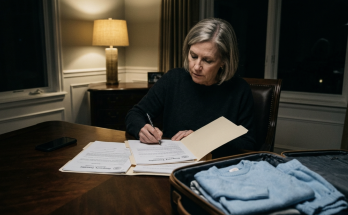
We did not remove anything from Evelyn's box for nearly fifteen minutes.
The first question was ownership.
The second was preservation.
The third was whether touching more than necessary might damage whatever evidentiary value the files possessed.
Raymond called the attorney he had mentioned earlier, a woman named Sandra Pike who handled financial abuse and complex family property disputes.
She answered while he stood in the storage hallway.
He summarized without embellishment.
Deceased relative.
Suspected misappropriation.
Original records.
Possible stalking documentation.
Sandra interrupted only once.
“Do not reorganize anything.”
Raymond looked at me.
“We haven't.”
“Photograph the box exactly as found. Photograph the contents layer by layer. Then secure the entire container somewhere Bernice cannot access it.”
Gregory said, “The unit is in my name.”
Sandra heard him through speakerphone.
“Who else has access?”
Gregory's face changed.
“My mother.”
“Change that immediately.”
He looked toward the elevator.
We photographed everything.
Then Gregory went upstairs with Raymond to remove Bernice's access authorization.
I remained beside the open unit, standing where I could see both the corridor and Evelyn's box.
For the first time since our wedding, I had several uninterrupted minutes to process what I was looking at.
The L.H. binder frightened me less than I expected.
Not because it was harmless.
Because uncertainty had been worse.
For the last several hours, Bernice's knowledge of me had felt almost supernatural, a web extending backward through my life.
Now the mechanism was visible.
Public records.
Professional directories.
Observation.
Financial research.
Human obsession.
Predatory, yes.
But human.
Humans leave records.
That mattered.
I picked up the binder marked B.M. FINANCIAL ACTIVITY.
I did not open it until Gregory returned.
When he did, he held a printed confirmation form.
“She is removed.”
“Good.”
Raymond locked the hallway door behind them.
Gregory crouched beside the box.
“I need to know.”
Sandra was still connected through Raymond's phone.
“You can review documents that belong to your aunt's estate if you are lawfully in possession,” she said, “but photograph before separating anything. Do not mark originals.”
We began with the binder about Bernice.
Evelyn had been systematic.
Bank statements.
Copies of checks.
Property records.
Notes.
Correspondence.
Each section covered a different person.
Gregory.
Their mother.
An elderly family friend named Samuel Kerr.
A widow called Patricia Dawes.
A former Marchwell client, Joanne Pike—not related to Sandra, as far as we knew.
The pattern became visible quickly.
Bernice had repeatedly positioned herself as helper, organizer, or financial adviser.
Then money moved.
Sometimes legally.
Sometimes ambiguously.
Sometimes through signatures that Evelyn believed were obtained under pressure.
Gregory's inheritance was only one example.
“She did this to Grandma?” he whispered.
Evelyn's notes suggested their mother developed dementia in her final years.
Bernice gained power of attorney.
Within eighteen months, nearly forty thousand dollars disappeared into categories labeled home care, household improvements, transportation, and family reimbursement.
Evelyn had challenged several transactions.
Bernice claimed she had been repaid for caregiving expenses.
No receipts.
No formal agreement.
Their mother's house was sold shortly afterward.
Proceeds were divided unevenly.
Bernice received more.
Gregory stared at the numbers.
“I thought Aunt Evelyn got the house money.”
“She didn't,” I said.
“How do you know?”
“Look.”
There were closing statements.
Evelyn had received a smaller distribution.
Bernice's share included an unexplained reimbursement line.
$62,000.
Gregory pressed his hand against his mouth.
Raymond sat against the wall.
“This goes back decades.”
“Yes.”
I turned another page.
Samuel Kerr.
Widower.
No children.
Bernice helped him after surgery.
Six months later, she became joint holder on one checking account.
Nine months later, a second.
When Samuel died, the remaining balance passed automatically to Bernice.
Evelyn had written:
B. says Sam wanted to thank her.
Possible.
But B. discouraged him from speaking with attorney unless she attended.
Then Patricia Dawes.
Older widow.
Bernice arranged bill payments.
Patricia later accused her of writing checks without permission.
No criminal complaint.
Family settled privately.
Pattern repeated.
Trust.
Dependence.
Access.
Isolation.
Transfer.
Just as Bernice had intended for me.
The violence Gregory attempted was not the central method.
It was an enforcement mechanism.
Money was the real target.
I opened another section.
Inside were copies of communications between Bernice and Evelyn.
One letter was furious.
You keep calling it help because admitting what you're doing would require you to see yourself clearly.
Another:
Gregory trusts you because you trained him to confuse obedience with love.
Gregory stopped reading.
He stood and walked out into the corridor.
I followed.
He put both hands on the concrete wall.
“I can't breathe.”
“Yes, you can.”
“I feel like I can't.”
“Look at me.”
He did not.
“Gregory.”
He turned.
I kept several feet between us.
“Feet flat.”
He obeyed.
“In through your nose.”
He breathed.
“Slow.”
Again.
His shoulders lowered slightly.
“This doesn't erase what you did to me,” I said.
“I know.”
“But you don't have to understand your entire childhood today.”
He laughed once through tears.
“My childhood.”
“Today, you need one fact at a time.”
He nodded.
“One fact,” I continued, “your mother controlled your money.”
“Yes.”
“Another fact: your aunt documented it.”
“Yes.”
“Another: you tried to use your mother's methods on me.”
His face tightened.
“Yes.”
“Do not collapse those facts into one excuse.”
“I won't.”
That answer mattered.
Not enough to repair anything.
But enough to continue speaking.
We returned to the unit.
The final binder was Gregory's inheritance.
The accounting was far worse than expected.
Original principal: $81,442.
Withdrawals documented by Evelyn: $47,300.
Unverified fees and reimbursements: $11,804.
Estimated legitimate expenses: less than $8,000.
Possible remaining amount at time of Evelyn's review: roughly $22,000.
Yet Gregory had been shown statements suggesting more than fifty thousand remained.
“How?” he asked.
I examined copies.
Some statements were not statements.
They were spreadsheets.
Printed at home.
Designed to resemble account summaries but without institution letterhead.
Bernice had created them.
“She fabricated balances.”
Gregory's face went pale.
“To make me think the money was still there.”
“Probably.”
He stared at one page.
“I thanked her.”
No one answered.
“I thanked her for managing it.”
Raymond looked down.
Gregory laughed bitterly.
“She used to tell me I was lucky because other people my age wasted inheritances.”
He rubbed both hands over his face.
“She was the one spending it.”
We reached a set of property documents.
Bernice's townhouse.
Purchase date.
Down payment transfer.
Source account ending in the same four digits as Gregory's inheritance.
There was the proof.
Not inference.
Direct transfer.
$18,000.
Gregory stared at it.
“That was mine.”
“Yes.”
“And then she charged me rent.”
“Yes.”
He stood so abruptly that the binder slid from his lap.
“I need to leave.”
“Where?”
“I don't know.”
“Not to Bernice.”
He glared at me.
For one second I saw the anger from the dining room again.
Then it passed.
His shoulders dropped.
“No.”
“Good.”
He looked ashamed that I had needed to say it.
Sandra, still periodically checking in through Raymond, instructed us to move the box into an attorney-controlled secure evidence room.
Gregory agreed.
Before we left, I opened the L.H. binder again.
This time I studied the dates.
Eight years ago, Bernice researched me heavily for about six months.
Then the activity stopped.
No records for several years.
Then, fourteen months ago, it resumed.
Property search.
Employer profile.
Photographs from a public charity event.
My professional biography.
A screenshot of a local article in which I had been quoted about financial literacy.
Then Gregory's name written beside mine.
I pointed.
“Here.”
Raymond read the date.
“Two months before you met.”
Gregory leaned closer.
His face emptied.
“She connected us before the fundraiser.”
“How?”
I turned the page.
A printed attendee list.
Simone's charity dinner.
My name.
Gregory's firm.
A handwritten circle around both.
Beside it, Bernice's writing.
G. should attend.
Gregory sat down.
“No.”
I did not need to explain.
His mother had orchestrated proximity.
Not necessarily the exact seat.
Not necessarily our conversation.
But she had pushed him into the room knowing I would be there.
“I thought I chose to go.”
“You did.”
“No.”
“Yes, Gregory. You did. She influenced you. That is not the same as removing every choice.”
He looked at me.
“You're defending my responsibility after finding out she manipulated me into meeting you?”
“Yes.”
“Why?”
“Because the alternative is pretending nobody ever chooses anything.”
That landed heavily.
He lowered his gaze.
I continued turning pages.
Bernice had recorded our first date.
Not details from the date itself.
Details Gregory told her afterward.
Restaurant.
Conversation topics.
My job.
My family.
My condo.
Second date.
Third.
Fourth.
Each followed by notes.
Promising.
No siblings.
Father deceased.
Mother absent.
Strong income.
No debt apparent.
I stopped.
Raymond read over my shoulder.
“It's a prospect file.”
Exactly.
That was the phrase my finance-trained mind had been avoiding.
She had evaluated me like an investment opportunity.
I turned another page.
There were objectives.
Secure marriage.
Discourage prenup.
Combine liquid assets.
Add G. to property title.
Reduce outside influence.
Eventually consolidate investments under family management.
I felt physically sick.
Gregory whispered, “Family management means her.”
“Yes.”
Near the bottom, one handwritten figure had been boxed twice.
Estimated accessible assets after marriage: $940K–$1.2M.
She had been close.
Too close.
Then another line.
Potential resistance high. Emotional leverage through abandonment history.
My chest tightened.
She had planned to use my childhood before the wedding.
Gregory covered his face.
“I told her those things.”
“Yes.”
“I gave her everything.”
“Yes.”
“I didn't know.”
“No.”
But I could not make the consequences disappear because he had not understood how Bernice would use the information.
He had betrayed my privacy.
He had given her the map.
I turned another page.
A new heading appeared.
POST-MARRIAGE FIRST WEEK.
Dinner standards.
Household authority.
Financial passwords.
Friends.
Gym.
Property discussion.
Escalation if refusal.
My blood went cold.
The night Gregory flipped the table was not merely influenced by Bernice.
It had been scripted.
Not word for word.
But structurally.
I looked at him.
“Did you see this?”
“No.”
“Did she give you instructions?”
“Verbally.”
“Exactly these?”
He read.
His face changed.
“Yes.”
Every detail.
The meal.
The schedule.
The accounts.
The deed.
Isolation.
Even the suggestion that physical fear should be established early.
Gregory stood frozen over the page.
Raymond looked at me.
“This is conspiracy.”
“I don't know the legal definition yet.”
“But it's planning.”
“Yes.”
Sandra's voice came from the phone.
“Photograph that page clearly.”
We did.
Then I turned to the final sheet in the binder.
Unlike the others, it was written by Evelyn.
Date: four weeks before her death.
If Bernice ever succeeds in bringing Lorelei Hart into Gregory's life, Lorelei must be warned immediately.
I have tried to keep them apart without involving Lorelei directly.
B. is fixated on the idea that L.H. represents both a financial opportunity and a personal insult because Lorelei's review nearly exposed the inheritance withdrawals.
If I am not here to stop her, someone else must.
Beneath that sentence was a name and phone number.
Claire Morgan.
Gregory stared.
“Claire knew Evelyn?”
“Apparently.”
I dialed.
Claire answered quickly.
“Lorelei?”
“Did Evelyn contact you before she died?”
Silence.
Then Claire began to cry.
“Yes.”
“Why didn't you tell me?”
“Because I didn't know how much was true.”
“Claire.”
“She said Bernice might someday try to connect Gregory with a woman named Lorelei Hart.”
Raymond closed his eyes.
“What did you do?”
“I thought she was paranoid.”
“When?”
“After Gregory and I broke up.”
“Why you?”
“She knew I understood Bernice.”
“And the anonymous messages?”
Claire stopped crying.
“What anonymous messages?”
I looked at Raymond.
Not Claire.
“Someone sent me photographs and told me about Evelyn's file.”
“I didn't.”
“Do you know who would?”
Silence.
Then she whispered, “Maybe Dana.”
My pulse quickened.
“Dana Whitcomb?”
“Yes.”
“You know her?”
“Not personally.”
“But?”
“Evelyn found her after I left Gregory. She connected us once by email.”
“Why?”
“Because she was trying to build a record of every woman Bernice had targeted through Gregory.”
The sentence changed the room again.
Not just financial clients.
Women.
Gregory sat very still.
“How many?” I asked.
Claire exhaled.
“I don't know.”
“Guess.”
“Evelyn believed there were at least five.”
Gregory looked as though someone had struck him.
I ended the call several minutes later after arranging to receive everything Claire still had.
Then I looked at Evelyn's binders.
Five women.
Maybe more.
Bernice had not simply been controlling her son.
She had been using him.
And I was beginning to understand why Evelyn had spent the final years of her life trying desperately to leave enough evidence behind for someone to stop her.
Click here to continue reading: PART 11: The Women Bernice Had Driven Away Began Comparing Their Stories, and Gregory Learned He Had Been the Bait in a Pattern He Never Saw
Three Days After the Wedding, One Late Dinner Exposed the Man Gregory Had Carefully Hidden Until the Marriage Papers Were Signed
Part 10 of 17