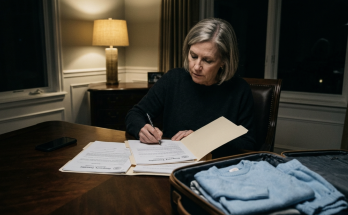
Thomas Greeley did not look like the man who had once been capable of making police reports disappear.
By the time we saw him again, he wore a hospital gown under county restraints, one shoulder bandaged from the Bellweather shooting. His hair was thin, his skin gray, his voice roughened by medication and age. Twenty-two years earlier, men like him had frightened people simply by entering a room with a badge. Now two officers stood behind him to make sure he remained exactly where he was.
Karen Sloane placed a recorder on the table.
“You understand this interview is being conducted pursuant to your cooperation agreement?”
Greeley nodded.
His attorney answered for the record.
“Yes.”
Sloane opened Samuel’s ledger to the page naming Martin Cole.
“Tell us what happened to him.”
Greeley stared at the photograph clipped to the page.
Martin had been forty-three when he died. A project estimator at Marlowe. Divorced. One daughter. According to newspaper reports, his car had left a rural road and entered a reservoir a year before Samuel’s death.
Greeley spoke slowly.
“Martin found duplicate invoices.”
Eleanor sat behind the observation glass with us.
She whispered, “I knew it.”
David looked at her.
“You suspected?”
“Martin asked me about subcontractors two weeks before he died.”
Greeley continued.
“He threatened to report Victor.”
Sloane asked, “Did Victor order his death?”
Greeley closed his eyes.
“Victor said Martin needed to stop creating problems.”
“That is not an answer.”
“It was how Victor spoke.”
“What happened?”
“Curtis followed him.”
David stiffened beside me.
Again Curtis.
Again a car.
Again an “accident.”
Greeley said Martin’s vehicle did not go into the reservoir by chance. Curtis forced it off the road while another car blocked the nearest turnoff.
Sloane asked, “Who drove the second car?”
Greeley hesitated.
“Richard Bennett.”
Danielle went completely still.
I reached for her hand.
She allowed me to hold it.
“Did Richard know Martin would die?” Sloane asked.
“No.”
“How do you know?”
“Because he panicked afterward.”
“What did he believe he was doing?”
“Boxing Martin in. Scaring him.”
Danielle closed her eyes.
The pattern was unbearable in its repetition.
Victor never needed everyone to intend murder.
He only needed each person to agree to one smaller wrong.
Follow the car.
Block the road.
Loosen a fitting.
Move the money.
Hide the report.
Make a call.
Destroy a document.
Then, when someone died, everybody already held enough guilt to remain silent.
Greeley coughed.
“Richard wanted to confess after Martin.”
“Why didn’t he?”
“Victor threatened Danielle.”
Danielle’s grip tightened around my hand.
Sloane asked, “How old was she?”
“Eleven.”
Danielle whispered, “Eleven.”
David put an arm around her.
Greeley continued.
“Victor had photographs taken outside her school.”
Exactly as he had done with Noah decades later.
The tactic had not changed because it worked.
Sloane turned the page.
“What evidence survived Martin Cole’s death?”
“His notebook.”
“Where is it?”
Greeley looked toward the glass.
“Grace knows.”
His attorney shifted.
“Thomas, answer completely.”
Greeley swallowed.
“Richard took it.”
“After Martin died?”
“Yes.”
“Why?”
“Insurance.”
That word again.
I had come to hate it.
Not insurance as protection.
Insurance as threat.
A secret kept not because it was right to preserve but because someone wanted leverage over the next person.
Sloane asked, “How did Grace get it?”
“When Richard died.”
“And where did she put it?”
“I don’t know.”
“How do you know she still had it?”
“She told Victor.”
“When?”
“Last year.”
David looked at me.
The timing mattered.
Last year was when his credit had begun collapsing.
When Grace intensified pressure around the Princeton house.
When I began estate planning.
All the threads had tightened at once.
Sloane asked Greeley one final question.
“Why are you telling us this now?”
He gave a tired smile.
“Because Victor lost.”
It was such a small answer that Sloane almost looked disappointed.
“No remorse?”
Greeley stared at the table.
“I’m seventy-two.”
“That wasn’t my question.”
He took a long breath.
“Remorse is what people call guilt when they finally run out of ways to avoid consequences.”
No one behind the glass moved.
I thought of Grace.
Richard.
Myself.
Perhaps that was the real ending waiting for all of us.
Not forgiveness.
Not punishment.
The point where explanations stopped changing what we had done.
Grace initially refused to reveal the notebook’s location.
Then Danielle went to see her alone.
She returned carrying no notebook.
Only a sentence.
“She wants to speak to you.”
I looked at her.
“Me?”
“Yes.”
“Why?”
“She says the location will mean something to you.”
I did not want another conversation with Grace.
I was tired of rooms where she sat across from me turning every fact into a contest.
But Samuel had waited twenty-two years for people to finish choosing fear over truth.
I went.
Grace looked thinner.
Court proceedings had begun stripping away the polished woman who once stood on the steps of my house and told me I was not welcome.
She did not ask whether I forgave her this time.
That was progress.
“Martin’s notebook,” I said.
She nodded.
“Where?”
“In your house.”
I stared at her.
“My house?”
“Not Princeton.”
“My house.”
“Yes.”
“How?”
“Richard put it there.”
“When?”
“After Samuel died.”
My anger rose.
“You entered my home?”
“No.”
“Then explain.”
Grace folded her hands.
“At Samuel’s funeral.”
I remembered the crowd.
People moving through rooms carrying food.
Business associates.
Neighbors.
Men from Marlowe.
Richard Bennett had been there.
I had not known who he was.
“Richard came to the funeral.”
“Yes.”
“He brought the notebook?”
“Yes.”
“Why put it in my house?”
“Because Victor was already searching his.”
“Where did Richard hide it?”
Grace looked at me.
“In something Samuel built.”
For a moment I thought of the workshop chest.
Then I knew.
“The grandfather clock.”
Grace nodded.
Samuel built it during the first years of our marriage.
Tall oak case.
Brass pendulum.
It had stood in my dining room for almost four decades.
David hated the sound when he was a teenager.
Noah loved watching the pendulum.
I had moved it from house to house because leaving it behind would have felt like abandoning Samuel twice.
“How do you know?”
“Richard told me before he died.”
“Did you ever retrieve it?”
“No.”
“Why?”
“I tried once.”
I stared at her.
“When?”
“Three years ago.”
My skin went cold.
“You were in my house.”
“You invited Danielle and me for Thanksgiving.”
I remembered.
Grace disappearing for ten minutes.
Claiming she needed aspirin.
“You searched the clock.”
“Yes.”
“And?”
“I couldn’t find the compartment.”
I laughed softly, not from humor.
Samuel had beaten all of them with carpentry.
“What did Richard tell you?”
Grace looked down.
“That the clock held Martin’s notebook and one last letter from Samuel.”
My heart stopped.
“What letter?”
“I never saw it.”
“You knew for eight years?”
“Yes.”
“And you said nothing.”
“Yes.”
“Why?”
Her eyes filled.
“Because if the notebook confirmed Martin was murdered, Richard would become part of another death.”
“He was already part of it.”
“I know.”
“No. You knew facts. That is different.”
Grace flinched.
I continued.
“You protected the version of Richard that let you keep functioning.”
“Yes.”
“And in doing that, you protected Victor.”
“Yes.”
I stood.
Grace whispered, “Ophelia.”
I stopped.
“I am not asking forgiveness.”
“Good.”
“I want Danielle to know her father tried to fix something before he died.”
“Then stop deciding which part she can bear.”
Grace nodded.
“I know.”
This time, I believed she might actually mean it.
Police came to my house before I touched the clock.
A technician inspected the cabinet.
At first, nothing.
Then David crouched beside the base.
“Dad never made joints like that.”
The technician looked.
A thin wooden strip along the rear panel had been replaced.
Different grain.
Barely.
The strip came free with gentle pressure.
Behind it was a narrow cavity running almost the full height of the clock.
Inside lay a notebook wrapped in waxed cloth.
And an envelope.
My name was written across it.
Samuel’s handwriting.
Again.
I sat before opening it.
David stood beside me.
Danielle stayed across the room.
This letter had not been intended for David.
It was mine.
Ophelia,
If Richard manages to leave this with you, then events have gone worse than I hoped.
I stopped reading.
David touched my shoulder.
“Take your time.”
I continued.
Samuel explained Martin’s notebook first.
Martin had documented false estimates and duplicate invoices.
More importantly, he had written down a conversation overheard between Victor and Greeley.
Victor spoke about “removing Martin before he reached the state.”
Samuel believed the notebook proved Martin’s death was murder.
He intended to submit it alongside the financial ledger.
Then came the part that mattered to me.
I did not tell you enough.
I thought keeping you outside this would keep you safe.
I understand now that ignorance can be another kind of danger.
I closed my eyes.
Twenty-two years before I made the same mistake with David, Samuel had understood it himself.
The letter continued.
If I come home, I will tell you everything.
If I do not, tell David only when the truth can protect him better than silence does.
I had spent years interpreting that instruction too broadly.
Waiting for some imaginary moment when truth would no longer hurt.
Samuel never promised that.
He only asked that it become useful.
The final lines blurred.
Do not let what these men did turn our family into people who measure love by what we hide from each other.
I love you.
I am trying to come home.
I lowered the letter.
Nobody rushed me.
The clock ticked.
Samuel’s clock.
Still keeping time after all of us had wasted so much of it.
David sat beside me.
“You did what you thought he asked.”
“Yes.”
“Too long.”
“Yes.”
He nodded.
“So did he.”
I looked at my son.
There was no accusation in his voice.
Only understanding.
Not absolution.
Understanding was enough.
Martin Cole’s notebook completed the case.
It contained dates, names, copies of project figures, and a page describing Richard’s role in the intimidation that preceded his death.
Richard had not known Victor intended murder.
Afterward, he tried to recover Martin’s notes.
That effort became the first step toward helping Samuel.
Danielle read every page.
She cried.
Then she asked investigators for a copy when the case allowed it.
“I want Noah to know someday.”
David looked at her.
“All of it?”
“All of it.”
He nodded.
“Me too.”
That decision may have been the first thing our family did differently.
Victor’s network collapsed quickly after that.
Not because evil suddenly became fragile.
Because conspiracies built on fear depend on everyone believing silence is still safer than speech.
Curtis talked.
Greeley talked.
Grace cooperated.
Bank officials produced records.
Retired employees came forward.
Families of people who had lost jobs, homes, contracts, and reputations contacted investigators.
Martin Cole’s daughter learned her father had not drunkenly driven into a reservoir as rumors once claimed.
Samuel’s name was formally cleared of every insinuation Victor had prepared against him.
Richard’s role became public too.
Not hero.
Not mastermind.
A compromised man who helped intimidate Martin, later tried to help Samuel, then spent decades hiding because fear was easier than accountability.
Danielle insisted on that full description.
“He doesn’t need to be innocent for me to love him,” she said.
I wished every parent understood that sentence.
The civil recovery took months.
David’s claim was recognized.
The exact amount changed through settlements, restitution, forfeiture, and competing claims.
In the end, he received enough to secure his family’s future many times over.
He declined assets clearly tied to victims.
A large portion of the recovered money funded restitution and a trust for families harmed by the Marlowe network.
David named it after Samuel and Martin together.
No one named anything after Victor.
The thirty-one-million-dollar account created to frame Samuel was emptied through court order and distributed among restitution claims.
David received none of it.
He never regretted that.
The Princeton house was sold after restoration.
We did not keep the burned wine wall.
David insisted on that.
A young family eventually bought the property.
They knew only that it had been renovated after a fire.
They did not know that for two decades grown adults had treated its deed like a weapon.
Maybe that was better.
David and Danielle bought a smaller home fifteen minutes from me.
Four bedrooms.
Big yard.
Ordinary mortgage they could have paid without inherited money, because David insisted.
The first time I visited, Noah dragged me to the backyard.
“No dead walnut trees,” he announced proudly.
David laughed from the patio.
“No hidden safes either.”
Danielle added, “We checked.”
Their marriage did not heal magically.
There were counselors.
Angry nights.
Questions Danielle could not answer.
Moments David wondered whether Grace had manipulated the beginning of their relationship beyond repair.
But they kept choosing to ask instead of assume.
That mattered.
One evening, months later, Danielle told him, “My mother may have arranged opportunities for us to meet. She did not make me love you.”
David answered, “Then I need to decide whether I still believe in what came after.”
He did.
Slowly.
Grace pleaded guilty to multiple charges.
Her cooperation reduced the sentence she might otherwise have received.
It did not erase it.
The companies she inherited from Richard were dismantled or forfeited where criminal proceeds could be traced.
She lost most of the wealth she once treated as protection.
Danielle visited her eventually.
Not with Noah.
Not at first.
Grace asked why.
Danielle told her, “Because seeing him is a relationship, not a right.”
Grace cried.
Danielle left anyway.
Months later, when professionals agreed and Danielle felt ready, Noah was permitted a carefully supervised visit.
He asked Grace why she lived “in a place with locked doors.”
Danielle later told me Grace answered simply:
“Because Grandma made choices that hurt people.”
No excuse.
No Victor.
No Richard.
No fear.
Maybe that was the beginning of something resembling accountability.
Victor Hale died in prison custody before all civil litigation ended.
Not violently.
Not dramatically.
His heart stopped during the night.
When David called to tell me, I waited for relief.
Nothing came.
Samuel remained dead.
Victor being dead did not return a single morning to us.
So I made coffee.
I opened the back door.
I listened to birds.
And I let Victor become something he had spent his entire life fearing.
Irrelevant.
Curtis received a long sentence despite cooperating.
Thomas Greeley did too.
Neither man received the complete mercy he tried to purchase with late honesty.
Their testimony mattered.
So did the years they chose silence.
Eleanor came to Samuel’s memorial when we finally replaced his old stone.
We did not remove the original inscription.
We added one line beneath it.
He was trying to come home.
David chose the words.
At the cemetery, Noah asked what they meant.
David crouched beside him.
“It means Grandpa was trying to do the right thing when something bad happened.”
Noah considered this.
“Did he win?”
David looked at me.
I let him answer.
“Not then.”
Noah frowned.
David touched the boy’s shoulder.
“But he left enough truth behind for other people to finish.”
Noah nodded as if that made perfect sense.
Children sometimes understand legacy better than adults.
They do not measure it in property.
They measure it in what remains possible because someone came before them.
Afterward, we returned to my house for dinner.
The grandfather clock stood in the dining room.
Police had repaired the hidden panel after removing Martin’s notebook.
I considered replacing it.
Then decided not to.
The narrow seam remained visible if you knew where to look.
I liked it that way.
A reminder that something can be damaged by secrets and still continue keeping time.
During dessert, Noah disappeared beneath the table.
Danielle laughed.
“Where did he go?”
A small hand appeared beside my chair.
He handed me a folded piece of paper.
“What’s this?”
“A party invitation.”
I opened it.
His sixth birthday.
Handwritten in uneven blue marker.
At the bottom:
GRANDMA HAS TO COME.
I looked across the table at David.
He smiled.
Danielle wiped her eyes.
A year earlier, a birthday party had become the place where our family finally broke open.
Now a child had reduced the entire question of belonging to five crooked words.
Grandma has to come.
I pulled Noah into my lap.
“Wouldn’t miss it.”
He grinned.
“Even if someone says you can’t?”
The adults went quiet.
Noah had no idea why.
I looked at my son.
At Danielle.
At the clock Samuel built.
At a family no longer pretending love required silence.
“No,” I said.
“Not anymore.”
That night, after everyone left, I sat at Samuel’s desk.
His photograph remained where it always had.
I took out the final letter and read it once more.
Do not let what these men did turn our family into people who measure love by what we hide from each other.
For twenty-two years, I thought protecting David meant carrying pain so he would not have to.
Grace believed protecting Danielle meant controlling what she knew.
Richard believed silence protected his daughter.
Even Samuel believed ignorance could keep us safe until he learned otherwise.
Every one of us had mistaken secrecy for shelter.
The house had not saved us.
The money had not saved us.
The hidden ledgers certainly had not.
What saved what remained of our family was much less elegant.
People finally told the truth.
They accepted that truth could hurt without being cruelty.
They stopped calling control protection.
They stopped calling fear loyalty.
They stopped confusing property with security.
And they accepted that forgiveness, where it came at all, could not be demanded as payment for confession.
I closed Samuel’s letter.
Outside, rain began tapping softly against the window.
Years earlier, nighttime rain after Samuel’s death had made the house feel empty.
Now it sounded ordinary.
I turned off the desk lamp and stood.
Before leaving the room, I touched Samuel’s photograph.
“You made it home,” I whispered.
Not in the way he intended.
Not in time to watch David grow.
Not in time to meet Noah.
But his voice had reached us.
His evidence had reached us.
His final lesson had reached us too.
I walked upstairs without checking the locks twice.
For the first time in more years than I could count, nobody in my family was guarding a secret powerful enough to own the next morning.
The End
Read more original stories on Feel Every Story.
My Son’s Midnight Message Was Meant to Keep the Peace, but It Finally Made Me Question Everything I Had Given
Part 17 of 17