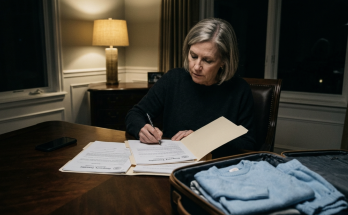
David did not touch the transfer agreement for several seconds.
The paper lay on the conference table beneath the fluorescent lights, surrounded by photographs, copied ledger pages, evidence bags, and cups of coffee nobody wanted anymore. Dawn had already passed, but the room still felt trapped in the night before.
“I owned part of that land?” he asked.
Robles nodded.
“Technically, an interest in the entity that held the parcel.”
“Since I was fourteen?”
“Since Samuel died.”
David stared at me.
“You knew?”
“No.”
He searched my face long enough to make certain.
Then his shoulders lowered slightly.
For once, the secret had not been mine.
Robles turned the document toward him.
“Samuel appears to have structured it through a custodial interest that matured when you reached adulthood. The problem is that nobody activated the transfer.”
“How does someone own something for twenty years without knowing?”
“Easier than you’d think when the entity becomes dormant, the records are buried, and everyone who knows about it either dies or benefits from silence.”
Eleanor sat across from us.
“Samuel probably intended to finish the paperwork after he met with investigators.”
Robles nodded.
“His death froze the process.”
David looked toward the copy of Samuel’s final recording.
“So Dad was trying to leave me evidence and money at the same time?”
“Not exactly,” I said.
Everyone looked at me.
I studied the documents again.
“Samuel hated mixing those two things.”
David frowned.
“What do you mean?”
“He used to say money changed the way people remembered motives. If he wanted you to inherit something, he would not have wanted you wondering whether he built the case for you.”
Eleanor gave a small nod.
“That sounds like him.”
Robles tapped the transfer agreement.
“This may have been practical. If Samuel expected criminal forfeiture or company collapse, placing an interest with David could preserve a legitimate claim.”
“Legitimate claim to what?” David asked.
“That’s what we need to calculate.”
The first estimate came two hours later.
It was not simple.
The dormant entity had held fractional interests in several properties, contractual recovery rights, and one disputed claim to funds routed through a shell network before Samuel’s death. Over the years, those assets had been sold, merged, refinanced, or transferred into successors.
Tracing David’s share meant following money through more than two decades of corporate changes.
Robles’s financial specialist arrived carrying three laptops.
By noon, he had an initial range.
“Conservatively,” he said, “the claim could be worth between eighteen and twenty-six million dollars.”
David laughed.
Nobody else did.
He looked around.
“You’re serious.”
“Yes.”
“More than the house.”
“Potentially much more.”
David leaned back.
For years, he had lived in a property bought by his mother because he believed he had failed to provide enough stability for his family.
Now he was being told that his dead father had unknowingly left him a claim larger than everything I had given him.
The irony was almost cruel.
Danielle stood near the window.
“How much of that did my mother know?”
Robles answered carefully.
“We cannot say.”
“She knew there was something.”
“Yes.”
“She knew enough to manipulate us for years.”
“Yes.”
David rubbed his forehead.
“That’s why she cared about the deed.”
“Partly,” Robles said.
I looked at him.
“Partly?”
He brought up another document.
“The Princeton property itself may have served as a trigger for David’s claim.”
“What does that mean?”
“There’s language suggesting the beneficial interest became easier to establish if the parcel was consolidated under a related family ownership structure.”
David frowned.
“So Mom buying the property helped me without either of us knowing?”
“Possibly.”
I almost laughed.
Samuel would have appreciated that.
For years, I believed I bought David a house because his business had struggled.
In doing so, I may have unknowingly completed part of the legal chain Samuel left behind.
Danielle whispered, “And my mother almost got herself added to it.”
Robles nodded.
“If Grace had gained valid ownership rights, she might have been able to assert standing in disputes involving the underlying entity.”
David looked sick.
“She wasn’t trying to steal a house.”
“No,” I said.
“She was trying to place herself inside the inheritance.”
The realization changed everything again.
Grace’s behavior had always seemed disproportionately intense.
Her obsession with the deed.
Her panic over the trust.
Her surveillance of my meetings.
She had not merely wanted wealth.
She wanted legal proximity to the one asset that could open Samuel’s buried financial claims.
Danielle sat down.
“My father knew.”
Eleanor answered softly.
“I think Richard understood some of it.”
“Then why leave Mom any of his companies?”
“Maybe because she already controlled them.”
Danielle looked at her.
“Or because he was afraid of her.”
No one answered.
David stood.
“I want to see Grace.”
Danielle turned quickly.
“Now?”
“Yes.”
“Why?”
“Because I need to hear what she knew.”
Robles shook his head.
“That is a bad idea without counsel present.”
“I didn’t say alone.”
Sloane, when told, was equally cautious.
Grace had not yet been formally charged with every suspected offense, but she was under guard at the hospital and had requested an attorney.
Any conversation could interfere with the investigation.
David looked at me.
“What do I do with that?”
“Wait.”
He laughed bitterly.
“I have done enough waiting.”
“Yes.”
He turned toward me.
“Then why should I?”
“Because this time waiting protects the truth instead of hiding it.”
That stopped him.
A few hours later, Grace’s attorney contacted Sloane.
Grace wanted to make a statement.
Not a plea agreement.
Not yet.
A statement.
She specifically asked that Danielle be present.
Danielle went pale when she heard.
“I don’t know if I want that.”
David said nothing.
I asked, “Do you?”
She looked at me.
“I want answers.”
“That isn’t the same thing.”
“I know.”
She sat quietly for several minutes.
Then stood.
“I’m going.”
David started to speak.
She raised a hand.
“You don’t have to come.”
He studied her.
“I’m coming.”
Grace was no longer in a hospital gown when we saw her.
She wore plain clothing provided by staff.
No makeup.
No jewelry.
Without the armor she usually chose so carefully, she looked older.
Much older.
Her lawyer sat beside her.
Sloane and Harris sat across the table.
David and Danielle were permitted in the room as witnesses to certain disclosures, with conditions.
I watched from behind the observation glass with Robles.
Grace looked at her daughter first.
“Is Noah safe?”
Danielle nodded.
“Yes.”
“Does he know?”
“No.”
Grace closed her eyes.
“Good.”
Then she looked at David.
“I’m sorry.”
His expression did not move.
“For which part?”
Her mouth tightened.
“I deserve that.”
“That isn’t an answer.”
Her attorney touched her arm.
Grace continued anyway.
“For making you distrust your mother.”
David said nothing.
“For using your signature.”
Still nothing.
“For telling Danielle the house had to become hers.”
David leaned forward.
“Did you know about the inheritance?”
Grace hesitated.
Her lawyer whispered something.
She answered.
“I knew there might be a claim.”
“How much?”
“I didn’t know.”
“Did you know the house was connected?”
“Yes.”
Danielle closed her eyes.
David’s voice sharpened.
“Since when?”
“After Richard died.”
“Eight years.”
“Yes.”
“So for eight years, every time you told me Mom was controlling because she owned the house, you knew that house might contain a legal path to something my father left me.”
Grace swallowed.
“Yes.”
“Why didn’t you tell me?”
“Because Victor would have known.”
“How?”
“He watched financial filings.”
“Then we could have gone to police.”
Grace laughed bitterly.
“To whom?”
“Harris.”
“You didn’t know him then.”
“No, but—”
“You think corruption announces itself?”
David stopped.
Grace’s fear was not invented.
That was part of what made her choices harder to understand.
She had reasons.
Then she turned those reasons into permission.
Danielle asked quietly, “Did Dad tell you Samuel was murdered?”
Grace nodded.
“When?”
“The night before Richard died.”
Danielle’s face tightened.
“Eight years ago.”
“Yes.”
“And you never told us.”
“No.”
“Did you tell Victor you knew?”
“Not directly.”
“Then why stay connected to him?”
Grace looked down.
“Because I thought I could control what he knew.”
David almost laughed.
“You thought you could control Victor Hale?”
“I controlled plenty for years.”
“That’s not the same thing.”
“No.”
Her voice became smaller.
“No, it isn’t.”
Sloane asked, “Tell us how the deed scheme began.”
Grace’s lawyer shifted.
Grace spoke anyway.
“Victor contacted me two years ago. He knew Ophelia had begun estate planning.”
“How?” Robles muttered behind the glass.
Grace continued.
“He believed Samuel’s surviving claim might surface if the Princeton property was placed into trust.”
Sloane asked, “What did he want you to do?”
“Get ownership access.”
“Why?”
“He said once my name was on the deed, Leonard Voss could create legal standing to challenge documents associated with the parcel.”
“Challenge or seize?”
“Both.”
Danielle’s eyes filled.
“You used me.”
Grace looked at her.
“Yes.”
The simplicity hurt more than an excuse would have.
“You told me Ophelia wanted custody of Noah.”
“I was trying to make you afraid enough to act.”
“That is using me.”
“Yes.”
“You told me David would lose everything.”
“I believed that part.”
“Because you were helping make it true.”
Grace had no answer.
David asked, “The credit lines?”
Grace closed her eyes.
“Victor said we needed leverage.”
“Whose idea was using my identity?”
“Mine.”
Danielle turned away.
David’s face went still.
Grace rushed to explain.
“I intended to close them. I needed to establish debt pressure so you would agree to restructure ownership.”
“You damaged my credit on purpose.”
“Yes.”
“To scare me.”
“Yes.”
“So I would give you access to Dad’s claim.”
“I didn’t think of it like that.”
“How did you think of it?”
“Survival.”
David leaned back.
“There’s that word.”
Grace frowned.
“What?”
“The word people use when they want their worst decisions to sound inevitable.”
Even Sloane looked at him.
Grace’s face collapsed.
“I was afraid.”
“So was Dad.”
Silence.
“He still tried to expose Victor.”
Grace whispered, “And he died.”
David’s jaw tightened.
“And you spent the next eight years helping the man who killed him.”
“I spent eight years trying to stay alive.”
“By putting us in his path.”
Grace began crying.
I watched through the glass and felt no pleasure.
This was not exposure as entertainment.
It was a family seeing the exact price of what had been hidden.
Sloane asked about Curtis.
Grace admitted calling him before the party.
She had discovered that Robles had begun requesting property records.
Victor ordered her to determine whether Samuel’s evidence had surfaced.
When I arrived with attorneys, she panicked.
She called Curtis and told him Mercer might matter.
Curtis went there immediately.
The burglary followed.
Grace stopped speaking.
Sloane waited.
“What happened after Mercer?”
Grace looked at Danielle.
“I realized Victor was going to kill Curtis.”
“How?”
“He told me Curtis had become unreliable.”
“And Leonard Voss?”
“Leonard called me. He said Victor was cleaning up loose ends.”
“So you tried to leave.”
“Yes.”
“Why not come to police?”
“I was afraid Greeley still had people.”
Harris asked, “Did he?”
“I don’t know.”
“Then why call Voss?”
“Richard told me Leonard had records.”
“What records?”
Grace looked toward the observation glass.
I felt as though she knew exactly where I stood.
“The original ownership trail.”
Robles whispered, “That’s what burned.”
But Grace continued.
“Not all of it.”
Sloane leaned forward.
“Where is the rest?”
Grace looked at David.
“Samuel made one more copy.”
David went rigid.
“Where?”
“I don’t know.”
“Then why say that?”
“Because Richard saw it.”
“When?”
“Before Samuel died.”
“What kind of copy?”
“Not paper.”
David stared.
“A tape?”
“No.”
“Then what?”
Grace looked exhausted.
“He photographed every page.”
Robles straightened.
“Microfilm?”
Grace nodded.
“Richard said Samuel stored it somewhere no corporate search would ever find.”
David looked toward the glass.
Toward me.
I already knew.
Not the location.
The principle.
Samuel hid important things inside ordinary family life.
Old houses.
Children’s lessons.
Personal objects nobody powerful would bother to understand.
David stood.
“What exactly did Richard say?”
Grace closed her eyes.
“He said Samuel put the truth somewhere that only Ophelia would keep forever.”
Every person in the room turned toward the glass.
Toward me.
I looked down at my hands.
Something only I would keep forever.
Not property.
Not paperwork.
Something sentimental.
Then I remembered the leather glove inside Samuel’s workshop chest.
One glove.
Not a pair.
The same glove Samuel wore the day he taught David to plant the walnut tree.
I stood so fast the chair struck the wall.
Robles looked at me.
“What?”
“The glove.”
We drove back to my house under police escort.
The wooden chest remained where we had left it.
Harris photographed the leather glove before anyone touched it.
At first, it looked ordinary.
Old brown leather.
Cracked across the palm.
Samuel’s initials burned near the cuff.
Then an evidence technician felt something beneath the lining.
A narrow strip.
He opened a seam that had been stitched by hand.
Inside was a black plastic cartridge no longer than my little finger.
Eleanor stared.
“Microfilm.”
David began crying.
Not loudly.
He simply sat on Samuel’s old desk chair and covered his face.
Twenty-two years.
Samuel’s final copy had been inside a work glove in my house the entire time.
The thing Victor spent decades trying to find had survived because I could not bring myself to throw away something that still carried the shape of my husband’s hand.
Click here to continue reading: PART 14: Samuel’s Hidden Film Exposed the Entire Network, but One Photograph Forced Danielle to Ask Whether Her Father Had Helped Arrange the Fatal Crash
My Son’s Midnight Message Was Meant to Keep the Peace, but It Finally Made Me Question Everything I Had Given
Part 13 of 17