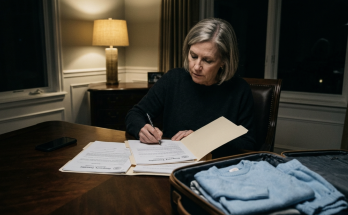
I opened it.
Inside were copies of her will, a letter from her attorney and beneficiary documents.
Sarah had left most of her estate to me.
Her Durham condo.
Her investment accounts.
Her savings.
And separately, she had named me beneficiary of a life-insurance policy.
I stared at her.
“No.”
“Yes.”
“I don’t want your money.”
“I know.”
“Then why?”
“Because I don’t have children.”
“That doesn’t make me your family.”
“No.”
She looked at me.
“But you’ve spent 22 years believing you owe me a debt.”
I couldn’t answer.
“The condo is worth around $280,000. Julian has only been helping me manage paperwork and my accounts because I became too sick to handle everything.”
I looked at him.
“He never took anything?”
Sarah shook her head.
“Not a dollar.”
That mattered.
Not enough.
But it mattered.
“Why leave it to me?”
“Because Julian talked about you.”
I stared at him.
“What?”
“All the time,” Sarah said.
“He told me you worked overtime to help your sister. That you helped your nephew pay his college deposit. That you complain whenever anyone needs help and then help them anyway.”
Despite everything, I laughed once.
That sounded exactly like Julian describing me.
“You talked about me with her?”
He nodded.
“All the time.”
“Then how could you lie to me?”
His eyes filled.
“Because every week I waited, the truth became harder to tell.”
“That doesn’t make it better.”
“No.”
Sarah reached toward me.
“I’m not giving you anything to buy forgiveness.”
“It won’t.”
“I know.”
“Then what do you want?”
“I want you to stop making decisions because of me.”
I stared at her.
“If you leave Julian, leave because you cannot live with what he did.”
She took a slow breath.
“If you stay, stay because you decide trust can be rebuilt.”
Her eyes held mine.
“But don’t spend the rest of your life trying to repay something you think you owe me.”
A few days later, Sarah’s doctors told her she didn’t have much time.
She asked to visit a small chapel outside Durham one final time.
I went.
Not because I had forgiven either of them.
Because I didn’t want another regret.
Sarah sat in a wheelchair near the altar.
Julian stood beside her.
At the end of the prayer, Sarah removed her ring.
Then she asked Julian to remove the one he wore only when he was with her.
She placed both rings into my hand.
“I don’t want to leave this world holding something that was never truly mine.”
“You don’t have to give these to me.”
“I know.”
Then she looked at Julian.
“Go home.”
He began crying.
“I mean it.”
Then she looked at me.
“And you.”
“What?”
“Stop punishing yourself for being 20.”
My throat tightened.
“I hurt you.”
“Yes.”
She didn’t soften the answer.
“But you didn’t destroy my life.”
I began to cry.
“Who did?”
Sarah smiled faintly.
“No one.”
She looked toward the chapel windows.
“Life did.”
She died four days later.
Julian held one hand.
I held the other.
For most of my life, I had imagined Sarah as the woman whose future I stole.
Then as the woman who stole part of my husband.
In the end, she was neither.
She was simply Sarah.
Complicated.
Frightened.
Flawed.
Human.
After the funeral, Julian and I met with an attorney.
The attorney confirmed that because Julian was still legally married to me, the second marriage had never been legally valid.
But that did not erase what he had done.
He had made false representations to obtain insurance coverage for Sarah.
Julian reported it.
The insurer investigated.
He was required to repay benefits that had been improperly obtained, along with penalties.
There were legal fees.
His employer terminated him.
It was humiliating and expensive.
I refused to shield him from any of it.
For once, Julian had to face the consequences of a choice he had made without asking anyone else to carry them.
Only after the legal mess was resolved did we begin talking seriously about our marriage.
We started counseling.
We separated our personal finances.
I demanded full access to every account, debt, insurance policy and asset.
No hidden passwords.
No secret trips.
No decisions made “for my own good.”
Julian agreed.
Some nights I hated him.
Some nights I missed him.
Sometimes I did both in the same hour.
I slept in the guest room for months.
Every morning, Julian left coffee outside the door.
No note.
No Clara-jane.
Just coffee.
Six months after Sarah died, a letter arrived.
I recognized her handwriting immediately.
Clara,
If you are reading this, then I am gone.
You have every right to be angry with Julian.
Please do not let anyone use my illness to convince you that what he did was harmless.
It wasn’t.
But don’t stay because you pity him.
And don’t leave because you think you owe me justice.
Choose for yourself.
I wiped my eyes and continued.
You once believed you stole my future.
You didn’t.
You made choices.
Julian made choices.
I made choices.
We all lived with them.
If you still love him and believe trust can be rebuilt, rebuild it.
If you don’t, walk away.
But whatever you do, do it because it is your life.
Not mine.
At the bottom she had written one final line.
And next time you owe someone an apology, don’t hide behind the bread aisle.
I laughed through my tears.
A year after Sarah died, Julian and I drove to Durham.
We visited a park she had loved.
Julian brought two coffees.
Then he took a small box from his jacket.
Inside was my wedding ring.
The one I had stopped wearing after the courthouse.
“I hoped someday you’d decide whether you wanted it again.”
I closed the box.
“I don’t want our old marriage.”
His face fell.
Then I handed him an envelope.
Inside was a postnuptial agreement our attorney had prepared.
Separate personal accounts.
Shared household expenses.
Full financial disclosure.
Joint decisions on major obligations.
No hidden debts.
No hidden properties.
No undisclosed marital filings.
At the bottom, I had written:
IF WE STAY, WE STAY HONESTLY.
Julian read it twice.
“Is this you saying yes?”
“No.”
He looked confused.
“It means we get to decide again.”
That was the difference.
At 20, I wanted Julian partly because Sarah had him.
At 24, I married him believing love meant I had somehow won.
At 42, I finally understood that a marriage wasn’t something you won.
It was something two people had to keep choosing honestly.
Julian and I are still married.
But our marriage isn’t what it used to be.
I don’t want it to be.
Before the courthouse, we had comfort without complete honesty.
Now the truth is sometimes uncomfortable.
But at least it is real.
As for Sarah’s estate, I kept enough to pay off the remaining mortgage and set aside money for our son’s education.
Most of the rest went into a patient-support fund at Duke.
It helps cancer patients with transportation, lodging, food and other expenses that can overwhelm families during treatment.
We named it:
THE SARAH VANCE PATIENT SUPPORT FUND.
Not Sarah Hayes.
Not the second wife.
Not my rival.
Just Sarah Vance.
A woman who had been part of my life long before I understood her.
I still keep her final letter beside my original marriage certificate.
One proves that Julian and I stood in a courthouse in 2008 and promised ourselves to each other.
The other reminds me that paperwork cannot make people honest.
Only people can do that.
I walked into the county clerk’s office because HR wanted proof that I was Julian Hayes’s wife.
Instead, I discovered a secret marriage.
A dying woman.
A pregnancy I never knew about.
A lost baby.
Three years of lies.
22 years of guilt.
And a husband who had done something deeply wrong while convincing himself that compassion made it acceptable.
It didn’t.
Understanding why Julian did it did not erase what he had done.
Forgiveness did not mean pretending the wound never happened.
And staying did not mean he was automatically entitled to another chance.
I stayed because, after every lie was exposed and every consequence was faced, I decided I wanted to see whether something honest could still be built from what remained.
On the first anniversary of Sarah’s death, I went to her grave alone.
I placed a small bouquet beside the stone.
For the first time, there was no competition between us.
No Julian.
No marriage certificate.
No imaginary scoreboard.
Just me and a woman I should have apologized to 22 years earlier.
I touched the top of her headstone.
“I’m sorry, Sarah.”
Nothing miraculous happened.
I didn’t need it to.
When I returned to the parking lot, Julian was waiting beside the car.
Halfway home, he reached across the console and offered me his hand.
I looked at it for several seconds.
Then I took it.
Not because I had forgotten.
Not because everything had been repaired.
Not because forgiveness erased responsibility.
I took his hand because it was my choice.
That was the lesson Sarah understood before I did.
The courthouse told me who Julian had tried to marry.
The truth taught me something much more important.