PART 1 TITLE: I Went to My Parents’ House for a Simple Favor and Found Two People Fighting for Their Lives
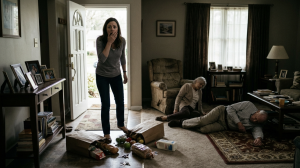
The first thing I noticed was the overturned chair. My father never left furniture out of place, especially not the wooden dining chair he had repaired himself. Yet there it lay beside the coffee table, one leg pointing toward the ceiling. A bowl had fallen nearby, scattering green grapes across the carpet. Then I saw my mother’s hand extending beyond the arm of the sofa, her fingers resting against the floor as though she had been reaching for something she could no longer grasp.
“Mom?” I called from the doorway. The house was unusually quiet. The television was on, showing a baseball game with the sound turned low. I stepped over a grape and saw my father lying on his side near the coffee table. His glasses were several feet away. My mother was beside him, partly concealed by the sofa. Neither moved when I spoke. I dropped my bag, crossed the room, and knelt beside my father.
His skin felt clammy beneath my fingers. I called his name and touched his shoulder, first gently and then hard enough to move him. His eyelids fluttered without opening. His breathing was shallow, interrupted by a sound that frightened me more than silence would have. My mother’s face was pale, her lips slightly parted. When I pressed my hand against her cheek, she gave no response. I reached for my phone with fingers that could barely hold it.
The emergency dispatcher asked me questions I struggled to answer. Were they breathing? Was there any obvious injury? Did they have medical conditions? I told her their names, their approximate ages, and that both were unconscious. She instructed me to remain on the line and check their breathing. I did exactly what she said, although I could hardly hear her over the rushing in my ears. At one point my father made a weak movement, and I thought he was waking. Then he became still again.
I remember looking at the clock above the kitchen entrance. It was 6:40 on Tuesday evening. Only fifteen minutes earlier, I had been considering whether to stop for groceries before coming over. Kara, my younger sister, had asked me to collect our parents’ mail because she couldn’t manage it herself. I had nearly postponed the errand. That ordinary hesitation became unbearable while I sat on the carpet between two unconscious people and listened for the approaching ambulance.
The paramedics arrived with equipment that seemed too large for the familiar living room. They asked me to move away while they examined my parents. One checked my mother’s pulse while another prepared oxygen. A third questioned me about medications, meals, and whether either parent had been ill earlier in the day. I knew their regular prescriptions but not what they had eaten. The kitchen smelled faintly of tea and cooked vegetables. Two cups stood beside the sink, and a pot remained on the stove.
“Could they have eaten something bad?” I asked. The paramedic examining my father did not offer a diagnosis. He glanced toward his colleague before telling me they needed to reach the hospital quickly. His careful tone made it clear that my parents were seriously ill. I watched them lift my mother onto a stretcher. One of her slippers fell off, and I picked it up without thinking. It was still in my hand when they carried her through the front door.
I followed the ambulances in my own car. At every red light, I stared at their disappearing taillights and fought the urge to drive faster. I called my husband, Michael, from the first intersection. He answered on the second ring, and I heard office noise behind him. I could barely form the words. He asked which hospital and said he would meet me there. Before hanging up, he told me to drive carefully. I had never heard him sound so frightened while trying so hard to hide it.
Michael was already outside the emergency entrance when I arrived. He took my car keys because my hands were shaking too badly to put them in my purse. We entered together and were directed to a waiting area where a vending machine hummed beneath bright fluorescent lights. A nurse collected the information I had given the paramedics and asked whether my parents might have taken anything unusual. I kept repeating that they had been perfectly healthy when I last saw them.
My father, Robert Carter, had retired six years earlier from a regional construction company where he had spent most of his working life. Retirement suited him. He maintained a vegetable garden, repaired household appliances that would have been cheaper to replace, and watched baseball with an almost scholarly seriousness. My mother, Helen, had filled her days with gardening, cooking, and a circle of friends who had known her for decades. Neither was especially adventurous with food or medicine.
The doctor came out after what felt like several hours. He was a tired-looking man with a quiet voice and a folded sheet of paper in his hand. He explained that both my parents were critically ill and that their symptoms suggested exposure to a toxic substance. More tests were needed before anyone could say exactly what had happened. The fact that they had collapsed at approximately the same time made an accidental medical emergency less likely.
“Are you saying they were poisoned?” Michael asked.
The doctor considered his answer. “We’re treating that as a serious possibility. Right now our priority is keeping them alive.”
I looked toward the doors through which the stretchers had disappeared. I wanted to ask whether either parent had regained consciousness, whether they were suffering, whether they knew I had found them. Instead, I asked the question that had begun to terrify me. “Are they going to die?”
“We’re doing everything we can,” he said. It was an answer that gave me no reassurance, but I could see he would not promise anything more.
Kara arrived shortly afterward, her dark hair damp from the rain. She stopped when she saw me, searching my expression before looking toward the treatment rooms. My sister was several years younger than I was. We had grown apart since reaching adulthood, although we still spoke about birthdays, holidays, and our parents’ needs. She asked what had happened, and I repeated the doctor’s explanation. She listened without interrupting, pressing her thumb against the side of her phone.
“I asked you to get the mail,” she said eventually. “I didn’t think you would go inside.”
Her words irritated me in a way I couldn’t explain. “The front door wasn’t locked. I called out and nobody answered.”
“I know. I just meant—” She stopped and looked away. “Thank God you were there.”
I asked whether she had spoken to our mother that afternoon. Kara said she had exchanged a few messages but had not heard anything unusual. When I asked if she had visited, she shook her head and said she had been busy. It did not occur to me then to question her answer. My attention was fixed on the doors across the waiting room and the possibility that a doctor might appear with news neither of us could bear.
Daniel arrived close to nine. He had been my father’s closest friend for more than thirty years, long enough that I could hardly remember a family gathering without him. He had attended school concerts, birthday dinners, weddings, and funerals. When I was seven, he had taught me to ride a bicycle while my father ran behind us shouting instructions. Seeing him enter the hospital made the situation feel both more real and less possible.
He embraced me, then Kara. His face was drawn, and he kept asking whether my father had spoken. When I told him neither parent was conscious, he sat down heavily. He wanted to know whether anyone had mentioned food poisoning, medication, or a gas leak. Michael explained what the doctor had said. Daniel stared at the floor for several moments, rubbing one hand over the other. He finally asked if the police had been called.
I hadn’t considered that the police might become involved. But when a uniformed officer appeared beside the waiting room an hour later, I understood that the hospital had reported the circumstances. He asked me to describe the scene and what I had touched. I told him about the overturned chair, scattered grapes, cups in the kitchen, and my father’s glasses. He wrote everything down, including the time I had entered the house.
Later that night, a detective named Harris introduced herself. She was in her forties, with an even manner and an attention to detail that made her questions unusually difficult to evade. She wanted to know who had access to the house, who visited regularly, and whether my parents had recently argued with anyone. I told her they were loved by everyone. She did not dispute it. She simply asked again about their keys.
My parents had never been especially concerned about security. There was a spare key beneath a ceramic bird near the back door, and several relatives and trusted neighbors had received copies over the years. Daniel had one because he sometimes checked on the house when they traveled. Kara had one too. So did our aunt, a neighbor, and their home-health aide. My father had installed a video doorbell several years earlier, but everyone believed the device had stopped working.
Harris asked whether either parent had received threatening messages or unexpected visitors. Nothing came to mind. My father occasionally complained about people from his former company, but I had always treated those remarks as harmless retirement grievances. He disliked waste and dishonesty, two qualities he believed were common in construction management. I mentioned this only because Harris asked about past disputes. She wrote down the company’s name without showing much reaction.
By midnight, my mother had been transferred to intensive care. My father remained unconscious, his condition unstable. We were permitted to look at them briefly through separate doorways. My mother seemed much smaller beneath the hospital blankets. My father’s hands, usually scratched from gardening or repairs, lay motionless at his sides. I had spent my childhood believing those hands could fix anything. The sight of them doing nothing unsettled me more than the machines surrounding his bed.
Kara left after promising to return in the morning. Daniel went home when a nurse assured him that he would be contacted if anything changed. Michael refused to leave me alone. We sat together until nearly two, speaking only when a staff member approached. Once, I asked why anyone would want to hurt my parents. Michael said there might still be an accidental explanation. He held my hand, but I could feel him thinking about the same possibility I was.
We eventually returned home because the doctors insisted there was nothing more we could do at the hospital. I went straight into the bathroom and washed my hands. The water ran warm over my knuckles, but I could still feel my mother’s cold cheek beneath my palm. Michael stood in the doorway, watching without speaking. When I finally turned off the tap, he handed me a towel and asked me to try to sleep.
I didn’t sleep. Near dawn, I opened the messages on my phone and reread Kara’s request from Tuesday afternoon. She had asked me to stop at our parents’ house, collect their mail, and leave it on the kitchen counter. It seemed harmless. Yet I found myself wondering why she had chosen that evening, and why she had been so particular about where I should put the envelopes. I almost called her before deciding I was exhausted and frightened enough to imagine significance in anything.
The next morning, Detective Harris telephoned with the preliminary findings. Toxicology results were not yet complete, but the medical team had become sufficiently concerned to request a criminal investigation. She wanted to search the kitchen more thoroughly and document everyone who had entered the property. I agreed, then asked whether the doctors had learned anything encouraging. She hesitated before telling me that both parents remained alive but critically ill.
Michael took the phone after I finished speaking. He asked Harris about the house’s security equipment and whether the police had examined the old doorbell. She said the officers had seen it but had not yet recovered any recordings. After the call, he stood beside the kitchen window for a long moment. I recognized the expression on his face: the quiet concentration he wore when a problem needed fixing.
“What are you thinking?” I asked.
“Your father never trusted equipment he couldn’t repair himself,” Michael said. “Maybe he didn’t completely abandon that camera when it stopped working.”
He explained that some older devices stored footage locally even when their applications stopped connecting properly. My father had tinkered with electrical components for years. It was possible he had maintained part of the system without mentioning it. Michael offered to check the unit if Harris permitted him. I agreed, although the thought of him returning to the house made my stomach tighten.
That afternoon, the police allowed Michael to inspect the exterior camera under their supervision. I remained at the hospital. He called once to say the housing was damaged but the internal storage assembly was still present. His voice sounded different when he said it. He was no longer trying to reassure me. He was concentrating on something he did not yet understand.
Hours passed before he returned home. I heard his car in the driveway, followed by the front door opening and closing with unusual care. When Michael entered the kitchen, he carried his laptop beneath one arm and a tiny plastic memory card sealed inside a protective sleeve. His face was pale, and he had not removed his coat.
“Emily,” he said, setting the laptop on the table, “I found a recording from Tuesday evening.”
I stood up, but he raised a hand before I could ask what it showed.
“There’s someone on it,” he said. “Someone who went into your parents’ house before you arrived.”
END PART 1
PART 2 TITLE: The Forgotten Doorbell Camera Revealed a Visitor Who Had Every Reason to Hide What Happened Before My Parents Collapsed
Michael placed the memory card on our kitchen table without letting go of it. The small rectangle of plastic seemed insignificant beside his laptop and the untouched coffee I had made an hour earlier. Yet he kept looking at it as though it might answer every question we had been afraid to ask. I pulled out a chair, but he remained standing, his hands braced against the edge of the table.
“How much did it record?” I asked.
“Enough to establish that someone came to the house. There are gaps, though. I don’t know whether the files are damaged or whether the camera stopped working.”
“Did you recognize the visitor?”
He hesitated. “I want to check the image on a larger screen before I tell you what I think.”
I disliked his caution, but I understood it. We had already spent a night imagining that my parents might have been deliberately harmed. An uncertain picture could turn an innocent person into a suspect in our minds. I asked whether Harris knew he had recovered anything. Michael said the supervising officer had authorized the inspection and been told that the storage might contain footage. He intended to hand it over, but he wanted us to understand what was there first.
Before opening the recordings, Michael asked me about the last time I had seen my mother conscious. I told him about my visit the previous Sunday. My parents had invited us to lunch, although Michael had been working and couldn’t come. Mom had prepared chicken soup and brought out the bread my father liked, thick slices spread with butter that he always pretended cost too much. The meal had been unremarkable until my mother asked me to stay behind while Dad went into his office.
She had looked unusually serious that afternoon. When I offered to wash the dishes, she took the plate from my hands and set it aside. She asked whether I believed people could keep important secrets from someone they loved. I assumed she was worried about a friend. She had recently become concerned about an acquaintance whose husband managed their finances without discussing them. But Mom shook her head when I mentioned that situation.
“Sometimes we mistake familiarity for knowledge,” she said.
I asked if something was wrong between her and Dad. She glanced toward the hallway, where we could hear him opening a drawer, and told me that their marriage was fine. Then she squeezed my hand, hard enough for me to remember it days later. Before I could question her further, Dad returned with a gardening catalogue, and she changed the subject. I had driven home thinking she was simply tired.
Michael listened carefully. “Did she mention Kara?”
“No. Why?”
“Because Kara has been acting strangely since the hospital.”
I wanted to object. My sister had always been difficult to read, especially when she was frightened. She became defensive when asked ordinary questions, then complained that nobody trusted her. It was a habit dating back to adolescence, when she interpreted nearly every family disagreement as evidence that I was favored. Our relationship had improved with age, but neither of us was particularly skilled at speaking openly.
Still, I couldn’t dismiss Michael’s observation. Kara had been unusually interested in the details of the house. She wanted to know whether the police had searched the office, whether the kitchen had been sealed, and whether anyone had checked the back door. Each question could be explained by concern. Taken together, they suggested she was looking for something specific. I told Michael that suspicion was not proof, and he agreed.
We opened the security application. Michael had already established that the device still retained some locally stored files. The recordings were arranged by date and time, although several entries were incomplete. Most showed ordinary scenes from the porch: delivery drivers, neighbors passing on the sidewalk, my father watering the flowerpots. I recognized the familiar crooked camera angle immediately. Dad had mounted the unit himself, and he refused to adjust it after discovering that doing so would require drilling another hole.
The footage from Tuesday began with an empty porch under steady rain. The light above the door shone against wet boards. A ceramic planter sat beside the steps, and the familiar shadow of the maple tree moved along the edge of the picture. I watched for several minutes, waiting for someone to appear. No one came. Then Michael adjusted the timeline and pointed toward a section where the recording had stopped unexpectedly.
“There’s more than one interruption,” he explained. “The software identifies one as a corrupted section. Another looks as though the recording process was deliberately stopped, but I can’t prove that.”
“Could Dad have turned it off?”
“Possibly. But we’d need to know when and why.”
I leaned closer, searching the frozen picture for details. The porch was empty except for rain. It seemed impossible that violence could begin in such an ordinary place. I remembered standing there as a teenager, arguing with Dad because I wanted to stay out later. I remembered Kara sitting on the steps after she failed her driving test. I remembered Michael carrying me through that doorway on our wedding night, laughing because my father had insisted on taking photographs.
The memory card held more than one day’s worth of files. We examined several earlier recordings to understand how reliably the camera worked. Some were clear. Others ended abruptly. Michael showed me that a brief outage did not necessarily indicate tampering; aging storage media could behave unpredictably. He seemed determined not to interpret every irregularity as evidence of a crime. I appreciated that restraint, even while wishing he would move faster.
At one point, a recording from Monday afternoon showed Daniel arriving with a paper bag. He knocked, and my father opened the door. The two men stood talking for several minutes. Dad appeared agitated, gesturing once toward the street before inviting Daniel inside. There was no audio, and I couldn’t identify the contents of the bag. Michael replayed the encounter, then wrote down the timestamp.
“Daniel said he hadn’t seen Dad since the weekend,” I observed.
“Maybe he forgot.”
“Daniel doesn’t usually forget visits.”
Michael saved the timestamp without commenting. We had known Daniel for most of our lives. His loyalty to my father had never been in question, but the footage reminded me how little I actually knew about their conversations. They had worked in overlapping professional circles and shared friendships I had never met. Retirement had not ended all those connections. I wondered what could have upset Dad enough to make him gesture so sharply.
A different file showed my mother leaving the house alone on Tuesday morning. She carried a shopping bag and paused to examine the mailbox before walking toward her car. Nothing about her movements suggested illness. She looked energetic, dressed in the blue sweater Kara had given her for Christmas, her gray hair tucked beneath a raincoat hood. I replayed that brief recording three times. It was the closest thing I had to seeing her healthy again.
Michael moved the timeline forward. Around midday, a vehicle stopped at the curb but remained outside the camera’s clearest field of view. We could see part of its dark bodywork and the reflection of a passing car in its window. Someone stepped onto the sidewalk and remained there briefly before returning to the vehicle. The camera never captured a face. I asked whether the police could identify the car from its shape. Michael said investigators might be able to compare it with other footage.
The afternoon recordings were patchier. At one point, the porch light switched on although daylight remained. A later file showed the front door opening from inside, but the person standing behind it was concealed by the door itself. Michael recorded each detail in a notebook. He had always been methodical, particularly when repairing electronics. During our marriage, I had sometimes teased him for treating a broken toaster like an engineering investigation. That afternoon, I was grateful for his patience.
I called Detective Harris to explain that the card contained several potentially relevant events. She asked us not to alter the original storage or attempt recovery using experimental software. Michael assured her that he was reviewing a copy and preserving the card. Harris said she would arrange for forensic examination. She also asked whether any recording clearly showed someone entering the property shortly before my parents were found.
Michael looked at me before answering. “We’re reviewing the final period now.”
Harris requested that we call immediately if we recognized anyone. When the conversation ended, I realized how much I wanted the footage to show a complete stranger. A stranger could be investigated without tearing apart our memories of family gatherings and shared meals. Someone familiar would force us to examine every conversation differently. I had already begun doing that with Daniel and Kara, and I hated myself for it.
While the final files loaded, my phone rang. Kara’s name appeared on the screen. She wanted an update on Mom and Dad, and I told her their conditions were unchanged. Then she asked whether Michael had returned from the house. I said he had. Her next question came too quickly.
“Did he get the camera working?”
I looked at Michael. “Why are you asking about the camera?”
“Because Dad kept complaining about it. I wondered whether it recorded anything useful.”
I told her we hadn’t determined that yet. She was quiet for a moment, then said she would call again after speaking to the hospital. Before hanging up, she asked whether I had been inside Dad’s office when I found our parents. I said I had barely left the living room. Her answer was a soft acknowledgment, followed by a hurried goodbye.
I set the phone down. Michael had heard only my side of the conversation, but he understood enough from my expression. We discussed whether to tell Harris. I decided we should. There was nothing inherently suspicious about Kara asking after the camera or Dad’s office, yet withholding those details would mean making investigative judgments we weren’t qualified to make. I sent Harris a concise message describing the call.
The footage finished loading. Michael enlarged the picture until the porch filled the laptop screen. Rain streaked across the lens. At first, all we could see was the quiet street and the pale light reflecting off wet concrete. Then headlights approached from the left. A vehicle slowed beside the curb. Its brake lights brightened, and the engine appeared to remain running.
A person emerged wearing a dark hooded jacket. Their head was lowered against the rain, and they carried something small in one hand. I leaned forward, trying to make out the object. It appeared pale against the black sleeve, perhaps a packet or plastic container. The visitor crossed the sidewalk without hesitation, moving directly toward my parents’ door.
“Pause it,” I said.
Michael stopped the recording. The figure was close to the steps now. Their face remained hidden beneath the hood. I studied the posture, the way one shoulder sat slightly higher than the other, and the familiar movement of the left foot. Something about the person disturbed me. I knew I had seen that walk many times before, but I resisted naming it.
We moved forward frame by frame. The visitor did not approach the doorbell to announce their arrival. Instead, they went beneath the camera, briefly leaving its field of view. When they reappeared, they were standing very close to the front door. One hand moved toward a pocket. A small metallic object caught the porch light.
“A key,” Michael said.
The visitor looked around before inserting it into the lock. The motion was practiced, not tentative. Whoever stood there knew which key to use and how the old lock tended to catch. My father had complained about that stubborn mechanism for years. It required a slight upward pressure on the handle. The visitor performed the movement automatically.
Michael turned toward me. “How many people know that trick?”
“Everyone who uses the door regularly.”
“Then we need to look carefully.”
The visitor lifted their head. For an instant, the hood shifted backward, exposing part of the face. The rain blurred the image, but the shape of the nose and the curve of the cheek were familiar. I pressed my fingers against my mouth. I had watched this person grow up. I knew the expression they wore when trying to hide embarrassment or irritation. I had never expected to see it outside my parents’ door under circumstances like these.
Michael paused again. Neither of us spoke. I wanted him to tell me the picture was distorted, that poor lighting could make unrelated people appear alike. But he knew what I was seeing. His hand rested on the laptop trackpad, perfectly still.
“Play the next few seconds,” I told him.
The visitor raised their face fully toward the camera, revealing a woman I recognized immediately. She looked briefly at the lens, then toward the street. Her hood slipped back far enough to expose damp strands of dark hair. There was no possibility that I had mistaken the shape of her face or the familiar narrowing of her eyes.
It was Kara.
My sister.
The person who had asked me to collect our parents’ mail that afternoon had entered their house before they collapsed. She had carried a small white container and used the spare key. Yet she had never told me she was there.
Michael let the footage continue. Kara disappeared inside, and almost immediately the picture froze. The recording resumed eleven minutes later. When my sister emerged, the white container was gone. She locked the door behind her, paused beneath the porch light, and glanced directly toward the camera.
Then she smiled.
It was a small, composed expression I could not interpret. She walked away while I sat staring at the screen, trying to reconcile the sister I knew with the woman who had just left our parents’ house carrying nothing.
END PART 2
PART 3 TITLE: My Sister Appeared on the Camera With a White Container, but an Anonymous Photograph Revealed a Second Visitor
For several moments after Kara disappeared from the recording, I couldn’t bring myself to look at Michael. The laptop’s cooling fan made a faint mechanical sound, and rain tapped against our kitchen window. Outside, somebody was walking a dog beneath a streetlight. Ordinary life continued a few feet away while my understanding of my family shifted beneath me. I asked Michael to play the footage again, although I wasn’t certain I could bear to watch it.
We studied Kara’s movements without speaking. She approached the house confidently, entered with a key, and remained inside during the missing section of the recording. When she emerged, she had no visible container. Her expression disturbed me, but I knew a facial expression was not evidence of murder. I forced myself to say that aloud. Michael agreed. He was worried about the missing eleven minutes, not simply the fact that Kara had visited.
“Maybe Mom asked her to bring medicine,” I suggested.
“Then we need to establish what medicine.”
“Maybe she brought food.”
“Then the container matters.”
I disliked the calmness of his answers. He wasn’t accusing Kara, but he was refusing every explanation I offered without evidence. I wanted to defend my sister because I remembered her as a little girl who cried whenever Dad left for a business trip. I remembered giving her my bedroom for a week after she became afraid of the dark. Those memories seemed impossible to connect with the person moving through the rain on the screen.
Michael pointed toward the timestamp. Kara entered at 6:17 p.m., only twenty-three minutes before I found our parents unconscious. It wasn’t a long interval. If she had brought something harmful, there might have been time for both parents to consume it before collapsing. But the possibility raised another question: why would she enter quietly rather than ring the bell? I reminded Michael that Kara had a key and used it frequently. Familiarity explained that much.
“What about the recording gap?” I asked.
He showed me the file information. The camera appeared to have stopped writing data shortly after she entered. It began recording again approximately eleven minutes later. Michael couldn’t determine whether someone had deliberately disabled it, whether the system had briefly lost power, or whether its faulty storage had caused the interruption. What troubled him was the timing. An aging camera could fail at any moment, but this failure occurred during the one visit we most needed to understand.
I asked him whether the gap could be recovered. He explained that deleted or incomplete files sometimes left recoverable information on storage media, but the original card should be examined by specialists. I insisted that we give it to Harris immediately. Michael nodded, then admitted he had delayed because he wanted me to see the recording before anyone questioned Kara. I understood his impulse, but I told him that protecting my feelings was not a reason to withhold evidence. He accepted the criticism without arguing.
Before we could call Harris, my phone began vibrating against the table. Kara was calling. Her name glowed on the screen between Michael’s hands and mine. He looked at me, then moved his head almost imperceptibly, warning me not to reveal the recording. I answered and tried to keep my voice steady. Kara asked whether I was home and whether Michael had returned from our parents’ house.
“Yes,” I said. “He’s here.”
There was a brief silence. “Did he come back with anything useful?”
“What are you looking for, Kara?”
“Nothing. I wanted to know whether Dad’s camera still worked.”
I looked at the laptop. “You told me it was broken.”
“I thought it was. Dad complained about it all the time.”
“Then why ask?”
She exhaled sharply. “Because I’m frightened, Emily. Both our parents are in intensive care. I’m trying to find something that helps.”
Her irritation sounded genuine. I almost apologized. Instead, I asked where she had been on Tuesday evening. She hesitated long enough for me to hear a vehicle pass in the background. Then she said she had stopped at Mom and Dad’s house. I closed my eyes. She had finally admitted the visit, but only after I had asked directly.
“Why didn’t you tell me?”
“I didn’t know it mattered.”
“Did you go inside?”
“Yes.”
“What were you doing?”
Another pause. When she answered, her voice had lost its sharpness. She said she had been upset and wanted to speak to Mom. I asked what had upset her. She told me it concerned something our mother intended to discuss with me. The words were so unexpected that I leaned forward. Michael watched my face, trying to follow the conversation.
“What did Mom want to tell me?”
Kara said nothing.
I repeated the question, more quietly. She began to answer, stopped, and then said she couldn’t discuss it over the phone. I asked whether it had anything to do with our parents’ illness. Her breathing changed. For an instant I thought she was crying, but before I could ask, the call disconnected. I stared at the dark screen, unable to decide whether she had hung up deliberately or lost reception.
Michael wanted to know what she had said. I told him about my mother’s intention to reveal something and about Kara’s reluctance to explain it. His expression tightened. He reminded me of the strange conversation I’d had with Mom on Sunday, when she questioned whether familiarity meant truly knowing someone. I had dismissed that conversation as a passing worry. Now it seemed connected to the visit Kara had concealed.
I tried calling Kara back. She didn’t answer. I sent a message asking her to tell me the truth, whatever it was. The delivery indicator appeared, but no response followed. Michael suggested that we stop contacting her until Harris could speak with her formally. He worried that repeated questions might cause her to delete messages or destroy something important. I didn’t like hearing my sister described as a possible suspect, even though the evidence made it unavoidable.
A new message appeared while we were discussing it. The number was unfamiliar. There was no greeting or signature, just a brief warning telling me that Kara was not someone I should rely on. I showed Michael. He asked whether I recognized the number, and I shook my head. Seconds later another message arrived, warning me to avoid my parents’ property. A third suggested that the house was being watched.
I read the messages several times. Their timing unsettled me almost as much as their content. Someone apparently knew that we were examining Kara’s movements and had decided to intervene. It could have been a frightened witness trying to help. It could also have been someone attempting to direct suspicion toward my sister. The sender offered no explanation. Every message made an assertion without providing a reason to trust it.
Michael put on his jacket and collected the laptop. “We’re going to Harris,” he said. “Now.”
I agreed. The sooner investigators examined the footage and messages, the sooner we might stop guessing. But as I gathered my bag, another notification appeared. This time the sender had attached a photograph. It showed my parents’ house from across the street, the lawn dark and wet beneath the streetlights. The maple tree beside the driveway cast a broad shadow over the pavement.
I recognized the angle immediately. The photograph had been taken from near the house opposite my parents’, where an elderly neighbor kept flowerpots along the front steps. The image was recent. The porch light burned, police tape could be seen near the entrance, and the timestamp indicated 10:39 that evening. It had reached my phone only three minutes afterward. Whoever took it was close enough to watch the property while we sat in our kitchen.
There was a figure beneath the maple tree. The person stood just outside the porch light’s reach, partly concealed by the trunk. At first, I thought the sender intended to show me that Kara had returned. I enlarged the photograph, expecting to recognize her jacket or the shape of her hair. Instead, the figure appeared broader across the shoulders, with a different posture. One hand held a pale object close to the body.
“Look at what he’s carrying,” Michael said.
It was a small white container, similar in shape to the one Kara had brought inside. The photograph wasn’t sharp enough to establish that it was identical. Still, the resemblance was difficult to ignore. Michael enlarged the picture further, adjusting the brightness until the person’s face became partially visible. I recognized the heavy brow and familiar line of the jaw.
“That’s Daniel,” I whispered.
Michael studied the screen without answering. Daniel had been at the hospital, distraught and asking whether my father would survive. He had embraced me and told me he couldn’t imagine our family without my parents. Now someone had photographed him outside their house after police had restricted access. The container in his hand made the visit even harder to explain.
I remembered the earlier recording of Daniel arriving on Monday with a paper bag. My father had appeared agitated, though the camera provided no audio to explain their conversation. At the time, I had wondered whether the two friends had argued. Seeing Daniel beneath the tree transformed that small detail into something I could not dismiss. I asked Michael whether the container might be medicine, food, or something completely harmless. He said we had no way of knowing.
The unknown photographer troubled me. Daniel was looking away from the camera, toward the house, but the picture had been taken from a position where someone could have observed him for several minutes. Why photograph him rather than confront him? Why send the image to me anonymously? And how did the sender know that the white container would be meaningful? The apparent assistance felt calculated, as though someone was determining which pieces of information I should receive.
I considered calling Daniel. He had never refused to explain himself to me, even when I was a child asking questions that annoyed my father. But Michael reminded me that anyone involved in poisoning my parents might already know the police were investigating. A direct accusation could make matters worse. I agreed not to contact him until we had spoken to Harris.
We gathered the evidence into a folder: copies of the available recordings, screenshots of Kara’s call history, the anonymous messages, and the photograph. Michael wrote down the time each item had reached us. His careful organization steadied me. For the first time since entering my parents’ living room, we were doing something beyond waiting for medical updates. It wasn’t enough to make me feel safe, but it gave my fear a direction.
As we prepared to leave, I asked Michael to show me the doorbell recording one final time. He hesitated, then opened it. Kara moved toward the door, took out the white container, and disappeared inside. Eleven minutes later she came out without it. I watched her pause on the porch. Her smile looked different now. Instead of satisfaction, I thought I saw strain in her face, the expression of someone performing calmness while afraid.
“Maybe she wasn’t bringing something in,” I said slowly.
Michael looked at me. “What do you mean?”
“Maybe she went there because she knew something was already wrong.”
I couldn’t prove it. The idea arose from nothing more substantial than a change in how I interpreted Kara’s expression. But Daniel’s presence introduced the possibility that another person had access to the house and knew about the container. What if my sister had discovered a threat and tried to interfere? What if her silence reflected fear rather than guilt?
Michael reminded me that even if Kara meant to help, she was withholding information investigators needed. I knew he was right. I thought about the brief telephone conversation in which she mentioned Mom’s intention to tell me something. My mother’s strange behavior on Sunday had clearly unsettled her. Perhaps they had argued about a family secret. Perhaps the danger had begun before Tuesday.
We left for the police station with the laptop secured inside Michael’s bag. The evening air was damp, and our driveway reflected the neighboring houses’ lights. I paused beside the passenger door to look at my phone once more. Daniel remained beneath the maple tree in the photograph, holding the pale container. He had known my parents longer than almost anyone outside our family, yet I knew very little about what occupied his life when he wasn’t with us.
Something about that realization frightened me. I had assumed the threatening visit on Tuesday was the beginning of the crime. Now I suspected that it might have been merely one visible moment in a sequence that began much earlier.
I got into the car and asked Michael whether there was any way to recover the missing eleven minutes from the doorbell camera.
“Maybe,” he said. “But whoever interrupted that recording may have done it for a reason.”
I looked back toward our front door. Somewhere inside that short absence lay the explanation for why Kara had entered our parents’ house and what she had done before leaving.
“We need to find out what happened during those eleven minutes,” I told him.
Michael started the engine. Neither of us spoke again until we reached the police station.
END PART 3
PART 4 TITLE: A Message About an Old Blue Box Led Us Back to My Father’s Office, Where the Missing Evidence Changed Everything
Detective Harris met us at the station shortly before eleven. She had removed her jacket and rolled the sleeves of her pale shirt to her elbows, but she looked as alert as she had during our first conversation. Michael placed the memory card and his notes on the interview-room table. I handed over my phone, explaining the anonymous messages and the photograph of Daniel. Harris listened without interruption, occasionally asking for a precise time or repeating a phrase to be certain she had understood.
She examined the picture of Daniel before turning to the recording. Her expression remained neutral as Kara walked toward the house, used the key, and disappeared inside. When the image resumed eleven minutes later, Harris watched my sister leave without the container. She replayed the interrupted section, then asked Michael how he had recovered the original storage. He described the damaged camera housing and the steps he had taken to preserve the files.
Harris placed the card in an evidence bag. She explained that a forensic examination might reveal whether the recording had been deleted, corrupted, or stopped manually. She wanted to examine the equipment at the property as well. The existence of a storage gap was not proof that someone had interfered with the device, she reminded us. But if it had been interrupted deliberately, the timing could be important.
“Who knew about the camera?” she asked.
I told her that most regular visitors were aware of it. Dad had complained for months that the application no longer connected properly. Kara knew. Daniel knew. The neighbors probably knew. Harris asked who could enter without knocking, and I gave her the list of people with keys. Saying the names aloud made me uncomfortable. These were people my parents trusted with their home, not strangers who had forced their way inside.
When I mentioned Kara’s phone call, Harris stopped writing. She asked me to repeat the part concerning my mother’s intention to speak with me. I explained that Mom had acted strangely on Sunday and that Kara seemed aware of whatever she had wanted to reveal. Harris wanted to know whether my parents had recently experienced financial problems, workplace disputes, or unusual requests for money. I told her about Dad’s former construction company and the visit Daniel had made on Monday.
Michael showed her the earlier recording. Daniel arrived with a paper bag, and my father appeared upset before inviting him inside. Harris watched it twice, then asked whether Daniel had been questioned. She said officers had contacted him about his whereabouts, but she couldn’t disclose the details. I asked whether he was a suspect. She responded that investigators were examining everyone who had access to the house. It was the only answer she could give without promising more than she knew.
Then Harris told us something that changed the atmosphere in the room. My mother had opened her eyes earlier that day. She remained weak and disoriented, and the medical team had not allowed a formal interview. But she had recognized my father during a brief period of consciousness and said my name. I stood up so abruptly that the chair struck the wall. For the first time since Tuesday evening, hope felt physical, almost painful.
“Can I see her?”
“Not tonight,” Harris said. “Her doctors want to avoid exhausting her.”
I asked whether she had spoken about what happened. Harris said my mother had not provided a reliable account. I wanted to go straight to the hospital anyway, but Michael gently persuaded me to wait for permission. If Mom was recovering, I couldn’t risk interfering with her treatment. Harris promised to ask the medical staff to contact us as soon as a visit became appropriate.
Before we left, Harris warned me not to confront Kara or Daniel. She also instructed us to stay away from my parents’ property while officers examined it. Someone had apparently returned there after the poisoning, and she did not want us exposed to additional danger or accidentally disturbing evidence. I agreed. As we walked out of the station, I felt exhausted enough to cry but too relieved by Mom’s improvement to surrender completely to fear.
Michael drove home through nearly empty streets. I watched the streetlights pass, thinking about my mother’s hand gripping mine on Sunday. She had wanted to tell me something then. Whatever had stopped her must have been serious. I wondered whether Dad knew about it, whether Kara had been involved, and whether Daniel’s visit on Monday concerned the same subject. The questions followed me into bed long after Michael fell asleep.
At 3:14 a.m., my phone vibrated on the bedside table. The unknown number had sent another message. This one claimed that my mother remembered what had happened but might be mistaken about the person responsible. A second message followed, instructing me to ask her about a blue box. I read the words several times, confused by the sudden reference to an object I hadn’t thought about in years.
I woke Michael. He sat up immediately when he saw my expression and read the messages without speaking. He asked whether my parents owned such a box. I began to say no, then remembered my father’s office. In the bottom drawer of his old wooden desk, he had kept a small metal container painted blue. The surface was scratched, and a rusty patch had formed near the hinge. I had tried to open it once as a child, but the lid was locked.
Dad had told me it contained paperwork too dull to interest a little girl. I had accepted the explanation because he often kept documents from work: invoices, warranties, tax forms, and contracts he insisted might someday become useful. The box remained in the same drawer for years. I couldn’t remember the last time I’d seen it, but I could picture its shape with surprising clarity.
“What was inside?” Michael asked.
“I never found out.”
“Did Kara know about it?”
“Probably. We both spent years playing in Dad’s office.”
Michael considered the messages. He suggested forwarding them to Harris rather than going to the house ourselves. I agreed and sent screenshots immediately. Then I lay awake beside him, trying to understand how the anonymous sender knew about something so specific. Anyone familiar with Dad’s office might have seen the container, but the person seemed convinced it mattered to the poisoning.
At 7:30 the following morning, Harris called. My mother was conscious again and had asked to see me. Michael and I left immediately. The hospital corridors were busy with nurses changing shifts and visitors arriving with coffee. I barely noticed them. I was concentrating on the possibility of hearing Mom’s voice, something I had feared I would never experience again.
She lay propped against pillows, her face pale beneath the soft hospital lighting. A nurse adjusted her intravenous line and stepped aside when we entered. Mom looked toward the door, recognized me, and began crying. I crossed the room and took her hand. Her fingers were weak but warm. I bent to kiss her forehead and told her how frightened I had been. She squeezed my hand as though she wanted to reassure me but lacked the strength.
Harris entered a few minutes later after receiving permission from the medical staff. She asked whether Mom felt able to answer a few questions. My mother looked at her, then at Michael, and finally back at me. She wanted to know who else was outside the room. Her voice was hoarse and quiet. When I asked what she meant, she said there were people pretending they didn’t understand what had happened.
I told her we were trying to find out. Mom tightened her grip on my hand. She explained that whoever had hurt her and Dad had not come simply to harm them. The person had wanted something in the house. I asked whether she meant money or jewelry. She shook her head, becoming visibly frustrated by the effort of speaking.
“The box,” she whispered.
My stomach tightened. “The blue one?”
She looked startled that I knew about it. Then she nodded. I told her someone had mentioned it in a message, though I couldn’t explain who. She said Dad had finally confided in her about the contents shortly before the poisoning. He had carried a secret for years, and she had insisted that they could no longer keep it from the rest of the family.
“What secret?” I asked.
Mom closed her eyes briefly to gather strength. She told us that Dad had discovered financial wrongdoing connected to the company where he had worked before retirement. Certain people had been moving enormous sums through false accounts and sham business arrangements. The records he retained suggested theft measured in millions of dollars. He had kept copies because he feared that the people involved would destroy the original evidence.
I struggled to connect the revelation with the man who spent afternoons tending tomatoes and repairing leaking taps. Dad had never mentioned investigating financial misconduct. He complained about former colleagues occasionally, but his remarks had sounded like ordinary frustrations left over from a long career. I asked whether Daniel knew. Mom’s expression changed, though she didn’t answer directly. She looked toward the door and asked whether anyone had been told she was awake.
Harris reassured her that hospital security was monitoring visitors. Then she asked who had known about the documents. Mom whispered Kara’s name. I felt Michael’s hand settle lightly against my shoulder. For a moment I believed my mother was identifying the person who had poisoned them. But Mom shook her head when I asked. Kara, she explained, had discovered who was behind the stolen money. That didn’t mean she had committed the crime.
“Did Kara try to warn you?” I asked.
Mom’s breathing became more labored. She said Kara had been frightened and that someone had persuaded her to remain silent. I asked who. Before she could answer, a monitor began sounding rapidly. The nurse moved toward the bed, checked the readings, and instructed us to step away. Mom reached toward me, trying to finish her warning, but her voice failed. We were ushered into the corridor while the medical team attended to her.
I stood outside the room with my hands shaking. Michael tried to reassure me that Mom had been conscious and had provided valuable information. Harris was already making calls. She wanted officers to search Dad’s office for the blue box before anyone else could interfere with the evidence. When she explained that we might be able to help identify the desk and drawer, I reminded her that she had warned us away from the house. She said the situation had changed, and we would enter only under police supervision.
Two officers accompanied us to the property. The house seemed smaller and more neglected than I remembered. Police tape remained near the entrance, and the front garden had not been watered since Tuesday. I followed Harris through the living room, keeping my eyes away from the place where I had found my parents. The overturned chair was still there. The grapes had been removed, but I could picture their positions on the carpet.
Dad’s office stood at the end of the hallway. His desk faced a window overlooking the garden, and shelves of manuals, photographs, and old files covered one wall. I pointed to the bottom drawer. It was locked. Harris examined the cabinet while an officer photographed the surrounding area. Michael crouched beside the desk and noticed a fresh mark on the floorboards, as though the heavy piece of furniture had recently been dragged.
Harris examined the mark without touching it. She then requested assistance opening the drawer while preserving any evidence. When the lock was released, she pulled it outward carefully. I stepped forward, already picturing the blue metal container inside. Instead, there were only a few loose sheets of paper and a faded envelope. The space where the box should have been was empty.
I told Harris that Dad had always kept it there. She asked when I had last seen it, and I admitted that several years might have passed. Still, the recent scratches beneath the desk suggested someone had moved it. The possibility that the box had been removed during or after the poisoning immediately occurred to all of us. Harris began documenting the drawer and examining its contents.
Michael had been unusually quiet since we entered the office. Now he told Harris that Kara had contacted him on the night our parents were hospitalized and asked whether police had searched Dad’s study. I turned toward him, shocked that he had never mentioned the call. He said he hadn’t understood its importance at the time. Harris asked to see his call history and confirmed that Kara had telephoned at 11:42 p.m.
I demanded to know exactly what my sister had said. Michael explained that she had asked whether investigators had entered the study or opened the desk. When he said he didn’t know, she had quickly changed the subject. He had assumed she was worried about family documents or financial records. Looking at the empty drawer, I no longer found that explanation convincing.
Harris asked whether anyone had told Kara about the office before the call. None of us could identify such a conversation. The detective wrote down the time and asked Michael to preserve the record. I realized that Kara might have known about the hidden documents before our parents were harmed. That knowledge could explain her visit, her anxiety, and her strange questions. Yet it still did not establish whether she had tried to protect our parents or betray them.
My phone vibrated. The anonymous sender had returned. The first message warned me to abandon the search for the box. Another claimed that we were approaching something dangerous. Harris instructed me not to reply and asked to examine the screen. Before I could hand it over, a third message appeared, directing me to question Michael about something he had found in Dad’s desk.
I looked at my husband. “What did you take from here?”
His expression changed. “Nothing.”
“Then why would someone send that?”
“I don’t know, Emily.”
A photograph arrived seconds later. In it, Michael stood alone in my father’s office. The image was taken from an angle near the doorway, and the timestamp placed it on the previous evening. He appeared to be holding a small blue metal box. The shape and scratched paint matched the container I remembered from childhood. Michael stared at the picture, his face draining of color.
I stepped away from him. “You told me you didn’t find it.”
“I didn’t take it,” he said.
“That’s not what I asked.”
He looked toward Harris, then back at me, as though searching for a way to explain himself. Before he could answer, a floorboard creaked overhead. Harris raised her hand for silence. The officers moved toward the staircase, and Michael reached for my arm. I pulled away, still holding the phone. Another creak sounded from upstairs, followed by the measured movement of someone approaching the landing.
Harris ordered whoever was there to identify themselves. A familiar male voice answered from above. I knew it immediately, although the situation made recognition feel impossible.
Daniel emerged at the top of the stairs, his hands raised. In one hand he held the blue box.
He told Harris that he had not poisoned my parents. He claimed he had been trying to protect them. Then he sent the box tumbling down the staircase. The lid struck a step and sprang open, scattering papers across the floor. I saw bank statements, photographs, contracts, and a handwritten sheet in my father’s unmistakable writing. Across the top was a warning about protecting me if something happened to him.
Daniel looked directly at Michael.
“Your sister isn’t the one who arranged this,” he told me.
I asked who was responsible.
Daniel’s expression hardened. “You should ask the man you married.”
END PART 4
PART 5 TITLE: Daniel Accused My Husband of Betrayal, but the Documents Scattered Across the Stairs Revealed a More Complicated Secret
For one suspended moment, nobody moved. Daniel stood on the upstairs landing with his hands raised, while Michael remained beside me at the foot of the staircase. Between them lay the contents of my father’s blue metal box. Papers covered the bottom steps, some folded and yellowed, others newly printed. A photograph had landed facedown near my shoe. I could hear an officer speaking into his radio, but the words seemed to come from another room. Daniel’s accusation hung in the air, waiting for someone to answer it.
“What are you talking about?” I demanded.
Daniel looked at Michael instead of me. “Ask him how long he’s known about Robert’s investigation.”
Michael’s face tightened. “You’ve got this wrong.”
“Then explain the photograph.”
“I intend to,” Michael said. “But not while you’re throwing accusations around.”
Detective Harris stepped between them before either man could continue. She ordered Daniel to descend slowly, keeping his hands visible. An officer met him halfway down the stairs and guided him into the hallway. Harris instructed everyone else to remain where they were while the scattered documents were photographed. The blue box lay on its side, its bent lid exposing a shallow compartment beneath a false metal bottom. Whatever my father had been protecting, he had taken considerable trouble to conceal it.
I stared at Michael. He reached toward me, but I moved away. It was a small movement, barely more than a shift of my shoulders, yet I saw him register it. During our marriage, he had been the person I trusted when everything else seemed uncertain. Now I was standing in my childhood home, looking at a photograph that appeared to show him holding the very object he claimed not to possess. I wanted him to speak before I had to ask another question.
“Emily,” he said quietly, “I was here yesterday, but I didn’t take anything.”
“You told me you came to inspect the camera.”
“That’s why I came.”
“Then why were you in Dad’s office?”
He hesitated. The hesitation was brief, but I noticed it. “I heard a sound upstairs while I was working outside. I went in with the officer’s permission to check whether someone was in the house. The office door was open.”
“And the box?”
“I saw it on the floor beside the desk. I picked it up. Then I put it back.”
I looked at the photograph on my phone. Michael was standing near the desk with the blue container in his hands. His explanation fit the image, but it did not explain why he had concealed the discovery from me. Nor did it explain how Daniel had obtained the box afterward. Harris asked Michael to repeat his account directly to her. His answers became more precise. He identified the officer who had accompanied him, described the position of the box, and estimated how long he had remained inside the office.
“Why didn’t you mention finding it?” Harris asked.
Michael glanced toward me. “I didn’t know it mattered. I thought it was an old tool case or something Robert kept for repairs. The lid was closed. I didn’t open it.”
Daniel gave a contemptuous laugh from the hallway. Harris immediately told him to remain silent. My husband’s jaw tightened, but he continued. He said the box had been lying beneath a stack of folders near the desk. When he lifted it, he noticed the weight but not the lock. He placed it on the desktop before returning outside to examine the doorbell equipment. He had assumed it would remain where he left it.
I could hardly bear the ordinary nature of his explanation. A person could hold an object without knowing its importance. That was reasonable. But Michael knew my father had been poisoned, knew the police were searching for clues, and had been careful enough to preserve a defective memory card. Why would he dismiss a locked metal box in a disturbed office? The inconsistency frightened me more than Daniel’s accusation because it was one I could not explain away.
Harris asked Daniel how he had entered the house. He said he had used the spare key that Robert had given him years earlier. When she asked why he had ignored police instructions to stay away, he looked suddenly older. His shoulders sagged, and the anger in his expression gave way to exhaustion. He said he had come because he believed someone was searching for the documents. He had intended to remove the box before it disappeared permanently.
“You understand that taking potential evidence from a crime scene is serious,” Harris told him.
“I understand,” Daniel answered. “But Robert was terrified that somebody would get those papers.”
“Who?”
Daniel looked toward Michael again. “People connected to the company.”
Harris asked him to be specific. Daniel pressed his lips together. After several seconds, he said that Robert had discovered a financial scheme involving fraudulent invoices, hidden accounts, and payments routed through companies that existed only on paper. He had become convinced that someone inside his former employer was stealing money from investors and clients. Daniel claimed to have helped him gather records, although he insisted he had not understood the full extent of what Robert had uncovered.
I listened with growing disbelief. My father had retired quietly. He attended neighborhood barbecues, complained about utility bills, and grew vegetables in a garden that produced more tomatoes than anyone could eat. The possibility that he had spent years collecting evidence of a major financial crime seemed impossible. Yet I remembered his temper whenever the company’s name appeared in conversation. He had once refused to attend a retirement dinner for a former supervisor, saying there were men he would never share a table with again.
Harris asked whether Daniel had visited my parents on Monday. He acknowledged that he had. Robert had called him and demanded that he bring copies of several old records. The men argued because Daniel wanted him to destroy everything. Robert refused. He believed the documents might one day protect his family. Daniel admitted that he had carried the papers in a brown bag and left them at the house. That explained the earlier doorbell recording, though it raised another question about why Daniel had denied visiting.
“I didn’t want to become involved,” he said when Harris challenged him.
“You’re involved now,” she replied.
Daniel lowered his head. “I know.”
An officer began collecting the papers after photographing their positions. Harris allowed me to look at several documents without touching them. One contained a list of bank transfers made over nearly six years. Another showed construction contracts bearing my father’s handwritten annotations. A third was a photograph of several men standing outside an office building. My father was among them, younger and broader across the shoulders, with Daniel beside him. Michael leaned forward when he saw the photograph.
One man stood at the edge of the group, his arm resting casually across another man’s shoulder. He had silver hair, an expensive-looking watch, and a smile that seemed practiced. I didn’t recognize him. Michael did. I saw it in the way he stopped breathing for a moment. Harris noticed too.
“Who is he?” she asked.
“Victor Lang,” Michael answered.
The name meant nothing to me. Michael explained that Victor was a senior executive associated with several construction and development businesses. He had been involved in financial restructuring projects, some of which Michael’s engineering consultancy had worked on. Michael said he had met Victor at industry events but had never been close to him. Daniel watched him with open skepticism.
“That’s all?” Daniel asked.
Michael turned toward him. “Yes.”
Daniel shook his head. “Robert knew about your connection to Lang.”
“Everyone in the industry knows Victor Lang,” Michael replied. “Knowing someone professionally doesn’t make you part of his crimes.”
I wanted to believe that distinction. Michael’s work brought him into contact with executives, contractors, investors, and consultants. He sometimes attended dinners where I barely knew anyone. He had never given me reason to suspect dishonesty. But I also knew that Daniel was choosing his words carefully, and that my father had apparently recorded Michael’s name among the documents he considered dangerous enough to hide.
Harris instructed one officer to take Daniel into another room for questioning. Before leaving, he turned toward me. His eyes were wet, though his voice remained steady. He said he had loved my father like a brother and would never deliberately harm him. Then he asked me to examine the handwritten warning in the box. He insisted that Robert had written it for me, not for the police.
I wanted to ask what the warning meant, but Harris stopped him. She said any explanation he had could be given in a formal interview. Daniel allowed himself to be led away. The silence that followed felt heavier than his accusation. Michael stood near the window, looking at the garden without seeing it. I could tell he wanted to speak, but he seemed uncertain which part of the disaster to address first.
Harris permitted me to read the warning after an officer photographed it. My father’s handwriting filled half a sheet of yellow paper. It was unmistakable: the slightly slanted letters, the heavy downward strokes, the way he crossed his sevens. He had written that if anything happened to him, I should protect the evidence and distrust anyone who claimed the matter could be settled privately. He warned that the people responsible had friends in places where honesty should have been guaranteed.
Near the bottom, one sentence made me feel as though the floor had shifted. My father wrote that the danger was not limited to strangers. Someone close to our family had become involved, perhaps without understanding the consequences. He did not name that person. Instead, he referred to a meeting he had arranged and a decision that could determine whether the truth survived.
I read the warning twice. The first time, I focused on Michael because Daniel had accused him. The second time, I noticed that my father never identified a man. He never even established that the person had acted willingly. The phrase “perhaps without understanding” seemed almost protective. I wondered whether he had suspected Kara, whose frightened questions and secret visit now haunted every conversation.
Harris asked whether I recognized the reference to a meeting. I did not. Michael said he had no knowledge of it either. The detective folded the document carefully and placed it with the other evidence. She explained that investigators would compare the financial records with company accounts and examine the handwriting. The papers were important, but she warned me that they did not establish who had poisoned my parents.
I asked about the white container Kara had carried into the house. Harris said investigators had recovered several containers from the kitchen and elsewhere in the property, but laboratory testing was incomplete. She would not speculate about whether any matched the one in the recording. I pressed her about Daniel’s photograph beneath the maple tree. She said they would investigate the time, location, and identity of the photographer.
Michael finally spoke. He asked Harris whether the anonymous messages might have been designed to turn me against him. She considered the possibility. Someone had photographed him in the office, withheld the image, and sent it only after the blue box became important. That timing suggested deliberate manipulation. The same sender had accused Kara indirectly and then revealed Daniel near the house. Each message pushed suspicion toward a different person.
I looked at my husband. “You should have told me you went into the office.”
“You’re right,” he said.
“Why didn’t you?”
He rubbed his forehead. “Because I’d already told you I went to inspect the camera, and I didn’t think the office mattered. Then everything happened so quickly.”
I wanted to ask whether he expected me to accept that explanation simply because we were married. Instead, I asked whether he had known about my father’s investigation before Tuesday. He looked directly at me.
“No.”
“Have you ever discussed my father with Victor Lang?”
“Not in any meaningful way.”
The qualification caught my attention. “What does that mean?”
Michael swallowed. He admitted that Victor had once mentioned Robert during a business dinner, asking whether he was enjoying retirement. Michael had answered politely and thought nothing of it. The encounter had occurred several months earlier. He had never told me because it seemed trivial. Now, with my father’s records scattered across the staircase, it no longer seemed trivial at all.
Harris asked for the date and location of that dinner. Michael supplied the details as accurately as he could. She also requested information about any professional work he had performed for companies connected to Victor. Michael agreed to provide it. His willingness to cooperate relieved me slightly, although I knew an innocent person and a careful liar might behave in much the same way.
By the time we left the house, the morning sun had risen above the neighboring roofs. Police vehicles stood along the curb. Several curtains moved in nearby windows as neighbors watched. I felt an unexpected anger toward them, not because they had done anything wrong, but because they could return to ordinary concerns after witnessing the destruction of our privacy. My parents’ marriage, my sister’s movements, my husband’s work, and my father’s friendships had all become subjects of official examination.
Michael opened the passenger door for me. I remained on the pavement.
“Did you know Dad was afraid of someone?” I asked.
He shook his head.
“Would you tell me if you did?”
His expression changed. “Emily, I understand why you’re asking. But I can’t prove a negative. I can only tell you the truth.”
I studied him. The man before me was the same person who had stayed awake beside me at the hospital and recovered footage that might help identify the person responsible. He had also concealed a visit to my father’s office. Both things were true. I realized that loving him would not protect me from having to judge his actions.
My phone rang before I could answer. The hospital was calling. A nurse explained that my father’s condition had changed. He had regained consciousness briefly and was asking for me, though his speech was difficult. She said the doctor wanted the family present because his condition remained unstable. I felt the blood drain from my face.
Michael reached for my hand. This time I allowed him to take it.
We drove toward the hospital without speaking. Halfway there, another message arrived from the unknown number. I opened it despite everything Harris had told me. The sender had written only one sentence.
Your father knows who gave them the poison.
I stared at the screen, then looked at Michael’s hands gripping the steering wheel.
For the first time, I understood that hearing my father’s answer might destroy something I could never recover.
END PART 5
PART 6 TITLE: My Father Woke Long Enough to Name a Witness, and His Warning Sent Us Toward a Hidden Financial Trail
My father was awake when I entered his hospital room, but the man lying beneath the blankets scarcely resembled the person I remembered. His face had lost its color, and oxygen tubing curved beneath his nose. He looked at me with an effort that was painful to witness. For a moment he seemed uncertain who I was. Then his eyes filled, and he tried to lift his hand from the bed.
I crossed the room and held it between both of mine. His fingers moved weakly against my palm. I wanted to tell him everything at once: that Mom was alive, that the doctors were helping her, that the police had found his documents, that I was frightened and furious and relieved. Instead, I said his name and told him I was there. It was all he seemed able to absorb.
A nurse adjusted the equipment beside the bed and explained that he could speak only briefly. His breathing remained fragile, and the medical team did not want him exhausted. Detective Harris stood near the doorway, having arrived shortly before us. Michael remained behind her. My father noticed him almost immediately. His gaze moved from Michael to me and back again, and something in his expression changed.
“Dad,” I said, leaning closer, “do you know what happened?”
He tried to answer, but his first words were too faint to understand. I brought my ear near his mouth. He whispered that the danger had begun long before Tuesday. I asked who had hurt him and Mom. His eyes closed, then opened again. He shook his head weakly.
“Not who you think,” he murmured.
I felt Harris move closer. She asked whether he remembered eating or drinking anything unusual. Dad struggled to focus on her. He said someone had come to the house, someone they had trusted enough to allow inside. My heart began hammering. I thought of Kara walking beneath the doorbell camera with the white container. I thought of Daniel’s visit and Michael’s unexplained presence in the office.
“Was it Kara?” I asked.
Dad shook his head again, more urgently this time. His hand tightened around mine.
“Don’t blame her,” he whispered.
The relief that passed through me was so sudden it almost made me dizzy. Yet I knew he had not said Kara was innocent of everything. He had said not to blame her, and the distinction mattered. Harris asked whether Kara had been present when he became ill. Dad’s expression tightened. He seemed to remember something distressing, but the effort of speaking made his breathing uneven.
The nurse signaled that we should stop. I begged for one more question. Dad looked toward Michael again and moved his lips. I leaned close enough to hear.
“Find the ledger,” he said.
“What ledger?”
“Ask Daniel.”
His eyes closed. The monitor beside the bed began sounding more rapidly, and the nurse moved between us. Harris guided me toward the doorway while the medical team attended to him. I resisted until Michael placed a hand against my back and urged me to move. The last thing I saw before the door closed was my father’s face turning toward the ceiling, his expression strained but conscious.
In the corridor, I leaned against the wall and tried to steady my breathing. Harris waited until a doctor came out and reassured us that Dad’s condition had stabilized before asking what he had said. I repeated the words carefully. She wrote them down, then asked whether I knew what ledger he meant. I told her I had never heard him mention one. Michael said the word could refer to financial records, but the blue box already contained documents of that kind.
“Then why would Dad distinguish it?” I asked.
Michael had no answer.
Harris said she would question Daniel about the ledger. She also intended to examine the financial records in the box for references to additional material. I asked whether I could speak to Daniel myself. She refused, explaining that his statements needed to be preserved without interference. He had already entered a restricted property, moved evidence, and accused Michael. She wanted to establish which of those actions reflected genuine fear and which might be attempts to protect himself.
My phone remained silent for the next hour. I kept checking it anyway, waiting for another anonymous warning. The messages had begun to control my attention. Every vibration made me imagine a new accusation, another photograph, another person I might be expected to distrust. Michael noticed and gently suggested that I turn off notifications from unknown numbers. I refused. However manipulative the sender might be, they appeared to know things the police had not yet explained.
We sat in the hospital cafeteria while my parents rested. Michael brought me tea and a sandwich I barely touched. I watched him tear the paper wrapper from his own food and remembered our early marriage, when we had shared cheap meals in parking lots after long workdays. He had always been attentive in small, practical ways. He remembered how I took my tea, carried spare batteries, and checked the tires before long drives. Those habits felt real. So did the photograph showing him holding Dad’s box.
“Why did Daniel accuse you?” I asked.
Michael set down his cup. “Because he thinks I helped Victor Lang.”
“Did you?”
“No.”
“Then why would he believe it?”
Michael looked toward the windows. He said that several years earlier, his consultancy had worked on a development project involving one of Victor’s companies. Michael’s team had reviewed technical specifications and construction budgets. The project had been ordinary from his perspective, but the financial arrangements were handled by other firms. If my father had discovered fraudulent payments connected to the development, Michael’s name might have appeared among the contractors.
I asked whether his company had received any unusual payments. He said not to his knowledge. Every invoice was supported by documented work. He offered to show me the records, but I told him that wasn’t the point. I needed to understand why he hadn’t mentioned the connection before Daniel forced the issue. Michael acknowledged that he had been afraid I would interpret it as evidence against him. The admission angered me because it meant he had allowed my ignorance to continue for his own comfort.
We were still sitting in the cafeteria when Kara arrived. She stopped several feet from our table, her eyes moving between us. She looked exhausted, with dark circles beneath her eyes and rainwater on the shoulders of her coat. I stood, uncertain whether to embrace her or demand answers. She spoke first.
“Mom told me Dad woke up.”
I nodded.
“Did he say anything?”
“He said not to blame you.”
Her face crumpled. For a moment she appeared younger than I had seen her in years. She pressed her fingers against her mouth and looked away. I moved closer, but she stepped back.
“Emily, I need to tell you something.”
“Then tell me.”
She glanced at Michael. “Not here.”
I refused to move. I had spent too long following other people’s instructions into dark corners of a story I barely understood. If Kara had something important to say, she could speak plainly. Her eyes filled with tears, but she remained silent until Michael offered to leave us alone. He stepped toward the vending machines, staying within sight but beyond easy hearing.
Kara sat down and folded her hands in front of her. She told me that several weeks earlier, Mom had discovered that Dad was keeping records connected to his former company. She had confronted him after finding a receipt for a storage unit. Dad had finally admitted that he possessed evidence of serious financial wrongdoing. Kara learned about the documents when she overheard part of their argument.
“Why didn’t you tell me?” I asked.
“Because Dad made me promise not to.”
“Since when do you keep his secrets?”
Kara looked wounded. “Since I realized people were threatening him.”
She explained that someone had contacted Dad repeatedly, demanding that he surrender documents and stop asking questions. The calls came from blocked numbers. Dad tried to dismiss them, but Mom noticed his anxiety. Kara said she had seen him checking the locks at night and carrying his phone everywhere. He even replaced the spare key beneath the ceramic bird, although he continued pretending that nothing was wrong.
I asked whether she knew who was responsible for the threats. Kara hesitated. She said she suspected Victor Lang but had no proof. Daniel had mentioned Victor’s name during an argument with Dad. Later, Kara found a business card tucked into a file, bearing the name of an accountant who worked for one of Victor’s companies. The accountant had contacted her directly after discovering she knew about the records.
“What did he want?”
“He said Dad could get hurt if he didn’t cooperate.”
I stared at her. “And you didn’t go to the police?”
“I wanted to. Dad begged me not to. He said he was trying to find someone he could trust.”
The explanation was painfully consistent with my father’s stubbornness. He had never liked asking for help. When confronted with a problem, his instinct was to solve it himself, even if doing so placed him in danger. I could imagine him insisting that he had everything under control while secretly preparing evidence against people with far more money and influence than he possessed.
I asked Kara about Tuesday evening. She looked down at her hands. She said she had gone to the house because Mom had called her in tears. Someone had demanded that the blue box be handed over that night. Mom wanted Kara to help persuade Dad to cooperate, at least long enough to keep the family safe. Kara brought a small white container holding medication Mom had left at her apartment earlier that week.
“What medication?” I asked.
“Her blood-pressure tablets. She’d forgotten them when she stayed with me.”
“Why didn’t you tell the police?”
Kara swallowed. “Because I was afraid they’d think I brought the poison.”
I felt anger rise beneath my relief. “You should have told them anyway.”
“I know.”
“Where did you put the container?”
“On the kitchen counter. Mom took it.”
I studied her face. She looked frightened, but I could not tell whether she was withholding more. I asked why she had smiled at the camera when leaving. Kara seemed genuinely confused. She said Dad had called out something sarcastic from the doorway about the rain, and she had smiled despite the tension. The camera’s silent image had preserved the expression while stripping it of its cause.
Her explanation made sense, but the timing remained terrible. She had entered shortly before the collapse and had introduced a container into the kitchen. I told her that Harris would need every detail. Kara agreed, then admitted that she had already contacted a lawyer. She was afraid the police would suspect her, and she wanted someone to help her give a complete statement without making another mistake.
I asked whether she knew about the ledger Dad had mentioned. Kara’s expression changed. She glanced toward Michael, then leaned closer.
“Dad kept two sets of records,” she whispered. “The blue box held copies, but the ledger was different.”
“What was in it?”
“I don’t know. He said it contained the original numbers. The proof nobody could explain away.”
I asked where it was hidden. Kara shook her head. She said Daniel might know because he had helped Dad understand the transactions. The possibility troubled her. She had never trusted Daniel as completely as our parents did. She thought he was too eager to manage other people’s problems and too comfortable speaking for Dad when Dad wasn’t present.
Michael returned when he saw Kara stand. She avoided his eyes. Before leaving, she touched my arm and told me that our mother had wanted us to remain together. I watched her walk toward the elevators, carrying a weight I could not yet understand. I believed some of what she had said. Other parts felt carefully arranged around facts she still feared revealing.
That afternoon, Harris called with a preliminary laboratory update. The toxic substance responsible for my parents’ illness had been identified, though she would not discuss every detail while the investigation remained active. It was an uncommon poison capable of causing severe neurological and cardiovascular symptoms. Investigators were examining food, drinks, medications, and household items to determine how it had been administered.
I asked whether the white medication container had tested positive. Harris said the results were not complete. She reminded me that finding poison in the house would not necessarily establish who placed it there. I told her about Kara’s explanation. Harris said Kara had contacted investigators through an attorney and would be interviewed formally. She sounded neither surprised nor reassured.
After the call, Michael suggested that we examine Dad’s old financial records at home. I had inherited several boxes of family paperwork during previous moves and might have stored copies of his retirement documents among them. We returned to our house and spent hours searching shelves and closets. Most of what we found was ordinary: insurance policies, tax returns, photographs, warranties, and correspondence dating back decades.
Near the bottom of one box, I found a small notebook with my father’s handwriting on the cover. It contained dates, names, and amounts written in short columns. Several entries were circled in red ink. Michael recognized one company name as a subcontractor connected to a development project his consultancy had reviewed. The discovery made him uneasy.
“These payments don’t match what I remember,” he said.
I asked him to explain. He pointed to a sequence of transfers made during a period when his firm had worked on site inspections. The amounts were far larger than the fees his company would have received for similar work. The entries suggested money had been routed through another business using his consultancy’s project code.
“Could someone have used your company’s name without your knowledge?” I asked.
“Possibly.”
“Could you prove it?”
“I’d need the original invoices and bank records.”
I watched him turn the pages. For the first time, he looked less like a man defending himself and more like someone confronting evidence that his work had been exploited. He asked permission to photograph the notebook for Harris. I agreed, and we carefully documented every page before putting it aside.
The last page contained a handwritten reference to a storage unit and a date several months earlier. Beneath it, Dad had written two initials: D.M. and V.L. I recognized Victor Lang’s initials immediately. Daniel’s surname was Mercer. The other initials matched him exactly.
I showed Michael. His face hardened.
“Daniel wasn’t just helping your father investigate,” he said. “He may have been involved in the transactions.”
Before I could answer, my phone rang. The caller was unknown, but this time a voice spoke when I answered. It was male, low and controlled. He told me that the ledger was not at the house and that searching for it would put my parents in further danger.
“Who are you?” I demanded.
The man ignored the question.
“If you want them to survive, stop asking Daniel Mercer for answers.”
The line went dead.
I stood motionless with the phone against my ear. Michael watched me, waiting. When I repeated the warning, he looked down at the notebook. The initials on the final page seemed to have acquired a new meaning.
Somewhere between my father’s office, Daniel’s past, and Victor Lang’s financial empire, there was a ledger powerful enough to make people threaten an entire family.
And someone believed I was getting close to finding it.
END PART 6
PART 7 TITLE: A Storage Unit Held My Father’s Missing Ledger, but Its Contents Suggested the Poisoning Was Part of a Larger Cover-Up
The notebook remained open between us long after the anonymous caller disconnected. Michael had written down the time of the call and everything I could remember about the man’s voice. I kept returning to the initials on the final page. D.M. and V.L. sat beneath the storage-unit reference, linked by nothing more than my father’s handwriting. Yet those two pairs of letters had begun to govern every frightening event in our lives.
I asked Michael whether we should go to the storage facility. He said no. Detective Harris had repeatedly warned us not to investigate alone, and the caller had just threatened my parents. We needed to give her the notebook and let the police determine whether the storage unit existed. I knew he was right, but sitting still had become unbearable. Every hour that passed seemed to offer the people responsible another opportunity to destroy evidence.
Harris answered on the third ring. I described the notebook, the initials, the storage-unit reference, and the threatening call. She asked me to photograph the relevant pages and send them securely, then promised to arrange for officers to examine the facility. I pressed her about whether the ledger could be there. She said the possibility was worth investigating but reminded me that handwritten notes did not establish ownership or possession.
Before ending the call, Harris asked whether I had discussed the storage unit with anyone else. I said only Michael knew. She told me to keep it that way. The instruction was reasonable, but it made me feel isolated. My sister was already under suspicion. Daniel had accused my husband. The person sending messages seemed able to observe us almost anywhere. I was beginning to understand why my father had hidden information even from people he loved.
Michael closed the notebook and moved it away from the edge of the table. He suggested we eat something. I told him I wasn’t hungry. He went into the kitchen anyway and returned with toast and tea. I watched him set the plate beside me, remembering how naturally we had once moved around each other. Now every thoughtful gesture carried a question. Was he caring for me because he loved me, or because he wanted to remain close enough to learn what I discovered?
The thought shamed me. Michael had done more than anyone to preserve evidence. Without him, the camera recording might never have been recovered. Yet he had also concealed entering my father’s office, and his professional connection to Victor Lang had become increasingly difficult to dismiss. I realized that suspicion did not require certainty. It could survive on contradictions and silence, growing stronger each time a person failed to explain something immediately.
The following morning, Harris asked us to come to the station. She had obtained records confirming that my father rented a small storage unit under his own name. The contract was renewed automatically, and the facility’s records showed that someone had accessed it twice during the previous week. One entry was associated with my father’s access code. The other had been made using a temporary code issued through the office.
“Who requested the temporary code?” I asked.
“The facility is reviewing its records,” Harris answered. “We don’t yet know whether the person who requested it is the same person who used it.”
She explained that officers had secured the unit and were preparing to examine its contents. She wanted us nearby in case they found personal items requiring identification. Michael asked whether we should expect to see the documents ourselves. Harris said the investigators would determine what could be shared. I accepted the limitation, though I was desperate to know what my father had hidden.
The storage facility stood on the outskirts of town, beyond a row of automotive repair shops and a vacant lot overgrown with weeds. Its metal buildings were painted beige, and security cameras watched the entrance from several angles. I remembered driving past the place with Dad years earlier. He had complained about people paying to store things they no longer needed. The memory made me smile briefly. Apparently he had been paying for a unit himself.
We waited in a small office while investigators worked. The manager, a thin man with nervous hands, brought us bottled water and then disappeared behind the counter. Through the window, I watched officers move between rows of identical metal doors. Harris had gone with them. Michael sat beside me, studying the notebook’s photographs on his phone. He had been unusually quiet since our arrival.
“What are you looking for?” I asked.
“Patterns,” he said.
He showed me several entries from Dad’s notebook. The same project codes appeared repeatedly beside large amounts. Some transfers seemed to coincide with stages of construction projects, but others occurred long after the work had been completed. Michael explained that legitimate payments usually followed identifiable milestones. These did not. The records suggested that project names had been used to disguise unrelated transactions.
I asked whether he had ever noticed irregularities during his consultancy work. He said his company reviewed technical compliance, not the movement of money between corporate accounts. Their reports could have been used as justification for payments without their knowledge. He sounded genuinely angry. For the first time, I saw how the scheme might have endangered more than my parents. Businesses like Michael’s could have been used to lend credibility to fraudulent transactions.
Harris returned nearly an hour later. She said investigators had found several boxes of financial records, computer equipment, and personal correspondence. A locked cabinet stood against the rear wall. My father had apparently converted the unit into a private archive, organizing material by year and company. The sheer volume of records surprised the officers. Harris believed they would need specialists to understand how the pieces fit together.
“Was there a ledger?” I asked.
“We found something that may be what Robert described.”
My knees weakened with relief. She warned that the document had not yet been examined fully. It was a thick binder containing handwritten entries, supporting invoices, and references to bank accounts. Several sections appeared to cross-reference information from the blue box. Harris would not allow us to handle it, but she showed me a photograph of the cover. My father’s handwriting appeared across a paper label.
I recognized the letters immediately. Dad had written the word “Originals” beneath the date. Below that, in smaller writing, he had added a warning that the material should never be released without copies being preserved. Even through a photograph, I could see the care he had taken. He had prepared for the possibility that someone would try to make the evidence disappear.
Harris asked whether Dad had ever mentioned a man named Patrick Sloan. The name was unfamiliar. She explained that it appeared repeatedly in the ledger beside initials associated with Daniel and Victor. Patrick had worked as an accountant for companies connected to the construction projects. Investigators believed he might have helped structure the transactions. His current whereabouts were uncertain.
Michael recognized the name. He said Patrick had attended several project meetings years earlier, although he did not remember speaking with him privately. Harris asked him for dates, locations, and any correspondence. Michael agreed to search his records. The frequency with which his professional past overlapped with my father’s investigation was becoming impossible to ignore.
I asked Harris whether the poison had been traced to a specific item. She said forensic testing was continuing, but investigators had identified a likely route of exposure through something both my parents consumed. She would not disclose the item because the information might be known only to the person responsible. I understood the need to protect the investigation, but the uncertainty tortured me. I wanted a simple answer: who had placed the poison in the house, and why?
The detective then told us that the security footage from the storage facility showed a visitor entering late on Monday evening. The person wore a cap and moved carefully, keeping their face away from the nearest camera. They used the temporary code, opened the unit, and remained inside for approximately twenty minutes. Harris believed the visitor had searched the contents, though investigators could not yet determine whether anything had been removed.
“Can you identify the person?” I asked.
“Not from the footage alone.”
Michael looked at her. “Was the visitor male or female?”
“The clothing and camera angle make that difficult to determine.”
Harris asked whether my father had given anyone else access to the unit. I knew of nobody. Daniel might have known because Dad had told him about the ledger, but I could not imagine my father granting him unrestricted access after they argued. Kara had mentioned the storage unit without knowing where it was. Michael said he had never heard of it before finding the notebook.
We were preparing to leave when Harris received a call. She listened for several moments, then asked us to remain nearby. An officer had found a small envelope taped beneath a shelf inside the unit. It contained photographs and a handwritten note addressed to me. Harris wanted to examine it before releasing anything, but she thought my father might have intended the contents to be found if he became unable to explain himself.
The photographs showed meetings outside office buildings, people exchanging folders, and several vehicles parked near warehouses. One picture captured Daniel speaking with Victor Lang beside a black sedan. Another showed Patrick Sloan carrying a briefcase into a financial services office. I examined each image carefully, searching for something I recognized. Then I reached the final photograph.
Michael was standing beside Victor Lang at an outdoor restaurant. Both men wore business clothes, and Victor appeared to be handing Michael an envelope. The picture was dated nearly three years earlier. I knew Michael had attended business meetings with people connected to Victor, but I had never heard about an envelope being exchanged.
Michael looked at the photograph and went very still.
“Do you remember this?” I asked.
He nodded slowly. “Yes.”
“What was in the envelope?”
He did not answer immediately. Harris watched him with the expression she wore when waiting for someone to decide whether to be truthful. Michael finally said the envelope contained documents relating to a consultancy project. Victor had asked him to review an engineering report privately before it was submitted to the development company.
“Why privately?” Harris asked.
“He said there were concerns about the report’s accuracy.”
“Did he pay you?”
Michael looked down. “Yes.”
I felt something cold settle inside me. “How much?”
He named an amount large enough to represent several months of his ordinary earnings. He said the work had been legitimate, though he now understood how it might appear. Victor had wanted an independent technical opinion. Michael had reviewed the report, documented his findings, and returned the material. He insisted he had not falsified anything.
Harris asked for the contract and payment records. Michael agreed to provide them. But I could hear the strain in his voice. He had not told me about this arrangement when I questioned him earlier. He had described his relationship with Victor as routine professional contact, yet the photograph revealed a private engagement substantial enough to require an explanation.
“Why didn’t you tell me?” I asked.
“Because it happened years ago, and I didn’t connect it to your father’s investigation.”
“You knew Victor’s name was in Dad’s records.”
“I did.”
“Then you should have told me.”
Michael looked at me with an expression I couldn’t read. “You’re right.”
The words had become painfully familiar. Each time I discovered another omission, he acknowledged it without quite explaining why he had kept silent. I wondered whether he was simply frightened of being misunderstood or whether he was revealing only what evidence forced him to admit.
Harris continued examining the envelope. The handwritten note beneath the photographs was short. My father warned that the financial records had already placed his family in danger. He wrote that he suspected someone connected to the scheme had begun using people close to him, whether through money, pressure, or deception. He believed the poisonings could be prevented if the truth reached the proper authorities.
The note ended with a request that struck me harder than the photographs. Dad asked me not to abandon Michael without learning what had happened. He wrote that some people had made mistakes without understanding the larger scheme, and that others had deliberately exploited those mistakes. The distinction, he warned, would matter when the truth emerged.
I looked at my husband. His face had changed. He seemed shaken not by the accusation but by the possibility that Dad had known about the private consultancy project all along. Michael asked Harris whether Robert had written anything else about him. She said there were additional records still being catalogued. He nodded, but I could see that the answer frightened him.
The storage-unit investigation had given us the ledger, but it had also revealed a more complicated danger. My father had not merely collected evidence against strangers. He had documented connections reaching into our own family, including my husband’s professional work and Daniel’s long friendship.
As we stepped outside, Michael stopped beside the car.
“Emily, there’s something else about that report,” he said.
I turned toward him.
He looked at the storage facility, then back at me. “When I finished reviewing it, I found discrepancies. I told Victor the numbers didn’t make sense.”
“What did he say?”
“He told me to forget them.”
“And did you?”
Michael swallowed.
“For a long time,” he admitted. “Yes.”
END PART 7
PART 8 TITLE: My Husband Finally Explained His Secret Deal, While a New Recording Suggested Someone Had Been Inside Our Home
Michael’s admission followed us into the car. He started the engine, then left his hands resting on the steering wheel without putting the vehicle in gear. I waited for him to continue. The storage facility stood behind us, its metal doors shining beneath the afternoon sun. Somewhere inside, investigators were examining the records my father had hidden for years. I could scarcely believe that one of those records had led directly to the man sitting beside me.
“What discrepancies?” I asked.
Michael stared through the windshield. “The report I reviewed compared construction progress with projected spending. Several payments were recorded as completed work, but the engineering data didn’t support them.”
“Meaning?”
“Meaning somebody was billing for work that hadn’t been done.”
I felt my stomach tighten. “And you told Victor?”
“Yes.”
“What happened then?”
Michael explained that Victor had requested a private meeting. He said the financial projections had been compiled from preliminary information and that errors were common before final approval. He asked Michael to revise the report so it focused only on technical compliance, leaving financial questions to the accounting department. Michael had believed the explanation at the time, although he acknowledged that he should have insisted on a formal review.
I asked whether he had altered his conclusions. He said he had not changed the engineering findings, but he had removed several references to questionable payments because they fell outside the scope of his contract. The revised report was technically accurate, he insisted. Yet the omissions allowed the project to appear more financially sound than it was. He now understood how someone could have used his work to support fraudulent transactions.
“Did Dad know?” I asked.
Michael nodded slowly. “I think he found the original version.”
The answer stunned me. My father had apparently been investigating the same discrepancies for years, and Michael had never told either of us about his involvement. I asked why he had remained silent after Dad began questioning company finances. Michael said he had not known the investigation concerned his report. He believed the matter had been resolved professionally. Only when Daniel mentioned Victor did he begin to recognize the connection.
“You’re an intelligent man,” I said. “You knew the numbers were wrong.”
“I knew there were discrepancies. I didn’t know people were stealing millions.”
“You knew enough to be uncomfortable.”
He looked at me. “Yes.”
The admission hurt more than another denial would have. Michael had made a choice years earlier to accept a narrow explanation rather than investigate something that threatened his income and professional relationships. He had not necessarily committed a crime, but his decision had helped conceal wrongdoing. I wondered whether my father had discovered that choice and kept it secret because he knew how much it would hurt me.
We returned home without speaking. I went upstairs and closed the bedroom door. Michael remained below, apparently making the calls Harris had requested. I sat on the edge of the bed and looked at our wedding photograph. Dad stood beside me in the picture, smiling so broadly that his eyes nearly disappeared. Michael’s arm rested around my waist. The image captured a time when I believed trust was something a family either possessed or lacked. I had not understood how easily people could conceal important truths while continuing to love one another.
My phone vibrated. This time the message came from Kara. She asked whether I had learned anything about Dad’s ledger. I considered ignoring her, but she had finally begun cooperating with investigators, and I did not want to punish her for that. I told her the police had found records at a storage facility. She replied immediately, asking whether Daniel’s name appeared in them.
I typed that it did, then deleted the message before sending it. I wasn’t certain what Harris wanted kept confidential. Instead, I told Kara that investigators were examining several people connected to Dad’s former company. She called a few seconds later. Her voice sounded strained.
“Emily, you need to be careful with Daniel.”
“Why?”
“Because he was involved before Dad started collecting evidence.”
I asked how she knew. Kara hesitated, then told me about a conversation she had overheard several months earlier. Dad had accused Daniel of allowing his name to be used on documents that concealed fraudulent payments. Daniel insisted he had been misled by Victor. The argument ended with Dad telling him that friendship did not erase responsibility.
“Why didn’t you mention this before?” I asked.
“Because I didn’t understand it. I thought they were fighting about money.”
I closed my eyes. “Kara, we can’t keep discovering important things one conversation at a time.”
“I know.”
“Then tell me everything.”
She began crying. Between uneven breaths, she admitted that she had met Patrick Sloan, the accountant connected to Victor’s companies. Patrick had approached her after learning she was Robert Carter’s daughter. He claimed Dad was putting himself in danger by holding stolen corporate documents. He offered to arrange a private settlement if she could persuade him to surrender the records.
I sat upright. “A settlement?”
“Money,” she whispered. “Enough to make the problem disappear.”
“Did you accept anything?”
“No.”
“Did you tell Dad?”
“Eventually.”
I asked what Patrick had offered. The amount she named was staggering. It was far more than our parents had saved during their working lives. Kara said she had initially believed Patrick was trying to compensate Dad for wrongdoing committed by his former employer. Only later did she understand that the money was intended to buy his silence.
I wanted to be angry, but the fear in her voice sounded genuine. She had been drawn into something dangerous by a man who understood her worries about money and family obligations. Kara had always struggled financially. She worked hard, but unexpected expenses seemed to follow her. Patrick might have believed she would be more vulnerable than I was.
“Did you give him anything?” I asked.
“No documents. But I told him Dad was keeping records somewhere outside the house.”
My heart sank. “You told him about the storage unit?”
“I didn’t know where it was. I only knew Dad had one.”
I understood then how the scheme’s participants might have learned that important evidence existed elsewhere. Kara had not necessarily meant to betray our father, but her disclosure could have directed dangerous people toward him. I asked whether Patrick had threatened her. She said he became aggressive after Dad refused the settlement. He warned that Robert’s investigation would harm everyone close to him.
“Why didn’t you tell me?” I asked again.
“Because I was ashamed.”
Her answer was so quiet that I almost missed it. I realized how often shame had governed our family’s silence. Michael had concealed professional compromises. Kara had hidden a disastrous conversation. Daniel had withheld his involvement in the records. My father had kept evidence secret because he feared what it might reveal. Each person believed silence would prevent harm, and each silence had made the eventual danger harder to understand.
After ending the call, I went downstairs. Michael was at the dining table surrounded by files from his consultancy. He had opened old project folders and was comparing invoices with the notes from Dad’s notebook. He looked up when I entered, then carefully closed one folder.
“I’m sending everything to Harris,” he said.
“Good.”
He waited, perhaps expecting more. I sat opposite him and told him about Kara’s conversation with Patrick. Michael listened closely. When I mentioned the attempted settlement, he leaned back in his chair and stared at the ceiling. He said Victor had used similar language during their meeting years earlier, describing disputes as misunderstandings that could be resolved privately.
I asked whether he thought Victor was directly responsible for the poisoning. Michael said he couldn’t know. Financial criminals did not always resort to violence, but people facing exposure might become desperate. He reminded me that several individuals appeared to have benefited from the fraudulent transactions. Victor could have directed the scheme without personally arranging the attack.
We spent the evening organizing what we knew. The blue box contained copies of financial documents and my father’s warning. The storage unit held original records and a ledger connecting multiple companies. Daniel had helped Dad gather evidence but had also appeared in transactions under investigation. Kara had disclosed information to Patrick under pressure. Michael’s consultancy report had been altered in scope, making it easier for fraudulent payments to escape scrutiny.
The most important question remained unanswered: how had the poison reached my parents? The financial evidence established motives, but motive did not identify the person who had entered their kitchen. Kara’s white medication container was being tested. Daniel had visited on Monday. Other people possessed keys. The camera had stopped recording during the crucial period. Every new fact brought us closer to understanding the financial scheme without resolving the attack itself.
Shortly after nine, Harris called with an update. Forensic specialists had examined the storage-unit footage and identified a distinctive mark on the visitor’s jacket. The same mark appeared on clothing worn by a person in one of my father’s surveillance photographs. The match was not conclusive, but it gave investigators a lead. Harris said they were attempting to locate Patrick Sloan for questioning.
I asked whether they had found him. She said his apartment was empty and his phone was disconnected. His employer claimed he had taken personal leave, but nobody could confirm his whereabouts. Investigators were examining financial records for evidence that he had left the area. The possibility that he was hiding made the situation feel more dangerous. A person who knew the scheme was collapsing might have little incentive to cooperate peacefully.
Before ending the call, Harris asked whether Michael had disclosed all his professional dealings with Victor. I looked at him. He nodded, and I told her that he was preparing records concerning the private engineering review. Harris said she would arrange a formal interview. She also warned us that the investigation might attract attention from people trying to determine how much evidence police possessed.
I asked whether we needed protection. Harris said officers had increased patrols near our home and the hospital. She advised us to report unfamiliar vehicles, avoid discussing the investigation publicly, and refrain from contacting suspected participants. I thanked her, though the instructions offered little comfort. The danger had already reached my parents’ living room. A patrol car passing occasionally would not erase that knowledge.
After the call, Michael checked the doors and windows. He had been doing it more frequently since the poisoning. I watched him move through the house, testing locks and looking into the dark yard. His concern seemed sincere, but I couldn’t forget that the anonymous messages had suggested someone was watching us. We had assumed the sender wanted to frighten me. What if the messages were also being used to measure how quickly we discovered certain facts?
I opened the security application connected to our own home. We had installed cameras after a package theft the previous year. Michael maintained the system, and unlike Dad’s doorbell, it worked reliably. I scanned the recent recordings, expecting to see nothing more than delivery drivers and passing cars. Instead, I found a notification from earlier that afternoon, while we were at the storage facility.
The camera had detected movement near our back door. The recording showed a person approaching from the side yard, keeping close to the fence. They wore a dark jacket and a cap pulled low. At first, I assumed it was a neighbor checking something along the property line. Then the person stopped beneath the kitchen window and appeared to examine the latch.
I called Michael over. He watched the footage, his expression tightening. The person moved out of the camera’s view for several seconds, then reappeared near the back door. One hand reached toward the handle. The door did not open. The figure stepped away, looked toward the street, and disappeared through the side yard.
“Did you recognize him?” I asked.
“No.”
“Could he have gotten inside?”
Michael checked the timestamp and the alarm history. The sensors showed no entry while we were gone, but one window contact had briefly reported an error. He frowned at the screen. The system sometimes produced false alerts during power fluctuations, yet the timing was troubling.
We walked together to the kitchen. The window above the sink was closed, but the latch looked slightly misaligned. Michael examined it without touching the surrounding frame. A faint scrape marked the painted wood near the lock. I remembered that the window had been difficult to close the previous week. I couldn’t tell whether the scratch was new.
Michael stepped back and called Harris. He described the recording and the possible tampering, then sent her the video. She instructed us not to disturb the area and said officers would come to examine it. While we waited, I stood in the hallway looking toward the kitchen. The room where we had eaten breakfast that morning suddenly felt unfamiliar. Someone had approached our home while we were away, possibly searching for the same evidence that had nearly killed my parents.
A patrol car arrived twenty minutes later. Two officers examined the exterior and photographed the window. They found signs that someone had attempted to manipulate the latch, though there was no clear evidence of entry. One officer asked whether we kept valuable documents in the house. Michael mentioned the notebook, which we had already copied and reported to Harris. The officer advised us to secure the original material and consider staying elsewhere temporarily.
I wanted to refuse. Leaving our home felt like surrendering it to strangers. But the events of the previous days had already taught me that pride could be dangerous. Michael suggested staying at a hotel where the police could reach us easily. I agreed. We packed a few clothes, medication, chargers, and essential documents while officers remained outside.
As I closed my suitcase, another notification appeared on my phone. This time the message came through an encrypted application I rarely used. The sender had attached a video file and a short note.
You deserve to see what happened before your parents collapsed.
I showed Michael. He asked me not to open it until investigators could examine the file safely. I knew he was right, but my hands were already shaking. The thumbnail showed my parents’ kitchen. The camera angle was different from the doorbell recording, positioned high near a cabinet.
I stared at the image. My father had never mentioned a camera inside the house.
“Where did this come from?” Michael asked.
I couldn’t answer.
The video was dated Tuesday evening. Its preview showed Mom standing at the counter, holding a white container. A second person was partly visible beside her, their face outside the frame.
I looked at Michael.
“Someone recorded them inside the kitchen,” I whispered.
He reached for his phone to call Harris again.
Then the preview advanced automatically, revealing a hand placing something beside my mother’s cup.
The hand wore a distinctive silver ring.
I had seen that ring before.
And suddenly I understood that the person we were looking for might have been standing much closer to my parents than either of us wanted to believe.
END PART 8
PART 9 TITLE: The Silver Ring in the Kitchen Recording Belonged to Someone We Trusted, but the Video Concealed One Crucial Detail
The silver ring caught the kitchen light for less than a second. Its narrow band and dark rectangular stone appeared clearly enough for me to recognize, yet I kept staring at the frozen image as though another examination might change what I saw. Michael stood beside me, one hand resting on the back of my chair. Neither of us spoke. The officers outside were checking the side yard, and somewhere beyond the window a car passed slowly through the neighborhood. I could hear all of it with painful clarity. My mind remained fixed on the hand hovering beside my mother’s cup.
“Daniel wears a ring like that,” I said.
Michael didn’t answer immediately. He bent closer to the screen, careful not to touch my phone. The stone appeared black, though the recording’s pale lighting might have changed its color. A thin diagonal line crossed one corner. I remembered that imperfection. Years earlier, Daniel had caught his ring against the metal edge of a toolbox while helping my father repair our garage door. He had complained that the damage made it look cheap. Dad had laughed and told him he was lucky to have kept his finger.
“It’s his,” I whispered.
“Possibly,” Michael said. “But we need to see the rest.”
I wanted to enlarge the picture again. Instead, I remembered that the sender was unknown, the file’s origin uncertain, and the recording potentially important evidence. Michael called Detective Harris while I kept the message open without playing it. He explained that an anonymous contact had sent what appeared to be interior footage from my parents’ kitchen. When he described the silver ring, Harris asked whether either of us had opened or modified the attachment. We hadn’t. She instructed us to preserve the message and remain at the house until she arrived.
The delay felt unbearable. I sat at the kitchen table with my phone placed facedown beside me, resisting the impulse to look at the recording again. Michael brought our suitcases down from the bedroom. The officers asked us to remain inside while they completed their examination of the window. Every movement in the house seemed unusually loud: the wheels of my suitcase crossing the floorboards, the refrigerator switching on, Michael’s footsteps in the hallway. I had never felt so exposed in a place that was supposed to belong to us.
Harris arrived with a digital-forensics investigator named Owen Reed. He was a quiet man with wire-framed glasses and a small equipment case. He asked permission to inspect the message and explained that viewing a file through its original application could sometimes reveal more about its source than copying it immediately. I handed him my phone. He worked carefully, recording the time, sender details, and available metadata before opening the attachment in a controlled environment.
The video began with my mother standing near the stove. She wore the same blue sweater visible in the doorbell recording from Tuesday morning. Her hair was tucked behind one ear, and she appeared tired but otherwise healthy. A white plastic container stood near the sink. She lifted it, looked at the label, and set it beside a small tray holding two cups. I felt an immediate ache at the sight of her ordinary movements. She was preparing tea in the kitchen where she had fed us throughout childhood, unaware that only a short time later she would be fighting for her life.
A second person stood partly outside the frame. Only the right arm and a narrow section of dark clothing were visible. The hand moved toward the cups, placing a small object beside my mother’s. The silver ring flashed. My mother said something, but there was no usable audio. The person moved slightly closer, and she turned toward them with an expression I couldn’t interpret. She did not appear frightened. If anything, she looked annoyed, the way she often did when someone interrupted her while cooking.
Reed stopped the recording at my request. “Is that Daniel’s ring?” Harris asked.
“I believe so,” I answered. “He’s worn it for years.”
“Can you describe it without looking at the image?”
I told her about the dark stone, the square setting, and the scratch along one corner. Harris wrote everything down. Michael added that he had seen Daniel wearing the ring at the hospital. Reed enlarged several frames, but the person’s face remained outside the image. The sleeve was dark gray, possibly wool or a heavy cotton blend. I couldn’t remember what Daniel had worn on Tuesday. I had been too frightened by my parents’ condition to notice.
The recording continued. My mother picked up the small object and examined it. Then she opened the white container. I leaned forward, expecting to see her take medication. Instead, she removed a folded paper and held it beneath the kitchen light. She appeared to read several lines before looking toward the unseen visitor. Her expression changed. She set the paper down slowly and shook her head.
“What is that?” I asked.
Reed paused the video. The paper was too far from the camera for its contents to be legible. Harris asked whether the white container might have been used to carry something other than medication. I told her Kara had claimed it held our mother’s blood-pressure tablets. That explanation might still be true; a folded paper could have been placed inside with the medicine. But I couldn’t ignore the possibility that Kara had concealed another reason for bringing it.
The next few seconds showed my mother gesturing sharply toward the hallway. The unseen person remained still. Then she reached for one of the cups and moved it closer to the counter’s edge. The hand with the ring entered the frame again, briefly blocking our view of the tray. By the time it moved away, a small pale packet lay beside the kettle. The recording ended before anyone drank.
I felt both relieved and frustrated. We had seen no unmistakable act of poisoning. The person’s hand had moved near the cups, but the angle concealed what happened. The packet might have contained sugar, medication, or something harmless. Harris made the distinction clear. The footage was potentially significant because it placed someone in the kitchen, not because it proved what that person had done.
Reed examined the file’s technical information. The recording had been exported from a compact indoor security camera, possibly one that stored clips through a local network device. He could not yet determine whether the timestamp was authentic or whether the video had been edited. The abrupt ending concerned him. Whoever sent the file might possess a longer version. Harris asked whether my father had ever installed an interior camera. I told her he disliked such devices, although he frequently experimented with electronics.
Michael remembered something then. Several months earlier, Dad had asked him about a small camera designed to monitor a workshop. He wanted to know whether it could record without an internet connection. Michael had suggested several options but never learned whether Dad bought one. Harris asked him to provide any messages or product information from that conversation. He agreed immediately.
I looked at him. “Why didn’t you mention that before?”
“Because I forgot until I saw the angle,” he said. “He called it a workshop camera. I didn’t know he might put it in the kitchen.”
I believed him, but his answer reminded me how many forgotten details had become important only after evidence forced them back into view. Dad had been preparing for something. His hidden documents, repaired doorbell, and possible interior camera were not isolated habits of a retired man who enjoyed gadgets. They were precautions taken by someone who feared his own house might no longer be safe.
Harris asked whether we had received any other messages from the sender. I showed her the warnings, photographs, and references to the blue box. She reviewed them in sequence, paying particular attention to the timing. Whoever controlled the account had revealed information selectively: first Kara’s possible involvement, then Daniel’s presence near the house, then Michael holding the box, and now an interior recording. Each disclosure arrived shortly after we discovered something related.
“Someone’s following the investigation,” Michael said.
“Or anticipating it,” Harris replied.
That possibility disturbed me. The sender might be watching us, but they might also have known from the beginning what evidence existed and when it would become useful. I asked whether the police could trace the messages. Harris said investigators were working on it, although encrypted services and disposable accounts complicated the process. She warned me again not to respond. I promised I wouldn’t, even though I wanted desperately to demand the complete recording.
After Harris left, the officers escorted us to a hotel near the hospital. Michael carried our bags through the lobby while I checked the people around us. A man reading a newspaper looked up when we passed. A woman at the reception desk smiled politely. Nothing about either person was suspicious, but I had begun interpreting ordinary attention as possible surveillance. We took a room on the fourth floor, away from the street, and checked the locks before unpacking.
I called Kara from the room. She answered immediately. I told her the police had received new evidence from the kitchen and asked whether she had seen Daniel at the house on Tuesday. Her silence lasted long enough to make me sit down.
“Emily, why are you asking me about Daniel?”
“Because I need to know.”
She said Daniel had called Mom earlier that day, but she didn’t know whether he visited. I asked how she knew about the call. Kara explained that Mom had mentioned it during their afternoon conversation. Daniel wanted to discuss the documents again. Dad had refused to meet him alone after their argument on Monday, so Mom offered to speak with him.
“Why would Mom agree to that?” I asked.
“Because she thought Daniel could calm Dad down. They’ve trusted him forever.”
I closed my eyes. My mother had apparently been trying to mediate a dispute she barely understood. She had invited into her kitchen the man my father suspected of involvement in the financial scheme. The thought made me angry at everyone who had allowed her to believe the situation could be resolved through friendship.
I asked Kara about the folded paper inside the white container. She hesitated before admitting she had placed a note with the medication. It contained a telephone number for an attorney she wanted Mom to contact. The attorney specialized in financial disputes and whistleblower protection. Kara had been trying to persuade our parents to seek independent legal advice rather than continue relying on Daniel.
“Why didn’t you tell me that earlier?”
“Because I thought you’d accuse me of interfering.”
“I might have thanked you.”
Kara gave a small, humorless laugh. “You haven’t thanked me for much lately.”
I let the remark pass. Our relationship had never been simple, but I could hear genuine exhaustion in her voice. I asked whether she still had the attorney’s contact information. She said she did and promised to send it to Harris. Before hanging up, she asked how Dad was doing. I told her he had spoken briefly and said not to blame her. She began crying again, this time without trying to hide it.
That night Michael searched his old emails and found the conversation about the workshop camera. Dad had asked whether a device could record continuously to a memory card and remain functional if disconnected from the internet. Michael had explained the limitations and recommended a model that could be concealed in a small room without attracting attention. Dad thanked him and said he had found a use for it. He never specified where.
The exchange was dated almost four months before the poisoning. By then, my father had already been receiving threats. He had apparently anticipated that someone might enter the house and wanted evidence of what happened. I wondered whether Mom knew. She had always disliked being recorded without warning. If Dad installed a camera in the kitchen, he might have told her, or he might have believed secrecy was necessary.
Michael sent the emails to Harris. A few minutes later, she called with an update. Investigators had located a small camera concealed above a kitchen cabinet, positioned almost exactly where the video seemed to originate. The device had been disconnected from its recording unit, and the removable storage was missing. Someone had known where it was or discovered it after entering the house.
“Could the anonymous sender have taken the card?” I asked.
“That’s one possibility.”
“Then they may have the entire recording.”
“Yes.”
Harris explained that the camera’s placement suggested deliberate concealment. It had been installed behind a narrow decorative panel, with only the lens exposed through a small opening. My father had gone to considerable trouble to hide it. The person who removed the storage might have searched the kitchen carefully or known about the device beforehand.
After the call, Michael sat beside me on the hotel bed. He asked whether I still believed Daniel had poisoned my parents. I told him I didn’t know. The recording placed someone wearing a ring like his in the kitchen, but the person’s face remained hidden. Daniel had already lied about visiting on Monday and entering the house after the poisoning. He had concealed his involvement in the financial records. Yet he had also preserved documents and warned me about Michael. His behavior was contradictory enough to support several explanations.
“Maybe he was trying to protect Dad,” Michael suggested.
“Then why keep lying?”
“Because he was afraid of what the truth would reveal.”
I looked at him. “You understand that answer better than most.”
He accepted the remark without protest. We sat quietly for a while. I wanted to forgive him for his omissions, but forgiveness felt premature while so much remained unknown. He had admitted altering the scope of a report and accepting a private payment from Victor. Those actions might have contributed to the scheme my father was trying to expose. I needed to know whether his guilt ended there.
Near midnight, another message arrived from the unknown sender. It contained no photograph or warning, only a short line of text.
Daniel was not the last person in the kitchen.
My pulse quickened. I showed Michael, then forwarded the message to Harris. Before she could respond, a second attachment appeared. It was a still image taken from the same interior camera. The timestamp showed 6:28 p.m., eleven minutes after Kara entered the house and twelve minutes before I found my parents.
My mother stood near the sink, her face partly turned away. My father was visible beyond her, leaning against the kitchen table. Between them stood a man wearing a dark jacket. His left hand rested on the counter, and the silver ring was visible. But this time the camera captured more than his hand.
The man’s face was turned toward my father.
It was Daniel.
I stared at the image, feeling the last of my uncertainty about the ring disappear. Yet the photograph contained something even more disturbing. A second person stood behind Daniel, partly hidden by the open kitchen door. Only a shoulder and a section of light-colored clothing were visible.
Michael enlarged the image.
“There’s someone else,” he said.
I nodded, unable to speak.
The second person’s hand rested against the doorframe. On the wrist was a watch I recognized from years of seeing it across breakfast tables and restaurant meals.
It belonged to Victor Lang.
And the timestamp placed him inside my parents’ house minutes before they collapsed.
END PART 9
PART 10 TITLE: Victor Lang Was Inside My Parents’ House Before They Collapsed, and the Search for Patrick Sloan Became Urgent
The watch was unmistakable. Victor Lang wore a large silver watch with a dark blue face and a distinctive broad clasp. I had noticed it in the old photograph recovered from my father’s storage unit. Michael had seen it at business meetings. Now that same watch appeared on the wrist of someone standing behind Daniel in my parents’ kitchen. The image showed only part of the man’s body, but the clothing and watch made the resemblance impossible to ignore.
Michael called Harris immediately. She asked us to preserve the message and avoid forwarding it to anyone else. Within twenty minutes, Reed joined the call to review the image remotely. He confirmed that the still appeared to come from the same camera as the earlier video, though he again cautioned that the timestamp and image integrity required verification. Harris said investigators would compare the watch with other photographs of Victor and examine whether he could be placed near the house on Tuesday evening.
I asked whether they could arrest him. Harris explained that being present in the house, even under suspicious circumstances, did not by itself prove he administered poison. They needed to establish what happened during the final minutes, whether the image was authentic, and whether Victor had an explanation for his presence. I knew she was being careful, but the thought of him moving freely while my parents lay in hospital beds made me furious.
Michael sat beside me after the call, his face drawn. He had known Victor professionally for years, yet he had never imagined seeing him in my parents’ kitchen. I asked whether Victor knew our address. Michael said it would have been easy to find through business records, public directories, or his connection to Dad. He then admitted that he had once mentioned our family during a dinner when Victor asked about Robert’s retirement. At the time, the question seemed harmless. Now it felt like part of a pattern.
“Did Victor ever ask about Kara?” I said.
Michael thought for a moment. “Not that I remember.”
“Daniel?”
“He mentioned Daniel once or twice. I assumed they knew each other through Robert.”
I stared at the still image. Daniel stood between my parents and Victor. His posture suggested he was speaking, perhaps trying to keep the situation calm. Mom’s hand rested near the white container. Dad leaned against the table, looking tense. The photograph preserved a scene I desperately wanted to hear. Without audio or the preceding minutes, it could show an argument, a warning, or a negotiation. It could also conceal the moment the poison was introduced.
I barely slept. Every time I closed my eyes, I pictured the kitchen with Victor standing in the doorway. I remembered Dad’s insistence that certain men from his former company could not be trusted. I had assumed he meant arrogant executives or dishonest supervisors. Perhaps he had been warning me about something far more serious, unable to speak plainly because he feared putting us in danger.
The next morning, Harris called to say investigators had located Patrick Sloan’s car at a long-term parking facility near the airport. The vehicle had been left there two days after the poisoning. Security footage showed Patrick entering the terminal with a small suitcase, but there was no record of him boarding a commercial flight under his own name. Investigators suspected he had either traveled using another identity or left the airport by a different route.
“Does that mean he’s running?” I asked.
“It means we’re treating his disappearance as significant,” Harris answered.
She explained that Patrick was now a priority witness. His financial records placed him close to the fraudulent transactions, and Kara had described him as the person who offered money in exchange for Dad’s silence. Investigators also believed he might have accessed the storage unit using the temporary code. If he had been involved in removing evidence, he could know who arranged the poisoning.
I asked whether Victor had been questioned. Harris said investigators were pursuing that avenue but could not disclose details. I could hear fatigue in her voice. She had been working almost continuously since the incident, and I realized that the case had expanded far beyond a household poisoning. It now involved corporate accounts, hidden documents, multiple witnesses, and possible obstruction of justice.
Michael spent the morning preparing records for his formal interview. He organized contracts, emails, invoices, and the original version of the engineering report Victor had asked him to revise. I watched him work from the other side of the hotel room. He appeared determined to cooperate, but I wondered whether the records would reveal mistakes he had not yet admitted.
At noon, he asked me to look at something. He had found an email from Victor dated three years earlier, sent shortly after their private meeting. It thanked Michael for his technical review and instructed him to submit the revised report through normal channels. Attached was a payment confirmation from a consulting company I didn’t recognize.
“That’s the company that paid you?” I asked.
“Yes.”
“Was it one of Victor’s businesses?”
“I thought it was an independent firm. Now I’m not sure.”
Michael showed me its registration details. The company had been formed only months before the payment and dissolved less than two years later. Its address matched a building associated with one of Victor’s financial advisers. Michael admitted that he had not examined the ownership structure when accepting the contract. He had been busy establishing his consultancy and welcomed the work.
I asked whether Dad might have discovered the connection. Michael said it was likely. The same consulting company appeared in several entries from the ledger. Some transfers were far larger than the payment Michael received, suggesting it had been used for multiple transactions. I felt a sharp mixture of anger and pity. Michael had not necessarily known he was participating in a fraudulent arrangement, but his willingness to accept a private engagement without asking enough questions had made him vulnerable.
“Why didn’t you investigate when you first noticed the discrepancies?” I asked.
He looked at the report. “Because I wanted the project to be legitimate.”
“Wanting something doesn’t make it true.”
“I know that now.”
I could hear the regret in his voice, but regret could not undo the consequences. My parents were in intensive care. Kara had been threatened. Daniel was under suspicion. Patrick had disappeared. A scheme that Michael once regarded as somebody else’s financial problem had reached into our marriage and nearly destroyed our family.
Later that afternoon, I visited Mom. She had improved enough to sit upright for short periods, though the doctors remained cautious. Her voice was still weak, and she tired easily. I sat beside her bed and told her the police were making progress. I did not mention every new discovery, fearing the stress would harm her recovery. She studied my face and asked whether I was keeping something from her.
“Mom, there are things I don’t understand yet.”
She nodded slowly. “Your father tried to protect us by not telling us everything.”
“Did he know Victor Lang came to the house?”
Her expression changed. She looked toward the doorway before answering.
“Yes.”
I leaned closer. “Was he invited?”
“Daniel said he wanted to settle things.”
“Did Dad agree?”
“Not really. He said Victor could speak, but he wouldn’t surrender anything.”
Mom paused to catch her breath. I waited, holding her hand. She said Daniel had insisted the meeting was safe because Victor wanted to avoid public scandal. Dad was skeptical, but he believed confronting Victor directly might reveal how much the other man knew about the evidence. Mom had argued against it. She wanted them to contact a lawyer and leave the matter to professionals.
“Why did you stay?” I asked.
“Because it was our home,” she whispered. “I thought nobody would dare hurt us there.”
The words made my throat tighten. My parents had trusted the boundaries of their own house. They believed the kitchen where they prepared meals and welcomed friends would protect them from the consequences of a corporate dispute. That belief had nearly cost them their lives.
I asked about the white container. Mom remembered Kara bringing her medication and a note with an attorney’s telephone number. She said she had opened the container and read the note while Daniel was present. Victor arrived shortly afterward. The conversation became heated. Dad accused Victor of stealing money and using false invoices to conceal the transactions. Victor denied wrongdoing and claimed the records had been misunderstood.
“Did anyone prepare tea?” I asked.
Mom closed her eyes. “I had already made it.”
“Who touched the cups?”
She frowned. The question seemed to trouble her. She remembered Daniel standing near the counter and Victor moving around the kitchen, but the details were blurred. She said she had felt suddenly dizzy after drinking, then noticed Dad struggling to remain upright. She tried to reach the telephone but couldn’t coordinate her movements.
“Did Victor leave?” I asked.
“I don’t remember.”
She began to tremble. I stopped questioning her and called the nurse. The medical staff checked her condition and asked me to let her rest. Before I left, Mom gripped my hand and whispered that she had seen something important just before losing consciousness. She couldn’t remember what it was. She only knew it had frightened her.
I promised not to press her. As I walked out, I felt the terrible weight of what she had endured. She had watched her husband become ill while her own body failed. She had been conscious long enough to understand that something was wrong, but not long enough to protect either of them. I wondered whether the missing portion of the recording would reveal what her memory could not.
I called Harris from the hospital parking lot and reported Mom’s account. Harris listened carefully, asking me to distinguish exactly what Mom had said from my interpretations. She thanked me and said investigators would speak with the medical team about a formal interview when Mom was strong enough. She also told me that the preliminary forensic examination of the kitchen items had produced a significant finding.
I stopped walking. “What finding?”
“The substance was present in residue from both cups.”
My heart pounded. “So it was in the tea?”
“That is the leading explanation.”
“Who put it there?”
“We’re still establishing that.”
Harris said the poison appeared to have been introduced shortly before my parents consumed the drinks. Investigators were comparing residue patterns and examining the containers recovered from the house. The white medication container did not contain the toxic substance. That result weakened the suspicion against Kara, though it did not answer every question about her actions.
I closed my eyes with relief. My sister had made mistakes, but she had not carried the poison in the container everyone had feared. I wanted to call her immediately. Harris asked me to wait until investigators had completed certain interviews. I agreed, though withholding good news from Kara felt cruel.
When I returned to the hotel, Michael was finishing a call. His expression was grim. He told me that one of his former colleagues had contacted him after hearing rumors about the investigation. The colleague remembered Patrick Sloan asking unusual questions during the development project, including whether Michael retained copies of the original report. At the time, the questions had seemed administrative. Now they suggested Patrick was searching for evidence that could expose the scheme.
Michael said the colleague had also mentioned a private meeting between Victor and Daniel shortly before Dad retired. According to the colleague, the men argued over a payment dispute. Daniel later claimed the matter had been resolved, but he stopped attending certain company events. The story fit the records showing Daniel’s initials beside suspicious transactions.
“Do you think Daniel was paid to keep quiet?” I asked.
“Maybe. Or maybe he was involved and tried to get out.”
I thought about Daniel’s distress at the hospital, his secret visits, and his decision to preserve the blue box. His behavior could reflect guilt or fear. I wanted to believe he had ultimately chosen to protect Dad, but the ring in the kitchen recording remained difficult to ignore.
That evening, Harris asked Michael to come to the station for his interview. He agreed and gathered his documents. Before leaving, he stood beside the hotel door and looked at me.
“Emily, I know you don’t trust me the way you used to.”
I said nothing.
“I can’t change what I failed to do three years ago. But I can tell the truth now.”
I wanted to respond, but the words wouldn’t come. He kissed my forehead lightly and left. I watched the door close behind him, uncertain whether the distance between us was temporary or permanent.
An hour later, another anonymous message arrived. This one contained an audio recording. The sender wrote that the conversation had occurred inside my parents’ kitchen on Tuesday evening. I forwarded the file to Harris without opening it, then called her office. She was still interviewing Michael, so an officer took the information and promised to alert her.
I waited for confirmation that the file was safe to review. Near ten, Reed called and said the recording appeared to contain voices, though its origin and authenticity were still under examination. He asked whether I wanted to listen while he documented my reactions. I agreed.
The audio began with my father’s voice, angry and unmistakable.
“You don’t get to threaten my family and call it a misunderstanding.”
Another man answered. His voice was smooth, controlled, and familiar from business events I had attended with Michael.
Victor Lang.
He told Dad that the documents would ruin innocent people as well as guilty ones. Dad responded that anyone who had knowingly stolen money deserved exposure. Daniel interrupted, pleading with both men to remain calm.
Then a third male voice spoke.
I had never heard it before, but Reed told me investigators believed it belonged to Patrick Sloan.
The man said, “The cups are ready. We need to finish this before she comes back.”
There was a scrape, a brief silence, and then my mother’s frightened voice.
“What have you done?”
The recording ended.
I sat motionless, the phone pressed against my ear.
Patrick had been in the kitchen too.
And someone had prepared the poisoned drinks before my mother understood what was happening.
END PART 10
PART 11 TITLE: The Voice on the Recording Exposed Patrick Sloan’s Role, but My Father’s Oldest Friend Still Refused to Tell the Truth
I listened to the final seconds of the audio recording three times before Reed asked me to stop. My mother’s voice carried a note of alarm I had never heard from her before. She was not a woman who frightened easily. During childhood illnesses, financial setbacks, and my father’s occasional injuries, she had remained steady, dealing with each problem in the order it appeared. Hearing her ask what someone had done made the events in the kitchen feel immediate and unbearably real.
Reed reminded me that the recording had not yet been authenticated. The voices sounded consistent with people we knew, but investigators needed to examine the file for editing, determine when it had been made, and establish whether the statements occurred in the sequence presented. I understood the caution. The anonymous sender had already demonstrated a willingness to release fragments that directed suspicion. A recording could reveal the truth, but a carefully selected excerpt could also conceal it.
“Do you think Patrick poisoned them?” I asked.
“I can’t make that determination,” Reed replied. “But the recording gives investigators another lead.”
I ended the call and sat alone in the hotel room. Michael remained at the station. I looked at the clock, wondering whether Harris had told him about Patrick’s voice. Part of me wanted to call him, but I resisted. He was giving a formal statement, and I did not want to interfere. More importantly, I needed a few hours without depending on him to interpret every new discovery.
The next morning, Harris called with news that investigators had located Patrick Sloan. He had been staying at a rented property several hours away, using an account connected to one of Victor’s former business associates. Officers had approached him during the night. He agreed to accompany them for questioning, though he initially denied knowing anything about my parents’ illness. Harris said his account changed after investigators mentioned the recordings.
“Did he confess?” I asked.
“Not to poisoning your parents.”
“What did he admit?”
“That he was at the house on Tuesday.”
I felt a sharp rush of anger. Patrick had vanished after the poisoning, hidden his whereabouts, and denied visiting the house. Yet he apparently expected investigators to believe he had done nothing wrong. Harris explained that he claimed Victor had asked him to attend a private meeting about financial records. Patrick said he believed they were negotiating a settlement, not planning violence.
I asked why he mentioned the cups in the recording. Harris said he had offered an explanation but that investigators were still evaluating it. She could not share details that might affect other interviews. Her restraint frustrated me, though I recognized the necessity. Patrick’s words had sounded incriminating, but the meaning of “the cups are ready” depended on what preceded and followed the excerpt.
Michael returned to the hotel shortly before noon. He looked exhausted. His interview had lasted several hours, and investigators had asked detailed questions about his consultancy work, the private payment, his contact with Victor, and the photographs from Dad’s records. He said Harris had been thorough but fair. He had provided access to old correspondence and offered to help identify project codes in the ledger.
I asked whether he had concealed anything else. He sat down opposite me and thought carefully before answering.
“I don’t believe so.”
“You said that before.”
“I know.”
He looked at his hands. “The more I examine those records, the more I realize how much I accepted without questioning. I wasn’t part of their scheme, Emily. But I gave them a report they could use, and I didn’t challenge the way they used it.”
I watched him struggle with the admission. He had always taken pride in his professional integrity. To acknowledge that his work had supported fraudulent transactions was painful. I could see that. Yet I also knew that remorse did not absolve him of responsibility. We would have to decide later what his choices meant for our marriage. For now, my parents’ survival and the criminal investigation mattered more.
I told him about Patrick’s arrest and the audio recording. Michael listened without interrupting. When I repeated the line about the cups, he frowned. He said Patrick had often been responsible for arranging meetings and handling practical details during the development project. The phrase might refer to serving tea, but its timing made it suspicious. Michael asked whether the recording captured any sound of packets opening or liquid being poured. I told him the excerpt was too brief to determine.
Harris contacted us again that afternoon. Investigators had recovered additional electronic files from Patrick’s rented property, including messages between him and Victor. Some concerned the financial scheme. Others referred to my father and the documents he had hidden. Harris said the messages demonstrated increasing concern about Robert’s determination to expose the fraud.
She also told us that Patrick had identified Daniel as the person who arranged the Tuesday meeting. According to Patrick, Daniel promised that Robert would listen if the discussion took place at his home. Patrick claimed he attended only because Victor wanted an accountant present to answer questions about the records. He insisted he had not known anyone intended to administer poison.
“Then why did he disappear?” I asked.
“He says he panicked when he learned your parents were hospitalized.”
I gave a bitter laugh. “That isn’t an innocent reaction.”
“It can be,” Harris said. “Fear doesn’t tell us precisely what someone did.”
I knew she was right, but the distinction offered little comfort. Patrick had been in the room shortly before my parents collapsed. Whether he placed the poison in the cups or merely watched someone else do it, his silence had endangered them.
The next development came from Daniel. Through his attorney, he agreed to give a more complete statement. Harris asked whether I would be willing to identify certain family details if needed, but she did not invite me to attend the interview. I spent the afternoon at the hospital instead. Dad was sleeping when I arrived. Mom was awake and asked whether Kara had visited. I told her my sister had been cooperating with the police and that the medication container had not contained poison.
Mom closed her eyes with relief. “I knew she wouldn’t hurt us.”
I held her hand. “She should have told us everything.”
“Yes,” Mom whispered. “But she was frightened.”
I asked whether she remembered Patrick Sloan. Her expression tightened. She said he had arrived with Victor and carried a leather folder. He spoke very little during the meeting. Daniel did most of the talking, urging Dad to consider a private agreement. Victor insisted the financial records were misleading and that releasing them would damage the company and innocent employees.
“Did Patrick make the tea?” I asked.
Mom shook her head. “I made it.”
“Did he touch the cups?”
She stared toward the window, searching her memory. After a long pause, she said Patrick had moved the tray while clearing space for his folder. She remembered thinking it was rude of him to rearrange her kitchen. Then Victor asked her to fetch a document from the hallway, and she left the room briefly.
My heart began racing. “Who stayed in the kitchen?”
“All three men. Your father was there too.”
“How long were you gone?”
“Perhaps a minute.”
I asked what happened when she returned. Mom said the cups were on the table and everyone had become unusually quiet. Daniel was standing near the counter. Patrick had closed his folder. Victor was speaking softly to Dad, urging him to accept a settlement. Mom remembered feeling that something had changed, but she could not identify what.
I told Harris about the conversation. She asked me to write down Mom’s words as accurately as possible and said investigators would seek medical permission for another formal interview. I was careful not to add my own assumptions. The short period when Mom left the kitchen might have provided an opportunity to poison the tea, but it still did not identify who had acted.
Later that evening, Kara came to the hospital. We stood together outside Dad’s room, both hesitant. I told her the medication container had been cleared. She covered her mouth, and tears filled her eyes. For several seconds she couldn’t speak. Then she hugged me so tightly that I felt her shoulders trembling.
“I’m sorry,” she whispered.
I held her, but I didn’t pretend everything was resolved. She had concealed meetings with Patrick, disclosed information about Dad’s records, and lied about visiting the house. Her fear had made the investigation more difficult. Yet she was my sister, and I believed she had never intended to harm our parents.
We sat in the waiting area and talked more openly than we had in years. Kara admitted that Patrick had exploited her financial worries. He knew she was struggling with debts and had implied that helping arrange a settlement could benefit the entire family. She had rejected the offer when she understood it involved suppressing evidence, but by then Patrick already knew she had access to Dad’s house and information about his documents.
“Did he ever ask you for a key?” I said.
“Yes.”
My stomach tightened.
“Did you give him one?”
“No. I told him Dad wouldn’t allow it.”
“Did he know about the spare key?”
Kara looked away. “I mentioned the ceramic bird once. I didn’t think anything of it.”
I sat back. The spare key beneath the bird had been known to family and friends for years. Patrick might have learned about it through Kara. If he had used it, he could have entered the house without forcing the lock. I asked whether she had told Harris. She said she had mentioned it during her interview. I was relieved, though the admission reinforced how carelessly information had moved among people who did not understand its danger.
Kara then told me something unexpected. Several days before the poisoning, Daniel had visited her apartment and asked whether she trusted Michael. The question seemed strange at the time. Daniel said he worried that Michael’s business connections could complicate Dad’s investigation. He urged Kara not to discuss the financial records with my husband. She had followed his advice.
“Why would Daniel care?” I asked.
“He said Michael had worked for Victor.”
“That much is true.”
“But Daniel made it sound worse. He said Dad had proof Michael was involved.”
I thought about Daniel’s accusation on the staircase. He had repeatedly directed suspicion toward Michael while avoiding detailed explanations of his own role. Perhaps he genuinely believed Michael was compromised. Or perhaps he needed us distracted while he protected himself.
Harris called shortly afterward. Daniel’s interview had produced new information. He admitted that he had helped introduce Victor to Robert years earlier and had signed documents associated with several financial transactions. He claimed he believed the arrangements were legitimate at the time. When Robert discovered discrepancies, Daniel tried to persuade Victor to correct them privately.
“Did Daniel receive money?” I asked.
“Yes,” Harris said. “We’re determining whether the payments were legitimate compensation or part of the fraudulent scheme.”
I felt a heavy disappointment. Daniel had been my father’s closest friend. He had attended family celebrations and comforted us at the hospital. Now it appeared he had benefited financially from the very transactions that endangered Dad. I wondered whether his grief was genuine, or whether he was frightened of losing everything if the truth emerged.
Harris said Daniel continued to deny poisoning my parents. He acknowledged being in the kitchen during the meeting and admitted touching the tray. He said he moved it away from documents Patrick spread across the table. He also admitted that Victor and Patrick had remained in the room when Mom went to retrieve a file. Daniel claimed he had turned toward the hallway to speak with Dad and did not see anyone tamper with the drinks.
“Why did he accuse Michael?” I asked.
“Because he believed Michael’s report helped conceal the fraud.”
“Did he have evidence Michael knew?”
“Not enough to establish that.”
I thanked her and ended the call. The truth was emerging, but it was not becoming simpler. Daniel had lied, accepted payments, and helped arrange the meeting. Patrick had disappeared and concealed his presence. Victor had threatened Dad and apparently tried to buy his silence. Michael had failed to report discrepancies years earlier. Each person had contributed to the circumstances that placed my parents in danger, but the identity of the poisoner remained uncertain.
That night, Reed sent Harris a technical assessment of the anonymous audio. The file appeared to be an excerpt from a longer recording. Its background noise matched the kitchen camera’s microphone characteristics, suggesting the video device had captured sound even though the first clip we received was silent. The excerpt had been cut at both ends, and several seconds were missing between statements.
Harris called to explain that someone had deliberately selected the portion containing Patrick’s incriminating line. The complete recording might show whether he referred to preparing tea, arranging a meeting, or something more sinister. Investigators were working to recover the original storage, but the anonymous sender remained unidentified.
I asked whether the sender might be Daniel. Harris said his access to the house and knowledge of the camera were being examined. It was possible he had removed the storage after the poisoning and released fragments to influence the investigation. Yet it was equally possible that someone else had obtained the files and was using them to expose or misdirect.
After the call, I returned to the hotel room and found Michael studying an old photograph from Dad’s files. It showed Victor, Daniel, Patrick, and several other men at a company event. Michael pointed to a woman standing near the edge of the group.
“Do you recognize her?” he asked.
I shook my head.
“Her name is Elaine Mercer. Daniel’s wife.”
I had known Elaine for years, though I hadn’t recognized her younger face in the photograph. She had died several years earlier after a long illness. Daniel rarely spoke about her death. I remembered attending the funeral and seeing my father stand beside him through the service.
Michael showed me another document. It was a bank transfer record from the ledger, dated shortly before Elaine’s treatment began. A substantial payment had been made to an account bearing Daniel’s name. The amount matched one of the suspicious transactions.
“Daniel may have taken money because he needed to pay for Elaine’s care,” Michael said.
I stared at the record. It offered a possible explanation for his involvement, though not an excuse. A desperate man might accept money he knew was improperly obtained, telling himself he would make things right later. If Daniel had done that, Victor could have used the payment to control him for years.
My phone vibrated before I could respond. The anonymous sender had returned.
This time the message contained a photograph of Daniel standing outside the hospital, taken less than an hour earlier. He was speaking with a woman in a dark coat. Her face was partly hidden, but she held a small electronic device in one hand.
Beneath the image was a sentence.
Ask Daniel who took the camera card.
I enlarged the photograph. The woman turned slightly toward the camera, revealing her face.
It was someone I had seen before, though I couldn’t immediately place her.
Then I remembered.
She was the nurse who had been on duty when my mother first regained consciousness.
END PART 11
PART 12 TITLE: The Nurse in Daniel’s Secret Meeting Held the Missing Camera Card, and My Mother Finally Remembered What She Saw
The woman’s face was partly obscured by the collar of her coat, but I remembered her clearly. She had stood beside my mother’s bed on the morning Mom first regained consciousness, adjusting an intravenous line while explaining that she needed rest. Her name was Laura Bennett. I remembered the badge clipped to her uniform and the gentle way she had asked me to step aside when Mom became tired. Seeing her in an anonymous photograph beside Daniel made my stomach tighten.
Michael studied the image. “Are you sure?”
“Yes.”
“Could they know each other?”
“They could. But why would someone photograph them together?”
I looked at the object in Laura’s hand. It was small and rectangular, dark on one side, with a pale edge catching the light. It might have been a phone, a portable charger, or a storage device. The anonymous message claimed it was connected to the missing camera card, but the photograph alone proved nothing. I reminded myself that the sender had repeatedly used selective images to direct our suspicions.
We forwarded the photograph to Harris. She called almost immediately and asked whether I recognized the woman independently of the message. I described Laura’s role at the hospital and the morning she had cared for Mom. Harris asked whether Laura had ever questioned me about the investigation or my father’s documents. I tried to remember. She had asked who was permitted to visit Mom and whether the family expected anyone else, but those questions were normal for a nurse managing a critically ill patient.
“Did she know Daniel?” Harris asked.
“I don’t know.”
“Have you seen them together before?”
“No.”
Harris said investigators would establish the circumstances of the meeting. She asked us not to confront Laura or discuss the photograph with hospital staff. I agreed, although the thought of someone connected to the investigation working near my parents frightened me. Harris reassured me that hospital security had been informed of the broader threat and that staff access to my parents’ rooms was being reviewed.
I spent the night thinking about Laura’s presence. She had been near Mom during periods when she was weak, disoriented, and unable to defend herself. If Laura were involved with Daniel, she might know what Mom had said before investigators arrived. She might also know whether my mother remembered anything about the poisoning. Yet I had no evidence that she had acted improperly. I was beginning to hate how suspicion attached itself to every ordinary interaction.
The following morning, Harris called with a surprising explanation. Laura Bennett was Daniel’s niece. She had grown up in another state and moved to our town only two years earlier. I had met her briefly at Elaine’s funeral but had not recognized her. Daniel had not mentioned the relationship when questioned about hospital contacts. Harris said Laura confirmed meeting him outside the hospital, though she insisted they were discussing family matters.
“Why didn’t Daniel tell us she was his niece?” I asked.
“That’s something we’re asking him.”
“What was she holding?”
“She says it was a portable storage device containing personal photographs.”
I felt a sharp rush of frustration. The explanation could be innocent, but it was too convenient to accept without verification. Harris said investigators had obtained the device with Laura’s consent and were examining its contents. She cautioned that family relationships, even concealed ones, were not evidence of criminal conduct. I understood, but Daniel’s repeated omissions had destroyed my willingness to grant him the benefit of the doubt.
Michael asked whether Laura had access to the missing camera footage. Harris said that remained under investigation. Laura claimed she had never entered my parents’ house and knew nothing about the camera. She said Daniel had asked her to safeguard certain digital files because he feared losing them during the investigation. According to Laura, the files contained photographs of Elaine and family correspondence.
I thought about the anonymous message. Someone had photographed their meeting and immediately suggested that Daniel had given Laura the camera card. If that claim proved true, Daniel might have controlled the recordings from the beginning. He could have released fragments to direct suspicion toward Patrick, Victor, Kara, or Michael while concealing his own actions.
Later that morning, Mom asked to see me. Her doctor said she had been remembering additional details and wanted to speak before they faded. Harris arranged to attend with a nurse who was not involved in the investigation. I arrived at the hospital feeling both hopeful and afraid. Mom sat upright against her pillows, a blanket folded across her knees. Her face remained pale, but her eyes were clearer than they had been during my previous visit.
“Emily,” she said when I entered, “I remembered the cup.”
I sat beside her. “What about it?”
She looked toward Harris, then back at me. “I saw someone put something in it.”
My heart began pounding. Harris asked her to describe the memory without guessing or filling in gaps. Mom closed her eyes for a moment and spoke slowly. She remembered leaving the kitchen to retrieve a file from Dad’s office. When she returned, Patrick was standing near the table, and Victor was speaking to Dad. Daniel had his back partly turned toward her. She saw a small packet near the kettle.
“Who touched it?” Harris asked.
Mom frowned. “I thought Patrick did.”
“Are you certain?”
“No. I saw his hand move. But Daniel was closer to the cups.”
She became frustrated, pressing her fingers against her forehead. Harris encouraged her to take her time. Mom said she had noticed a fine white residue near one cup and asked what it was. Patrick told her he had spilled sweetener while preparing his drink. She believed him because the packet looked like the kind people used for tea. She wiped the counter with a cloth and returned to the conversation.
“Did you drink from that cup?” I asked.
Mom nodded. “I think so.”
“What about Dad?”
“Daniel handed him the other one.”
I felt a chill. The recording showed Daniel’s ring near the cups. Mom now remembered him handing Dad a drink. Yet Patrick had handled the packet, and Victor had been present. The sequence suggested cooperation, or at least a series of actions that allowed one person to conceal what another had done.
Harris asked whether Mom remembered anyone warning her not to drink. She shook her head. She said Victor had been impatient, urging Dad to sign a document. Dad refused. Daniel tried to calm him, saying the disagreement could still be settled. Patrick stood near the counter, gathering papers. Mom remembered feeling increasingly uneasy because the men seemed more interested in controlling the room than discussing the records.
Then she recalled something else.
“Daniel said he was sorry,” she whispered.
I leaned closer. “When?”
“After your father became ill.”
Harris asked her to explain. Mom said Dad had suddenly gripped the edge of the table, complaining that the room was spinning. She tried to help him, but her own legs weakened. Daniel caught her arm as she stumbled. He kept repeating that he was sorry. She couldn’t tell whether he meant he had harmed them or failed to prevent something. His face had looked terrified.
“What did Victor do?” Harris asked.
Mom’s expression hardened. “He told them to leave.”
“Who?”
“Patrick and Daniel.”
“Did he call for help?”
“No.”
I felt anger rise in my chest. If Victor had ordered the others to leave while my parents were collapsing, he had at least failed to assist them. Whether he intended their deaths or merely wanted to escape responsibility, his conduct was monstrous. Mom said she had heard hurried footsteps and a door closing. She tried to reach the telephone, but her hands would not obey her. The next thing she remembered was waking in the hospital.
Harris thanked her and ended the interview before she became exhausted. I remained beside Mom, holding her hand. She looked at me with an expression I remembered from childhood, when she knew I was upset but couldn’t fix the problem for me.
“Your father tried to protect us,” she said.
“I know.”
“He was wrong to keep everything secret.”
I nodded. “I know that too.”
She squeezed my hand. “Don’t let fear make you forget who people are.”
The words unsettled me. I had spent days trying to determine which familiar faces concealed betrayal. Mom was reminding me that wrongdoing and love could exist in the same person, and that fear could distort judgment as easily as trust. I wanted the truth, but I no longer believed it would divide everyone neatly into innocent and guilty.
After leaving the hospital, I met Michael at a quiet café nearby. He had spent the morning reviewing additional financial records with investigators. He told me the ledger established a pattern of fraudulent transfers through several companies, including the dissolved consulting firm that paid him. His own payment appeared to be one small part of a much larger arrangement.
I told him Mom’s account. He listened carefully, then said the sequence suggested Patrick had prepared the poison while Daniel handled the cups. Victor might have directed the meeting and controlled what happened afterward. I reminded him that Mom’s memory remained uncertain, and Harris had not established the precise order. Michael agreed. He seemed increasingly careful about separating facts from assumptions, perhaps because his own past mistakes had taught him the cost of accepting convenient explanations.
We discussed Daniel. I could not forget Mom’s memory of him apologizing as she collapsed. If he had knowingly handed Dad a poisoned drink, his apology might have been an expression of guilt. If he had discovered the poisoning only when it took effect, it might have been horror at realizing what his associates had done. Either possibility fit his later behavior: preserving the blue box, warning me about Michael, and refusing to disclose the full truth.
“Maybe Daniel’s trying to protect Laura,” I suggested.
Michael looked thoughtful. “Or maybe Laura knows something he doesn’t want the police to hear.”
The possibility remained speculative, but it made sense of Daniel’s secrecy. Laura had access to hospital information and might have helped him preserve or conceal digital files. I wondered whether she had been the anonymous sender. If so, she could have released evidence gradually while trying to protect her uncle from direct suspicion. The thought was disturbing, but not impossible.
That afternoon, Harris called with the results of the storage-device examination. Laura’s device contained family photographs, as she claimed, but it also held several encrypted files. Reed had been able to identify the format without opening all the contents. The files appeared to come from a security camera system compatible with the one found in my parents’ kitchen.
My heart raced. “So she had the missing recording?”
“She had copies of some files from that system,” Harris answered. “We’re still determining whether they’re complete.”
“Did Daniel give them to her?”
“That’s what Laura says.”
Harris explained that Laura had received the device from Daniel after the poisoning. He told her the files were important but did not explain their contents. She had been frightened by his behavior and agreed to keep the device temporarily. When investigators questioned her, she decided to cooperate. She denied sending the anonymous messages, and Harris said they had not yet found evidence connecting her to the account.
I asked whether Daniel had finally admitted removing the camera card. Harris said he had acknowledged finding the recording unit after the poisoning and taking its storage. He claimed he feared Victor’s associates would destroy the footage. He said he copied the files before giving the device to Laura, intending to provide the evidence to authorities once he understood what it showed.
“Why didn’t he give it to the police immediately?” I asked.
“That’s one of the questions we’re still examining.”
The answer frustrated me, but I recognized the pattern. Daniel had repeatedly chosen secrecy over cooperation, claiming he was protecting someone or something. His decisions had made him appear guilty even if his intentions were more complicated. I wondered whether he had watched the entire recording and known from the beginning who poisoned my parents.
Harris said Reed was working to recover the encrypted files and compare them with the anonymous excerpts. If successful, the investigation might finally establish what happened during the missing minutes. She promised to contact us when the analysis produced reliable findings.
I returned to the hotel with a strange mixture of hope and dread. The complete recording could identify the person responsible. It could also reveal that someone I loved had participated more directly than I wanted to believe. I thought about Dad’s warning not to abandon Michael without learning the full truth. I thought about Mom’s plea not to let fear erase everything I knew about people.
Michael was waiting in the room when I arrived. He had ordered dinner, though neither of us felt hungry. We ate quietly, discussing practical matters: the hospital, the police, whether we should remain at the hotel another night. For a few minutes, the conversation almost resembled our ordinary marriage. Then my phone rang.
It was Harris.
Her voice was controlled, but I could hear urgency beneath it. Reed had recovered a continuous recording covering the crucial period in the kitchen. The file appeared substantially more complete than the anonymous excerpts, though investigators were still verifying its integrity. She wanted us to come to the station the following morning because the footage contained something that directly concerned Michael’s earlier statements.
I looked across the table at my husband.
“What does it show?” I asked.
Harris hesitated.
“It shows what happened after your mother left the kitchen,” she said. “And it shows that someone entered the house whom we haven’t discussed yet.”
I felt my mouth go dry.
“Who?”
“I’d rather explain when you arrive.”
The call ended.
Michael watched me carefully. I repeated Harris’s words. His expression changed in a way I couldn’t interpret. He looked toward the window, then back at me.
“Emily,” he said, “there’s something I need to tell you before we see that recording.”
I set down my phone.
He took a slow breath.
“The night before your parents were poisoned, Victor Lang contacted me.”
I stared at him.
“He asked me to help him arrange a meeting with your father. I told him no.”
“Why didn’t you tell Harris?”
Michael’s eyes filled with something that looked like shame.
“Because after I refused, he said he would find another way.”
For several seconds, I couldn’t speak.
Then I asked the question that had been waiting beneath every omission.
“Michael, did you know they were coming to my parents’ house on Tuesday?”
He looked at me, and this time he did not answer quickly.
END