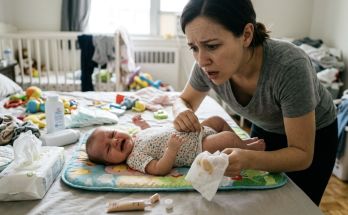
The final judgment came months after the morning I carried Paige toward the paramedics with her small body trembling against mine. By then, she had grown noticeably. Her cheeks were fuller, her attention sharper, and her injured leg had healed sufficiently for her doctors to encourage age-appropriate movement under continued supervision. She was beginning to explore the world with the determination of a child who had discovered that ordinary objects could be reached, touched, and examined. I watched her progress with an intensity that sometimes embarrassed me. Each new movement felt precious because I remembered how much pain movement had once caused her.
The criminal proceedings had taken longer than any of us wanted. Investigators reviewed electronic evidence, interviewed witnesses, and worked with medical specialists to establish the strongest supported conclusions. Daniel continued disputing responsibility for Paige's injuries and attempted to explain his records as misunderstood parenting notes. His defense challenged the interpretation of the P-17 file, the reliability of Kate's account, and the medical conclusions about earlier trauma. The court examined those arguments rather than dismissing them simply because his conduct appeared disturbing.
In the end, the judgment held Daniel criminally responsible for serious harm to Paige and for conduct connected to concealing that harm and intimidating those who might disclose it. The court considered the medical evidence, the documented timeline, the recovered records, the threatening communications, and witness testimony. Not every suspected incident could be proved individually, and the judgment did not pretend otherwise. But the evidence established enough to support a finding of responsibility for the central acts prosecuted. Daniel received a custodial sentence, and protective restrictions concerning Paige remained in place.
I sat in the courtroom when the judgment was announced. Kate was beside her advocate several seats away. Daniel faced the judge with the same controlled expression I remembered from family dinners, but this time his confidence could not alter the outcome. He had spent months preparing explanations that blamed other people, yet the combined evidence had exposed the contradictions. I did not feel the triumph I once imagined I would. I felt tired, relieved, and deeply sad that justice had required a child to endure so much suffering before the truth could be established.
The judge addressed the seriousness of harming a person who could not protect herself or explain what happened. Paige had been entirely dependent on adults for safety. The concealment of her injuries and the delay in seeking medical care compounded the danger. I listened with my hands clasped together, remembering the first photograph of the bruise beneath the beige coating. That small image had helped preserve the condition in which Paige arrived at my apartment. I was grateful I had taken it, but I wished there had never been a reason.
Kate cried quietly as the court concluded. Her own actions had also been examined through the appropriate legal and child-protection processes. She had acknowledged concealing an injury, delaying care, and initially making a false accusation against me. Authorities considered her cooperation, the coercive circumstances she described, and the consequences of her failures. Her responsibility was addressed separately from Daniel's. No single judgment erased the harm caused by her choices, and no one promised that her relationship with Paige would return immediately to what it had been.
Afterward, Kate and I stood outside the courthouse beneath a gray sky. People moved past us carrying briefcases and paper cups, absorbed in ordinary concerns. My sister asked whether I felt relieved. I said I did, but I also felt grief. Daniel's conviction meant there had been accountability, yet Paige would still need medical follow-up and a secure home. The legal process could establish responsibility. It could not give back the nights when she cried in pain or the opportunities adults had missed to protect her.
Kate said she understood. She had been attending counseling consistently and working with professionals to address the fear and isolation that shaped her decisions. She had also begun learning how to identify coercive behavior without surrendering her own judgment. The process was slow. Some sessions left her exhausted. Others helped her recognize patterns she had once considered normal. She had moved into independent housing and taken steps to manage her own finances. For the first time in years, she could make ordinary decisions without preparing an explanation for Daniel.
The child-protection team continued supervising her relationship with Paige. Visits were structured around the baby's needs rather than Kate's desire for reassurance. Sometimes Paige reached toward her mother immediately. On other days, she remained cautious and needed time to settle. Kate was learning not to interpret every hesitation as rejection. She followed the supervisor's guidance, responded gently, and ended visits when Paige became tired. The work required patience, but it was the kind of patience my sister had been prevented from practicing in her marriage.
I remained Paige's approved caregiver while the authorities evaluated longer-term arrangements. My apartment had become a small landscape of bottles, blankets, toys, medical paperwork, and carefully placed furniture. The kitchen calendar was crowded with appointments. I learned which songs made Paige smile, which textures she disliked, and how to recognize when she needed a break from stimulation. I also learned how quickly a day could disappear into feeding, cleaning, comforting, and watching a child discover something new.
There were difficult nights. Sometimes Paige woke crying, and I could not immediately understand why. I would check her diaper, offer comfort, and follow the medical guidance if I suspected pain. In those moments, fear sometimes returned with such force that I had to remind myself she was safe. Her doctors had explained that recovery would not follow a perfect straight line. She might have ordinary illnesses, developmental frustrations, or periods of increased sensitivity. Not every cry was evidence of renewed harm. My task was to respond thoughtfully rather than allow the past to turn every sound into an emergency.
The first time Paige laughed freely while I was changing her clothes, I had to sit down afterward. I had made a ridiculous noise while trying to pull a sleeve over her hand, and she responded with a sudden burst of laughter. I repeated it, and she laughed again. There was nothing dramatic about the moment. No revelation, no danger, no hidden evidence. It was simply a baby enjoying the attention of someone who loved her. Yet I found myself crying because such moments had once been overshadowed by fear.
My mother began visiting more often. She helped with meals, held Paige while I worked through paperwork, and sometimes sat quietly beside me after the baby fell asleep. We talked about the signs we had missed. She remembered Kate becoming withdrawn during pregnancy and Daniel answering questions for her. She remembered how uncomfortable family gatherings sometimes felt. We did not pretend that hindsight made everything obvious. Some warning signs had been ambiguous. Others should have prompted more concern. We agreed that the lesson was not to blame ourselves endlessly, but to take future concerns seriously and ask direct questions when someone seemed afraid.
I also thought often about the hospital staff. The paramedic who recognized the severity of Paige's pain, the nurse who documented the bruise, the doctors who ordered imaging, and the investigator who listened carefully had each contributed something essential. None of them knew the whole story at first. They acted on the information available and continued examining what did not fit. Their careful work prevented the case from becoming a contest between Daniel's confidence and Kate's fear.
The concealer tube remained one of the details I could never forget. It was an ordinary object with an ordinary purpose, yet in our family it had become a tool for hiding a child's suffering. Daniel had relied on appearances: carefully dressed photographs, controlled conversations, and explanations that sounded reasonable when heard without context. The hospital had looked beneath the surface. The investigators had examined records he thought would remain private. The court had considered how those pieces fit together. The truth emerged not because one person suddenly understood everything, but because multiple people refused to ignore what they could verify.
The P-17 file was another haunting part of the case. Daniel had tried to give cruelty the appearance of method. He wrote about observations and responses while ignoring the person at the center of them. Martin Hale's testimony helped establish that his project lacked legitimate oversight and had been rejected when he sought professional interest. The recovered records showed how Daniel attempted to organize and justify his conduct. But no spreadsheet or proposal could change the fact that Paige was a child who needed safety, comfort, and medical care.
I sometimes wondered whether Daniel ever understood that distinction. During the proceedings, he continued speaking about misunderstandings, household stress, and his intentions. He rarely seemed concerned with what Paige experienced. I stopped trying to understand his inner life beyond what the evidence showed. My energy belonged elsewhere. Paige needed appointments, routines, and the security of knowing someone would come when she cried. Trying to solve every mystery about Daniel's motives would not make her safer.
Kate's progress brought its own complicated emotions. She continued apologizing, but I eventually told her that repetition was no longer useful. I did not need her to describe her guilt every time we met. I needed her to remain honest, follow the protective arrangements, and become someone Paige could safely depend on. Kate accepted that. She began speaking less about forgiveness and more about the practical work she was doing: counseling, parenting education, financial planning, and cooperation with the child-protection team.
One afternoon, after a supervised visit, Kate asked whether I thought Paige would ever know what happened. I told her that as Paige grew older, she deserved truthful, age-appropriate explanations from the adults responsible for her care, guided by professionals who understood childhood trauma. She did not need to carry secrets designed to protect our reputations. Kate nodded slowly. She said she wanted her daughter to grow up knowing that asking for help was allowed and that adults could be questioned when something felt wrong.
That conversation stayed with me. Our family had once treated silence as a form of loyalty. We avoided uncomfortable subjects, softened criticism, and told ourselves that respecting privacy meant not asking too many questions. Daniel exploited that habit. He made cruelty look like discipline and isolation look like concern. The experience taught me that loyalty without honesty can become dangerous. Protecting someone sometimes means refusing to accept the explanation they offer, especially when a vulnerable person may be suffering.
As Paige's healing progressed, her doctors encouraged more normal movement. I watched her roll, reach, and eventually begin pulling herself toward objects with increasing confidence. Each milestone brought joy and anxiety. I worried about falls, discomfort, and whether I was doing everything correctly. The medical team reminded me that children need room to explore safely. I learned to balance caution with trust in her growing abilities. Paige did not need a world without every possible risk. She needed a world where adults responded when something went wrong.
Her first birthday approached while the longer-term care arrangements were still being reviewed. I decided to keep the celebration small. There would be no elaborate party or crowded room filled with people expecting her to perform. My mother baked a simple cake, and a few trusted relatives came to visit. Kate attended under the conditions approved by the child-protection team. She brought a soft yellow blanket and a handwritten card for Paige to read when she was older. The card contained no excuses. It expressed love and a commitment to becoming a safer, more reliable mother.
Paige was more interested in the wrapping paper than the gifts. She squeezed a ribbon between her fingers, examined it seriously, and then dropped it onto the floor. When my mother began singing, Paige looked around the room with wide eyes. Kate joined softly. I watched my sister's face as she sang. There was sadness there, but also a kind of attention I had not seen in her during the months before the hospital. She was focused on Paige rather than on whether someone might criticize her.
After the celebration, Kate helped me gather the discarded paper while the supervisor remained nearby. She thanked me for caring for Paige. I told her she did not need to keep thanking me. The arrangement existed because Paige needed protection, not because I wanted gratitude. Kate said she understood. Then she told me she had accepted that rebuilding their relationship might take years and might never follow the path she once imagined. She would continue doing the work because Paige deserved it, regardless of the outcome.
I respected that answer. It did not resolve every question about our family's future, but it showed that Kate was beginning to separate love from entitlement. She could love Paige without demanding immediate access. She could regret her mistakes without insisting that regret erase them. She could seek recovery from Daniel's coercion while still accepting responsibility for the decisions she made. Those were difficult truths, and she was learning to live with them.
The legal judgment remained part of our lives. There were documents to preserve, agencies to communicate with, and occasional updates concerning protective restrictions. But the case no longer occupied every hour of every day. Ordinary routines gradually took more space. Paige learned to recognize familiar songs. She developed a preference for a particular stuffed rabbit. She made impatient little sounds when I took too long preparing her food. Each small habit reminded me that she was growing beyond the identity of a child who had been hurt.
One evening, I found the first photograph I had taken of the concealed bruise while organizing evidence copies. I had avoided looking at it for weeks. The beige coating, the dark discoloration beneath, and the tiny curve of Paige's leg were still exactly as I remembered. I felt the old panic rise, followed by a quieter realization. That photograph had been necessary, but it was no longer the only image I carried of her. My phone now held hundreds of pictures of ordinary life: Paige smiling in her crib, gripping a toy, studying sunlight on the floor, and laughing at her grandmother.
I preserved the evidence as instructed, then closed the folder. I did not delete anything or pretend the past had vanished. I simply refused to let that single moment define everything Paige would become. Her injuries were part of her history, but they were not the whole of her life.
Later that night, Paige woke and began crying. I went to her room, checked that she was comfortable, and lifted her gently. She settled against my shoulder while I walked slowly across the floor. Outside, a car passed through the quiet street. The apartment smelled faintly of clean laundry and the lotion I had used after her bath. I could feel her breathing become steadier against my chest.
I remembered the first morning, when her cries had frightened me because nothing I did seemed to help. I remembered the concealed bruise, the frantic phone calls, and the terrible uncertainty of carrying her into the hospital. That day had changed all of us. It exposed a cruelty hidden beneath ordinary family life, forced my sister to confront her silence, and placed responsibility where it belonged. The process had been painful, imperfect, and slower than I wanted. But Paige was alive, healing, and surrounded by people who now understood that her safety came before every adult's comfort.
When I lowered her into the crib, she opened her eyes briefly and looked at me. I rested a hand near her shoulder and waited until she settled. There was no urgent decision to make, no secret to uncover, and no threatening message waiting on my phone. For that moment, there was only a child falling asleep in a safe room.
I turned off the light and left the door slightly open. If Paige woke again, I would hear her. And this time, when she cried, someone would come.
The End
Read more original stories on Feel Every Story.
My Sister Left Her Six-Month-Old Daughter in My Care, but a Terrifying Cry and a Hidden Mark Changed Everything That Morning
Part 12 of 12