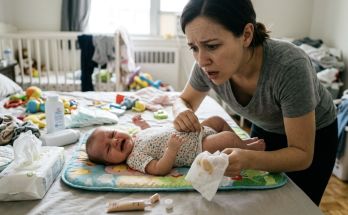
The first scream came from the living room while I was washing a coffee mug. It was so sharp and desperate that I dropped the mug into the sink, sending water across the counter. I had heard my six-month-old niece cry plenty of times. Paige could protest a late feeding or a wet diaper with impressive determination. But this was different. The sound seemed to come from somewhere deeper than ordinary discomfort. I hurried into the living room and found her lying in the portable crib, her small face flushed, her fists drawn tightly against her chest. When I reached beneath her to lift her, she screamed again, and her entire body stiffened.
“Paige, sweetheart, what's happening?” I whispered, gathering her against my shoulder. Her little fingers caught the fabric of my shirt, but she continued crying. I tried rocking her the way my sister Kate had shown me, shifting my weight from foot to foot and murmuring nonsense into her soft hair. Nothing helped. Paige had always responded to being held. Even when she was exhausted, she usually settled after a few minutes against my chest. This time, every movement seemed to make her worse. I lowered myself carefully onto the sofa, afraid that even adjusting my arms might hurt her.
Only forty minutes earlier, Kate had arrived at my apartment carrying Paige's diaper bag and looking as though she had not slept properly in a week. My older sister had once been the kind of person who noticed a crooked picture frame from across a room. That morning, her sweater was buttoned unevenly, and she had forgotten to remove the price tag from a new pair of slippers. She had asked me to watch Paige for a few hours while she dealt with something important. When I asked what it was, she looked toward the parking lot instead of answering.
“You'll be all right with her?” Kate had asked, though she knew I had babysat dozens of times. I told her of course. She adjusted Paige's blanket, checked the bottles inside the diaper bag, and then stood motionless beside the door. I remember thinking that she wanted to tell me something. Her lips parted twice, but each time she looked down at her phone and changed her mind. Finally, she touched Paige's cheek and said, “If she becomes unusually difficult to settle, promise me you'll get help rather than trying to manage everything yourself.” I assured her I would. She seemed to study my face, as though measuring whether I understood something she had not actually said.
Now I remembered those words while Paige cried in my arms. I checked the time and reached for my phone. Kate did not answer. I called again, listening to the ringing while I gently supported Paige's back. When the call went to voicemail, I sent a message explaining that the baby was crying unusually hard and asking whether she had been sick. I waited long enough to watch the screen dim, then placed the phone beside me. Paige was breathing in uneven little gasps between cries. Her forehead did not feel particularly warm, and I could see no obvious injury. But when I tried to reposition her left leg, her cry rose so suddenly that I stopped moving altogether.
I decided to change her diaper, hoping that a rash or irritation might explain her distress. I laid a thick towel across the sofa and lowered her onto it, keeping one hand behind her neck. The moment I started opening the fasteners of her sleeper, Paige began trembling. I spoke softly, telling her exactly what I was doing, though she was too young to understand. Her diaper was only slightly damp. There was no obvious rash. Then I pushed the fabric away from her left thigh and noticed a strange patch of color near the upper part of her leg.
At first, I thought Kate had applied a cream. The skin was covered with an unusually smooth beige substance, several shades different from Paige's natural complexion. It looked almost as though someone had painted a small section of her thigh. I leaned closer. The substance had gathered faintly in the creases of her skin, and there was a darker edge where the coloring stopped. I touched the area gently with the back of one finger, and Paige cried so violently that I snatched my hand away. I had not pressed hard enough to leave a mark. Whatever was beneath that coating was already terribly painful.
A cold feeling settled beneath my ribs. I took out my phone and photographed the strange patch before disturbing it further. Then I dampened the corner of a clean washcloth and touched only the outer edge. A little of the beige color came away. Beneath it was a dark bruise, purple near the center and reddish along one side. I stared at it, unable to understand what I was seeing. My sister had sent Paige to me with an injury concealed beneath something that looked unmistakably like makeup. The more I examined the exposed skin, the less ordinary the situation seemed.
I stopped immediately and took a second photograph. I knew very little about injuries in infants, but I understood that a baby who could barely move herself around a room should not have a bruise of that size without an explanation. I looked at Paige's face. She was exhausted from crying, her lower lip quivering, her breath catching each time she tried to settle. I wanted to call Kate and demand an answer. Instead, I reached for the diaper bag, hoping she had included a note about medication or a recent appointment. There were bottles, wipes, diapers, formula, a spare sleeper, and a folded blanket. Nothing that explained the bruise.
My hands shook as I dialed Kate again. This time she answered, but she did not greet me. I heard movement behind her, followed by a quiet mechanical sound that might have been a car door. “Kate, something's wrong with Paige,” I said. “She won't stop screaming, and there's a bruise on her leg.” For several seconds, my sister said nothing. Then she asked where I had found it. The question disturbed me more than her silence. She had not asked how Paige was breathing, whether she had a fever, or whether she needed medical help. She wanted to know exactly where the injury had been discovered.
“On her left thigh,” I answered. “There's something covering it. It looks like foundation.” Kate took a sharp breath. I heard a man speaking somewhere nearby, too faintly for me to distinguish his words. She said she was busy and would call back. I interrupted her. “I'm taking her to the hospital.” The line became so quiet that I checked whether the call had disconnected. When Kate finally spoke, her voice sounded thin and unfamiliar. She asked whether I was certain that was necessary. I looked at Paige, who had begun crying again despite barely moving, and said there was nothing to discuss.
Kate told me to wait until she could come back. I refused. She tried once more, saying that Paige sometimes cried when she was overtired and that I might be worrying unnecessarily. I could hear fear beneath her words, but I mistook it for embarrassment or irritation. “She's in pain,” I said. “I don't know why, and neither do you unless there's something you're not telling me.” Kate made a small sound, almost like a sob. Then she ended the call. I stared at the screen for a moment before gathering the baby's things. Whatever Kate knew, I could not afford to spend another minute arguing.
I called emergency services, described Paige's symptoms, and followed the dispatcher's instructions while help was arranged. I kept her as still as possible, avoiding pressure on her injured leg. Waiting felt unbearable. The apartment was painfully ordinary around us: a half-read magazine on the coffee table, sunlight across the rug, my abandoned mug resting crookedly in the sink. Paige was wrapped loosely in a blanket, her cheek against my arm. Every so often she stopped crying long enough to breathe deeply, and I felt a brief, unreasonable surge of hope that the danger had passed. Then she moved and cried again.
When the paramedics arrived, one of them introduced herself and immediately knelt beside us. She asked about the timing of the crying, Paige's feeding, and the injury. I explained everything, including the strange coating and the photographs. The paramedic examined Paige without moving the injured leg more than necessary. Her expression remained professional, but I noticed how carefully she exchanged a glance with her colleague. They prepared Paige for transport and reassured me that I had made the right decision to seek help. That reassurance did not make me feel better. It confirmed that something was seriously wrong.
The ride to the hospital passed in fragments. I remember the paramedic checking Paige's breathing and asking whether she had fallen recently. I said not while she had been with me. She asked whether Paige was crawling. I explained that she could roll and squirm but was not yet moving independently. Another question followed about who usually cared for her. I told her Kate and Kate's husband, Daniel, were her primary caregivers. Speaking their names in that setting felt strange, as though I had dragged my family into a situation none of us yet understood.
At the emergency department, a nurse guided us into an examination room. A doctor arrived soon afterward and introduced herself before inspecting Paige. She asked me to repeat everything from the beginning. I described Kate's visit, the first unusual scream, the concealing substance, and my attempt to expose just enough skin to understand what I was seeing. The doctor listened without interrupting, then asked whether I had the original photograph. I showed her. She enlarged it, studied the patch, and called another member of the medical team to the room.
While Paige was being assessed, I tried Kate again. Her phone rang without an answer. Daniel did not pick up either. I sent a message saying that Paige was at the hospital and needed them. It remained unread. The silence was becoming difficult to explain. Kate had always been anxious about ordinary childhood illnesses. She had once called me three times because Paige sneezed repeatedly after a bath. Yet now that her daughter was being examined for a painful injury, she was nowhere to be found.
The doctor returned with a nurse and asked permission to photograph the affected skin for the medical record. She explained that they also needed imaging to determine whether there was an injury beneath the bruise. I asked if she suspected a broken bone. She did not speculate, telling me that the examinations would provide better information. Then she asked a question that made the room feel suddenly smaller. “Ally, has anyone told you how Paige got this bruise?” I shook my head. She looked down at the chart and wrote something without speaking.
I thought of Daniel. He worked for a medical supply company and often spoke confidently about doctors, treatment costs, and the supposed incompetence of ordinary people making medical decisions. He had always seemed reserved rather than cruel. At family gatherings, he smiled politely, answered questions with careful precision, and rarely joined conversations unless someone addressed him directly. I remembered once suggesting that Paige seemed unusually quiet around him. Daniel had told me that parents knew their own children better than relatives who visited occasionally. I had considered the remark rude, nothing more.
The nurse prepared to take Paige for imaging. When she lifted the baby, Paige gave another piercing cry, and the nurse immediately adjusted her support. I wanted to follow them, but the doctor explained that I would need to wait briefly outside the examination area. I watched the doors close behind them. The silence that followed was worse than the crying. With Paige gone, I could no longer concentrate on holding her or comforting her. There was nothing to do except think about that bruise and the layer of makeup someone had applied over it.
A hospital social worker approached me in the waiting area and asked whether she could sit down. She had a folder in her hands and a calm manner that made me nervous. She wanted to know who had brought Paige to my apartment and whether I had been alone with her before the screaming began. I answered carefully. She asked whether anyone else had visited. No. Had Paige fallen? No. Had I noticed the discoloration immediately? No, only during the diaper change. Each answer seemed to move us farther away from an ordinary medical emergency.
I showed her the photographs and explained that I had preserved the original image because I suspected the substance might matter. She asked me not to delete or alter anything. Then she wanted to know where the diaper bag was. I pointed to it beside my chair. She said the medical team might need to examine its contents later and asked me to leave everything as it was. The request made me look at the bag differently. That morning, it had been an ordinary object filled with the things a baby needed. Now it seemed possible that it contained evidence.
My phone vibrated. I grabbed it, expecting Kate, but the notification was only an automated appointment reminder. I felt a rush of anger at how badly I wanted my sister to call. I wanted her to explain the bruise, tell me there had been an accident, and offer some reasonable account of the makeup. I wanted to believe that the hospital was being overcautious. Yet every time I pictured Kate's face at my doorway, I remembered her hesitation and her peculiar instruction to get help if Paige became difficult to settle.
The doctor came back after what felt like hours. A second physician accompanied her, carrying the imaging results. They did not sit down immediately, and I noticed that the social worker remained nearby. The doctor told me Paige was receiving appropriate care and that the orthopedic team needed to evaluate the findings. I asked what they had found. She explained that an abnormality had appeared in the upper part of Paige's left leg and that additional assessment was necessary. My mouth went dry before she finished speaking.
“Is it broken?” I asked. The doctor confirmed that the images showed a fracture. I gripped the arms of my chair, trying to understand how a six-month-old baby could have suffered such an injury without anyone telling me. The doctor spoke gently, explaining that they would treat Paige's pain and determine the safest way to stabilize her leg. Then she said they were concerned by more than the current fracture. Other findings suggested possible injuries from an earlier time, and a full examination was being arranged.
I looked from the doctor to the social worker. “Are you saying someone hurt her?” The doctor said they could not determine the complete circumstances from the images alone, but the pattern required a formal child-protection investigation. I asked how old the other injuries were. She explained that specialists would evaluate that question. My mind returned to every cheerful photograph Kate had sent, every carefully dressed image of Paige smiling beneath soft blankets. I had seen a happy baby. I had never considered what might be concealed beneath her clothes.
Then the doctor added that the hospital had contacted the appropriate authorities. An investigator would be speaking with me because Paige's injuries could not be explained by ordinary infant movement. I nodded, although I was struggling to follow her words. Somewhere beyond the examination doors, my niece was receiving treatment for a broken leg. My sister would not answer her phone. And someone had disguised a painful bruise with cosmetics before leaving the baby in my care.
I had believed the worst discovery of the morning was the makeup on Paige's thigh. Standing in that hospital corridor, I understood that the makeup had merely been the first thing someone had failed to hide.
Click here to continue reading: PART 2: As the Hospital Investigated My Niece’s Injuries, My Sister Made an Accusation That Turned Me from Her Protector into a Suspect
My Sister Left Her Six-Month-Old Daughter in My Care, but a Terrifying Cry and a Hidden Mark Changed Everything That Morning
Part 1 of 12