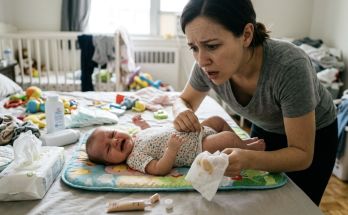
Kate sat beside Paige's hospital bed with both hands clasped tightly between her knees. She looked at her daughter but seemed unable to hold her gaze for long. I had known my sister all my life. I could recognize the expression she wore when she was hiding a birthday surprise, when she was struggling not to cry, or when she had made a decision she expected me to challenge. This was something different. Her face carried the strained concentration of someone choosing each word carefully because she had spent months learning that the wrong sentence could have consequences.
I asked what she meant when she said Daniel's treatment of Paige had begun before the baby was born. Kate explained that her husband had become increasingly controlling during the pregnancy. He monitored her meals, questioned her sleep schedule, and demanded explanations whenever she spoke with friends or relatives without telling him first. At first, she mistook his behavior for anxiety about becoming a father. He read medical articles, attended appointments, and insisted that every decision should prioritize the baby's health. Gradually, his concern became a set of rules Kate was not allowed to question.
“He made it sound as though I was careless whenever I disagreed,” she told me. “If I wanted to visit Mom, he asked why I couldn't rest at home. If I spoke with you, he wanted to know what we discussed. Even ordinary appointments became arguments.” I remembered how Kate stopped inviting me along to pregnancy checkups. At the time, she said Daniel wanted to be more involved. I had thought it was sweet that he attended every visit. Now she explained that he insisted on answering questions for her and sometimes corrected her descriptions of symptoms.
I asked when she realized his behavior was no longer ordinary concern. Kate looked down at her hands. She said the change became unmistakable when Daniel began speaking about the baby as though she were an inconvenience to be controlled rather than a person to be loved. He complained about lost sleep before Paige was even born and predicted that crying would destroy their marriage. When Kate suggested they could share the responsibilities, he told her that a competent mother should be able to manage without disturbing her husband.
After Paige's birth, Daniel's expectations became more severe. He wanted the house quiet, the baby's routine exact, and Kate available whenever he demanded her attention. Paige cried because she was hungry, tired, uncomfortable, or simply needed to be held. Daniel treated each cry as proof that Kate had failed. He accused her of spoiling the child and insisted she was creating bad habits by responding too quickly. Kate became afraid of ordinary sounds from the nursery. She learned to wake at the smallest movement because she wanted to reach Paige before Daniel heard her crying.
I struggled to understand how anyone could expect a six-month-old infant to obey rules. Kate said she had asked the same question repeatedly. Daniel answered that children should learn early that crying did not guarantee attention. When Paige became distressed, he sometimes ordered Kate to leave the room. If she argued, he reminded her that he paid the household bills and understood medical matters better than she did. He worked for a medical supply company and frequently used that experience to suggest that his judgments carried authority. Kate had gradually stopped challenging him aloud.
I asked whether he had physically hurt her during the pregnancy. Kate hesitated before describing incidents of being grabbed, shoved, and prevented from leaving rooms during arguments. She said he had threatened her long before she could identify what was happening as abuse. Sometimes he apologized afterward and blamed exhaustion or financial pressure. At other times, he insisted she had provoked him by refusing to follow instructions. I remembered the red mark on her face from an earlier visit and wondered how many explanations I had accepted without questioning them.
Kate said the first time she tried to leave, she went to our mother's house. She stayed there briefly, hoping the distance would allow her to make a plan. Daniel came looking for her, promising counseling and a fresh start. He also warned that he could make a custody dispute painful if she refused to return. Kate went home believing she might still save the marriage. I did not interrupt, although I wanted to ask why she had not called me. The answer was becoming painfully clear: Daniel had learned how to make every possible escape route seem dangerous.
The second attempt came after Paige was born. Kate had packed a small bag and planned to leave while Daniel was at work. Somehow he discovered the preparations. He told her that she would never be able to prove she was a capable mother because he had recordings of her at her worst. Whenever Paige cried for hours, whenever Kate lost patience or dissolved into exhausted tears, Daniel took out his phone. Sometimes he deliberately provoked an argument, then began recording after Kate became upset.
I asked whether the recordings showed him threatening her. Kate said most did not. He controlled when the recording started and what parts of the conversation were preserved. He collected images of her crying, raising her voice, and struggling to soothe Paige. He warned that a lawyer could use those moments to portray her as emotionally unstable. Whether his threats would have succeeded was uncertain, but Kate had become convinced that leaving might cost her daughter. She had little money of her own and no clear understanding of how to protect herself.
I looked at Paige sleeping in the bed. “But he was hurting her,” I said. My sister lowered her head. She admitted that she had noticed unexplained marks and unusual reactions long before the current injury. At first, Daniel offered explanations that sounded plausible: accidental pressure from clothing, irritation from carrying equipment, or small mishaps that happened while caring for an infant. When she questioned those explanations, he accused her of becoming hysterical. Over time, she began keeping track of things she could not explain.
She described the family barbecue I remembered. Paige had cried when Kate tried to place her in a carrier. Kate now believed the movement had pressed against an injury she had not understood. Daniel had become irritated by the attention the crying attracted, and Kate responded sharply because she feared his reaction. Hearing her explain it made me remember the awkward silence around the table. We had all sensed something was wrong. None of us had recognized how much was wrong.
I asked about the pediatrician she had mentioned three weeks earlier. Kate admitted that Paige had developed another mark and seemed uncomfortable when moved. She wanted an independent examination. Daniel insisted the child needed rest and said unnecessary medical visits would make Kate appear incapable of managing ordinary parenting problems. She contacted me indirectly, hoping I would suggest a doctor and give her a reason to seek care. When I asked what had happened, she lost courage and abandoned the plan.
The admission hurt. I remembered seeing the message and replying casually, assuming my sister was simply gathering information. Now I understood that she had been searching for an opening. I also understood that she had not used it. I told her I wished she had explained what was happening. Kate looked at me and said she wished the same thing every day. Neither of us could change the past, and the baby in the bed made that impossibility unbearable.
Then I asked about the previous night. Kate's hands began trembling. She said Paige had been restless after her evening feeding. Daniel complained repeatedly, insisting that Kate make the crying stop. At some point he went into the nursery while Kate was in another room. She heard Paige cry in a way she had never heard before. When she rushed in, Daniel was standing beside the crib. Paige's left leg looked swollen, and any attempt to move her brought immediate distress.
Kate wanted to call an ambulance. Daniel refused. He told her the injury was minor and warned that if she involved doctors, he would say she had caused it while handling Paige carelessly. Kate said she pleaded with him to let her seek help. He responded by reminding her of the recordings he had collected. He claimed he could make investigators believe she was dangerous and that Paige would be taken away. When she tried to reach for her phone, he blocked her way.
I felt anger rise in my chest. “He couldn't have known what the doctors would believe,” I said. Kate agreed quietly. But by then she had been frightened for so long that even an uncertain threat seemed powerful. Daniel had isolated her from people who might challenge his version of events. He insisted his knowledge of medical products gave him an advantage she did not possess. The more frightened Kate became, the harder she found it to judge what help was possible.
I asked who had put the makeup on Paige's thigh. Kate admitted she had done it under Daniel's orders. He supplied the concealer and told her to hide the discoloration before anyone saw the baby. She said she hated doing it and tried to keep her hands steady so she would not cause Paige additional pain. Daniel had also controlled what topical products were used. Kate did not know everything he applied, but she remembered him handling a cream that he said would reduce the baby's discomfort.
I thought of the numbing substance detected by the hospital. Until that moment, I had imagined the cosmetics as a desperate attempt to cover a single injury. Now I understood that they were part of a method Daniel had repeated: conceal visible signs, discourage independent examination, and invent explanations before anyone could question him. I asked why Kate had not defied him despite the threats. She did not claim that fear made her choices harmless. She said she had failed Paige and knew it.
“What happened this morning?” I asked. Kate told me she had spent much of the night awake beside the baby's crib. She could see that Paige was in pain, and she knew Daniel would not permit a hospital visit. By morning, she had decided that someone else needed to discover the injury. She could not persuade Daniel openly, so she arranged for me to babysit. He knew I sometimes cared for Paige and considered it ordinary. Kate hoped that once I saw the baby's condition, I would seek treatment regardless of her instructions.
I remembered her standing at my door, checking the diaper bag. She admitted she had left the concealer inside and deliberately said I should seek help if Paige became unusually upset. She had wanted me to recognize the danger without having to speak directly. But when I phoned to say I was taking Paige to the hospital, Daniel was close enough to hear part of the conversation. He demanded to know what I had discovered. Kate panicked and ended the call before she could tell me anything else.
I asked how Daniel had persuaded her to accuse me. Kate said he later contacted her from an unfamiliar number after learning that Paige was at the hospital. He instructed her to describe the baby as healthy when she left my apartment and to suggest that I had become angry about the crying. He threatened to use his recordings against her if she contradicted him. Kate obeyed at first. Then, when officers reached her at home and Daniel was absent, she began explaining the truth. Each admission terrified her because she had no idea where her husband had gone.
I told her about the photograph sent to my phone. She looked at the picture of Paige in the crib and recognized the silver ring. Her face changed when she saw the warning beneath it. She said Daniel sometimes photographed Paige during crying episodes and recorded Kate's responses. He claimed he was documenting how difficult their household had become. Kate now believed he was collecting material to support whatever account suited him. She had seen him use a work phone for some recordings, though she did not know how many files he kept.
I asked whether he could reach the hospital. Kate looked toward the closed door and said she did not know. That uncertainty had kept her from speaking freely when she first arrived. The investigator had arranged restrictions on access to Paige, but Kate still feared Daniel could persuade someone that he belonged at his daughter's bedside. I reassured her that hospital staff knew about the investigation. Yet I did not dismiss her fear. I had already seen how easily Daniel could conceal cruelty behind a controlled voice and respectable appearance.
Kate took a long breath and admitted that she had been documenting incidents secretly for months. She photographed injuries when she could do so safely, preserved records of medical appointments, and wrote down dates when Paige showed signs of pain. She had also saved audio recordings of threatening conversations. Some of the evidence involved unexplained purchases and paperwork connected to Daniel's work. She did not fully understand the financial documents, but they worried her enough that she began keeping copies.
I stared at her. “Why didn't you give those records to the investigators immediately?” Kate explained that the files were hidden because Daniel regularly checked her phone and searched her belongings. She feared that if he found them, he would destroy everything and retaliate. She had created a secret collection of documents, photographs, and recordings, hoping one day she would have enough evidence to seek protection. Yet every time she considered approaching someone, Daniel reminded her how thoroughly he could damage her credibility.
I asked where the evidence was. Kate hesitated. She looked at the officer outside, then at Paige. “If Daniel discovers the hiding place before the police do, it will all disappear,” she said. I told her the investigator needed to know immediately. Kate nodded, but her hands were shaking so badly that she could barely hold the phone. I offered mine, then remembered it had been examined because of the threatening messages. There was no reason to delay telling the people already trying to protect Paige.
The investigator entered after Kate asked to speak with her. My sister explained that she had information relevant to Paige's injuries and Daniel's conduct. She described the records without trying to minimize her own actions. She admitted applying the concealer, allowing the hospital visit to be delayed, and initially accusing me under pressure. The investigator listened carefully and explained that Kate would need to provide a complete formal statement. Kate agreed. The choice seemed to cost her something physically; she looked pale and exhausted, but she did not withdraw what she had said.
Before standing, Kate reached for my hand. Her fingers were cold. She told me she was frightened that Daniel would find her or destroy the evidence while she was speaking to investigators. I said the authorities were searching for him and that hiding information would only give him more time. Kate nodded. For the first time that afternoon, she looked directly at me without immediately turning away. She asked whether I would make sure Paige remained safe while she gave her statement.
I promised I would stay with the baby as long as the hospital permitted. Kate squeezed my hand and began describing a loose floorboard in the bedroom she shared with Daniel. Beneath it, she said, was a blue storage box containing the materials she had collected. She had kept it hidden because Daniel rarely moved the furniture on her side of the room. She also knew the quickest way to reach the compartment without drawing attention.
The investigator asked what was in the box. Kate described photographs, medical records, audio recordings, bank statements, and a handwritten record of the occasions when Paige had been hurt. She had kept dates and notes because Daniel often denied incidents afterward, leaving her questioning her own memory. The investigator's expression became more intent as Kate explained that the papers included information about payments connected to medical supplies. Kate could not explain every transaction, but she was certain the records mattered.
I looked at my sister, trying to reconcile the woman who had hidden her child's injuries with the woman who had secretly preserved evidence of them. Both had lived inside Kate for months. Her fear had endangered Paige, yet her determination to preserve the truth might finally help establish what Daniel had done. I told her she had to give the investigator everything, including details that might make her own decisions difficult to defend. She said she would. She was finished allowing Daniel to choose which parts of the truth could be spoken.
The investigator asked Kate to remain in the protected hospital area while officers arranged the next steps. Kate provided the location of the house key and explained how the hidden compartment could be opened. The investigator made a call, speaking quietly but firmly. I watched her write down the description of the blue box. The possibility that it contained evidence of repeated injuries was terrible enough. The inclusion of financial records suggested another question we had not yet understood: why Daniel had been documenting and purchasing things connected to Paige's condition.
Kate rose slowly and approached her daughter's bed. Paige stirred when her mother touched her fingers. Kate bent close, careful not to disturb the injured leg, and whispered that she was going to tell the truth. I stood beside them without speaking. I could not promise that the family would recover quickly or that Kate would escape responsibility for her choices. All I could see was a frightened mother beginning to cooperate and a baby whose safety could no longer depend on secrecy.
The investigator returned to confirm that officers were being sent to recover the hidden evidence. Kate closed her eyes for a moment. When she opened them, she looked more frightened than before, but she did not ask anyone to stop. I understood then that revealing the blue box was a decision she could not undo. Daniel might deny everything she had said. He might try to discredit us both. But there would now be records beyond his immediate control.
As the investigator prepared to leave, Kate caught her attention one last time. She said the box contained more than a few isolated photographs. She had kept a written list, recording every incident she could identify since Paige was born. Each entry included a date, what she observed, and whatever explanation Daniel had given afterward. The investigator asked how many entries there were.
Kate swallowed and answered, “Seventeen.”
I looked at Paige, only six months old, sleeping beneath the hospital blanket. Seventeen incidents. The number was so much worse than anything I had imagined that I could not speak.
The investigator left to coordinate the recovery of the box. Kate remained beside me, staring at her daughter. Somewhere beyond the hospital, Daniel was missing. And beneath a floorboard in his own bedroom lay a record that might expose not only what he had done to Paige, but why he had been so determined to prevent anyone from discovering it.
Click here to continue reading: PART 5: The Seventeen Entries in My Sister’s Hidden Notebook Revealed a Pattern of Cruelty and a Missing Record Daniel Had Tried to Destroy
My Sister Left Her Six-Month-Old Daughter in My Care, but a Terrifying Cry and a Hidden Mark Changed Everything That Morning
Part 4 of 12