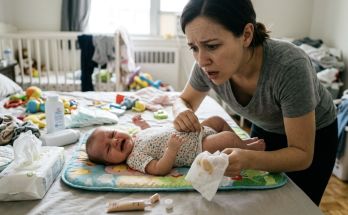
By the time the first major court hearing approached, Paige was no longer in the hospital. Her doctors had approved discharge after arranging a detailed recovery plan, and the child-protection team had authorized a temporary placement in my home. The approval came with specific conditions: medical follow-up, regular contact with assigned professionals, and strict limits on access by anyone whose involvement remained under review. I had spent days preparing my apartment. I moved furniture to make room for the crib, installed the recommended safety equipment, and placed Paige's medical instructions in a folder beside the kitchen calendar. The apartment looked different, but not unfamiliar. It had become a place organized around the needs of one small child.
The first night Paige slept there, I barely closed my eyes. I checked on her whenever she moved, afraid that discomfort might go unnoticed. The medical team had shown me how to handle her safely, how to recognize concerning symptoms, and when to seek help. Her leg was healing, but she still needed careful positioning and follow-up. Each ordinary task required attention. I learned to prepare bottles while listening for changes in her breathing, to organize appointments around her rest, and to distinguish a hungry cry from a cry that suggested pain.
Kate visited only under the supervision arranged by the child-protection team. The first visit was difficult. She entered the room slowly, stopped beside the crib, and began crying before she could speak. The supervisor gently encouraged her to focus on Paige rather than her own distress. Kate wiped her face, sat down, and waited until she was invited to hold her daughter. I watched carefully, prepared to intervene if the baby became uncomfortable. Paige studied her mother's face, then reached toward her sweater. Kate made a small, broken sound and gathered herself before speaking.
She had begun attending counseling and working with an advocate to establish an independent life. Her progress was not smooth. Some days she was determined and practical. Other days, she became overwhelmed by guilt and fear. She had moved into temporary housing away from Daniel's home and was learning to manage finances that he had previously controlled. The child-protection team was evaluating her capacity to provide safe care over time. No one had promised that she would regain unsupervised access, and Kate no longer demanded that outcome immediately.
Meanwhile, the legal case against Daniel continued. Investigators completed additional interviews, reviewed medical records, and prepared evidence for prosecutors. The recovered P-17 file became central to understanding his conduct, but the case did not rely solely on its disturbing language. Specialists examined the dates, authorship, and relationship between the entries and Paige's documented injuries. The court would need to consider not only what Daniel wrote but whether the evidence established the acts alleged against him.
I met with prosecutors before the hearing to prepare my testimony. They asked me to describe only what I personally observed. I could explain Paige's condition when Kate left her at my apartment, the unusual crying, the concealed bruise, the photographs I took, and the calls I made. I could not testify that I witnessed Daniel cause the fracture because I had not. I appreciated the clarity. The facts I knew were already serious enough. I did not need to invent certainty about moments I had never seen.
The prosecutor asked me to reconstruct the morning in precise order. Kate arrived with Paige and the diaper bag. She appeared exhausted and made the unusual comment about seeking help if the baby became difficult to settle. Paige began screaming shortly afterward. I checked her diaper, found a beige substance covering part of her left thigh, and discovered the bruise beneath. I took photographs, contacted Kate, and called emergency services. The hospital later diagnosed a fractured femur and identified other concerning findings. I repeated the sequence until I could explain it without becoming lost in anger.
When the hearing began, I was surprised by how ordinary the courtroom looked. There were wooden benches, folders stacked on tables, and people speaking in low voices. Daniel sat beside his legal representative wearing a plain suit. He looked smaller than I remembered, though perhaps that was because he no longer controlled the room. He did not appear frightened. He watched the proceedings with the same restrained expression he used during family gatherings. Seeing him brought back the old discomfort of being corrected and dismissed, but now I understood that his confidence was not evidence of innocence or authority.
Kate sat several rows behind me with her advocate and legal adviser. She looked pale but determined. We had spoken briefly outside the courtroom. She told me she planned to answer every question accurately, including those about her own failures. I said that was all anyone could ask. We did not embrace. The relationship between us had changed too much for easy gestures. But when she looked toward the front of the courtroom, I saw that she was no longer searching for Daniel's approval.
The prosecution began by presenting the medical evidence. Specialists described Paige's current fracture and the additional findings that raised concern for earlier trauma. They explained why the reported explanations were inconsistent with parts of the medical picture, while acknowledging the limits of assigning exact dates or causes to some injuries. The testimony was careful and technical. I found it harder to listen to than the investigator's summaries because every detail concerned something Paige had endured in a body too small to protect itself.
The defense questioned the specialists about accidental injuries, uncertainty in dating trauma, and the possibility that some findings had alternative explanations. The doctors answered without exaggeration. They distinguished between what the images clearly showed and what remained medically uncertain. I realized how important that restraint was. The case would be stronger if each conclusion stayed within the evidence rather than stretching to satisfy our desire for justice.
When I was called to testify, my hands trembled as I approached the witness stand. I told the court about Paige's screaming and the way her body stiffened when I tried to move her. I described the makeup-like substance on her thigh and the dark bruise beneath it. The photographs were displayed, and I identified each one. I explained that I had taken them before removing more of the coating because I wanted medical staff to see exactly what I found. My voice shook when I described the call in which Kate asked where the bruise was rather than asking how Paige was doing.
The defense asked whether I could have accidentally injured Paige while changing her diaper. I said I had supported her carefully and stopped touching the leg when she cried. The lawyer asked whether I had medical training. I said no. He asked whether I knew exactly when the fracture occurred. I said I did not. Then he asked whether I disliked Daniel. I paused before answering. I told him that I had found Daniel difficult and controlling, but my personal feelings did not change what I observed that morning.
The questioning continued, but I kept returning to the facts. Paige was already in severe pain before I discovered the bruise. The discoloration was covered with a substance I had not applied. I sought medical help because her condition frightened me. I did not know who caused the injury, and I had never claimed to witness it. When I finished, I felt exhausted but strangely steady. Daniel's old method of making people doubt themselves had less power when the questions were answered one fact at a time.
Kate's testimony came later. She described Daniel's controlling behavior during pregnancy, his threats about custody, and his repeated efforts to prevent medical care. She admitted that she had concealed Paige's bruise under makeup and delayed seeking help after the baby's leg became swollen and painful. She also acknowledged that she initially accused me because Daniel instructed her to do so. Her voice broke several times, but she did not withdraw those admissions. Watching her was painful. She was exposing both Daniel's cruelty and her own failure to protect her daughter.
The defense questioned Kate about inconsistencies in her earlier statements. She acknowledged them. The lawyer asked why she had not called emergency services immediately. She said she was afraid of Daniel's threats, but she understood that fear did not make the delay harmless. He asked whether she had ever become frustrated with Paige's crying. She said yes, as many exhausted parents do, but denied intentionally injuring her. When he suggested she was blaming Daniel to avoid responsibility, she answered that she expected her own actions to be examined separately. She was not asking the court to pretend she had done nothing wrong.
I watched Daniel during her testimony. He occasionally leaned toward his lawyer, but he did not interrupt. The courtroom no longer belonged to him. He could not end the conversation by walking out or accuse Kate of disloyalty without consequences. She was speaking in a setting where her words could be tested against records rather than dismissed through intimidation. I wondered whether she felt the same change. Her shoulders remained tense, but she did not look toward him for permission to continue.
The prosecution then introduced portions of the recovered recordings and documents. The court heard Daniel refusing medical care and warning Kate about the consequences of involving outsiders. The P-17 file was discussed alongside the independent records that helped establish its timing and origin. Martin Hale testified about Daniel's attempt to interest him in the proposed project and his own rejection of it. He explained that he had seen no legitimate research oversight and had warned Daniel against pursuing the idea. His testimony did not establish every injury, but it supported the broader picture of Daniel's intentions.
The financial evidence was more limited than I had expected. Prosecutors showed that Daniel made purchases associated with his private project and maintained separate records, but they did not claim that the transactions alone proved abuse. The investigator had warned us about that distinction. In court, it became clear why it mattered. Daniel's conduct was frightening enough without treating every unusual purchase as criminal. The strongest evidence concerned his documented decisions, threats, concealment, and the medical condition of his daughter.
During a break, I sat beside Kate in a quiet corridor. She looked exhausted. For a long time neither of us spoke. Then she said she had spent years believing that if Daniel sounded certain, everyone else must be wrong. Hearing his claims examined one by one had made her realize how much of his power depended on people accepting his confidence as proof. I told her I had felt the same way when he questioned my ability to care for Paige. She looked at me with tears in her eyes. “He made us doubt ourselves,” she said. “And Paige paid for it.”
I did not disagree. The court could determine legal responsibility, but it could not return the months Paige had spent in fear and pain. I thought about her at home with the temporary caregiver who had been approved to stay while I testified. She was probably waking from a nap, looking for a familiar face, and expecting someone to respond when she cried. That ordinary expectation mattered more to me than any dramatic moment in the courtroom.
When proceedings resumed, the prosecution presented the prepared blame statements recovered from Daniel's devices. One accused Kate. Another suggested I had mishandled Paige. The documents were compared with messages Daniel sent after the hospital visit and with his statements to investigators. The pattern was unmistakably relevant: he had anticipated different ways the injuries might be discovered and drafted explanations that shifted responsibility to others. The court would determine what conclusions could properly be drawn, but the existence of those competing narratives exposed the dishonesty beneath his confident accounts.
The defense argued that the drafts were private notes written during family conflict and did not prove Daniel caused the injuries. That was a legitimate point for the court to consider. Yet I could not forget that the documents contained details Daniel used when he pressured Kate to blame me. His words were not harmless abstractions. They had been deployed in real conversations while Paige lay in a hospital bed.
Near the end of the hearing, the court considered the protective arrangements and the evidence supporting continued restrictions on Daniel's contact with Paige. The judge emphasized that the child's safety remained paramount while the criminal proceedings continued. The restrictions were maintained. Daniel would not be permitted to contact Paige or interfere with witnesses under the existing orders. I felt a rush of relief, though I knew the broader case was not finished.
Outside the courthouse, Kate stopped beside me. She said she had been afraid that telling the truth would destroy what remained of our family. Now she understood that the family had already been damaged by secrecy. The only chance of rebuilding anything was to stop protecting false accounts. I looked at her and said that truth was necessary, but not sufficient. Paige would need consistent safety over time. Kate nodded. She did not ask for an easier answer.
When I returned home, Paige was awake in her crib. I washed my hands, approached slowly, and spoke her name. She turned toward my voice and made a small excited sound. I lifted her with the care her doctors had taught me, supporting her injured leg, and held her against my chest. Her cheek rested against my shirt. I thought about everything the court had heard that day and how little of it she could understand. Then I realized that was exactly as it should be. She did not need to carry the burden of proving what happened to her. That responsibility belonged to the adults.
The hearing had not yet resolved every allegation, but it had changed something essential. Daniel's explanations were being tested in public, Kate's silence had been broken, and the evidence could no longer be hidden beneath a floorboard or a layer of concealer. We were moving toward an outcome that would not depend on one frightened person's memory. Whatever the final judgment, Paige's injuries had finally been recognized as facts that demanded accountability.
Click here to continue reading: PART 12: After the Court Delivered Its Judgment, My Niece Began Healing and Our Family Learned That Protection Required More Than Love and Regret
My Sister Left Her Six-Month-Old Daughter in My Care, but a Terrifying Cry and a Hidden Mark Changed Everything That Morning
Part 11 of 12