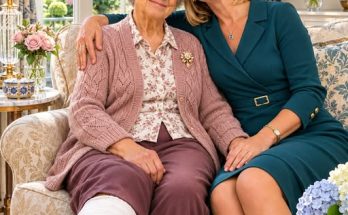
The first time Clare showed me one of her new drawings, she looked nervous.
She stood in my kitchen holding a sheet of paper.
I was making tea.
The late afternoon light came through the balcony door.
My little apartment smelled faintly of the flowers I had bought that morning.
Clare waited until I put the kettle down.
“Grandma, can I show you something?”
I turned toward her.
“Of course.”
She held out the paper.
It was a drawing she had made at school.
I looked at it carefully.
There were shapes and colors arranged with a confidence I hadn't seen in her before.
She had always enjoyed creative things.
But during the weeks after the argument at Michael's house, she rarely talked about anything except the trouble between her parents.
Now she was talking about art.
It made me happier than I could explain.
“Did you make this in class?”
She nodded.
“At the art club.”
I looked up.
“You joined?”
A small smile appeared.
“Yes.”
She looked down.
“I wanted to try it.”
I handed the paper back carefully.
“I'm glad you did.”
She studied my face.
“Do you think it's good?”
I smiled.
“I think you worked hard on it.”
She laughed softly.
“That's not the same thing.”
I laughed too.
“No, it isn't.”
I looked at the drawing again.
“It's very good, sweetheart.”
Her smile widened.
For a moment, she looked like the girl I remembered before the financial secrets began weighing on her.
Not a frightened teenager holding a phone while her father shouted.
Not a child sitting on the stairs with a packed bag.
Just Clare.
Sixteen years old.
Proud of something she had made.
I wanted more afternoons like that.
Over the following weeks, her routine became steadier.
She attended school.
She talked with her friends.
She spent time on her drawings.
She still worried sometimes.
I could see it when her parents' names appeared during conversations.
But she wasn't living in constant fear anymore.
That mattered.
The temporary living arrangement had given her a calmer place to stay while the family addressed what had happened.
I tried to keep my apartment ordinary.
There were meals.
School things.
Quiet evenings.
Sometimes a movie.
Sometimes we sat together without talking much.
I didn't want her to feel she had been moved from one place full of obligations to another.
She had enough responsibilities for her age.
I wasn't going to turn her into my companion because I was lonely.
I had learned how dangerous it could be when an adult treated someone else's love as a solution to every personal need.
Michael had done that to me.
I didn't want to repeat the pattern with Clare.
So when she wanted to spend time with friends, I encouraged her.
When she wanted to draw alone, I let her.
When she complained about homework, I listened and smiled.
She didn't have to entertain me.
She didn't have to make me feel useful.
She was my granddaughter.
That was enough.
One afternoon, she came home carrying a larger sheet of paper.
She kept it turned away from me.
I noticed immediately.
“What's that?”
She smiled.
“Something.”
I laughed.
“Something?”
She nodded.
“It's not finished.”
I didn't press.
I had spent months being questioned about things I should have been allowed to decide for myself.
I wasn't going to make Clare feel that every choice required an explanation.
She took the paper to her room.
Later, I heard her moving things around.
Then the apartment became quiet.
I sat in the rocking chair.
Outside, the street was peaceful.
My plants had begun to grow stronger.
I wasn't an expert gardener, but I enjoyed tending them.
It reminded me of the old house.
I remembered the flower beds.
The afternoons I spent working outside.
The little basket I carried when I cut flowers.
The photograph Michael had brought me showed that version of my life.
Sometimes I looked at it and felt sad.
I missed the house.
I missed the garden.
I missed the neighbors who had known me for years.
But I didn't regret leaving Michael's home.
That was different.
I could miss what I had lost without wishing I had remained somewhere I was being mistreated.
A few days later, Clare came into the living room with the large paper.
She held it against her chest.
“Grandma, I finished it.”
I put down my cup.
“May I see?”
She nodded.
Then she turned it around.
I stared.
It was a painting of a small house.
There was a garden.
A woman sat in a rocking chair on the porch.
Beside her stood a teenage girl holding flowers.
I felt my throat tighten.
The house wasn't exactly my apartment.
My apartment didn't have a porch or a garden.
But I recognized the feeling.
The flowers.
The chair.
The girl.
The woman.
I knew who they were.
“Is that us?”
Clare nodded.
“Yes.”
I looked more closely.
She had chosen gentle colors.
The woman looked peaceful.
The girl looked comfortable standing beside her.
There was something written at the top.
HOME IS WHERE SOMEONE LISTENS.
I read it twice.
Then I looked at Clare.
She was watching me carefully.
“Do you like it?”
I couldn't answer immediately.
I reached for her hand.
“Sweetheart, it's beautiful.”
She smiled.
I looked at the painting again.
Home.
For years, I had thought that word meant a house.
A familiar kitchen.
A garden.
A place where I knew which floorboard made noise.
Then I sold my home and moved into Michael's house.
His house was much larger.
It had expensive furniture.
Comfortable rooms.
A beautiful dining table.
But I had never felt fully welcome there.
I was useful.
I was needed.
But I wasn't free.
Now I lived in a small apartment.
The furniture wasn't expensive.
The kitchen was narrow.
There was only one bedroom.
Yet I could sit quietly without someone reminding me what I owed them.
And Clare could speak without being shouted down.
I looked at the words on the painting.
They made perfect sense to me.
“Why did you choose that sentence?” I asked.
Clare looked down.
She thought for a moment.
“Because when I told you what I saw, you listened.”
My eyes filled.
She continued.
“Even when it was something bad.”
I squeezed her hand.
“You were frightened.”
She nodded.
“I thought everyone would be angry.”
I looked at her.
“Some people were.”
She lowered her eyes.
“Yes.”
I waited.
Then she looked up.
“But you didn't tell me to stop talking.”
I felt a tear slide down my cheek.
I wiped it away.
Clare continued.
“At home, I used to think the best thing was not making Mom or Dad upset.”
I remembered her sitting at the dining table.
The way she looked toward Michael before answering.
The way her hands shook around her phone.
I nodded.
“I know.”
She looked at the painting.
“I thought being strong meant staying quiet.”
I listened.
Then she said, “Now I think sometimes you have to tell the truth even when people don't want to hear it.”
I felt something inside me soften.
She had learned a difficult lesson.
One I wished she hadn't needed to learn so young.
But I was proud of her.
I looked at the woman in the painting.
The one sitting in the rocking chair.
She looked calm.
I wondered whether Clare saw me that way.
For months, I had felt frightened.
Confused.
Ashamed.
I had questioned whether leaving my son's house meant I had failed as a mother.
Now my granddaughter had painted me as someone who listened.
Not someone who cooked every meal.
Not someone who paid every bill.
Someone who listened.
I reached for Clare.
She hugged me.
I held her tightly.
“You understood something that took me most of my life to learn.”
She laughed.
“Really?”
I nodded.
“Really.”
We stood together for a while.
Then she pulled back.
“Where should we put it?”
I looked around the living room.
There was space near the balcony.
Beside the family photographs.
I pointed.
“How about there?”
She smiled.
“Perfect.”
We placed the painting where I could see it from the rocking chair.
It looked right.
The old photographs showed where I had been.
The painting showed what mattered now.
I stood back and looked at it.
For the first time in weeks, I felt something close to happiness without sadness following immediately behind it.
That evening, Clare sat at the kitchen table working on homework.
I prepared a simple dinner.
Nobody demanded that it be ready at a particular minute.
Nobody complained about the menu.
When we finished eating, Clare helped clear the table.
I didn't ask her to.
She simply carried her plate to the sink.
I watched her.
For a moment, I remembered how much work I had done at Michael's house.
There, help had become an expectation.
Here, a small act of kindness still felt like kindness.
“Thank you,” I said.
She smiled.
“It's just a plate, Grandma.”
I laughed.
“I know.”
But the difference mattered.
The following day, I spoke with Daniel about the remaining financial matters.
The repayment process was continuing.
The bank had already helped secure what remained under my control.
The account associated with Clare had been addressed through the appropriate review, with attention to protecting her information.
There were still issues that required careful handling.
I understood that.
I no longer expected one signature or one apology to make everything disappear.
But I could see progress.
And I could see the effect of that progress on Clare.
She no longer looked frightened whenever my phone rang.
She didn't ask every evening whether I was going to lose all my money.
She talked about school.
She made plans.
She laughed more often.
I wanted that to continue.
One night, after she had gone to bed, I sat near the balcony.
The painting hung where we had placed it.
I looked at the words again.
HOME IS WHERE SOMEONE LISTENS.
I thought about my son.
I still loved him.
I hoped he would continue taking responsibility.
But I also understood that rebuilding our relationship would require something I couldn't supply for him.
He had to learn to listen.
Not simply wait until I stopped talking.
Not dismiss my concerns because I was older.
Not treat apologies as a way to avoid consequences.
Really listen.
I thought about Jessica too.
I didn't know whether she would ever acknowledge the full harm her choices had caused.
The legal and financial process would continue regardless.
I couldn't control her response.
I could only refuse to let her fear or anger dictate what happened in my life.
I looked at Clare's painting once more.
Then I leaned back in the rocking chair.
The apartment was quiet.
I could hear faint traffic outside.
I could see the flowers near the balcony.
I had once believed growing older meant becoming dependent on the people I loved.
Now I was discovering that independence could return.
Not all at once.
Not without loss.
But through ordinary decisions.
A protected bank account.
A signed agreement.
A quiet afternoon.
A granddaughter who felt safe enough to paint.
I smiled.
For that evening, it was enough.
Click here to continue reading: PART 11: Six Months After Leaving, I Had Built a Quiet Life of My Own and Faced a Dinner Invitation I Never Expected From Michael
I Thought My Son Had Given Me a Place to Grow Old, Until One Sunday Dinner Made Me Question Everything I Had Sacrificed
Part 10 of 15