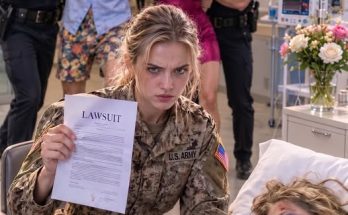
I had spent most of my life believing that the truth eventually made things easier.
Even when it was painful.
Even when it wasn't what I wanted.
At least the truth gave you something solid to stand on.
But sitting beside Emily's hospital bed, I was beginning to understand why people sometimes feared it.
Because the truth could change everything.
And sometimes the hardest part was realizing how little you actually knew.
I looked down at my daughter's hand.
Her fingers rested quietly against mine.
They were warm.
That small detail had comforted me from the moment I arrived.
I had traveled across thousands of miles to reach her.
Now I was sitting close enough to touch her, and I still felt helpless.
The ventilator continued beside us.
Air moved through the tubing.
A brief pause followed.
Then the machine began another cycle.
I had become so familiar with the sound that I noticed whenever my attention drifted away from it.
I hated that.
I hated that a machine had become part of the way I recognized my daughter's breathing.
I wanted to hear her breathe on her own.
I wanted to hear her complain about the uncomfortable pillow.
I wanted to hear her ask when we could go home.
I wanted something ordinary.
Anything ordinary.
But Emily remained unconscious.
Her chestnut hair lay against the hospital pillow.
The bruise near her left temple was still dark.
Her eyes remained closed.
And the two squeezes I'd felt when I first held her hand hadn't happened again.
I tried not to think of that as a disappointment.
She wasn't responsible for reassuring me.
She was twelve years old.
She had suffered a serious head injury.
Whatever she could or couldn't understand, she deserved care without being asked to prove anything.
I knew that.
But I was still her mother.
And mothers weren't always reasonable when their children were hurt.
Sometimes we held on to the smallest things.
A sound.
A movement.
A memory.
Something that reminded us of the child we knew before everything changed.
For me, it was two squeezes.
One.
A pause.
Another.
Six years earlier, those squeezes had been our secret signal.
Emily had been afraid of thunderstorms.
She would climb into my lap when the noise became too much.
Sometimes she couldn't speak.
So I taught her to press my hand twice.
It meant she was still there.
Still listening.
Still with me.
That memory had remained tucked away in my heart for years.
Then I reached the hospital.
I held her hand.
And I felt the same pattern.
I had never been so frightened by something that also gave me hope.
I wanted to believe she'd recognized me.
I wanted to believe she'd heard my voice.
But I knew what Angela had said.
Movements could occur after a serious brain injury without conscious intention.
Dr. Whitaker needed to evaluate what I'd observed.
I couldn't replace that evaluation with a memory, no matter how meaningful the memory was.
I looked toward the door.
I was still waiting for the attending physician.
Grant stood near the bed.
He had become quiet again.
I wondered whether he was watching Emily or simply trying to avoid another conversation.
I couldn't tell.
I had once been able to read his expressions without effort.
Now every look seemed uncertain.
His exhaustion was obvious.
So was mine.
But exhaustion didn't explain everything.
There was still the accident report.
And there was still the message.
I looked toward the bedside table.
The manila folder rested beside my phone.
I had stopped opening them.
I knew the information too well.
The accident had been recorded at 10:43 on Tuesday night.
Grant's message had been sent at 7:16 that evening.
He had told me Emily was asleep.
Safely settled.
Everything quiet.
I remembered reading the message while I was overseas.
I had felt relieved.
I had imagined my daughter sleeping peacefully while I finished another difficult day.
I had trusted the words.
I had trusted the man who sent them.
Now those words had become a question I couldn't answer.
How had Emily ended up in a catastrophic car accident three hours and twenty-seven minutes later?
I had asked Grant where he was at the time.
He had gone pale.
He hadn't answered.
Since then, we'd spoken about doctors.
About medical uncertainty.
About the movement of Emily's hand.
We'd even discussed how important it was to communicate honestly.
But the original question remained.
I wondered whether he realized how often I thought about it.
Probably.
He knew me.
Or at least, he had once known me.
He knew I didn't abandon important questions simply because the answers were inconvenient.
I looked at him.
He was watching Emily.
For a moment, I almost felt sorry for both of us.
We had once shared a family.
We had once believed that whatever happened between us, we would always protect our daughter.
Now I was sitting beside that daughter, wondering why her father couldn't explain the night she was injured.
I didn't want to suspect him.
That was important.
I didn't want any terrible explanation to be true.
I wanted the discrepancy to have a simple answer.
I wanted him to tell me something I'd misunderstood.
I wanted to discover that the report had been entered incorrectly.
Or that something ordinary had happened between the message and the accident.
But wanting those things didn't establish them.
And I couldn't invent a harmless explanation any more than I could invent a terrible one.
I needed facts.
I looked down at my uniform.
The fabric was still creased from travel.
The smell of aviation fuel lingered around the collar.
I had worn this uniform while crossing three time zones.
I had slept badly in it.
I had gripped the strap of my duffel bag while Natalie insulted me in the corridor.
And now I was sitting in it beside my daughter, trying to make sense of an accident that happened while I was thousands of miles away.
My rank meant nothing here.
I had known that when I first arrived.
But I was beginning to understand it more deeply.
I couldn't order Emily to wake up.
I couldn't require Grant to become honest simply because I needed him to be.
I couldn't make a physician give me certainty where the medical evidence didn't support it.
All I could do was ask questions and listen carefully.
I hated how limited that felt.
I reached toward Emily's pillow.
One strand of hair had moved near her forehead.
I brushed it back.
Gently.
Just as I had done when she was little.
The gesture brought another memory.
Emily asleep beside me after a summer storm.
Her hair spread across my arm.
Her hand tucked into mine.
She had finally stopped trembling.
The thunder had moved farther away.
And I had stayed still because I didn't want to wake her.
Back then, waiting had been peaceful.
Now it felt unbearable.
I looked at her face.
"Sweetheart, I wish you could tell me what happened."
My voice was quiet.
I waited.
No response.
I swallowed.
"I know that's not fair."
Her face remained motionless.
"You shouldn't have to explain any of this."
I looked down.
"The adults should know."
That was what hurt.
Emily had been in her father's care while I was deployed.
I had trusted that arrangement.
I had trusted him to tell me when something important happened.
But somehow, I had returned to a hospital room with more questions than answers.
I looked at Grant.
"Can we talk?"
He turned toward me.
"We've been talking."
I nodded.
"I know."
I paused.
"But not about the question I asked when I opened the accident report."
His expression changed.
I saw the tension return to his shoulders.
I didn't want to hurt him.
I wasn't trying to punish him.
I wanted him to understand why the question mattered.
"Grant, I wasn't there Tuesday night."
He lowered his eyes.
"You were."
I waited.
He didn't respond.
"You know things I don't know."
I glanced at Emily.
"And she can't tell us."
My voice tightened.
"That's why I need you to."
Grant rubbed his forehead.
He looked exhausted.
For a moment, I wondered whether I should stop.
Perhaps he genuinely couldn't explain everything.
Perhaps he'd been given incomplete information too.
Perhaps he was simply overwhelmed.
I couldn't know.
But none of those possibilities made the question disappear.
I kept my voice low.
"I'm not asking you to tell me what you think I want to hear."
He looked at me.
"I'm asking you to tell me what you know."
The room was quiet except for the machines.
I waited.
Grant looked at the folder.
Then at my phone.
For a moment, I saw the same expression he'd worn when I first confronted him.
The same discomfort.
The same hesitation.
I couldn't read his mind.
I didn't know what the expression meant.
But I knew he wasn't ready to give me the explanation I needed.
I looked away.
I felt a sudden wave of sadness.
Not just because I was frightened about Emily.
Because I had believed we could face something like this together.
Even after the divorce.
Even after everything that had happened between us.
I had believed that when Emily needed us, we could set the rest aside.
Now I wondered whether I'd been wrong.
I looked at my daughter.
She hadn't moved.
The ventilator continued.
I wanted to ask her father again.
Where were you?
What happened?
Why didn't you tell me?
But I didn't.
Not because I was giving up.
Because repeating a question without receiving an answer was beginning to turn the room into something Emily didn't deserve.
A place full of tension.
A place where her parents watched each other instead of her.
I couldn't allow that to become the only thing happening beside her bed.
I turned toward Grant.
"We need to finish this conversation."
He looked up.
"Not by shouting."
I paused.
"Not by guessing."
I glanced at the folder.
"But by going through what we actually know."
He nodded faintly.
I couldn't tell whether he agreed.
Still, I had made my position clear.
I wasn't going to accuse him without evidence.
I wasn't going to pretend the discrepancy was meaningless.
And I wasn't going to forget it.
I looked toward the door again.
I wanted Dr. Whitaker to arrive.
The medical conversation had been delayed far longer than I wanted.
I needed to know what the examinations showed.
I needed the doctor to understand the movement I'd felt.
I needed to hear what the medical team knew about Emily's prognosis.
And I needed to understand why discussions about withdrawing life support were taking place.
Those were serious questions.
They deserved answers based on clinical findings, not on how frightened or exhausted either parent had become.
I looked toward Grant.
"Whatever the doctor tells us, I want us to listen."
He nodded.
"I know."
"And if we don't understand something, we ask."
Another nod.
I took a breath.
I didn't want to argue about it.
I wanted him beside me in that conversation.
Not because I trusted every judgment he'd made.
But because Emily was still his daughter.
He had been with her through nine days I had missed.
His observations mattered.
Mine mattered too.
We needed both.
I looked down at Emily's hand.
Her fingers were still warm.
I thought about the two squeezes.
I thought about how quickly I had recognized them.
I hadn't needed a doctor to tell me why the pattern was familiar.
But I did need a doctor to tell me what could reasonably be concluded from it.
Those were different things.
I finally understood that I could protect the memory without turning it into medical proof.
That was important.
I didn't have to deny our secret signal.
I didn't have to pretend the movement meant nothing to me.
I only had to acknowledge that its medical significance remained uncertain.
I leaned closer to Emily.
"Mom's here."
I waited.
"I know you can't answer me the way you used to."
My eyes filled.
"That's all right."
I rested my hand beneath hers.
"You don't have to."
The monitor continued beeping.
I wiped my face.
I had spent most of the day thinking that I needed Emily to squeeze again.
Now I understood that she didn't need to do anything for me.
I was the one who needed to act.
Not dramatically.
Not angrily.
Carefully.
I needed to remain present.
Listen to the doctors.
Preserve the records.
Ask questions about the accident.
And avoid making decisions based on fear alone.
I looked toward the manila folder again.
The time was still there.
10:43 PM.
The message was still there too.
7:16 PM.
Those facts had not changed.
Neither had Grant's silence.
But something in me had changed.
I was no longer asking the questions because I wanted to catch someone doing something wrong.
I was asking because Emily deserved an accurate account of what had happened.
She deserved that whether the explanation was simple or terrible.
Whether it hurt Grant.
Whether it hurt me.
Whether it changed how I remembered the last nine days.
I took a slow breath.
My shoulders were aching.
My eyes burned.
I had barely slept.
But I felt clearer about one thing.
The truth wasn't something I could force into existence.
I had to find it in what could actually be established.
I looked toward Grant.
He was still beside the bed.
I didn't know whether he would answer my questions.
I didn't know whether the doctor would have encouraging news.
And I didn't know whether Emily would ever repeat the signal.
But I knew what I could promise.
I could remain honest.
I could pay attention.
I could refuse to substitute assumptions for evidence.
I looked at my daughter.
Her face remained still.
I held her hand.
"I'm here, baby."
I paused.
"And I'm listening."
There was no squeeze.
No visible change.
I didn't interpret the silence.
I simply stayed beside her.
For the first time since arriving, I understood that loving Emily meant more than wanting a particular outcome.
It meant accepting the responsibility to learn what was true.
Even when the truth was incomplete.
Even when it frightened me.
And even when the answers had not yet come.
Click here to continue reading: PART 18: I Returned Home Believing I Might Lose My Daughter, and Two Small Squeezes Taught Me What I Could Promise Without Knowing Her Future
I Had Crossed Thousands of Miles to Reach My Daughter, but the First Words I Heard Outside Her Hospital Room Changed Everything
Part 17 of 18