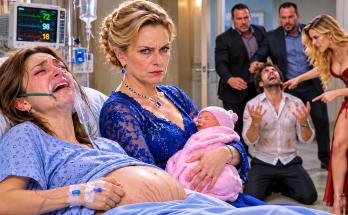
The envelope had become the object I hated most in that hospital room.
It was not especially large.
It was not unusual.
Just brown paper with a metal clasp.
But I could not look at it without remembering Ethan's face.
The impatience.
The coldness.
The way he seemed offended by the fact that I was sick.
He had brought those papers as though they were an ordinary piece of business.
Something he expected to finish quickly.
I wondered whether he had considered what it would feel like for me to receive them.
I could not know.
Perhaps he had thought about it.
Perhaps he had not.
What mattered was that he had delivered them anyway.
Three days after Lily was born.
While I was receiving treatment for heart failure.
That fact would not change no matter how he explained it later.
I had tried to reach for the envelope when he first placed it on the bed.
My hands shook so badly that I could not manage the clasp.
I remembered the embarrassment.
It was strange that I had felt embarrassed.
I was the person being treated cruelly.
I was the person struggling to breathe.
Yet I had felt ashamed because my fingers would not cooperate.
That showed me how deeply I had begun accepting responsibility for things that were not mine to control.
I could not control the weakness of my heart muscle.
I could not control the swelling in my ankles.
I could not control the frightening pressure in my chest.
And I could not control Ethan's willingness to care.
But I had still felt that somehow I had failed him.
That realization made me uncomfortable.
I had spent years building an identity around competence.
At Fort Bragg, people expected me to solve problems.
I was accustomed to being the person who knew what needed to happen next.
Even when situations were complicated, I could usually identify a starting point.
But becoming seriously ill had stripped away that certainty.
My body no longer responded the way I expected.
I needed medication.
Monitoring.
Rest.
And help with things I would normally have done without thinking.
I hated being dependent.
Ethan had seen that dependence and treated it as proof that I was no longer worth his time.
That hurt more than the divorce papers themselves.
Because marriage had always meant something different to me.
I had never expected Ethan to be perfect.
I knew he could be impatient.
I knew he sometimes struggled with the demands of my career.
But I had assumed there was a line he would never cross.
I thought he would remain beside me if I became seriously ill.
That was such a basic assumption that I had never questioned it.
Not until Wednesday evening.
When he arrived wearing his navy polo shirt and carrying fast food, I had been waiting for reassurance.
I had wanted him to ask about Dr. Patel.
I had wanted him to sit beside my bed.
I had wanted him to show some interest in what the doctors were doing to keep me alive.
Instead, he asked when I would be discharged.
Then he asked about money.
Then he wanted to know whether I could return to work the following week.
I remembered staring at him.
The questions had seemed so disconnected from what was happening to me.
I was in heart failure.
I had given birth days earlier.
I was on parental leave.
Yet he was talking about my job as though I had taken an inconvenient vacation.
I told myself he was frightened.
That was the explanation I chose.
I could not bear the possibility that he simply did not care enough.
So I made his behavior easier to understand.
I imagined fear beneath the anger.
Concern beneath the impatience.
Love beneath the silence.
Looking back, I realize how much of that explanation came from me.
Ethan had not told me he was frightened.
He had not said he was overwhelmed by the diagnosis.
He had not apologized for the way he spoke.
I supplied those meanings because I wanted to preserve the marriage I believed we had.
By Thursday afternoon, he had made that impossible.
He came back with papers.
He told me he had been unhappy for years.
He blamed my military career.
Then he said he did not want to spend his life caring for a sick woman.
I had never heard him speak with such disregard.
It shocked me.
But what shocked me even more was how quickly I began searching for something I could have done differently.
Had I worked too much?
Had I failed to notice his unhappiness?
Had I become too focused on my career?
Had I somehow allowed our marriage to reach this point without understanding it?
Those questions were painful because some of them involved real difficulties.
My work had demanded sacrifices.
I knew that.
There had been times when Ethan wanted me home and I could not be there.
There had been moments when military responsibilities came first.
I was not going to rewrite our history and pretend I had always been an easy spouse.
But none of those difficulties justified what happened in the hospital.
That was the distinction I needed to make.
A marriage could have problems.
A husband could be unhappy.
A couple could even decide to separate.
But there were ways to handle those things without humiliating someone who was seriously ill.
Ethan had chosen not to use them.
He could have waited until I was medically stable.
He could have spoken calmly about the future.
He could have allowed me time to recover before asking for legal decisions.
Instead, he had thrown the envelope onto the bed.
It landed beside Lily.
I kept remembering that.
The distance between the papers and the pink blanket had been so small.
Yet they represented completely different parts of my life.
Lily represented everything I wanted to protect.
The envelope represented everything Ethan was trying to end.
I wished he had understood what that looked like.
I wished he had seen his daughter lying there and reconsidered.
But he did not.
He seemed more interested in whether I would sign.
I had always been careful with documents.
That came from my work.
I knew that a signature could carry consequences long after the moment passed.
I would never tell someone under my command to agree to something they did not understand.
I would never assume that pressure made a document more valid.
Yet when Ethan presented the papers, I almost reached for them without asking what they contained.
I had been frightened.
I had wanted him to stop looking at me with contempt.
And I had wanted the conversation to end.
That was the dangerous part.
For a moment, I had been more concerned with escaping the humiliation than understanding what I was being asked to do.
I could admit that now.
I had been close to surrendering my judgment simply because I was exhausted.
My hands saved me from acting too quickly.
Not deliberately.
Not through courage.
They were shaking because I was ill and overwhelmed.
But the delay gave me time to realize what was happening.
Then Margaret arrived.
She made the situation worse.
Her expression had told me almost immediately that she knew about Ethan's plans.
He told her he had given me the papers.
She seemed pleased.
I remember feeling a strange sense of betrayal when I saw them exchange that understanding.
They were acting together.
Or at least they agreed about what should happen to me.
I was the only person in the room who had not been prepared.
Margaret then called my father.
She spoke about me as though I were something her family no longer wanted.
I hated the way she said I was sick.
Not because it was untrue.
I was sick.
Seriously sick.
But she used the word like an accusation.
As though illness were a character flaw.
As though I had become less worthy of respect because my heart was failing.
She described me as useless.
I kept returning to that word.
Useless.
I had never measured people that way.
At least, I hoped I had not.
My career had taught me that everyone had different responsibilities and strengths.
Someone could be unable to perform one task and still have enormous value.
A person could need help without becoming a burden to be discarded.
Yet Margaret spoke as though my illness erased the years I had spent building a life with her son.
I looked at Lily and wondered what Margaret would think if her granddaughter became seriously ill one day.
Would she speak about her that way?
I did not want to imagine it.
But the question came anyway.
I wanted Lily to grow up knowing that being vulnerable did not make her less lovable.
I wanted her to know she could ask for help.
That she did not need to earn kindness through perfect health or constant usefulness.
Those were things I had believed before becoming a mother.
Now they felt like promises I needed to make.
I did not know whether I would recover enough to raise her the way I had imagined.
Dr. Patel had been honest about that.
My heart condition was serious.
Treatment could help.
But recovery was not guaranteed.
I had to live with that uncertainty.
It frightened me more than the divorce.
I could survive losing a marriage.
I could survive changing my idea of home.
But the thought of not being there for Lily was almost unbearable.
I remembered asking Dr. Patel whether I would live to watch her grow up.
He had not promised me a happy ending.
I respected him for that.
He explained the treatment plan and told me that many women improved.
I held on to those words.
Not because they guaranteed anything.
Because they gave me a reason to keep working with the doctors.
I needed to take the medication seriously.
I needed to rest.
I needed to allow people to monitor my condition.
And I needed to avoid making the emotional situation more dangerous than it already was.
That was why having the lawyers mattered.
Rebecca and the second lawyer could examine the papers.
They could help me understand the questions Ethan had created.
I did not need to face the documents alone.
I did not need to accept Ethan's interpretation as the only one.
And I did not need to sign something simply because he was impatient.
The house was an especially important part of that.
Ethan had told me to leave.
Margaret had repeated that he wanted the house.
Neither had shown interest in whether I had somewhere safe to recover.
Neither had considered what moving a newborn would mean while I was receiving treatment for heart failure.
They seemed to believe the problem would disappear once I was out of their sight.
But I was not a problem to be removed.
I was a person.
Lily was a child.
And the house was part of the life we had built.
It deserved more consideration than a command spoken beside a hospital bed.
I thought about the lockbox file.
I had asked my father to bring it because I knew the papers concerning the house were important.
I did not need to make claims about them before the lawyers had examined everything.
That would have been careless.
I only needed to make sure the facts were available.
It was the same approach I would have taken at work.
Gather the information.
Identify what could be established.
Avoid making decisions based on assumptions.
I wondered why I had not demanded the same care from Ethan sooner.
Maybe because I had trusted him.
Maybe because marriage had made me less willing to challenge the person I loved.
Maybe because I wanted peace at home after spending so much of my working life dealing with difficult situations.
Whatever the reason, I could see the result.
He had become accustomed to presenting his wants as though they settled the matter.
And I had become accustomed to trying to keep the peace.
That arrangement had collapsed the moment I became ill.
I could no longer make everything easy for him.
I could not work the following week.
I could not leave the hospital when he wanted.
I could not pretend that my heart condition was minor.
And he had responded by demanding a divorce.
It was painful to admit.
But I had to stop blaming myself for his reaction.
I could examine my own mistakes without accepting responsibility for his cruelty.
Those were not the same thing.
I thought about the way my father had looked at Ethan.
He had not needed to deliver a long speech.
He had not asked Ethan to explain why he no longer loved me.
He had simply told the lawyers to begin with the house.
That instruction had restored something important.
Order.
Not the kind of order that comes from controlling people.
The kind that comes from refusing to let anger replace facts.
I needed that.
My life felt chaotic.
My body was frighteningly unpredictable.
My marriage was ending in a way I had never imagined.
But the documents could still be examined carefully.
The house could still be discussed properly.
And I could still receive medical treatment without being pressured into immediate legal decisions.
I looked at Lily.
I wanted to hold her.
I wanted to press my face against her hair and forget everything else.
But I could not forget.
Not yet.
There were questions that needed answers.
The divorce papers.
The house.
What Ethan intended to do.
What I needed to protect.
I had to allow those questions to be addressed in the right order.
And the first order was simple.
My health came before any argument.
I needed to remain alive.
Lily needed her mother.
Everything else had to be considered around that reality.
I was not ready to forgive Ethan.
I was not ready to understand him.
I was not ready to decide what the rest of my life would look like.
But I was ready to stop accepting that my illness made his wishes more important than mine.
That was the change I felt when I looked at the envelope.
It was still frightening.
It still represented the end of a marriage I had believed in.
But it no longer represented a decision I had to make alone.
I had asked for help.
The help had arrived.
And I was no longer willing to let fear make me sign away my future without understanding what I was doing.
Click here to continue reading: PART 11: I Looked at My Daughter’s Pink Blanket and Understood That Surviving My Illness Was Only the First Responsibility I Faced
Three Days After My Daughter Was Born, I Learned My Heart Was Failing and My Marriage Was Not What I Believed
Part 10 of 15