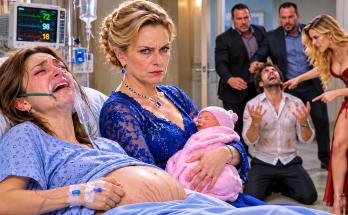
Lily had been in the world for three days.
Three days.
It was difficult to understand how so much could happen in such a short time.
When I first held her, I believed I was beginning the happiest chapter of my life.
I was exhausted after fourteen hours of labor.
My body ached.
I could barely keep my eyes open.
But none of that mattered when the nurse placed Lily against my chest.
She was warm.
Her face was tiny.
And her black hair stood up in a way that made me smile.
I remember touching her cheek.
I remember trying to understand that she was mine.
Not an idea anymore.
Not an ultrasound picture.
Not a name we had chosen.
A real little girl.
I had spent months imagining what motherhood would feel like.
I expected exhaustion.
I expected uncertainty.
I expected nights when neither Ethan nor I knew how to settle her.
But I had also expected joy.
The ordinary joy of bringing a child home.
I had imagined the yellow nursery.
The crib.
The blankets.
The quiet moments when I would stand beside her and wonder how someone so small could change my life so completely.
I had not imagined lying in a hospital bed with a failing heart.
I had not imagined needing oxygen.
And I had certainly not imagined divorce papers beside her blanket.
That was what made the situation so difficult to accept.
Everything I had prepared for was still waiting.
But the life I expected to bring Lily into had changed.
I did not know whether Ethan would ever understand what he had done.
Perhaps he would continue to believe his decision was reasonable.
Perhaps he would blame my career.
Perhaps he would insist that our marriage had been unhappy for years.
I could not control his explanation.
But I could control whether I accepted it without question.
I had spent too much time trying to understand his feelings while ignoring my own.
Now I had a daughter.
And I needed to think about what kind of example I wanted to give her.
That thought frightened me.
Not because I expected Lily to understand anything that happened during her first week.
She was far too young.
But because I knew the choices I made now could shape her future.
I wanted her to grow up feeling safe.
I wanted her to know that love should not disappear when someone becomes ill.
I wanted her to understand that asking for help was not shameful.
And I wanted her to know that she did not have to accept cruelty simply because it came from someone she loved.
Those were lessons I had believed in for years.
But I had not always lived by them.
That was difficult to admit.
I had defended Ethan in my own mind so often that I barely noticed myself doing it.
When he became impatient, I called it stress.
When he complained about my military responsibilities, I blamed my schedule.
When he seemed distant, I told myself that not everyone expressed affection in the same way.
Some of those explanations might have been reasonable at the time.
But I had become too willing to use them.
I had stopped asking whether his behavior was fair.
I had stopped asking whether I was receiving the same understanding I offered him.
And when Lily was born, I continued making excuses.
I remembered the cafeteria coffee.
It seemed like such a ridiculous detail now.
Ethan had held our newborn daughter for a few minutes.
Then he gave her back and complained about the taste of his coffee.
I had laughed.
I remembered the sound of my own weak laughter.
I had wanted the moment to remain happy.
I did not want to ask why he seemed so detached.
So I told myself he was tired.
I had just spent fourteen hours in labor, yet I was worrying about whether he felt comfortable.
That memory embarrassed me.
Not because caring about him had been wrong.
Because I had been so determined to protect his feelings that I ignored my own disappointment.
I could see that pattern more clearly now.
And I did not want Lily to grow up believing it was normal.
I wanted her to be kind.
I wanted her to consider other people's needs.
But I also wanted her to know that kindness did not require accepting mistreatment.
That was a lesson I was still learning myself.
I looked toward her bassinet.
The clear plastic sides reflected the hospital light.
Her pink blanket was tucked around her.
She seemed so small against the medical equipment surrounding us.
I remembered the first time I noticed my breathing problems.
I had tried to walk to the bathroom.
Such an ordinary thing.
I expected soreness.
I expected weakness from labor.
But I did not expect to feel as though I could not fill my lungs.
The nurse had noticed the change in my lips.
She checked my oxygen level.
Then she called for help.
Everything happened quickly after that.
Blood tests.
X-rays.
More examinations.
The frightening sensation of my heart racing even while I lay still.
By Wednesday morning, Dr. Patel had explained the diagnosis.
Peripartum cardiomyopathy.
I had asked him to repeat it.
I needed to understand the words.
He told me the heart muscle had weakened around childbirth.
My heart could no longer pump blood efficiently.
I was experiencing heart failure.
I remembered feeling the room become strangely quiet.
Not because the equipment stopped making noise.
But because everything inside me seemed to focus on those words.
Heart failure.
I had never imagined hearing them about myself.
I was thirty-eight.
I had served in the Army for years.
I had always considered myself physically capable.
Now my own heart had become the reason I might not see my daughter grow up.
I asked Dr. Patel that question directly.
Would I live long enough to watch her grow?
He was honest.
He explained that treatment could help.
Many women improved.
Some recovered considerable heart function.
But he could not promise exactly what would happen to me.
I appreciated his honesty.
Even though it frightened me.
He gave me a plan.
Medication.
Monitoring.
Rest.
I could understand those things.
I could follow instructions.
But I could not control the result.
That was the part I struggled with.
I had built my adult life around preparing for difficult situations.
If something could go wrong, I wanted to understand the risk.
If a problem appeared, I wanted to identify the next step.
That approach had served me well in the military.
But this was not an operation I could manage from a desk.
My body was the problem.
And the treatment would take time.
I needed to accept that.
I also needed to accept that Lily could not depend on me in exactly the way I had imagined during those first days.
I wanted to carry her.
I wanted to settle her.
I wanted to spend every possible moment holding her.
But my condition made even small movements difficult.
That hurt.
It made me feel as though motherhood was slipping away before it had properly begun.
I knew that was not a fair judgment.
I had not stopped being Lily's mother because I needed medical care.
But emotions were not always fair.
I felt guilty whenever I could not do something for her.
I felt ashamed that other people had to help.
And I felt frightened that I might not recover.
Then Ethan entered the room with the divorce papers.
His behavior seemed to confirm my worst fear.
That being sick had made me less valuable.
That I had become a burden.
That I was no longer the woman he wanted.
I had to fight against that idea.
Because it was not true.
My illness had changed what I could do.
It had not changed who I was.
I was still Caroline.
Still Lily's mother.
Still a woman who had worked hard and taken her responsibilities seriously.
I was still entitled to respect.
And I was still entitled to make decisions about my life.
The fact that I needed help did not erase any of that.
I thought about how I would feel if Lily were lying in a hospital bed one day.
The thought made me shiver.
I imagined someone telling her that she was worthless because she was ill.
Someone demanding that she leave her home because treatment was inconvenient.
Someone expecting her to sign papers while she was frightened and weak.
I knew exactly what I would want for her.
I would want someone to protect her.
I would want her to know she was loved.
I would want her to receive proper care.
And I would want her to understand that no person's cruelty could define her value.
Then I realized something uncomfortable.
I needed to want those same things for myself.
I had been willing to fight for Lily from the moment she was born.
But I had hesitated to fight for my own dignity.
I had tried to understand Ethan.
Tried to excuse him.
Tried to make myself easier to live with.
Even after he told me he wanted a divorce, part of me still wondered whether I could persuade him to stay.
That part of me was grieving.
I knew that.
Nine years of marriage did not disappear in one afternoon.
But I could not let grief make decisions for me.
Lily needed me to think clearly.
And I needed to survive long enough to do that.
I looked at my parents.
Their arrival had changed the atmosphere around the legal situation.
My father had brought the house file I requested.
He had contacted Rebecca.
Two lawyers were there.
And he had told Ethan that the house was where the examination should begin.
I was grateful.
But I also felt sadness.
This was not how I wanted my parents to meet their granddaughter in her first days of life.
I had imagined joy.
Family.
A sense of celebration.
Instead, they had been called because my mother-in-law wanted them to take me away.
I wondered whether Margaret understood how cruel that call had been.
She had not asked whether I needed assistance.
She had not offered to help with Lily.
She had not shown concern about my medical condition.
She had simply described me as an unwanted sick woman.
I would remember that.
Not because I wanted to spend my life angry.
But because I needed to stop pretending those words meant nothing.
They mattered.
They revealed how Margaret was willing to treat me when I could no longer make life easy for her son.
And Ethan had stood there while she did it.
His silence had been a decision too.
I did not know how Lily would understand her father when she was older.
That was a question for another time.
I was not going to decide her entire future while lying in a hospital bed.
But I knew I could not build her sense of safety around pretending Ethan had behaved kindly.
He had not.
That was the truth.
And truth mattered.
I thought about the house again.
It was not only a place where we kept furniture.
It was where Lily's nursery waited.
The yellow walls.
The crib.
The small things we had prepared before she arrived.
I wanted to take her there.
I wanted to see her sleeping in the room we had made ready.
But I also knew that the house had become part of a dispute.
Ethan wanted me out.
Margaret supported him.
My father had asked the lawyers to examine the documents.
That was where things stood.
I could not pretend the matter was settled.
I did not yet know what the lawyers would establish.
But I knew the question deserved careful attention.
And I knew my daughter deserved more than a hurried decision made because her mother was too sick to argue.
I thought about the pink blanket.
It had been beside the envelope when Ethan threw it onto the bed.
I hated that image.
I wanted Lily's earliest belongings to be associated with love.
Not rejection.
Not paperwork.
Not the sound of adults arguing about where she and I should live.
But I could not change what had already happened.
I could only decide how to respond.
That was becoming clearer to me.
I did not need to become cruel because Ethan had been cruel.
I did not need to shout because Margaret had shouted.
I did not need to pretend I was healthy enough to handle everything alone.
I needed to remain honest.
I needed to accept help.
And I needed to keep Lily's well-being at the center of every decision.
That was enough.
I thought about the alarm from the monitor.
The sudden pain.
The darkness narrowing my vision.
The medical staff rushing into the room.
For those frightening moments, I had been certain that nothing mattered except getting another breath.
The house had disappeared from my thoughts.
The divorce papers had disappeared.
Even Ethan's words had become distant.
All I wanted was to survive.
That memory reminded me what came first.
My heart.
My treatment.
My chance to live.
I could not protect Lily if I ignored the medical danger.
I could not make good decisions if I allowed stress to push my body beyond its limits.
So I had to let the lawyers deal with the documents.
I had to let my parents support me.
I had to let the doctors continue their work.
It was a difficult kind of surrender.
But it was not defeat.
I was learning that sometimes responsibility meant allowing other people to help.
Sometimes strength meant admitting you were frightened.
And sometimes protecting your child began with taking care of your own life.
I looked at Lily again.
Her hair still stood up in that funny little way.
I wanted to laugh the way I had when she was born.
I could not quite manage it.
But I felt something gentle beneath the fear.
Love.
That had not changed.
Ethan could end our marriage.
Margaret could insult me.
The doctors could tell me my recovery was uncertain.
But none of them could change the fact that Lily was my daughter.
I had loved her from the first moment I held her.
And I wanted to be there for every ordinary day that followed.
I wanted to see her grow.
I wanted to hear her voice.
I wanted to know the person she would become.
That desire was stronger than my embarrassment about needing help.
Stronger than my pride.
Stronger than my wish to pretend the marriage could still be saved.
I understood then that surviving my illness was not the only challenge ahead.
I would also have to learn how to make decisions without depending on Ethan's approval.
I would have to face the truth about our marriage.
And I would have to protect my daughter without allowing fear to make me careless.
Those responsibilities were waiting for me.
I could not solve all of them that afternoon.
But I could begin.
I could follow Dr. Patel's treatment plan.
I could allow the lawyers to examine the papers.
I could trust my parents to stand beside me.
And I could remember that Lily needed a mother who valued her own life.
That was the decision I made while looking at the pink blanket.
I would not measure my worth by whether Ethan wanted to stay.
I would measure my next steps by what kept my daughter and me safe.
Click here to continue reading: PART 12: As the House Documents Became the Center of the Dispute, I Finally Stopped Asking Why Ethan Did Not Want to Save Our Marriage
Three Days After My Daughter Was Born, I Learned My Heart Was Failing and My Marriage Was Not What I Believed
Part 11 of 15