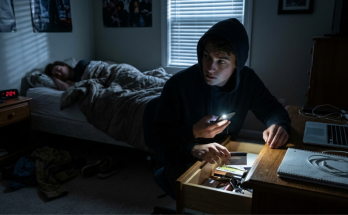
The folder was thinner than I expected.
I had imagined important financial records would come in a heavy envelope or a thick binder.
Instead, I was sitting on my bedroom floor holding a few sheets of paper that had been forgotten beneath school certificates.
My father's watch was beside my knee.
The house was quiet.
I could hear faint voices downstairs.
I didn't try to make out what anyone was saying.
I wanted to read.
The first document was a letter from my father's attorney.
It was dated two months before he died.
I recognized the attorney's name.
Patricia Evans.
I remembered hearing it when I was younger, though I hadn't thought about her in years.
The letter explained that my father had established a trust for my education and early adult development.
I read that sentence twice.
A trust.
Not just some savings that my mother had been free to use whenever she needed it.
The original amount was thirty-two thousand dollars.
I stopped reading.
Thirty-two thousand.
I said it quietly to myself.
I had spent years thinking about the fifteen thousand dollars I'd managed to save on my own.
I knew exactly how much effort it took to put money aside.
But my father had arranged more than twice that amount for me.
And I had never known the full figure.
I turned the page.
The documents explained that the money was intended to help with my education and provide a foundation as I entered adulthood.
My mother had been named trustee.
That word made me pause.
I knew what a trustee was in a general sense.
Someone responsible for managing money or property for another person.
But I had never considered what it meant in my own family.
My mother had always spoken about the college fund as though it belonged to the household.
As though whatever money was there could be spent if life became difficult.
I had accepted that explanation.
I was seventeen when she told me there was nothing left.
I remembered the kitchen table.
I remembered her crying.
I remembered how ashamed I felt for asking about money when she was still dealing with Dad's death.
So I stopped.
That was the decision I kept coming back to.
I stopped asking.
I worked.
I borrowed money for school.
I paid it back.
And whenever things became hard, I reminded myself that my mother had already done as much as she could.
Now I stared at the number on the page.
$32,000.
I had never seen a statement showing where it went.
I kept reading.
Near the end, the attorney explained that I was entitled to annual information about the trust's activity.
I sat straighter.
Every year.
I looked through the papers again to make sure I understood.
There was no mention of waiting until I was older before I could see what had happened.
The documents described a regular accounting.
I had never received one.
Not at seventeen.
Not at eighteen.
Not when I went to college.
Not when I started paying back my loans.
Nothing.
I thought of the conversations I'd had with my mother whenever I mentioned Dad's money.
She would become upset.
Sometimes she told me the subject was painful.
Sometimes she said there were bills I didn't understand.
Usually, I apologized.
I had thought I was being considerate.
Looking back, I was also afraid.
I didn't want to be the son who made his mother cry.
I didn't want to be accused of caring more about money than family.
And I didn't want to hear that my father had left me something I couldn't have.
So I learned not to ask.
I turned another page.
There was a handwritten note.
I knew the writing immediately.
Dad leaned his letters slightly toward the right.
He used blue ink whenever he could.
Even as a boy, I'd noticed that he wrote carefully, as though every word deserved enough room on the page.
I picked up the letter with both hands.
He had addressed it to me.
He wrote about hoping I would grow into someone who understood that having money wasn't the same as having a good life.
But he also wanted me to have choices.
He didn't want me trapped by dependence on other people.
He wanted me to have the chance to build something for myself.
He explained that my mother would manage the money while I was too young to handle it.
And near the end, he reminded me that I had a right to understand decisions affecting my future.
I put the page down.
I couldn't read any more for a minute.
I had spent nine years trying to become the man my father would have wanted me to be.
I worked.
I kept my promises.
I did my best not to depend on anyone.
But I had misunderstood one thing.
I had treated independence as proof that I should never need help.
Dad hadn't written that.
He had wanted me to have support so I could stand on my own.
I picked up his watch.
It wasn't expensive.
At least, I had never thought it was.
The strap was worn.
The face had a few scratches.
But I remembered seeing it on his wrist when I was younger.
I held it until my hands stopped shaking.
Then I placed it beside the letter.
I tried to think clearly.
A trust had existed.
My mother was responsible for managing it.
The documents said I should have received statements.
I hadn't received any.
That didn't tell me exactly where the money had gone.
But it told me I needed answers.
I took photographs of the papers.
Then I arranged them in order.
I didn't want anything getting lost.
I had already learned what could happen when someone else controlled information about my money.
I looked at the door.
It was closed.
I remembered the security footage of Caleb opening my drawer.
Then I thought about the bank documents showing my mother had somehow gained access to my business account.
The two situations were different.
One involved a debit card.
The other involved paperwork I hadn't authorized.
But both had happened inside a family that expected me to accept explanations without asking too much.
I couldn't ignore that anymore.
My phone vibrated.
An unfamiliar number appeared.
I considered letting it ring.
I was exhausted, and I didn't want another argument.
But I answered.
"Hello?"
A woman asked whether she was speaking to Julian Miller.
I confirmed that I was.
"My name is Patricia Evans," she said.
I looked down at the letter.
For a second, I thought I had misunderstood her.
"Patricia Evans?"
"Yes. I represented your father in certain estate matters."
I sat up.
"I was just reading a letter from your office."
She went quiet for a moment.
Then she asked whether I had recently found information about the money my father had arranged for me.
I looked around my room.
I hadn't told anyone outside the attorney I'd called.
I hadn't contacted Patricia.
"How did you know?"
She explained that she had received a telephone call the day before.
The caller wanted to ask about the status of my father's trust.
Specifically, whether it had been properly closed.
I held the phone tighter.
"Who was it?"
Patricia hesitated.
Then she told me it was my mother.
I stared at the wall.
Of course.
My mother had spent the day telling me not to interfere with family matters.
But she had already contacted my father's former attorney.
"Why did she call?" I asked.
Patricia explained that my mother had described me as financially troubled.
She had suggested I might begin making accusations against her.
Then she had asked whether the old trust paperwork could be changed.
I looked at my father's letter again.
The ink had faded slightly.
But the words were still clear.
"Can those documents be changed now?"
"Not simply because someone wants them changed," Patricia said.
She explained that the trust had legal requirements that couldn't be ignored.
Then she asked what I had found.
I told her about the folder.
The attorney's letter.
The original amount.
The annual statements I had never seen.
She listened.
When I finished, she told me she still had the original trust records.
I felt a strange mixture of relief and dread.
For years, I'd thought the answers were lost.
Now I knew someone had kept them.
"Can you tell me whether the money was all spent?"
Patricia paused.
"The last records I have don't support the explanation you've been given."
I looked at the document in my lap.
"What do you mean?"
She told me the trust had not been empty when I reached eighteen.
I closed my eyes.
For nine years, that had been the central fact in my mother's story.
There was no money.
Nothing left.
No reason to ask.
And now the attorney who had helped create the trust was telling me something different.
"How much was there?"
Patricia said she wanted me to see the records in person.
But she confirmed that a substantial withdrawal had occurred not long before my mother told me the fund was exhausted.
I asked where it had gone.
She explained that the transaction wasn't identified as an expense for my college education.
I pressed my palm against the floor.
I had expected answers.
I hadn't expected to feel seventeen again.
Back in that kitchen.
Trying not to make my mother more upset.
Promising I would figure things out.
Patricia asked me to come to her office the following morning.
She wanted me to bring the documents I had found.
She also advised me not to confront my mother again before we reviewed everything.
I asked why.
She said it would be better to understand the records before having another conversation.
That made sense.
I had spent the entire day reacting to one discovery after another.
The missing card.
The bank transfer questions.
My mother's account authorization.
The trust folder.
I was tired of reacting.
I needed facts.
I told Patricia I would be there.
She gave me the office details.
Then we ended the call.
I stayed on the floor.
The old folder lay open in front of me.
I tried to remember when Dad had first told me he wanted me to go to college.
I could remember him encouraging me to study.
I could remember him talking about work and making decisions for myself.
But I couldn't remember him explaining the money.
Maybe he had planned to do it when I was older.
Maybe he assumed my mother would tell me.
I didn't know.
And I hated that I couldn't ask him.
I put the papers back in the folder.
I kept his handwritten letter separate.
I wanted to read it again later.
Then I heard Caleb laughing downstairs.
The sound carried through the house.
He seemed completely comfortable.
That morning, two officers had questioned him about taking my card.
The purchases were still being investigated.
And he was already laughing at something on his phone.
I sat there listening.
I wasn't angry about the laughter itself.
I was angry because the house seemed capable of returning to normal while my life felt as though it had come apart.
I thought about walking downstairs and telling my mother about Patricia's call.
I wanted to see her face.
I wanted to ask why she had tried to change documents before I even knew they existed.
But Patricia had told me to wait.
For once, I listened to someone who wasn't asking me to protect Caleb.
I opened my notebook.
I wrote down what I knew.
The original trust had been funded with thirty-two thousand dollars.
My mother had been its trustee.
I was supposed to receive annual statements.
Patricia had records showing money remained near my eighteenth birthday.
And a large withdrawal had occurred before my mother told me the fund was gone.
I looked at those notes for a long time.
They were plain facts.
Nothing dramatic.
Yet each one made the past look different.
I thought about my college years.
I worked warehouse shifts because I needed steady money.
I accepted extra projects because my loans still had to be paid.
I spent weekends learning design skills and trying to build a client base.
Every time I fell behind, I reminded myself there was no family money to help.
I never blamed Dad.
I believed he'd done what he could.
I never blamed my mother, either.
I thought she'd been forced to make impossible decisions.
Now I wondered whether I'd been carrying consequences that didn't belong to me.
The thought made me feel disloyal.
That was another habit I had to recognize.
Even with documents in front of me, part of my mind wanted to excuse her.
Maybe she'd misunderstood the rules.
Maybe the money went to something necessary.
Maybe there was an explanation I hadn't heard.
I wasn't ready to decide.
I was ready to look.
That was different.
I put the folder into my bag.
I checked my laptop to make sure the copies were saved.
Then I moved my father's watch into a safer place.
I didn't want to leave it beside the desk drawer anymore.
Not after what Caleb had done.
My phone vibrated again.
This time, it was my mother.
A text message.
She wanted us to talk the next day.
Then she warned me not to investigate Dad's money.
I read it once.
Then again.
I could hardly believe she had written it.
If the fund was gone for legitimate reasons, why didn't she want me to see the records?
Why had she called Patricia first?
Why had she tried to find out whether the documents could be changed?
I took a screenshot.
I saved it with the other records.
Then I put the phone face down.
It was 10:18 p.m.
I was supposed to get up early for my appointment.
But I couldn't sleep.
Every time I closed my eyes, I thought about the way my mother had said there was nothing left.
I remembered believing her without hesitation.
I remembered feeling guilty for even asking.
And now I remembered her expression when I'd mentioned the missing college money earlier that day.
I had seen fear in her face.
At the time, I couldn't understand it.
I was starting to.
I got out of bed and checked the folder one last time.
The pages were still there.
My father's handwriting was still there.
The amount was still thirty-two thousand dollars.
I put the folder near my keys.
Tomorrow, I would go to Patricia's office.
I wouldn't ask my mother for permission.
I wouldn't warn Arthur.
And I wouldn't let anyone tell me I was selfish for wanting to know what had happened to money my father had intended for me.
That was the first decision I'd made all day that brought me any peace.
Click here to continue reading: PART 4: My Father’s Attorney Showed Me Where $27,500 Had Gone, and I Finally Understood Why My Mother Tried to Keep Me Away From the Records
My Brother Took My Business Debit Card in the Middle of the Night, but My Parents Were More Worried About His Future Than Mine
Part 3 of 18