By the time Caleb called, I had become used to living alone.
The apartment still wasn't impressive.
The kitchen was still tiny.
My desk still took up most of the bedroom.
And the living room window still faced the same parking lot.
But those things no longer bothered me.
They had become familiar.
I knew how the light moved across the room during the day.
I knew which part of the kitchen counter was most convenient for making coffee.
I knew how quiet the apartment became after dark.
Most importantly, I knew I could work without anyone entering my room and touching my belongings.
I had learned to appreciate ordinary things.
A locked door.
A quiet evening.
A bank account that only I controlled.
A desk drawer that stayed closed unless I opened it.
Those were things I had once taken for granted.
Now they mattered.
Miller Creative Studio was still small.
I was working independently.
There were no employees.
No large office.
No expensive furniture.
But I had clients.
I had regular work.
And I could see a future for the business if I kept making careful decisions.
I spent most mornings reviewing projects.
Then I worked through whatever needed attention.
Some days involved website layouts.
Other days were spent making revisions.
I handled client communication, design work, and invoices myself.
It wasn't glamorous.
But I enjoyed it.
I liked knowing that every project helped build something that belonged to me.
I still checked my finances carefully.
The bank's recovery process had helped repair the damage from Caleb's theft.
My savings were growing again.
And the trust settlement was being handled through the repayment arrangement Patricia had helped establish.
I didn't receive all the money at once.
The agreement was structured over time.
But the difference was that the obligation had been formally documented.
I no longer had to rely on my mother's promise that she'd replace the money someday.
That mattered.
The legal case involving Caleb remained part of our family's history.
I knew he had faced consequences after admitting what he'd done.
But I had stopped trying to control every development.
I had given the police the evidence.
The bank had reviewed the transactions.
Caleb had provided a written admission.
What happened next was his responsibility.
I couldn't live his life for him.
I had spent too many years being expected to solve problems that weren't mine.
One afternoon, six months after I moved out, my phone rang.
I was sitting at my desk.
A client project was open on my screen.
I glanced at the caller.
Caleb.
I stared at his name.
We hadn't spoken much since I left the house.
There had been occasional messages.
Short conversations.
Nothing that made me believe our relationship had returned to normal.
I hadn't decided whether I wanted it to.
Part of me still felt angry whenever I remembered the stolen card.
Another part remembered the little boy I had helped with schoolwork years earlier.
I let the phone ring.
Then I answered.
"Hello?"
For a moment, I heard nothing.
Then Caleb spoke.
"Hey."
His voice sounded different.
Quieter.
Less certain.
"Hey," I answered.
There was another pause.
I waited.
He cleared his throat.
"Can we talk?"
I looked at the project on my screen.
"About what?"
He hesitated.
"About everything, I guess."
I leaned back.
I had imagined this conversation before.
Sometimes I thought he'd call to apologize.
Sometimes I thought he'd ask for money.
Sometimes I thought he'd accuse me of ruining his life because I hadn't withdrawn the complaint.
I didn't know what to expect.
"Okay," I said. "I'm listening."
He took a breath.
Then he started talking about the things he had lost.
The phone.
The PlayStation.
The sneakers.
All the things he'd bought using my debit card.
He said they were gone.
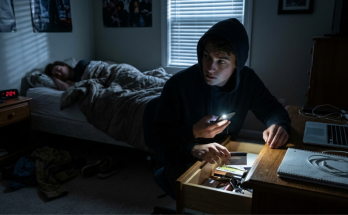
I looked at the small drawer beside my desk.
The one where I now kept my own cards and important things.
I remembered the morning I found the unauthorized transactions.
I remembered seeing the purchases and feeling sick.
Nearly nine thousand dollars.
I had worked so long to save it.
And Caleb had treated it like money he could spend without consequences.
Now he was telling me the things were gone.
I didn't know whether he expected sympathy.
So I stayed quiet.
He continued.
"Mom kept saying you were trying to wreck my future."
I closed my eyes.
Of course she had.
That had been her argument from the beginning.
She had worried about the consequences for Caleb.
She hadn't seemed nearly as worried about what he'd taken from me.
I looked at Dad's framed letter.
"What do you think?" I asked.
Caleb went quiet.
Then he said, "I don't know."
I waited.
He sounded uncomfortable.
I could hear him breathing.
For once, I didn't rush to fill the silence.
I wanted him to think about the question.
Not repeat whatever Mom had told him.
After a while, I said, "Caleb, you knew that card was mine."
"I know."
"You knew I hadn't said you could use it."
"I know."
"And you knew the purchases were coming out of my savings."
He spoke more quietly.
"Yeah."
I looked out the window.
A car moved through the parking lot.
Then it disappeared from view.
I tried to remember what I had wanted from Caleb when I first discovered the theft.
I wanted him to admit what happened.
I wanted him to understand that the money represented years of work.
I wanted him to stop treating me like someone who could always replace whatever he took.
I still wanted those things.
But I was tired of arguing.
"Then why did you do it?" I asked.
He was silent for several seconds.
I thought he might hang up.
Then he answered.
He said he'd expected me to get angry.
He knew I would be upset.
But he believed Mom would step in and make the whole thing go away.
I didn't speak.
I couldn't.
He continued.
He said he'd assumed I would eventually forgive him because Mom would insist that I had to.
I looked down at my hands.
There it was.
The answer I'd been waiting for.
Caleb hadn't taken the card because he was confused about money.
He hadn't misunderstood who owned the account.
He knew I'd be angry.
But he didn't think my anger would matter.
He expected Mom to protect him.
And he expected me to accept it.
I felt a familiar ache in my chest.
I thought about all the smaller arguments we'd had growing up.
Things he'd broken.
Promises he'd ignored.
Times he'd taken something and been told to return it without further consequences.
Mom would remind me he was younger.
Arthur would tell me to stop making a fuss.
And eventually, I would let it go.
Caleb had learned from that.
He had learned that if he waited long enough, somebody else would make me stop complaining.
I asked him why he'd believed that would happen.
His answer was simple.
"Because it always did."
I stared at the framed letter.
For years, I had wondered whether I was exaggerating the way our family treated us differently.
Now Caleb was describing the same pattern.
He had seen it too.
He had relied on it.
And he had assumed it would protect him when he took nearly nine thousand dollars.
I swallowed.
"That's exactly why I couldn't let it go this time."
He didn't argue.
I heard him breathe out.
Then he said, "I'm sorry."
I looked down.
I had wanted to hear those words.
For months, I had wanted him to acknowledge what he'd done without blaming me.
But hearing the apology didn't magically repair anything.
I still remembered the bank account.
The police officers in the living room.
The security footage.
Mom crying while telling everyone I could earn the money again.
I still remembered feeling as though my future mattered less than Caleb's wants.
An apology couldn't erase all that.
I didn't want to punish him forever.
But I couldn't pretend a few words were enough.
So I stayed quiet.
He spoke again.
"I really am."
I nodded even though he couldn't see me.
"I hear you."
He waited.
I didn't say I forgave him.
Not yet.
Then I asked what he'd been doing.
He sounded surprised.
"What?"
"What are you doing now? Working? Studying?"
He cleared his throat.
"I got a job."
I sat straighter.
"Where?"
"A warehouse."
I looked at the desk.
For a moment, I remembered my own warehouse shifts.
I remembered coming home tired.
I remembered trying to finish assignments after work.
I knew what that kind of job could feel like.
"Full-time?" I asked.
"Yeah."
I paused.
"How long have you been there?"
"Four months."
That surprised me.
Caleb had always struggled with sticking to things he didn't enjoy.
My mother had made excuses whenever he quit or refused responsibilities.
Now he was telling me he'd been working full-time for four months.
I didn't know whether he liked it.
I didn't know whether he had any long-term plans.
But he had kept going.
"That's good," I said.
He laughed quietly.
"Doesn't feel good every day."
I almost smiled.
"Most jobs don't."
He didn't argue.
That was new too.
In the past, Caleb usually became defensive whenever someone suggested that earning money required effort.
Now he sounded tired.
Maybe he was finally learning something that couldn't be explained to him while Mom paid for everything.
He told me a little about working.
Nothing dramatic.
Just that he had to show up.
That the hours were long.
That he didn't always feel like going.
I listened.
I didn't lecture him.
I didn't tell him I had done harder work.
I didn't compare our lives.
I wanted him to understand the value of earning money for himself.
But that understanding had to come from experience.
I couldn't give it to him.
After a while, he became quiet again.
Then he said, "Can I ask you something?"
I looked at my laptop.
"Sure."
He hesitated.
"Would you ever teach me how to do design?"
I didn't answer immediately.
I thought I had misunderstood.
"Design?"
"Yeah. The stuff you do."
I looked at the project on my screen.
For years, my family had treated my work as though it was something I could do whenever they needed money.
They saw the payments.
They saw the savings.
But they rarely seemed interested in how much effort went into learning the skills.
Now Caleb was asking about the work itself.
I wasn't sure what to think.
"What made you interested?"
He hesitated.
"I've been thinking about doing something besides the warehouse."
I waited.
He continued.
"I know you build websites and stuff. I wondered if I could learn."
I looked at Dad's letter.
I had wanted Caleb to become responsible for his own life.
I didn't want him depending on Mom forever.
And I didn't want to spend the rest of my life refusing to speak to him.
But I was afraid of falling into the same pattern again.
He would ask for help.
I would do the work.
Then he would expect more.
That had happened too many times.
I needed to be clear.
"I can answer questions," I told him.
He didn't speak.
"But I'm not giving you money."
"Okay."
"And I'm not doing assignments or projects for you."
"I know."
"You'll have to learn the skills yourself."
He paused.
"That makes sense."
I leaned forward.
"There’s something else."
"Yeah?"
"If you ever take my money or touch my accounts or belongings without permission again, I'm not going to have another conversation about it."
He was quiet.
Then he said, "I understand."
I waited.
I wanted him to really hear me.
I wasn't trying to frighten him.
I was telling him what would happen if he crossed that boundary again.
No excuses.
No family meeting.
No argument about how old he was.
I would protect myself.
Caleb spoke again.
"I'm not going to do that."
I wanted to believe him.
I wasn't ready to.
"Then show me," I said.
He nodded.
I could hear it in the way he answered.
"Okay."
We talked a little longer.
He asked about learning design.
I told him he'd need to practice.
I told him he'd make mistakes.
I told him he couldn't expect every project to turn out well the first time.
He listened.
He asked a few questions.
I answered them.
And for a moment, the conversation felt like two brothers talking about work.
Not a victim and the person who took his money.
Not the responsible child and the protected child.
Just two adults.
I hadn't expected that.
Before we ended the call, Caleb apologized again.
This time, I didn't rush to respond.
I told him I appreciated hearing it.
But I also told him trust would take time.
He said he understood.
Then we said goodbye.
I put the phone down.
For several minutes, I sat there without moving.
The apartment was quiet.
The client project remained open on my screen.
Dad's letter stood beside the monitor.
I looked at the sticky note.
MY LIFE. MY RULES.
I thought about the conversation.
Caleb had admitted something important.
He had known Mom would usually protect him.
He had expected me to be forced into forgiveness.
And for the first time, he seemed to understand why that pattern had been wrong.
I didn't forgive him that day.
I wasn't ready.
But I also knew I didn't want to spend the rest of my life hating my younger brother.
If he was changing, I wanted to leave room for that.
Not by trusting him blindly.
Not by giving him access to my finances.
Not by pretending the theft hadn't happened.
By allowing his future actions to matter.
He had been working for four months.
He was asking about learning a skill.
He had finally admitted why he thought he could take my card.
Those things didn't erase the past.
But they were different from the excuses I'd heard before.
I picked up my coffee.
It had gone cold.
I drank it anyway.
Then I opened my notebook.
I wrote down a few things Caleb could start learning if he was serious about design.
I didn't create a full plan for him.
I didn't offer to supervise every hour.
I simply noted some questions I could answer if he asked.
That was all I was prepared to do.
And for once, I didn't feel guilty about having a limit.
I returned to my client project.
The work needed attention.
I adjusted a section of the layout.
Then I checked the mobile version.
I was surprised by how calm I felt.
Not happy exactly.
Not relieved.
Just calmer.
For the first time since Caleb took my card, I had spoken to him without somebody else telling me what I was supposed to forgive.
There had been no Arthur.
No Mom.
No family argument.
Only Caleb and me.
He had spoken for himself.
I had answered for myself.
It wasn't a repaired relationship.
But it was the first conversation that made me think one might eventually be possible.
Click here to continue reading: PART 12: After Caleb’s First Real Apology, I Learned That Rebuilding Trust Was Different From Forgiving Him, While My Mother’s Silence Continued to Hurt
My Brother Took My Business Debit Card in the Middle of the Night, but My Parents Were More Worried About His Future Than Mine
Part 11 of 18