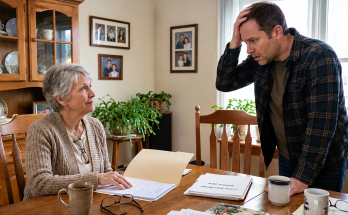
Kyle held the document close to his face.
He read the same paragraph twice.
Then he looked at me as though I had placed the wrong papers in front of him.
I knew that expression.
He had worn it as a teenager when he discovered that something he wanted came with conditions.
Only this time, the conditions involved a great deal more than permission to use a car.
“Mom, what exactly does this mean?”
I didn't answer immediately.
I wanted him to read it properly.
Not glance at it.
Not search for the part he liked.
Read it.
I told him to start at the beginning of the section.
He looked back down.
The wording was formal, but the meaning was not especially difficult.
The payment he had received in March counted toward his eventual inheritance.
If that payment turned out to be equal to or greater than his final share, he would not receive another distribution.
Kyle read that part aloud.
His voice became slower toward the end.
Then he stopped.
He stared at the page.
And laughed.
It wasn't a happy sound.
It was the short, strange laugh of someone who had just discovered that the situation was different from what he expected.
“Are you saying I could end up with no more money?”
I sat back in Frank's chair.
“I'm saying the amount you received has to be counted.”
He shook his head.
“But I'm your son.”
“I haven't forgotten.”
“Your only son.”
“Yes, Kyle.”
He seemed to believe repeating that fact would change what was written.
I understood why he was upset.
He had imagined one hundred and twenty thousand dollars as the beginning.
Apparently, he had never considered that it might represent much of what he would eventually receive.
I reminded him that the payment had been made early because he requested it.
The agreement simply recorded that arrangement.
He put the pages on the coffee table.
“Who decided this?”
I told him Frank and I had discussed the principles of our estate plan years earlier.
After Kyle asked for the money, Mr. Dunne had prepared and updated the appropriate documents.
Kyle frowned.
“Then why wasn't I told?”
I looked at him.
I remembered the attorney's office.
The polished desk.
The papers laid out in front of us.
Mr. Dunne reading through the conditions.
Kyle nodding.
The pen moving across three signature spaces.
I remembered every part.
“You were there when he explained it.”
Kyle looked away.
“He didn't tell me I might get nothing later.”
“He explained that the payment would reduce what you could receive.”
“That isn't the same thing.”
I felt tired.
It was exactly the kind of argument Frank used to recognize before I did.
Kyle wasn't asking what the document meant anymore.
He was searching for someone to blame for what it meant.
I reminded him that Mr. Dunne had asked whether he understood.
Kyle said he had been thinking about the money.
I believed him.
That was precisely the problem.
He had been thinking about what the payment would allow him to buy.
Not what the payment represented.
Not what his father and I had spent our lives saving.
And certainly not what his decision might mean later.
“Then the lawyer should have made it clearer,” he said.
I shook my head.
“He made it clear, Kyle. You didn't pay attention.”
His jaw tightened.
I hadn't meant to sound unkind.
But I was no longer willing to pretend that his carelessness was somebody else's responsibility.
He reached for the agreement again.
“Well, the house still comes to me eventually.”
There it was.
The assumption beneath everything else.
The reason he had arrived with plans for my kitchen and bedroom.
He believed the house was already his in every way that mattered.
Only my continued presence stood between him and possession.
I looked toward the fireplace.
The photograph of Frank and me beside the tractor was still hanging there.
It had been taken when we were celebrating the end of our mortgage.
Our faces looked younger.
Frank's hair was darker.
And we were grinning like two people who had finally done something they once thought impossible.
I remembered how he had held my shoulders that afternoon.
He had been proud.
Not because the property made us wealthy.
Because we had worked until we could finally say it belonged to us.
I had never thought I would need to explain that memory to Kyle.
But I did.
I pointed toward the papers.
“There's another section you should read.”
Kyle looked annoyed.
“About what?”
“The property.”
He turned the page.
I watched him scan the first few lines.
At first, he looked impatient.
Then his forehead creased.
He read more carefully.
He glanced at me.
Then returned to the document.
“Why is the farmhouse treated separately?”
I folded my hands.
“Because your father and I made arrangements for it.”
He shook his head.
“But Dad left you everything.”
“He did.”
“Then I'm next.”
I looked at him.
“That isn't something you get to decide.”
Kyle stared at me.
I explained that Frank's will had left his property to me.
I was the owner.
The home and land remained under my control during my lifetime.
Our estate arrangements also included a trust structure governing certain assets after my death.
Those arrangements did not give Kyle an automatic right to take the farmhouse because he happened to be my only child.
He kept looking at the papers.
I could see the moment he began to understand.
He had imagined himself as the next owner of everything.
The document described something different.
An estate plan.
Conditions.
Rights that belonged to me.
Decisions that had not yet become his to make.
“Dad wouldn't have wanted this,” he said.
I looked toward the photograph again.
That hurt.
Frank had loved Kyle.
He had worried about him too.
Both things were true.
I told my son that his father had spent forty-six years working for what we owned.
He had never been comfortable with the way Kyle handled money.
He had hoped our son would learn patience.
He had also wanted me protected.
Kyle's expression became defensive.
“You're making Dad sound like he didn't trust me.”
I considered that.
Frank had trusted Kyle to love us.
He had trusted him to be a devoted father to his own children.
But he had not trusted him to make careful financial decisions every time.
There was no point pretending otherwise.
I told Kyle that concern about money didn't mean a lack of love.
It meant his father knew him.
“He wanted me to have something,” Kyle insisted.
“He wanted you to have a good life.”
“Then why would he make it difficult?”
I looked at him for a long moment.
“Because giving you everything whenever you ask isn't the same as helping you.”
He didn't answer.
I stood and walked toward the fireplace.
For a moment, I looked closely at Frank's face in the photograph.
I wished he were there.
He would have understood the legal language better than I did.
He would also have understood the anger growing behind Kyle's silence.
But Frank wasn't there.
And I had to speak for myself.
I turned around.
I told Kyle the property belonged to me.
The house.
The land.
The money I had saved.
The decisions about where I would live.
I wasn't asking for his approval.
I wasn't announcing a temporary arrangement.
I was stating what was already true.
Kyle lowered the agreement.
“Mom, I think you've taken this the wrong way.”
I stared at him.
“What part?”
“The part about you moving.”
He shifted in his seat.
He said he hadn't meant to make me feel unwanted.
He had only been looking ahead.
Thinking about what the family might need.
I reminded him that he had said I should leave by spring.
He shrugged.
“That wasn't meant as an order.”
I asked what he would call it.
He didn't answer.
I reminded him that the apartment above the garage was only four hundred square feet.
It wasn't an appropriate replacement for the three-bedroom farmhouse I had spent almost four decades making into a home.
He said he had thought it might be easier for me.
I told him he had never asked.
That was what kept returning to me.
He had never asked whether I was struggling.
Never asked if I wanted to move.
Never asked whether I would welcome another family into the house.
He had simply decided.
Kyle said Jenna and he would have made arrangements so I could remain nearby.
I felt a small ache in my chest.
Nearby.
I had spent thirty-eight years living in that house.
Now my own son was explaining that I could remain nearby if he took it over.
I told him I had no intention of moving.
He rubbed his forehead.
Then he took out his phone.
“I need to speak to Dunne.”
I nodded.
“That sounds sensible.”
He called from the living room.
Mr. Dunne answered after two rings.
Kyle immediately began asking about the March agreement.
I couldn't hear every word from the attorney, but Kyle soon put the call on speaker.
He asked whether Mr. Dunne knew about the inheritance provision.
Mr. Dunne confirmed that he had prepared the agreement and explained it before Kyle signed.
Kyle argued that he had understood the paperwork as a way to receive money.
Nothing more.
Mr. Dunne reminded him that it was an advancement agreement.
He had explained how the early payment affected any future distribution.
Kyle said he hadn't realized it might leave him with no additional inheritance.
Mr. Dunne calmly reminded him that understanding the consequences had been the reason for reviewing the document together.
Kyle closed his eyes.
I could almost see him trying to remember the meeting.
The questions.
The signatures.
The money he had been so eager to receive.
Then he asked whether the agreement could be changed.
Mr. Dunne explained that my wishes and the governing estate documents controlled that question.
He also made it clear that he represented me in the estate planning matter.
Not Kyle.
Kyle looked at me.
I said nothing.
Then he asked about the house.
That was the question he cared about most.
Mr. Dunne explained that the legal ownership remained with me.
Kyle did not have a current ownership right merely because he was my son.
He couldn't simply move into the farmhouse.
He couldn't claim possession.
And he couldn't require me to leave.
The attorney advised him to consult his own lawyer if he wanted an independent review of the recorded property title and estate documents.
Kyle swallowed.
“Then I can't move my family there?”
Mr. Dunne's answer was simple.
He would need my permission.
Not a promise.
Not a prediction about the future.
My permission.
The call continued briefly before Kyle ended it.
He put his phone down.
For a long while, he looked at the floor.
I returned to Frank's chair.
The room felt strangely quiet.
I had expected another argument.
Instead, Kyle looked worried.
Not disappointed.
Worried.
Finally, he spoke.
“Jenna is going to be very upset.”
I studied his face.
“Why would Jenna be upset?”
He didn't answer immediately.
He rubbed his hands together.
Then he admitted that Jenna and he had already been making arrangements.
I asked what kind.
He said they had discussed moving to the farmhouse the following year.
I reminded him that I had never agreed.
He nodded.
Then he mentioned Jenna's parents.
They were planning to sell their own home and move closer to the family.
Kyle and Jenna had been working out how everybody might eventually fit into the arrangement.
I stared at him.
“Everybody?”
He hesitated.
He said it wouldn't necessarily happen at once.
There were still details to work out.
Details.
I couldn't believe the word.
My son had been planning a future for several people using a property that belonged to me.
And I had not even been invited into the conversation.
I asked whether he had told Jenna that the house was his.
He looked toward the window.
He wouldn't meet my eyes.
That told me enough.
I looked back at Frank's photograph.
For the first time, I understood that the argument about moving wasn't simply an impulsive suggestion.
Kyle had already told other people they could make plans around my home.
And now that the truth was in front of him, he was frightened of having to explain it.
Click here to continue reading: PART 3: My Son Had Promised My Farmhouse to His Wife and Her Parents Before Discovering How Little of His Inheritance Remained
My Only Son Walked Into My Living Room and Told Me to Leave the Home His Father and I Had Built
Part 2 of 15