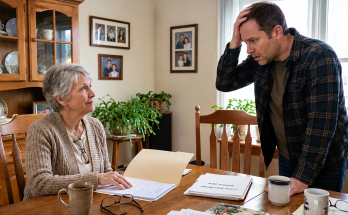
I sat across from Kyle and tried to understand how many decisions had been made without me.
Jenna knew about moving to the farmhouse.
Her parents knew.
They were preparing to sell their place.
And apparently, my son had been speaking as though he already owned the property.
I had known Kyle could be careless with money.
I hadn't realized he could be so careless with the truth.
I asked him when he intended to tell me about Jenna's parents.
He looked uncomfortable.
He said they were only considering different possibilities.
Nothing was final.
I reminded him that he had just told me he wanted me out by spring.
That sounded fairly final to me.
He said he hadn't expected me to react so strongly.
I looked around my living room.
Frank's chair.
The fireplace.
The pictures we had gathered over the years.
A lifetime represented by ordinary things.
Then I looked back at my son.
“You expected me to be pleased?”
He shook his head.
“Mom, I thought we could make it work.”
I wondered whether he had ever pictured me sitting alone in that small garage apartment.
Four hundred square feet.
A fraction of the home I had spent thirty-eight years caring for.
Perhaps he had imagined I would enjoy having fewer rooms.
Perhaps he had told himself I would be grateful for the arrangement.
I couldn't know what he had been thinking.
But I knew he hadn't asked me.
And that mattered more than any explanation he offered afterward.
Kyle said Jenna and he had wanted the children to grow up closer to the farm.
I understood that desire.
I wanted my grandchildren to enjoy the place too.
But visiting their grandmother was not the same as replacing her.
I told him I loved having the family there.
I would always welcome the grandchildren.
That didn't mean I was ready to surrender my house.
Kyle shifted forward.
“Mom, you're making it sound like we wanted to throw you away.”
I shook my head.
“I am telling you what you asked me to do.”
He said there were ways to make everybody comfortable.
I asked why those ways all seemed to require me to give up something.
He looked down.
I waited.
Then I told him what I should have said at the beginning.
I loved him.
He would always be my son.
But I would remain in my home as long as I chose.
I wasn't giving him control of my property.
And I wasn't changing the estate arrangements because he had promised things to his wife or her parents.
Kyle stared at me.
For a moment, I could see his frustration returning.
Then he asked what he was supposed to tell Jenna.
I almost felt sorry for him.
He had made promises he couldn't keep.
Now he wanted me to solve the embarrassment.
I told him to explain what had actually happened.
He shook his head.
He said Jenna and he had already spent money preparing.
I asked what he meant.
He mentioned furniture.
I waited.
Then he said they had been considering changes to the kitchen.
My kitchen.
The kitchen Frank and I had designed together.
I remember looking through the doorway at the cabinets.
We had installed them twenty years earlier.
They still served me perfectly well.
I kept the dishes in places my hands knew without thinking.
There was a drawer for the towels.
A cupboard for the baking pans.
A little space beside the sink where Frank used to leave his coffee cup.
I didn't need a new kitchen.
I certainly didn't need my son planning one without asking.
“Did you actually speak to somebody about remodeling it?”
Kyle nodded.
He said they had looked into contractors.
I stared at him.
There was something almost absurd about it.
He had been choosing improvements to a room he didn't own.
He was planning a place for his wife.
A place for her parents.
A smaller place for me.
And all of it had happened while I was going about my normal days, completely unaware.
Kyle tried to explain that they had intended to pay for the renovation.
That made me ask a question.
“With what money?”
He looked away.
It was a small movement.
But I noticed.
I had seen it before.
When he was younger, Kyle would look somewhere else when he knew he hadn't thought something through.
Frank had always recognized that look.
Now I did too.
I thought about March.
The attorney's office.
The signed agreement.
The payment I had transferred.
One hundred and twenty thousand dollars.
Then I thought about the boat.
The storage fees.
The insurance.
All the expenses he had brushed aside when I raised them.
Something didn't fit.
I looked directly at him.
“Kyle, how much of that money is still available?”
His expression changed.
He asked why I needed to know.
I told him I wanted an answer.
He looked toward the window again.
Not much, he said.
I asked him to be specific.
He hesitated.
Then he said he thought he had about twelve thousand dollars left.
At first, I didn't speak.
I was trying to do the subtraction in my head.
One hundred and twenty thousand.
Twelve thousand.
The difference was one hundred and eight thousand dollars.
Four months.
I repeated the numbers aloud.
He didn't correct me.
I felt my stomach tighten.
There are moments when you hear something so troubling that anger takes a while to arrive.
At first, there is only disbelief.
I had spent years worrying about whether I was spending too much on ordinary things.
I compared prices.
Waited for sales.
Kept appliances working as long as they could be repaired.
Frank had been the same.
And here was our son, telling me that almost everything I had given him in March was gone.
I asked where it had gone.
Kyle mentioned the boat.
I knew it had been expensive.
I hadn't understood how expensive the entire decision had become.
He began listing costs.
Repairs.
Insurance.
Storage.
Equipment.
The things that came after the purchase.
I listened.
Each item seemed to lead to another.
I asked whether he had considered those expenses before buying it.
He said he had underestimated them.
I could hear the embarrassment in his voice.
But I was too troubled to comfort him.
The money was gone.
I couldn't make that fact disappear by speaking gently.
I asked about his job.
He said he was still employed.
Then I asked about his personal savings.
He hesitated again.
My heart sank.
“Kyle, have you been using those too?”
He admitted that he had.
Some of his own money had gone toward boat payments and other expenses.
I asked how much.
He didn't give me a clear number.
I could see that he was uncomfortable.
I was uncomfortable too.
Because the truth was becoming harder to ignore.
My son had bought something he couldn't properly afford.
He had used the early inheritance to support that purchase.
Then he had started using his own savings.
And now he was standing in my living room trying to explain why I should move into the apartment over the garage.
I looked at him carefully.
I wondered whether he had convinced himself that moving into the farmhouse would solve his financial problems.
No mortgage to worry about.
A larger home.
Room for his family.
Property he believed would eventually be his.
Perhaps, in his mind, it all added up.
But it was built on one assumption.
That I would give him what he wanted.
I asked whether he understood how the situation looked to me.
He sighed.
“Mom, I know I've made a mess.”
I waited.
He said things would improve.
He just needed time.
I nodded.
Time was something he could take.
Money was another matter.
He looked at me hopefully.
“Could you help me get through it?”
I felt a familiar pull.
The same feeling I had experienced in March.
He was my son.
He was worried.
And I had the means to make some of his immediate problems disappear.
That was the temptation.
Not because I believed another payment would solve everything.
But because mothers don't enjoy watching their children struggle.
Even grown children.
Even children who have been selfish.
I could almost hear Frank asking what Kyle intended to do differently.
What had he learned?
What would prevent the next problem?
I looked at my son.
I thought about how quickly the first payment had vanished.
And I realized that giving him more might only postpone the moment when he had to face his own decisions.
I told Kyle he could take time to get himself organized.
He seemed relieved.
Then I explained that I wasn't offering more money.
His face changed.
He reminded me that I had savings.
I told him I knew exactly what I had.
I had spent decades helping to build it.
He said he wasn't asking for everything.
I reminded him that he had already received one hundred and twenty thousand dollars.
The amount he requested.
The amount he agreed to accept as an early inheritance.
Four months earlier, he had assured me he could handle it.
Now he was asking for my home.
And possibly more money.
I couldn't ignore the pattern anymore.
I told him there would be no second payment to replace what he had spent.
Kyle leaned back.
“So you're just going to refuse?”
I nodded.
“Yes.”
He stared at me.
I could see anger replacing embarrassment.
He said I didn't understand how much pressure he was under.
I told him I understood that he was in trouble.
But I hadn't put him there.
That distinction mattered.
He had chosen the boat.
He had agreed to the expenses.
He had spent the money.
And he had promised my property to other people without permission.
I wasn't going to accept responsibility for those choices.
For a moment, he looked as though he might argue again.
Then he stood.
He picked up his jacket.
I remained seated.
There was nothing else I could explain that he hadn't already heard.
He walked toward the front door.
I followed him with my eyes.
Before leaving, he turned around.
He asked whether I was really going to let him go home without giving him anything.
I felt the words more deeply than I expected.
Without anything.
He had received $120,000.
He had a job.
A wife.
Children.
And he was standing in a house where he had always been welcome.
Yet he was speaking as though I had left him empty-handed.
I took a breath.
I told him he had arrived expecting me to surrender my home.
If he left with his self-respect intact, he was leaving with more than he seemed to realize.
His face reddened.
For a moment, I thought he might say something that neither of us could easily take back.
But he didn't.
He opened the door.
And left.
I watched his truck move down the driveway.
Past the porch.
Past the garden.
Toward the road beyond the fields.
Only when it disappeared did I realize how tightly I had been gripping the chair.
My fingers hurt.
I went into the kitchen.
Filled the kettle.
Made tea.
Then sat at the table where Frank and I had shared breakfast for thirty-eight years.
My hands trembled when I lifted the cup.
I set it down before spilling anything.
I didn't regret refusing Kyle.
I regretted that refusing him had become necessary.
I looked toward the empty chair across the table.
Frank had always believed our son needed to learn that choices carried consequences.
I had believed that too.
But I had hoped life would teach Kyle gently.
Now I wondered whether my own willingness to help had allowed him to postpone that lesson.
I sat there until the tea cooled.
Then I put the cup in the sink.
I tried to return to my ordinary evening.
But I couldn't stop thinking about one thing.
Kyle had told Jenna that the farmhouse would be theirs.
I didn't know exactly what he had said.
I didn't know how much money they had already committed.
And I didn't know whether Jenna understood that none of it had been approved by me.
That uncertainty troubled me more than I wanted to admit.
At 8:17 that evening, my phone rang.
Jenna's name appeared on the screen.
I answered.
She didn't begin with a greeting.
She said Kyle had told everyone I was turning the house over to them.
I put my teacup down.
So that was what she had been told.
And now we were going to have to discuss it.
Click here to continue reading: PART 4: My Daughter-in-Law Called About the House She Thought Was Already Hers, and I Learned How Far My Son Had Misled Everyone
My Only Son Walked Into My Living Room and Told Me to Leave the Home His Father and I Had Built
Part 3 of 15