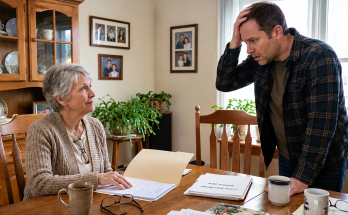
There was one thing I hadn't changed.
My estate documents.
Even after Kyle began visiting regularly, I kept the arrangements Frank and I had made.
I didn't rush to reward him.
I didn't rush to punish him.
I simply left the documents in place while I thought about what I wanted.
That was harder than it sounds.
There were days when I felt so happy to have my son around again that I wanted to forget everything that had happened.
Then there were mornings when I remembered his face as he discussed moving me into the garage apartment.
Those memories didn't disappear just because he fixed a porch board.
They were both part of the truth.
I loved my son.
And my son had hurt me.
I had to learn how to live with both facts.
After Frank died, I had assumed the estate plan would remain mostly unchanged.
We had spent years arranging our affairs carefully.
The farmhouse.
The land.
Our savings.
The provisions concerning Kyle.
We wanted everything clear.
We also wanted to make sure I could continue living independently.
Frank had been particularly firm about that.
He didn't want me worrying about whether anyone would eventually pressure me to sell or move.
I had thought he was being unnecessarily cautious.
Now I understood.
His concerns had not been imaginary.
They had simply appeared later than either of us expected.
One morning, I took out the estate documents again.
I spread them across the kitchen table.
I didn't read every legal phrase.
Some sections were easier to understand after Mr. Dunne explained them.
But I knew what the documents were intended to accomplish.
The $120,000 advancement would be accounted for.
Kyle had no present right to claim my home.
And the trust arrangements would govern certain assets after my death.
I thought about the question Mr. Dunne had asked during our previous appointment.
Did I still want Kyle to receive what might remain of his inheritance?
At the time, I hadn't known.
I was too upset.
Too disappointed.
Too frightened by how quickly my son had begun treating my life as something that should make room for his plans.
But now I could think about the question without feeling quite so wounded.
I wasn't certain I wanted to disinherit Kyle.
I also wasn't certain I wanted to leave everything to him.
For many years, I had imagined those were the only two choices.
Everything.
Or nothing.
Then I remembered something Frank and I had discussed long before his death.
There was a local community organization that helped older residents remain independent in their own homes.
Frank had admired that work.
So had I.
We knew how important it was to have a safe place to live.
We understood what it meant to grow older while wanting to keep control of daily decisions.
And we had talked about helping people who didn't have the resources we had been fortunate enough to build.
At the time, it had been one of those conversations couples have about the future.
Something we intended to consider more carefully.
Then life became busy.
Frank became ill.
And after he died, I spent so much time adjusting to being alone that I didn't return to the idea.
Now I thought about it again.
The organization helped older people remain in familiar surroundings.
People who wanted to stay in their own homes.
People who sometimes needed assistance to make that possible.
I thought about the garage apartment.
Four hundred square feet.
The place Kyle had suggested I should move into so he could take over the farmhouse.
I thought about how frightened and angry I had felt.
Then I thought about older people who might not have the financial security or legal protections I had.
Some might face pressure from family.
Others might struggle simply because their homes required work they couldn't afford.
Frank and I had been fortunate.
We owned our property.
We had saved.
We had an attorney who understood our wishes.
Not everyone had those advantages.
I wanted part of what we had built to help someone else remain independent.
That thought stayed with me throughout the morning.
I made breakfast.
Washed the dishes.
Then went outside to check the flowers.
But I kept thinking about it.
By afternoon, I knew I wanted to discuss the idea with Mr. Dunne.
I called his office and arranged an appointment.
I didn't tell Kyle.
Not because I was hiding something to punish him.
Because I didn't need his permission.
That was a lesson I was still practicing.
My finances were mine.
My estate plan was mine.
And I had a right to consider changes without turning every decision into a family discussion.
When the appointment came, I drove to Mr. Dunne's office.
The familiar building no longer made me nervous.
During the earlier visit, I had been worried about protecting myself from pressure.
This time, I was thinking about what I wanted my money to accomplish.
That felt different.
Mr. Dunne welcomed me.
He asked how things were going with Kyle.
I told him they were better.
I explained that Kyle had sold the boat.
That he and Jenna were working on their debts.
That he had begun visiting without asking for anything.
I mentioned the garden.
The porch repairs.
And the old toolbox.
Mr. Dunne listened.
He seemed pleased that our relationship was improving.
But he didn't suggest that those changes required me to revise my estate plan.
I appreciated that.
He understood something I was beginning to understand too.
A better relationship didn't have to mean a different financial arrangement.
I could forgive Kyle.
I could enjoy spending time with him.
And still decide that the existing advancement agreement was appropriate.
We reviewed the documents again.
Mr. Dunne confirmed the property arrangements.
He explained the trust provisions.
We discussed how future distributions would be handled under the applicable terms.
Then I brought up the community organization.
I told him Frank and I had discussed helping older residents remain in their homes.
I explained that I wanted to leave a portion of my estate for that purpose.
He asked questions about my wishes.
I answered carefully.
I didn't want to make the decision because I was angry with Kyle.
I didn't want the gift to become some kind of message directed at him.
That wasn't what Frank and I had discussed.
The organization had mattered to us long before the family disagreement.
And now, after experiencing how quickly someone could begin questioning my independence, it mattered even more.
I wanted the money to be useful.
Not simply inherited because someone expected it.
Mr. Dunne discussed ways to reflect my wishes within the estate arrangements.
We considered the existing provisions.
The possible future distributions.
And the importance of making everything clear.
I asked whether the charitable portion would affect the way Kyle's earlier advancement was accounted for.
Mr. Dunne explained that the documents needed to work together.
Any final distribution would depend on the estate's value, the governing terms, and the required accounting.
I listened.
I wasn't interested in creating confusion.
There had already been enough of that.
I wanted my wishes properly written.
I wanted Kyle's advancement recognized.
And I wanted the community organization to receive the portion I intended.
Mr. Dunne assured me we could document those choices carefully.
We discussed the details.
I asked questions.
He answered them.
When something wasn't clear, I asked him to explain it again.
I thought about Kyle sitting in that same office in March.
He had been so eager to receive the money that he barely seemed to hear the explanations.
I wasn't going to repeat that mistake.
The documents mattered.
The wording mattered.
And understanding what I was signing mattered most of all.
I took my time.
When we finished, I felt comfortable with the direction of the plan.
I wasn't trying to leave Kyle with nothing.
I wasn't making a decision out of revenge.
I was deciding that a portion of the estate should serve a purpose Frank and I had valued.
That was all.
I drove home thinking about my husband.
He would have liked the idea.
I felt certain of that.
We had both believed that people deserved dignity as they grew older.
We had seen how hard it could be for someone to remain independent when money was limited.
And we had wanted our savings to do some good beyond our family.
I parked in front of the farmhouse.
Then I sat in the car for a moment.
The afternoon sun was falling across the fields.
The porch was quiet.
The garden looked healthy.
I thought about how different the property seemed when I wasn't viewing it through Kyle's expectations.
For a while, every conversation about the house had felt dangerous.
I worried someone might ask me to leave.
Or suggest selling it.
Or tell me what should happen after I died.
Now I could simply look at it as my home.
Not an inheritance waiting to be claimed.
Not a financial problem someone else wanted to solve.
My home.
I went inside.
Then I placed the papers where they belonged.
I didn't call Kyle to announce what I had discussed.
I made dinner.
I washed the dishes.
And I spent the evening quietly.
A few days later, Kyle came to visit.
Jenna was with him.
We sat outside.
The weather was warm.
The garden was doing well.
Kyle asked whether I needed help with anything.
I told him I was managing.
Then I mentioned the estate decision.
Not the private details.
Only that I had decided to leave part of what I owned to the community organization Frank and I had admired.
Kyle looked surprised.
He asked which organization I meant.
I explained its purpose.
It helped older residents remain independent in their homes.
People who wanted to continue living where they felt safe.
I watched his face.
There was a time when I would have worried about telling him.
A portion of the estate going somewhere else meant there might be less for him.
I knew he understood that.
The old Kyle might have argued.
He might have asked how much.
Or whether I had considered his children.
Or why strangers should receive something that could remain in the family.
But he didn't.
He looked toward the farmhouse.
Then he nodded.
“Dad would have supported that.”
I felt tears gathering in my eyes.
I smiled.
“I believe he would.”
Kyle looked at me.
He didn't ask how much I intended to leave.
He didn't ask whether his own inheritance had changed.
He simply said he thought it was a good thing.
Jenna agreed.
We talked briefly about the organization.
Then the conversation moved on.
I sat there for a while, feeling something I hadn't expected.
Relief.
Not because Kyle approved my decision.
I no longer needed that.
I was relieved because he seemed capable of hearing about my wishes without making them about himself.
That was a meaningful change.
I thought about Frank's letter.
He had wanted me to enjoy the life we built.
He had wanted me to remain free to decide what was right for me.
And he had hoped Kyle would eventually become more careful.
I couldn't say every concern had disappeared.
But I could see progress.
Real progress.
That evening, after Kyle and Jenna left, I returned to the living room.
I stood beside the fireplace.
Frank's photograph looked back at me.
I told him quietly that I had finally taken care of the idea we used to discuss.
The community organization.
The portion of the estate.
The hope that our savings could help someone else.
Then I sat in his chair.
For years, I had imagined leaving everything behind as a simple transfer from one generation to the next.
Now I understood that inheritance could mean something broader.
It could support family.
It could preserve memories.
It could help strangers remain in their own homes.
And it could reflect the values of the people who had spent their lives building it.
I didn't know exactly what my estate would be worth when I died.
I didn't know what Kyle might eventually receive after the advancement was accounted for.
Those questions would be answered when the time came.
But I knew my wishes were clear.
And I was satisfied with them.
For the first time, I could think about my estate without feeling that my son and I were standing on opposite sides of a table.
The money was no longer the center of our relationship.
I hoped it would stay that way.
Click here to continue reading: PART 11: Nearly a Year After He Tried to Take My Home, My Son Returned to the Living Room and Finally Understood What Hurt Me Most
My Only Son Walked Into My Living Room and Told Me to Leave the Home His Father and I Had Built
Part 10 of 15