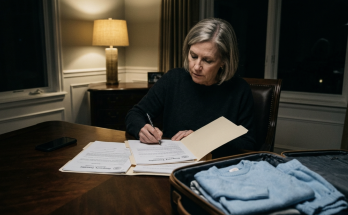
The emergency room smelled of antiseptic, overheated air, and burnt coffee.
Elena lay beneath two hospital blankets while a nurse adjusted the intravenous line in her arm. Her fever had climbed during the taxi ride. By the time we reached the hospital, she was shaking so violently that she could barely answer the admitting physician’s questions.
Noah had been taken to pediatrics for observation.
I stood between their rooms, still wearing my uniform beneath an open winter coat, feeling as though my body had arrived home while the rest of me remained somewhere thousands of miles away.
A doctor named Patel approached shortly after midnight.
His expression was controlled, but not reassuring.
“Your wife is severely dehydrated,” he said. “She is also showing signs of a post-surgical infection. We caught it early enough to treat aggressively, but she should not have been alone in her condition.”
“She wasn’t supposed to be alone.”
The words came out evenly.
Too evenly.
Dr. Patel glanced at the military identification clipped near my chest, then back at me.
“She also appears malnourished. When was her last full meal?”
I looked through the glass wall at Elena.
Her eyes were closed. Her face seemed even smaller against the white pillow.
“I don’t know.”
That answer hurt more than I expected.
For months, I had known the exact fuel consumption of every vehicle under my command. I knew the names, blood types, and emergency contacts of the soldiers serving beside me. I could recite mission schedules from memory.
But I did not know when my wife had last eaten.
I had trusted my family to know for me.
“How is my son?” I asked.
“He is underweight, but stable. He was cold when you brought him in. His temperature is improving.”
Cold.
My eleven-day-old son had been cold inside the apartment I paid for while my mother toasted the new year beside a hotel pool.
Dr. Patel waited.
“Mr. Carter, I need to ask something difficult. Was your wife intentionally denied food or medical care?”
I stared at him.
Elena had begged me not to confront my mother. She had not asked me to protect herself. She had asked because she was afraid of what my mother would say.
That distinction mattered.
“I don’t know yet,” I said. “But I’m going to find out.”
At 12:14 a.m., I called a lawyer.
Not a family friend.
Not someone my mother knew.
I called Major Rebecca Sloan, a military attorney who had once helped one of my soldiers recover money stolen through identity fraud. She answered on the fourth ring, her voice sleepy but immediately alert.
“Daniel?”
“I need advice.”
“Are you safe?”
“Yes.”
“Is Elena safe?”
“She is now.”
There was a pause.
“Tell me everything.”
I spoke for six minutes.
Rebecca interrupted only twice.
The first time was to ask whether my mother had legal access to my financial accounts.
The second was to ask whether the apartment had cameras.
“Yes,” I said. “Two inside the common areas. Security system. Cloud backup.”
“Do not contact your mother,” Rebecca said. “Do not warn anyone. Save every message, every transaction, every recording. Change your passwords from a secure device. Remove account permissions, but do not close anything yet.”
“I already canceled the cards.”
“That’s fine. What did you authorize the money for?”
“Food, medical transportation, household expenses, supplies for the baby, and assistance for Elena.”
“Was that written anywhere?”
“Yes. Emails. Text messages. A spreadsheet.”
“Good.”
Her voice became colder.
“Then this may be more than family cruelty. Depending on what they purchased and how they represented the expenses, it could be fraud, theft, exploitation of a vulnerable adult, and possibly child endangerment.”
I looked at Elena through the glass.
“What do I do first?”
“Protect your wife and child. Then preserve the evidence.”
I already knew how to do that.
At 1:03 a.m., I opened my laptop in the hospital waiting room.
The apartment security system required two-factor authentication. My mother did not know the password, but she knew the cameras existed. Months earlier, she had complained about them.
“A home should feel like a home,” she had said. “Not a military checkpoint.”
I had almost disabled them before deployment.
Almost.
The first recording I opened was from December twentieth.
My mother stood in the kitchen wearing a cream-colored coat, holding a grocery bag. Rachel leaned against the counter scrolling through her phone. Elena was eight months pregnant and moving slowly.
“There’s no room for all this health food,” my mother said.
She removed the broth, vegetables, yogurt, fruit, and prepared meals I had stocked before leaving.
Elena looked confused.
“Daniel bought those for after the birth.”
“And Daniel wastes money because you make him nervous.”
My mother placed the food into two large reusable bags.
“Mark’s gym trainer says organic food is better. It shouldn’t go to waste here.”
Rachel laughed.
Elena placed one hand over her stomach.
“I’ll need some of it.”
“You’ll survive,” my mother replied. “Women have been giving birth for thousands of years without imported berries.”
I watched the recording twice.
Then I downloaded it.
The second recording was from December twenty-third.
Elena stood near the kitchen table while Rachel opened a package addressed to me. Inside were infant blankets, a breast pump, surgical recovery garments, and a set of small bottles.
Rachel held up the breast pump.
“These things cost hundreds.”
“That’s mine,” Elena said quietly.
Rachel glanced at my mother.
My mother smiled.
“You can use a hospital one.”
The next day, the unopened breast pump appeared in a video taken from the building lobby. Mark carried it toward the elevator with several other boxes.
I searched the transaction history from the authorized credit cards.
A resale marketplace deposit had been made into Rachel’s account two days later.
I felt something inside me settle.
Not explode.
Settle.
Anger was chaotic.
This was clearer.
At 2:20 a.m., I found footage from the morning Elena went into labor.
She stood in the hallway doubled over, gripping the wall.
“My contractions are close,” she said. “I think we need to leave.”
My mother sat on the sofa painting her nails.
“You’re being dramatic.”
“My water broke.”
Rachel looked up from her phone.
“Can’t you call a car?”
“Daniel left money for transportation.”
“That money is for emergencies,” my mother said.
Elena stared at her.
“This is an emergency.”
My mother sighed, opened her purse, and removed a credit card bearing my name.
“No. This is inconvenient.”
Elena called a taxi herself.
The hospital records later showed that she arrived alone.
Her labor became complicated. Noah’s heart rate dropped. The surgeons performed an emergency C-section.
My mother did not arrive until seven hours after the operation.
According to the footage, she had spent those seven hours inside my apartment with Rachel and Mark, opening wedding gifts from storage and deciding which items could be returned for cash.
At 3:05 a.m., I stopped watching.
Not because there was nothing else.
Because there was too much.
I created three encrypted copies of every file. One went to Rebecca. One went to secure military cloud storage. One went onto an external drive I placed inside my locked suitcase.
Then I checked the spending.
The fourteen thousand dollars had disappeared in less than five weeks.
The charges included designer clothing, salon appointments, premium liquor, a beach cabana reservation, airline upgrades, jewelry, nightclub deposits, and a suite at a South Beach resort.
There were also smaller transactions.
Those were worse.
Forty-eight dollars at a baby supply store.
My mother had told me she purchased formula.
The receipt showed perfume.
One hundred twenty-six dollars at a pharmacy.
She had claimed it was for Elena’s medication.
The itemized bill showed cosmetics, diet supplements, and a heated styling brush.
Three hundred dollars listed on the spreadsheet as “emergency cleaning.”
The payment had gone to Mark’s online sports betting account.
They had not merely wasted the money.
They had documented their lies and expected me never to examine them.
At 4:17 a.m., Rachel tried to use one of the canceled cards at the hotel bar.
The charge was declined.
Thirty seconds later, my phone rang.
I let it ring.
A message followed.
**Rachel:** Daniel, there’s a problem with the card. Call me immediately.
Then another.
**Rachel:** The bank probably flagged it because we’re traveling.
Then my mother.
**Mom:** Happy New Year, sweetheart. We tried to buy dinner for Elena and the baby, but the card isn’t working. Can you fix it?
I read the message three times.
She did not know I was home.
She was standing in a luxury resort, asking me to restore the card by pretending she was buying dinner for the woman she had abandoned.
I took a screenshot.
Then I put the phone facedown.
At dawn, Elena woke.
Her eyes searched the room until they found me.
“Noah?”
“Stable. Warm. The pediatrician says he should be fine.”
Her shoulders loosened.
I moved closer.
“Why didn’t you tell me?”
She looked toward the door.
“Your mother said your mission was dangerous. She said distracting you could get someone killed.”
“You had surgery.”
“She said soldiers’ wives are supposed to be strong.”
“That isn’t strength.”
“I know.”
Her voice broke.
I sat beside her bed.
“How long?”
Elena’s fingers tightened around the blanket.
“Since before Noah was born.”
“What did they do?”
She closed her eyes.
The story emerged in fragments.
My mother had taken Elena’s phone at night, claiming screen use would make her anxious.
Rachel had answered messages pretending to be her.
They had told Elena I was too busy to call.
When I sent money, my mother showed her altered screenshots with lower amounts.
When Elena asked for food, she was accused of being ungrateful.
When she asked for pain medication after surgery, Rachel told her dependency could ruin a mother’s reputation.
Mark had complained about the baby crying and threatened to leave Noah alone in the apartment hallway if Elena did not silence him.
I felt my hand curl into a fist.
Elena noticed.
“Daniel.”
“I’m not going to do anything reckless.”
“That’s what scares me.”
I looked at her.
She knew me better than anyone.
She knew shouting would have been temporary.
Silence meant I had chosen a direction.
“What aren’t you telling me?” I asked.
Her face changed.
It was small, almost invisible, but I saw it.
“There’s more.”
She began to cry.
Not loudly.
Elena rarely cried loudly.
“They made me sign papers.”
“What papers?”
“I don’t know.”
“When?”
“The day after I came home from the hospital. I was medicated. Your mother said they were insurance forms.”
“Did you read them?”
“She covered most of the pages. She only showed me where to sign.”
My pulse slowed.
That was always how danger felt to me.
The world became narrower.
Every sound separated itself from the next.
“What name was on the documents?”
“I saw a logo. Carter Family Holdings.”
That company belonged to my late father.
After his death, ownership had been divided between my mother and me. It held two rental properties, investment accounts, and the family home in Queens.
My father had structured my share so that my mother could not sell major assets without my authorization.
Unless my spouse signed certain waivers.
I called Rebecca again.
She answered immediately.
“Tell me you found something useful.”
“They had Elena sign documents while she was medicated.”
Silence.
“What documents?”
“Possibly related to Carter Family Holdings.”
“Daniel, listen carefully. Do not tell anyone you know. I’m going to contact a corporate attorney and check public filings.”
“They may be trying to sell something.”
“Or transfer something.”
I looked toward Elena.
“Can they?”
“If the documents were forged, misrepresented, or signed without informed consent, they can be challenged. But we need to know what was filed.”
Rebecca paused.
“And Daniel?”
“Yes?”
“Your family’s hotel problem may become the least of their concerns.”
At 7:40 a.m., a social worker entered Elena’s room.
She asked me to step outside while she spoke to my wife privately.
I agreed.
Fifteen minutes later, she invited me back in.
Elena had authorized the hospital to document suspected neglect and coercive control. Because an infant had been involved, the hospital was required to notify child protective services.
Normally, those words would have terrified me.
Instead, they brought relief.
A system larger than our family had entered the room.
My mother could insult Elena.
She could lie to relatives.
She could claim misunderstanding.
But she could not order medical records to disappear.
By midmorning, a police detective named Marcus Bell arrived.
He was tall, broad-shouldered, and spoke with the patience of someone who had learned that silence often produced better answers than pressure.
I gave him the handwritten note, transaction records, security footage, and messages.
He watched several clips without expression.
When the video showed Mark threatening to put Noah in the hallway, Detective Bell stopped it.
“Does this man live in the apartment?”
“No.”
“Did he have permission to be there?”
“Only because I believed he was helping.”
“Did your mother and sister have legal authority to use your funds for personal travel?”
“No.”
“Did they know the money was restricted to your wife’s recovery and your child’s care?”
“I have written proof.”
He nodded.
“Where are they now?”
“South Beach.”
“Hotel name?”
I gave it to him.
He wrote it down.
“What happens next?” I asked.
“I coordinate with local authorities. We verify the evidence and determine probable cause. Financial crimes take time. Endangerment may move faster.”
He closed the folder.
“Do not contact them.”
“I won’t.”
He looked at me for a moment.
“You’re remarkably calm.”
“No,” I said. “I’m organized.”
At 10:12 a.m., my mother finally realized something was wrong.
She called seven times.
Rachel called eleven.
Mark sent three messages.
The first was polite.
**Mark:** Hey, brother. We need to sort out this card issue.
The second was irritated.
**Mark:** Your family is stranded because you made some banking mistake.
The third was a threat.
**Mark:** Fix this before I call your commanding officer and explain how unstable you are.
I forwarded all three to Detective Bell.
At 10:36, my mother left a voicemail.
Her voice was sweet.
“Daniel, darling, I don’t know why you’re ignoring us. Elena must be upset and filling your head with nonsense. You know how emotional women become after childbirth. We’ve sacrificed so much for both of you.”
I saved it.
At 10:41, another voicemail arrived.
The sweetness was gone.
“You had no right to cancel those cards. Rachel and Mark are humiliated. The hotel is demanding payment. Call me now.”
Saved.
At 10:53, the third arrived.
“You think you can punish your own mother? After everything I’ve done? That apartment is only yours because of this family. Your career exists because I raised you. Elena is weak, manipulative, and unfit to care for a child. When you lose custody of that baby, remember that I warned you.”
I played that message for the social worker.
Then I saved it twice.
By noon, Noah was brought into Elena’s room.
I held my son for the first time while winter sunlight spilled through the blinds.
He weighed almost nothing.
That was how it felt.
A warm, fragile bundle tucked into my arms, breathing softly, one tiny hand closing around the edge of my uniform.
I had imagined that moment for months.
In every version, my mother stood nearby crying with happiness.
Rachel took photographs.
Elena smiled from a hospital bed surrounded by flowers.
Instead, the room contained a detective’s business card, antibiotic bags, social-service forms, and a plastic bag holding evidence from an empty refrigerator.
Elena watched me.
“He has your forehead,” she whispered.
“He has your courage.”
She looked away.
“I wasn’t courageous.”
“You kept him alive.”
Her eyes filled.
“That’s all courage is sometimes.”
At 1:18 p.m., Rebecca called.
Her voice had changed.
“I found the filing.”
“What did they do?”
“Three days ago, an amendment was submitted to Carter Family Holdings. It claims Elena voluntarily waived spousal notice rights and consented to the transfer of your voting interest.”
“To whom?”
“Your mother.”
I looked down at Noah.
“How?”
“The documents include your signature.”
“I didn’t sign anything.”
“I know.”
“What else?”
“A sale agreement was drafted for the Queens property.”
My childhood home.
My father’s home.
The house he had spent thirty years paying for.
“Has it been sold?”
“Not yet. But there is a buyer.”
“Who?”
“A private investment company called North Atlantic Redevelopment.”
The name meant nothing to me.
Rebecca continued.
“There’s another problem. The proposed sale price is far below market value.”
“How far?”
“About forty percent.”
“Why would my mother agree to that?”
“I don’t think she was planning to lose money.”
She sent me a document.
The buyer’s representative was listed as M. Holloway.
I stared at the name.
“Rebecca, who is Holloway?”
“I’m still checking.”
The hospital door opened.
Detective Bell entered, holding his phone.
“Local officers are at the resort.”
Elena’s hand tightened around mine.
“What are they arresting them for?” I asked.
“Right now, suspected financial fraud and child endangerment-related offenses. Charges may expand.”
My phone rang again.
Rachel.
For the first time, I answered.
“Daniel!” she shouted. Music and voices echoed behind her. “There are police here. Mom says this is Elena’s fault. Tell them it’s a misunderstanding.”
I said nothing.
“Daniel?”
In the background, Mark was arguing with someone.
A man ordered him to place his hands where they could be seen.
My mother seized Rachel’s phone.
“You listen to me,” she hissed. “You will fix this. You will tell them we had permission.”
“You didn’t.”
“We are your family.”
“So are Elena and Noah.”
Her breathing became harsh.
“That woman has poisoned you.”
“No.”
I looked at my wife and son.
“She showed me who you already were.”
My mother lowered her voice.
“You have no idea what you’re doing.”
“I know exactly what I’m doing.”
“You think those videos protect you?”
I froze.
She knew about the footage.
Before I could respond, she laughed.
Not nervously.
Confidently.
“You always were too much like your father,” she said. “Always collecting proof after it’s already too late.”
The line went silent.
Detective Bell looked at me.
“What did she mean?”
“I don’t know.”
But something cold had moved through me.
I reopened the security account.
The recordings were still there.
Then I noticed a login from three weeks earlier.
An administrator login.
Not mine.
Someone had accessed the system remotely and downloaded selected footage.
I checked the account details.
The login had been created using an email address attached to Carter Family Holdings.
My mother had known the cameras were recording.
She had known I might see everything.
And she had done it anyway.
That meant she was either catastrophically arrogant—
or the videos were never the real danger.
At 2:07 p.m., Rebecca called again.
“I identified M. Holloway.”
I put the phone on speaker.
“His name is Matthew Holloway. He works through shell companies buying distressed properties.”
“I’ve never heard of him.”
“Elena has.”
My wife looked at the phone.
“No, I haven’t.”
Rebecca hesitated.
“He visited your apartment six days ago.”
I opened the footage from that date.
The camera showed my mother standing near the kitchen door. A gray-haired man entered wearing an expensive overcoat. He carried a leather folder.
Elena was asleep in the bedroom.
Rachel poured him a drink.
Mark shook his hand.
My mother handed him a copy of my deployment orders.
Then Holloway said something that made every person in the hospital room go still.
“The transfer must be completed before Daniel learns the child survived.”
Elena covered her mouth.
I replayed the sentence.
Before Daniel learns the child survived.
Not before I returned.
Not before I discovered the fraud.
Before I learned Noah had survived.
Holloway opened the folder and placed a photograph on the kitchen table.
The camera angle caught only part of it.
A military vehicle.
A burned road.
Men in uniform.
One of them was me.
The picture had been taken overseas less than a month earlier.
My mother tapped the image with one finger.
“You promised he would not come home early.”
Holloway leaned back.
“And you promised the medical complication would resolve itself.”
Elena made a sound beside me.
A quiet, wounded gasp.
Detective Bell stepped closer to the screen.
“Play it again.”
I did.
My mother’s face remained calm in the recording.
Holloway collected the photograph.
Then he looked directly toward the security camera.
For one terrible second, it felt as though he were looking through time, straight at me.
He smiled.
“Delete whatever you need to delete,” he said. “By the time the soldier understands what happened, his wife will blame herself, the infant will be gone, and his assets will belong to you.”
The recording ended.
Noah began to cry in my arms.
Elena reached for him, but her hands were shaking.
Detective Bell immediately called his department.
Rebecca was speaking, but I could barely hear her.
The room had become distant.
My mother’s neglect had never been careless.
The empty refrigerator was not laziness.
The missing medicine was not selfishness.
The freezing apartment was not an accident.
They had been waiting for Elena’s infection to worsen.
They had been waiting for my son to stop breathing.
And someone connected to my overseas assignment had been helping them.
My phone vibrated.
A message appeared from an unknown number.
It contained a single photograph.
My father, standing beside Matthew Holloway twenty-two years earlier.
On the back of the photograph, written in my father’s handwriting, were six words:
**If anything happens to me, find him.**
A second message arrived.
**Your mother did not kill him.**
Then a third.
**But she knows who did.**
I stared at the screen while police radios crackled around me and my newborn son cried against my chest.
For the first time since entering the apartment, my control nearly broke.
Not because of what my mother had done.
Because of what she had been hiding.
And somewhere beneath the fear, exhaustion, and rage, one question rose above all the others.
If my father’s death had not been an accident—
why had the same man now come for my wife, my child, and me?
**…If you want to know what happened next, please type “YES” and like for more.**