At sixty-eight, I could tell what kind of morning Michael was having by the sound of his coffee cup touching the kitchen counter. A soft tap meant he had slept. A sharp little knock meant another restless night. That Tuesday, the ceramic struck granite hard enough to make me look up from the newspaper. Michael stood with his back to me, shoulders narrow beneath an old gray sweater, one hand braced beside the sink. Eighteen years earlier I would have crossed the room, rested my palm between those shoulders, and asked what was wrong. Instead, I folded the newspaper and said, “Your cardiology appointment is Thursday.” He answered, “I remember.” That was what our marriage had become: dates, groceries, medication refills, and weather.
We had been married more than thirty years. To people who saw us at Christmas dinners, retirement parties, neighborhood barbecues, or our son Jake’s birthdays, we probably looked unusually steady. Michael still opened doors for me in public. I still remembered which pie he liked at Thanksgiving. We signed cards together, divided household bills without arguing, and stood shoulder to shoulder in photographs. What no photograph showed was that my husband had not kissed me, held me, or slept beside me since the spring of 2008.
The separation had no legal name. We had never filed papers. We had never announced anything to our families. Michael simply moved into the guest room one night and remained there. At first I assumed his absence would last several days. Then weeks. Then months. Eventually his clothes disappeared from our bedroom closet, his razor from our bathroom, his books from the bedside table. He never returned them. Neither of us discussed it after the first year because discussion required a kind of intimacy too.
I knew why he had left the bed.
I had betrayed him.
Even after eighteen years, I could not make that sentence prettier. I had been forty-two, restless in ways I had not understood, angry at Michael for disappointments he had never known existed because I had never voiced them. I met a man through work who listened too carefully and laughed at things Michael had stopped noticing. What began as lunches became messages. Messages became meetings. Then came the affair.
Michael discovered it before I found the courage to confess.
I still remembered coming home one evening and finding him seated at the dining table with my phone in front of him. He did not shout. That would almost have been easier. He turned the screen toward me and asked, “How long?” His voice was so calm that I heard the refrigerator humming in the kitchen behind him.
“Michael—”
“How long, Susan?”
I told him.
He stared at the wall over my shoulder. “Does Jake know?”
“No.”
“Keep it that way.”
Our son was seventeen then, finishing his final year of school and talking constantly about leaving for college. Michael’s first instinct, even while I was dismantling him, was to protect Jake. That fact became another piece of guilt I carried.
The affair ended immediately. The man I had thought cared for me disappeared with humiliating speed once my marriage collapsed. When I told him Michael knew, he replied that things had become “too complicated.” For months I hated him. Eventually I understood that hating him was easier than admitting I had willingly risked my family for someone who had never intended to share the consequences.
Michael stayed.
That surprised everyone except the people who did not know what had happened.
He stayed in the house, continued paying his portion of the mortgage, attended Jake’s graduation, and sat beside me when our son packed for college. Yet something in him had shut down. He was never openly cruel. He did not insult me. He never threw the affair into my face during arguments, largely because we stopped having arguments. He became courteous.
Courtesy can be colder than anger.
“Do you need anything from the store?”
“No, thank you.”
“I’ll be home late.”
“All right.”
“Jake called.”
“I’ll phone him tomorrow.”
That was our language.
One week after Michael discovered the affair, I stopped sleeping properly. I would lie awake until dawn imagining every possible future: divorce, public humiliation, Jake refusing to speak to me, Michael finding someone else. I began relying on sleeping tablets prescribed months earlier after my mother’s death. The first pill stopped working. Then two barely helped. My memory of the night everything went wrong remains fragmented even now.
I remember sitting on the bathroom floor.
I remember water running in the sink.
I remember thinking that I needed one full night without dreams.
Then darkness.
When I opened my eyes again, fluorescent light stretched above me. My tongue felt thick. There was tape on my hand, a needle in my arm, and a deep soreness low in my abdomen. Michael sat beside the hospital bed.
For one confused second I thought the affair had never happened. His fingers were wrapped around mine, and his face looked wrecked from exhaustion.
“What happened?” I whispered.
“You took too many pills.”
The shame came back immediately.
“Did I—”
“You’re alive.”
My stomach hurt when I tried to shift.
“What did they do?”
Michael looked toward the window. “They pumped your stomach. There were complications.”
“What complications?”
“You’ve been very sick.”
That explanation should not have satisfied me, but I was weak, disoriented, and relieved that he was sitting there. A nurse entered before I could ask more. She checked my IV, looked at me, then at Michael.
There was something peculiar in her expression.
I remember it now because of what happened years later.
At the time I barely noticed.
She started to say, “Mrs. Miller, about the procedure—”
Michael stood.
“She’s still confused,” he said. “The medication hasn’t worn off.”
The nurse hesitated.
Her eyes moved from him to me.
Then she nodded. “The doctor will speak with you later.”
I fell asleep before any doctor came.
When I woke again, Michael was gone. Another nurse said I would recover. No one mentioned a procedure. I was discharged after what I believed had been two nights, though the days blurred together badly enough that I never checked the dates. Michael drove me home, placed my suitcase inside the bedroom, and slept in the guest room.
For the next few months, survival took all my attention. I returned to work. Jake went to college. Michael and I learned how to inhabit separate emotional countries beneath the same roof. The abdominal discomfort faded. Whatever questions I might have asked about the hospital disappeared beneath shame.
I told myself I had nearly destroyed my family.
I told myself Michael owed me nothing.
Most dangerously, I told myself that whatever happened afterward was probably what I deserved.
Years passed.
Jake graduated, found work, built his own adult life. Michael advanced in his career and eventually retired. I stayed in education until my own retirement. We replaced the roof, bought new cars, buried relatives, changed insurance companies, remodeled the kitchen, attended weddings, and celebrated anniversaries that felt increasingly dishonest.
Our thirtieth anniversary was particularly strange. Jake insisted on taking us to dinner.
“You two are impossible,” he joked after ordering champagne. “Thirty years and you still act like you’re on your first date.”
Michael and I looked at each other.
Jake meant shy.
I almost laughed.
Instead Michael lifted his glass.
“To family.”
Not to us.
Family.
I drank.
Sometimes I wondered whether Jake understood more than he admitted. Children notice geography inside houses. Even adult children notice when their parents never touch. He must have known Michael slept down the hall. Yet he rarely asked questions, and when he did, I offered easy answers.
“Your father snores.”
“I keep him awake.”
“We sleep better separately.”
Half-truths became another structure holding the family upright.
One evening, several months after I retired, I found Michael asleep in the armchair with an old photograph on his lap. It showed the three of us years earlier: Jake perhaps eight, Michael still dark-haired, me laughing at something outside the frame. Michael woke when I lifted the picture.
“Sorry,” I said.
He took it from me too quickly.
“Just cleaning.”
“Michael.”
He looked up.
I almost asked whether he had ever forgiven me. I had rehearsed the question for years.
Instead I said, “Dinner’s ready.”
He placed the photograph facedown.
That night I realized I was more frightened of his answer than I was of the silence.
A few weeks later I developed persistent pelvic discomfort. Nothing dramatic. A dragging ache, occasional pressure, a strange heaviness I initially dismissed as age. When it continued, I scheduled an appointment with Dr. Laura Evans, the gynecologist I had started seeing after retirement.
I mentioned the appointment to Michael over dinner.
“Tuesday at ten,” I said.
He kept cutting his chicken. “For what?”
“Probably nothing.”
His knife stopped for half a second.
“Something wrong?”
“Just discomfort.”
He looked at me then, really looked, and an expression crossed his face that I could not identify.
“Where?”
I touched my lower abdomen.
Michael’s fingers tightened around his fork.
I noticed.
“What?”
“Nothing.”
“You look worried.”
“I’m not.”
The answer came too quickly.
That night I woke at 2:40 and walked down the hallway for water. Michael’s guest-room door was open. He sat on the edge of his bed with his back to me, holding his phone. I could hear him breathing.
“Michael?”
He flinched.
I had never seen him flinch at my voice.
“You all right?”
“Yes.”
“You don’t look all right.”
He placed the phone facedown.
“Go back to bed, Susan.”
Something about the sentence stayed with me.
Not the words.
The fear beneath them.
The morning of my appointment, Michael was already in the kitchen when I came downstairs. He had made coffee for both of us, though he had stopped automatically preparing mine years ago.
He pushed the mug toward me.
“Call me afterward.”
I stared at him.
“Since when do you worry about routine appointments?”
He rubbed his left thumb over his wedding ring.
It was a habit I knew well. Michael did it whenever he was hiding anxiety.
“Just call me.”
I left without promising.
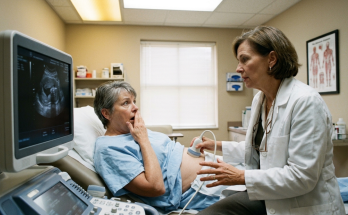
Forty minutes later, I was lying beneath a paper drape while Dr. Evans moved an ultrasound probe and stared at a monitor with growing concentration.
She had been chatting moments earlier.
Then she stopped.
Her eyes narrowed.
She adjusted the image.
“What is it?” I asked.
“Give me a minute.”
The room suddenly felt colder.
She studied the screen, clicked several measurements, then looked at my chart.
“Susan, have you ever had uterine surgery?”
“No.”
“A D&C?”
“No.”
“Any procedure after a miscarriage?”
“I’ve never miscarried.”
Her eyes returned to the screen.
“Are you sure?”
I laughed nervously.
“I think I’d remember something like that.”
Dr. Evans did not laugh.
She removed her gloves and pulled her chair closer.
“Susan, there is scarring here that normally has an explanation.”
My mouth went dry.
“What kind of explanation?”
“A previous procedure.”
“I told you, I never had one.”
She watched me carefully.
“Then we need to understand why your body says otherwise.”
And eighteen years after waking in a hospital with pain Michael told me not to worry about, I finally remembered the nurse who had tried to tell me something.
Click here to continue reading: PART 2: One Question From My Doctor Brought Back the Hospital Room My Husband Had Spent Eighteen Years Helping Me Forget
For Eighteen Years We Shared a House, a Son, and a Marriage Neither of Us Was Willing to Name
Part 1 of 18