The clock above the ICU door changed from 7:46 to 7:47 while my phone rang unanswered against my palm. I watched the seconds advance because there was little else I could do without pain. Breathing hurt. Swallowing hurt. Moving my left shoulder sent a bright line of fire through my ribs. Even holding the phone required both hands because one wrist was swollen and wrapped beneath an IV line. When my mother's voicemail picked up again, I ended the call before the recorded greeting finished.
That made nine attempts.
Three to my mother. Two to my father. Two to Lauren. Two to the family group chat, where everyone had somehow managed to read my messages without answering them.
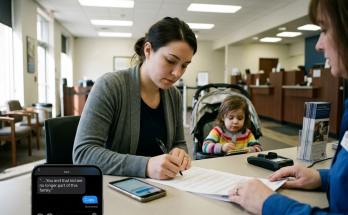
The only response had come from Mom nearly an hour earlier. Four words appeared beneath my message saying I was in the hospital.
Is this actually urgent?
I kept staring at the question until the screen dimmed.
Twenty-four hours before, I had been driving south on Fifth Avenue after a meeting with an accounting firm. I remembered a green light, the gray nose of a delivery truck appearing where it shouldn't have been, and the impossible realization that the driver wasn't slowing down. There had been no time to brace properly. Metal slammed into metal hard enough to turn the driver's side of my sedan inward.
The next fragments came without sequence. Safety glass glittering across my lap. A horn screaming continuously. Someone outside shouting not to move me. Blood on my blouse. The sour smell of an airbag. A paramedic asking whether I knew my name while I tried to understand why I couldn't fill my lungs.
By the time I reached the trauma center, my spleen had ruptured. Three ribs were fractured. Internal bleeding had dropped my blood pressure so rapidly that the emergency team stopped asking me questions and started cutting away my clothes.
I knew none of that while it was happening.
I learned it afterward from Marisol.
She was standing beside my bed now, checking the clear tubing feeding into my arm. She was somewhere in her forties, with tired eyes that missed nothing and the economical movements of someone who had worked trauma floors long enough to know that wasted motion cost time. She had been kind without being sugary, which I appreciated more than I could say.
When she noticed the phone still in my hands, she reached down and lowered the blanket where I had twisted it around my fingers.
"You've done enough calling," she said.
Her voice wasn't stern. That made the words worse.
I looked at her. "You spoke to my mother."
Marisol's hand stopped against the IV pump.
There had been something different in her expression every time my family came up. Not pity exactly. Discomfort. The guarded face of a professional carrying information she wished belonged to someone else.
"I need you to tell me what happened," I said.
"You need rest."
"I've been resting for almost an entire day."
"You've been recovering from emergency abdominal surgery."
"Then tell me while I recover."
She exhaled through her nose and checked the monitor above my shoulder. My pulse was already climbing. "Miranda, this isn't going to help your heart rate."
"What did she say?"
Marisol pulled the visitor's chair closer but didn't sit. Instead she rested one hand on its plastic back, as if preparing herself.
"You know your blood type?"
"O-negative."
She nodded. "That created a problem yesterday."
I knew enough from years of routine physicals to understand the basics. O-negative blood could be given broadly, which was why hospitals guarded it carefully in emergencies. But someone with O-negative blood had far fewer options when receiving a transfusion.
"We had unusually low stock," Marisol continued. "There had been a serious highway collision earlier. Several trauma cases came in before you. When your bleeding accelerated, the surgical team requested additional O-negative units."
I listened to the steady electronic chirp beside me.
"And you called my family."
"We called the emergency contacts in your file."
"My parents are compatible."
"According to the medical information they previously provided, yes."
Something cold moved through me despite the warm blankets.
"What time?"
"Your mother's first completed call was around eleven eighteen yesterday morning."
I pictured yesterday at eleven eighteen. I had probably been unconscious. Maybe already under anesthesia. My family had been alive somewhere else, walking around beneath ordinary daylight, receiving a phone call that their daughter might die.
"What did you tell her?"
Marisol hesitated.
"Please."
"I told her you had been in a major vehicle collision. I explained that you were unstable, that you were experiencing internal blood loss, and that we urgently needed a compatible donor if either parent could come."
No room for misunderstanding.
No vague message saying I had bumped my head.
No receptionist casually mentioning that I might want visitors.
Unstable. Internal bleeding. Urgently needed.
"And what did Mom say?"
Marisol's jaw tightened.
"She thought the hospital must be overreacting. She said you had always been tough and that she was sure the doctors could manage."
I swallowed. The inside of my throat felt scraped raw from the breathing tube.
"Was that all?"
"No."
"Tell me."
Marisol looked directly at me now. "She said they were helping your sister settle into her new house and couldn't leave in the middle of moving everything. She suggested we use whatever blood was already available and said they would come later."
For several seconds, I heard nothing except the monitor.
Then a different sound rose in my memory: Lauren laughing two weeks earlier while holding fabric samples beneath the recessed lights of a furniture showroom.
Mom had spent months talking about that house. The Ridgefield kitchen. The vaulted ceiling. The landscaped backyard. The guest bedroom that apparently required a custom bed frame. Lauren had been treated as though she'd conquered a continent instead of purchasing a house with a down payment no one had satisfactorily explained.
Yesterday was her move-in day.
Of course it was.
"Did my mother understand I could die?" I asked.
Marisol did not answer immediately.
That was an answer.
"Did you tell her?"
"Yes."
The monitor changed rhythm.
Marisol stepped closer. "Miranda."
I shut my eyes.
My entire childhood rearranged itself in an instant, not because any individual memory was new, but because I suddenly stopped supplying excuses for all of them.
Lauren's dance competitions had mattered more than my science fairs because dance involved a whole team. Lauren's college crises required immediate flights because she was sensitive. When I started my company, Dad told me not to be disappointed if it failed because software businesses disappeared every day. When I sold it, Mom cried with pride—and then asked whether I might help my parents refinance the lake property.
I had spent years translating neglect into understandable circumstances.
They were busy.
Lauren needed them more.
Dad was old-fashioned.
Mom didn't know how to show affection.
They loved me differently.
Yesterday I had been opened on an operating table while my mother stood in Lauren's new suburban house choosing where furniture should go.
No translation could make that love.
"How did I get the blood?" I asked.
"A neighboring county hospital released units after our attending escalated the request. A transport brought them."
"How long?"
Marisol's mouth tightened. "Longer than anyone wanted."
"If those units hadn't come?"
Her eyes moved toward the floor.
That answer was clearer than words.
I reopened my phone.
The family chat showed that Dad had read my message at 1:07 p.m. Lauren at 1:09. Mom had read it earlier.
My last message had been sent after I woke properly.
I'm in ICU. Please call me.
All three had seen it.
None had answered.
I looked again at Mom's question.
Is this actually urgent?
Something inside me became very quiet.
Not peaceful. Finished.
I had spent thirty years auditioning for a role in my own family, and yesterday they had finally told me whether I'd gotten the part.
"Marisol."
"Yes?"
"My purse is in the closet, isn't it?"
She glanced toward the narrow storage cabinet. "Yes."
"There's a black card holder in the inside pocket. Can you bring it to me?"
She retrieved the purse and set it carefully beside my leg. I couldn't bend enough to reach inside, so she searched where I directed until she found the card.
JULIAN VANCE
VANCE, LOWELL & HART
PRIVATE WEALTH AND ESTATE COUNSEL
Marisol read the name, then looked at me.
"Do you want me to call him?"
"Yes."
"Tonight?"
I watched the clock advance another minute.
"Especially tonight."
She dialed and held the phone near my ear.
Julian answered on the third ring.
"Miranda?"
He knew my number. He also knew I never called after business hours.
"Julian," I said, struggling to keep my voice level, "I need you to come to the hospital."
His tone changed immediately. "What's happened?"
"I had an accident."
"Are you all right?"
"No."
There was a short silence.
"What do you need?"
I looked at my mother's unanswered text one final time.
"I need every document giving my parents authority over me revoked. The will. The trust. Medical decisions. Financial access. Everything."
Another pause.
"Miranda, are you certain?"
My ribs ached when I drew my next breath, but the answer came easily.
"Bring whatever I have to sign."
Click here to continue reading: PART 2: My Lawyer Arrived Expecting an Estate Change and Discovered Someone Had Already Tried to Take Half a Million Dollars
Nine Unanswered Calls Forced Me to Learn What My Family Had Chosen While Surgeons Fought to Keep Me Alive
Part 1 of 12