
Six months before Sarah told me to disappear on New Year’s Eve, I had been looking for a cardboard box of Christmas ornaments when I heard David discussing my house with his father in the garage.
I remember the ordinary details more clearly than anything dramatic. Dust on my fingertips. The smell of motor oil. A broken strand of red lights hanging over my arm. Late-afternoon sun cutting through the open garage door and making every floating speck visible.
David stood beside his SUV with Robert.
Robert was sixty-four, broad-shouldered, silver-haired, and always dressed as if someone might unexpectedly photograph him. He worked in property development and spoke about real estate the way gamblers spoke about winning tables.
I heard him ask, “Has she signed yet?”
David answered, “Not yet.”
I stopped behind the hallway door.
There was no reason for me to assume they meant me. Sarah and David had dozens of plans, applications, purchases, and schemes I only half understood.
Then Robert said, “You’ve been there two years. What is she waiting for?”
David sighed. “Sarah thinks her mother will eventually agree. She usually does.”
The Christmas lights slipped against my wrist.
Robert lowered his voice. “If you can get control before rates change, you can pull enough equity to make the investment work.”
My throat tightened.
David said, “I know.”
“And Ellen?”
“She’ll keep the cottage.”
Robert laughed.
I remember that laugh.
Not because it was especially cruel, but because it was casual. The laugh of two men discussing a detail that had already been settled.
David continued, “The cottage is important. It makes her feel like she still has something.”
They both laughed then.
I stepped backward before my body could betray me.
I walked to the kitchen.
Filled a glass with water.
Sat down.
And stayed there until my hands stopped shaking.
For two years I had defended David to myself.
He was ambitious.
He was under pressure.
He grew up in a family that talked too much about money.
He did not understand how difficult widowhood had been.
He loved Sarah.
Every explanation contained enough truth to make the next excuse possible.
But hearing him discuss my home as an asset he expected to control stripped away the interpretations I had used to comfort myself.
That evening Sarah came into the kitchen carrying three sheets of paper.
“Mom, we need your signature on a few boring things.”
I looked at them.
One document concerned authority over household financial matters. Another related to a refinancing application. The third included language about durable power of attorney.
If I had seen them the previous week, I might have signed wherever Sarah placed a sticky arrow.
Instead, I said, “My glasses are in the cottage.”
“You can use mine.”
“Our prescriptions aren’t the same.”
She smiled impatiently. “You don’t need to read every word. David already checked everything.”
I looked across the room at my daughter.
She was wearing the blue sweater I had bought her the previous Christmas.
Michael always said Sarah’s face revealed dishonesty because one side of her mouth became tight.
That afternoon it was tight.
“I’ll read them tomorrow,” I said.
Her smile disappeared.
“Mom, there are deadlines.”
“Then one day shouldn’t matter.”
She stared at me longer than necessary.
Finally she collected the papers.
“Fine.”
The moment she left, I called the number of an attorney my neighbor had recommended months earlier.
Patricia Monroe agreed to see me the next morning.
Her office surprised me. No mahogany walls. No enormous desk. No intimidating shelves of untouched law books. Just a bright room, two comfortable chairs, several plants, and a woman with short gray hair who listened without interrupting while I explained how I had gradually become a guest on property that belonged entirely to me.
When I finished, Patricia asked, “Whose name is on the deed?”
“Mine.”
“Any trusts, transfers, joint ownership?”
“No.”
“Did your husband leave his share to you?”
“Yes.”
“Have you signed anything granting Sarah ownership?”
“No.”
“David?”
“Absolutely not.”
She leaned back. “Then the first thing you need to understand is simple. Being made to feel powerless and legally being powerless are entirely different things.”
I stared at her.
It had been so long since anyone had put the situation that plainly that I almost did not know what to do with the sentence.
Patricia examined the papers Sarah had brought me.
She did not exaggerate what she saw.
That was one reason I trusted her.
She explained that the documents would not instantly hand my property to Sarah and David, but together they could provide authority and access that I had no sensible reason to grant.
“Did they explain any of this?”
“They said it was routine.”
“It isn’t routine for you.”
I looked down.
Patricia closed the folder.
“Ellen, I want to ask you something unrelated to the documents.”
“All right.”
“If Sarah and David had to begin paying market rent tomorrow, could they afford it?”
I thought about the new SUV in the driveway.
Sarah’s designer handbags.
Weekend trips.
Restaurant bills.
Packages arriving almost daily.
“I don’t think so.”
“What if they also had to cover utilities?”
“No.”
“Their entertainment?”
“No.”
“The spending on your credit card?”
I looked at her.
“No.”
Patricia tapped one finger against the folder. “Then what you have built is not temporary assistance anymore. They depend on your inability to refuse them.”
I bristled at that.
“They’re my family.”
“I didn’t say they weren’t.”
“You make it sound calculated.”
“I’m asking whether the outcome has become convenient enough that nobody except you has an incentive to change it.”
That silenced me.
Because for the first time I considered the arrangement from Sarah and David’s perspective.
Why would they save aggressively for a modest house when they were living free in a much larger one?
Why limit restaurant spending when I covered utilities?
Why postpone a vacation when Sarah possessed a card connected to my account?
Why respect the woman in the cottage if that woman never made refusal carry a consequence?
I had spent years waiting for them to become uncomfortable with taking.
Perhaps they were waiting for me to become uncomfortable with giving.
“What should I do?” I asked.
Patricia surprised me.
“Nothing dramatic.”
I blinked.
“You’re telling me they may be trying to gain control of my house.”
“And confronting them today would accomplish what?”
“They would know I understand.”
“They would also know you have changed.”
I frowned.
She continued. “Right now they believe they can predict you. That belief gives you time to protect yourself properly.”
I thought of David laughing in the garage.
“What would protection look like?”
“Information first.”
That became our rule.
For the next six months, I learned more about my finances than I had learned in the previous twenty years.
I opened accounts Sarah could not access.
Changed passwords.
Reviewed automatic payments.
Documented purchases.
Had cameras installed around the property.
Confirmed the deed and insurance.
Asked the utility companies what authority anyone else possessed.
Transferred charges where appropriate.
And, gradually, I began studying the credit-card statements instead of simply paying them.
The numbers embarrassed me.
Not because I could not afford them.
Michael had planned carefully. We had investments, savings, and very little debt.
The embarrassment came from recognizing how thoroughly my generosity had been converted into expectation.
A seven-hundred-dollar dinner Sarah never mentioned.
Electronics delivered to the house.
Car services.
Furniture I had never chosen.
Hotel charges.
Jewelry.
A private transportation charge from a city neither Sarah nor I had visited.
When I raised small questions, the answers were always vague.
David had handled it.
Sarah would check.
It was probably business.
Maybe the card had been used accidentally.
Nothing was ever serious enough, in isolation, to produce the explosion I feared.
Together, however, the statements told a different story.
One afternoon Patricia spread six months of records across her conference table.
“You understand this is not about revenge,” she said.
“I know.”
“Do you?”
I looked at her.
“Some people wait until they are angry enough, then try to punish everyone at once.”
“I don’t want to punish Sarah.”
“What do you want?”
The answer took time.
“I want my life back.”
Patricia nodded.
“Then make decisions that produce that result.”
That was when I told her about the cottage.
Not merely that I lived there.
That I wanted to sell it.
She studied me.
“Separately from the main property?”
“At first.”
“Where would you go?”
“I don’t know.”
“Does Sarah know?”
“No.”
“David?”
“No.”
Patricia closed her pen.
“Are you certain you’re leaving because you want to leave, rather than because they successfully pushed you out?”
I thought about that question for nearly a week.
Then, sitting alone in the cottage one rainy morning, I finally understood the answer.
I did not want the cottage.
I did not want to remain thirty yards from the main house, hearing Sarah and David live inside rooms that still contained my memories while congratulating myself for protecting one small building.
If I left, I wanted distance.
Choice.
A front door no one entered without asking.
So I called Patricia again.
“I changed my mind.”
“About selling?”
“About what I’m selling.”
There was a pause.
Then she understood.
“The entire property?”
“Yes.”
“Are you sure?”
I looked through the window at the maple Michael had planted.
“No.”
Patricia waited.
I took a breath.
“But I’m doing it anyway.”
We kept the listing private.
A broker Patricia trusted approached a limited number of buyers.
Inspections occurred while Sarah and David were away.
Documents arrived electronically.
I started sorting thirty years of belongings into three categories: keep, sell, donate.
No one noticed.
That part hurt almost as much as anything.
I removed Michael’s fishing equipment from the garage.
No question.
I packed photographs from the upstairs closet.
No question.
I took three boxes of books from the study David had converted into a gaming room.
He never asked where they went.
By December, I had reduced my life to what could fit into my car, one storage unit, and several suitcases.
The buyer had made an offer.
Patricia had prepared the final paperwork.
All I needed was the courage to finish what I had begun.
Then New Year’s Eve arrived.
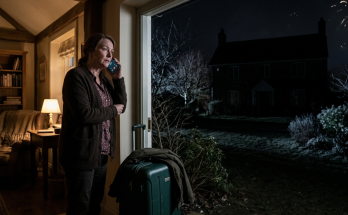
Sarah walked into the cottage and asked me to remain invisible during her party.
After she left, I called Patricia.
She answered on the second ring.
“Ellen?”
“I’m ready.”
She did not ask what had happened.
“For the sale?”
“For all of it.”
A short silence followed.
Then Patricia said, “I’ll prepare the final documents.”
I stood at the cottage window watching Sarah cross the lawn toward my house.
“Can we complete it before Monday?”
“We can complete your side. The rest proceeds on schedule.”
“Good.”
“Ellen.”
“Yes?”
“You sound different.”
I watched David open the back door for Sarah. She said something to him. He glanced toward the cottage.
Then they both went inside without coming over.
“I finally understood something.”
“What?”
“They aren’t expecting me to stay because they love having me close.”
Patricia waited.
“They’re expecting me to stay because nobody believes I’ll leave.”
That evening, I placed Michael’s old watch on the table beside the black folder.
For the first time since beginning this process, I stopped wondering whether I had the right to change everything.
The only question left was whether Sarah and David would understand what they had lost before or after they discovered who had actually been paying for the life they called theirs.

One Comment on “PART 2 – They Thought Two Years of My Silence Meant Permission, but I Had Already Begun Counting Every Dollar and Every Lie”