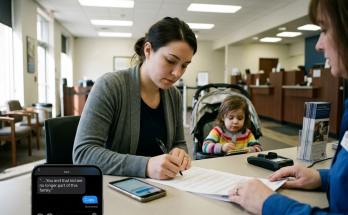
The voicemail lasted fourteen seconds. I was standing at the kitchen sink with soap sliding down my wrist when my father’s name flashed across my phone, disappeared, and left a red notification behind. I nearly ignored it. Our last conversation had ended with him accusing me of making Rachel’s life harder because I had questioned another request for money. Nothing about that Tuesday morning made me expect a permanent break.
I dried my hand on the dish towel and tapped the message. Dad’s voice came through flat and controlled, which somehow made the words worse. He said that my son and I were no longer part of the family. There was no shouting, no drunken slur, no accidental cruelty in the middle of an argument. He had called, waited for the tone, and recorded the sentence deliberately.
I played it again because some primitive part of me insisted I must have misunderstood. In the living room, my son sat cross-legged on the rug, finishing cereal while arguing with my husband about whether dragons could beat dinosaurs. His socks didn’t match. Milk had dried along one corner of his mouth. He was seven years old and entirely unaware that his grandfather had just erased him with a sentence.
My father had never hidden his disappointment in me, but he had been especially cruel after my son was born. He had treated my marriage like a rebellion and motherhood like another poor decision I would eventually ask him to fix. At the hospital, while I held my newborn against my chest, Dad had studied him and managed to make a remark about mistakes becoming permanent. I had forgiven that too.
Forgiveness had become my specialty. Rachel missed rent, and I covered it. Mom called because the electric bill was overdue, and I transferred money. Dad needed help after another business arrangement fell apart, and somehow my savings became the reasonable solution. Every crisis arrived wrapped in the same language: family helps family, Claire. You’re the responsible one. We can count on you.
I opened my text thread with Dad. Months of messages sat above the keyboard—payment reminders from me, requests from him, arguments where I had begun calmly and ended apologizing. His most recent message concerned Rachel’s rent. He had written as though her landlord were my problem and her failure to budget were an emergency I had caused by not acting quickly enough.
I typed one word.
Copy.
My thumb hovered over the arrow. I could have written a paragraph. I could have asked whether he meant it. I could have reminded him that I had paid for Mom’s dental work, helped refinance their house, carried Rachel through three jobs and two apartments, and answered every late-night phone call he made when money was short.
Instead, I sent the word.
No response appeared.
My husband came into the kitchen while buttoning his cuff. He took one look at me and stopped. “What happened?”
I handed him the phone.
He listened once. His jaw tightened. Then he played it again, not because he doubted me but because the calmness of Dad’s voice was difficult to believe. When the message ended, my husband placed the phone on the counter with unusual care.
“He said that about your son?”
“Our son,” I corrected automatically.
“I know.” His eyes stayed on mine. “That’s why I’m asking.”
I looked past him. Our boy had abandoned dinosaurs and was now searching under the sofa for a green crayon. “Apparently Dad has decided blood only counts when it’s convenient.”
My husband watched me for a few seconds. He had spent years avoiding telling me what to do about my family. He knew how quickly I defended them when anyone else criticized them, even after spending an entire evening cleaning up the consequences of their choices. This time he only asked, “What are you going to do?”
At first I didn’t know.
Then I looked at the phone again and thought about the accounts.
There were too many. A savings account I had opened years ago so my parents would have an emergency cushion. A family travel fund that had gradually become a general spending account. A credit card on which Rachel was an authorized user because Dad had promised it would help her rebuild her credit. Another account my mother could access because, at the time, it had seemed practical.
My name was attached to nearly all of it.
So was my money.
“I’m going to the bank,” I said.
My husband’s expression changed. “Today?”
“Right now.”
He understood before I explained. He glanced toward our son, then back at me. “Do you want me to stay?”
“No. Take him to school. I want his morning to stay normal.”
Our son came running in holding the missing green crayon like a trophy. “Found it.”
I knelt and wiped the cereal from his cheek.
“Grandpa mad again?” he asked.
The question struck harder than the voicemail.
“What makes you ask that?”
“You have the face.”
“What face?”
“The quiet one.”
My husband looked away.
I kissed my son’s forehead. “Grandpa’s dealing with grown-up things. None of it is your job.”
He seemed satisfied. Seven-year-olds could accept an answer and move on when adults did not contaminate it with their own anxiety. He stuffed the crayon into his backpack and asked whether they could stop for juice on the way to school.
When the door closed behind them, the apartment became unnaturally still.
I opened my banking application and went through each account one by one. The numbers told a story I had avoided reading. Transfers to Rachel. Purchases I didn’t recognize. Restaurant charges in neighborhoods where I never ate. A large electronics purchase two weeks after Rachel had told me she could barely afford groceries. Payments for my parents’ household expenses that had quietly become routine.
Nothing individually looked catastrophic.
Together, it looked like a second household had been living inside my income.
At the branch, the air smelled of printer toner and stale coffee. A banker named Lauren led me into a glass-partitioned office and asked what I needed.
“I want to remove every authorized user from every account that is legally mine,” I said. “I also want to close the shared credit line and separate anything that can be separated without another signature.”
Lauren’s professional smile disappeared as she studied the screen.
“You have several connected products.”
“I know.”
“This could cause declined payments.”
“I understand.”
“Automatic charges too.”
“I understand.”
She glanced at me. “Do the other users know you’re doing this?”
“No.”
Her fingers rested above the keyboard. “Would you like time to contact them first?”
My father’s voice replayed in my head.
No longer part of this family.
“No.”
Lauren nodded and began.
The process took nearly two hours. Some accounts could be closed immediately. Others required transfers. I moved my personal funds into a new account with credentials nobody in my family knew. Rachel’s authorization on the card disappeared with a few clicks. My parents lost access to the emergency account I had funded almost entirely myself.
Lauren stopped at one old savings account.
“This one has unusual activity.”
I leaned forward. “What kind?”
“Several transfers over the years. I’d need to pull older records to see everything.”
“How old?”
“Possibly five years or more.”
I frowned. “I barely use that account.”
“Someone did.”
A faint pressure formed behind my ribs.
“Can you print what you can see?”
She did.
I scanned the first page while the printer produced the rest. Many withdrawals had descriptions so vague they looked harmless: family expense, investment, temporary transfer. The amounts were larger than I remembered approving.
“Did I authorize these?”
Lauren tilted the page toward herself. “I can’t tell from this screen. Some may have been initiated by another authorized person.”
“My father?”
“Possibly.”
I folded the pages and placed them in my bag.
Lauren hesitated before handing me the final forms. “Once we finish, anyone using these cards or linked accounts may notice very quickly.”
I signed.
“Good.”
She studied me, perhaps wondering whether I understood the storm I was inviting.
I did.
What I didn’t understand yet was how long that storm had already been building.
When I left the bank, Dad still had not replied to my text. Rachel had not called. Mom had not sent one of her carefully worded peacekeeping messages. The silence felt almost luxurious.
I sat in my car, locked the doors, and listened to my father’s voicemail once more.
For years, I had treated belonging to my family as a debt I had to keep paying.
Now he had canceled the membership himself.
I deleted nothing.
I saved the recording in three places.
Then I started the car.
Click here to continue reading: PART 2: The Cards Stopped Working Three Days Later, and My Sister Finally Revealed What My Family Thought I Was Supposed to Provide
Fourteen Seconds From My Father Ended My Place in His Family and Forced Me to Look at Every Account Differently
Part 1 of 15