Rachel called before eight the following morning. I was standing in the kitchen, trying to swallow a piece of dry toast, when her name appeared on my phone. She asked whether I had access to the original monthly statements for our joint savings account, not merely the transaction summaries I had downloaded. I told her I did. Then she asked me to check whether any large transfers had been initiated from the account during the last ninety days. There was something unusually deliberate about the way she spoke. I set the toast aside and opened my laptop, suddenly aware that the amounts I had already discovered might represent only part of the problem.
The account balance appeared on the screen. For a moment, I thought the website had failed to load properly. The number was considerably lower than it should have been. I refreshed the page, waited, and checked again. Nothing changed. Overnight, another transfer had been processed. This one was for twelve thousand dollars. It had been initiated two days earlier, before Mark's meeting with Rachel, but the funds had only just cleared. I stared at the transaction reference until the figures blurred. My husband had sat across from me and admitted mishandling our savings while another substantial payment was already moving out of the account.
I read the amount to Rachel. She asked me to download the confirmation and preserve the available details. She then instructed me to contact the bank's fraud department and explain that I was disputing the purpose and authorization of transfers from a jointly held account. She was careful not to promise the bank would reverse them. Mark was an account holder, and his authority to move money complicated the matter. Still, we needed an immediate record of my objection and a clear understanding of what protective measures were available. I wrote down everything she said, then asked whether he could empty the account entirely before we resolved anything.
Rachel didn't give me a comforting answer. She said the risk depended on the account's terms, the bank's procedures, and the legal orders we could obtain. She intended to seek appropriate temporary financial protections through the divorce proceedings. In the meantime, she told me to document the balance, preserve all statements, and avoid making retaliatory withdrawals that might create additional disputes. Her calmness helped me concentrate. I had spent too many days reacting emotionally to revelations that changed by the hour. This required careful, immediate action.
The bank representative listened while I explained the situation. I told her that my husband and I were separating and that substantial transfers had gone to accounts I did not recognize. She verified my identity, reviewed the recent activity, and explained the limits of what the bank could disclose about another institution's account holder. She could confirm the transactions and initiate a review, but she could not simply classify an authorized account holder's transfer as fraud because the other spouse objected. I understood the distinction, though it did little to ease my fear. By the time I ended the call, I had a case reference number and a list of documents Rachel would need.
I printed the updated statements and spread them across the dining table. The newest transfer appeared alongside several smaller ones I had already identified. Together, they formed a pattern that seemed increasingly deliberate. Money had left our account over months, sometimes in amounts modest enough to disappear among ordinary expenses, sometimes in sums large enough that Mark should have known I would eventually notice. I tried to calculate the total without making mistakes. My hands were unsteady, and I kept losing my place. Finally, I closed the calculator and waited for Rachel's more thorough review.
My first impulse was to call Mark. I wanted to ask how he could sit in an attorney's office and promise cooperation while concealing another transfer. But Rachel had warned me against confrontations that might produce more confusion than evidence. Instead, I sent him a short message asking that all further financial discussions take place through counsel. He responded almost immediately, asking whether I had discovered the transfer. I stared at those words. He didn't ask what I meant. He already knew exactly which payment had prompted my message.
I forwarded the exchange to Rachel without replying. A few minutes later, Mark called. I let the phone ring. He called again, then left a voicemail explaining that he had been trying to resolve an obligation to Ashley and hadn't realized the payment would clear after our meeting. He claimed the transfer had been difficult to stop. I listened once, saved the recording, and felt an exhausted disbelief settle over me. He was still describing deliberate financial decisions as though they were unfortunate weather events beyond his control.
By late morning, Rachel had arranged a conference call with a forensic accountant named Daniel Price. Daniel spoke plainly and asked for specific records: bank statements, credit-card activity, tax returns, account ownership information, and any documents connected to the proposed property purchase. He explained that our immediate task was to trace the funds rather than assume their final destination. A payment to a company associated with Ashley's brother did not necessarily mean the brother retained the money. We needed to see where it went afterward, which would require formal requests for records.
I appreciated the distinction. I had begun imagining a coordinated scheme involving Ashley and her family, but imagination couldn't establish financial facts. Daniel asked when I first noticed the transfers. I explained that Mark had handled much of the account administration and had repeatedly reassured me that our savings were secure. Daniel asked whether I had authorized any gifts or loans to Ashley. I said I hadn't even known Mark was romantically involved with her. The silence that followed was brief but uncomfortable. Then Daniel told me to preserve every statement in its original form and avoid altering the files.
After the call, I sat alone at the table, surrounded by documents that had once represented our ordinary married life. We had opened the savings account shortly after buying the house. I remembered the afternoon we signed the paperwork, laughing because Mark had accidentally brought an expired driver's license and we had to drive home for another form of identification. We had deposited a small amount each month at first. Later, when our salaries improved, we increased it. That account was supposed to make our future less frightening. Now it had become another reason I couldn't sleep.
At noon, my sister Laura called. I had told her about the pregnancy but had avoided describing the full extent of Mark's behavior. She lived two hours away and had always liked him, though she sometimes complained that he could be stubborn. When I finally explained the affair and the missing money, she fell quiet. Then she asked whether I was safe. The simplicity of the question nearly undid me. I told her Mark hadn't threatened me physically, but I was frightened about finances and exhausted by the uncertainty. Laura said she could drive to Austin that evening.
I began to refuse. I told her she had work and responsibilities of her own. She interrupted gently, reminding me that I had helped her through a difficult period years earlier without treating it as an inconvenience. She wasn't asking permission to care about me, she said. She wanted to know whether I would feel better with someone in the house. I looked at the empty chair where Mark usually sat and admitted that I would. Laura promised to arrive after dinner.
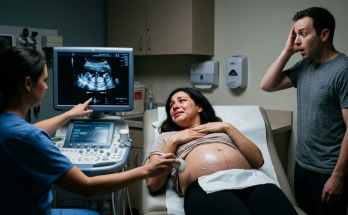
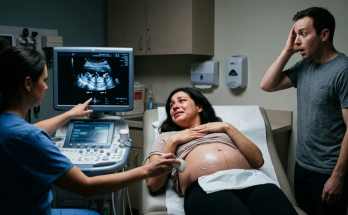
That afternoon, I attended a follow-up medical appointment arranged after the ultrasound. The physician reviewed the twin pregnancy and discussed the additional monitoring I would need. I answered questions about my symptoms, nutrition, and general health. When the doctor asked whether I had been experiencing unusual stress, I nearly laughed. Instead, I explained that my marriage was breaking down and that I was dealing with a difficult financial situation. She listened without judgment and reminded me that I didn't have to manage the pregnancy alone. She encouraged me to keep my appointments and ask for support when I needed it.
I left with new instructions and another appointment scheduled. In the parking lot, I sat in my car for several minutes, staring at the papers. There was something reassuring about medical care that proceeded according to observable facts. The doctors measured, examined, documented, and explained. They did not decide what was true because it was emotionally convenient. I wished my marriage had been governed by the same ordinary discipline.
Laura arrived shortly after seven carrying an overnight bag and a container of homemade soup. She took one look at the papers covering the dining table and set the food down without comment. Then she hugged me. I had expected questions, perhaps advice. Instead, she held me until I stopped trying to appear composed. When we finally sat down, she asked me to begin wherever I wanted. I told her everything, starting with the pregnancy test and ending with the twelve-thousand-dollar transfer.
She listened carefully, occasionally asking for a date or clarification. When I described Mark bringing Ashley to the ultrasound, Laura set down her spoon. Her expression changed, but she didn't interrupt. At the end, she asked whether Mark had apologized publicly for accusing me of infidelity. I said he had promised to correct the story but hadn't done so. Laura looked at the phone beside my plate and said, "Then he hasn't repaired the damage. He's only acknowledged it to the person who already knew the truth."
Her words stayed with me. Mark had spent the previous days presenting his remorse as though it should change my decisions immediately. Yet the people he had misled still believed parts of his accusations. Some had sent sympathetic messages to him. Others avoided me. He had created a public story in which I was the unfaithful wife, and correcting that story apparently remained less urgent than convincing me to forgive him.
After dinner, Laura helped me sort the records into labeled folders. She had a practical patience that made difficult tasks seem manageable. We separated medical documents from financial statements, messages from legal correspondence, and confirmed facts from unresolved questions. Then she noticed a name repeated across several payment references. It belonged to the company connected with Ashley's brother. Laura wrote it on a sheet of paper and asked whether Daniel had investigated the business registration. I said he was beginning that process.
The company was called Westbridge Property Services. Its name sounded ordinary enough to belong to a legitimate real-estate business. The documents I had found, however, didn't clearly explain what services it had provided to Mark or Ashley. Laura examined one of the invoices and pointed to the description. It referred vaguely to consulting and property preparation. The amount was thousands of dollars. I had never heard Mark mention consulting services connected to a house purchase.
I sent the invoice to Daniel. He responded later that evening, confirming that it was relevant and asking whether I possessed any additional invoices. I searched the study again. Behind a folder of insurance paperwork, I found an envelope containing several receipts and a printed agreement. The paper was folded twice, with Mark's signature near the bottom. I recognized his handwriting immediately. The agreement described the transfer of funds for property-related expenses, but another line caught my attention. It referred to a reimbursement arrangement contingent upon the sale or refinancing of a residential property.
I read it three times. The property description did not match Ashley's proposed house. It appeared to refer to ours.
Laura watched my face and asked what I had found. I handed her the page. She read the relevant paragraph, then looked up sharply. Neither of us understood exactly what legal authority the document might carry, but its implication was disturbing. Mark appeared to have represented that money connected to our marital residence could support an obligation involving Westbridge Property Services.
I called Rachel, who asked me to photograph every page and email the complete document. She explained that the wording needed careful examination before we could determine whether it created any enforceable claim. Mark could not necessarily bind my interest in the property merely by signing a private agreement, and the document might contain defects that limited its effect. Still, she wanted to review our title records immediately. The possibility that Mark had attempted to involve our home in his arrangement with Ashley made the situation more serious.
I walked into the living room and looked around. The couch had a small tear beneath one cushion. A bookshelf leaned slightly because Mark had assembled it without checking the floor. Photographs from our wedding and vacations hung above the fireplace. The house was imperfect and familiar, full of work we had done together and plans we hadn't completed. I tried to imagine explaining to my children that the place I intended to raise them had been compromised because their father wanted to finance another woman's future.
Laura came to stand beside me. She asked whether I wanted to stay with her until matters settled. I considered it. Her house would be peaceful, and I wouldn't have to face memories of Mark in every room. But leaving felt premature. Rachel had advised me not to make major property decisions without understanding the consequences. More importantly, this was my home. I had contributed to the mortgage, repairs, taxes, and everyday expenses. I wasn't ready to surrender the ordinary space of my life because Mark had behaved dishonestly.
The following morning, Rachel contacted me with preliminary results from the property records. No completed transfer of title appeared, and she had not identified a recorded lien arising from the Westbridge agreement. That relieved one immediate fear. However, she explained that the agreement still mattered because it showed Mark had been discussing our home as a source of future money without consulting me. She intended to demand a complete explanation and seek orders preventing further questionable transactions during the divorce.
I asked whether we could recover the savings. Rachel said we would pursue the issue, but she wouldn't promise an outcome before examining all the evidence. Some funds might be traceable and subject to repayment or adjustment in the marital settlement. Others could be difficult to retrieve if they had moved through multiple accounts or been spent. Her honesty frightened me more than a confident reassurance would have, but it also helped me understand what needed to happen next.
By afternoon, Daniel had prepared a preliminary transaction chart. He explained that the payments linked to Westbridge were larger than the transfers I had initially recognized. Several amounts had been routed through accounts Mark described as personal investment or business expenses. The total was not yet final, but it represented a substantial portion of the savings we had accumulated during our marriage. Daniel emphasized that he was identifying movements of money, not yet establishing who ultimately benefited from each one.
I looked at the chart and remembered every postponed vacation, every weekend spent repairing the house ourselves, every conversation about whether an unnecessary purchase could wait. I had trusted that those sacrifices were building security for both of us. Now that security had been weakened by choices I hadn't known existed.
Then Daniel pointed to one transaction that differed from the others. It was not merely a transfer from savings. It involved a payment connected to an application for credit using information associated with our home. The application had not been completed, but supporting paperwork had been submitted.
When he emailed the relevant page, I opened it beside the earlier Westbridge agreement. My name appeared among the applicant information. Below it was a signature that looked like mine.
I stared at the screen until Laura came over to see why I had stopped speaking.
I had never signed that document.
Click here to continue reading: PART 6: A Signature Bearing My Name Forced Me to Question How Far My Husband Had Gone to Finance the Life He Wanted Elsewhere
The Morning I Discovered I Was Pregnant, My Husband Turned a Medical Surprise Into an Accusation That Threatened Our Marriage
Part 5 of 10