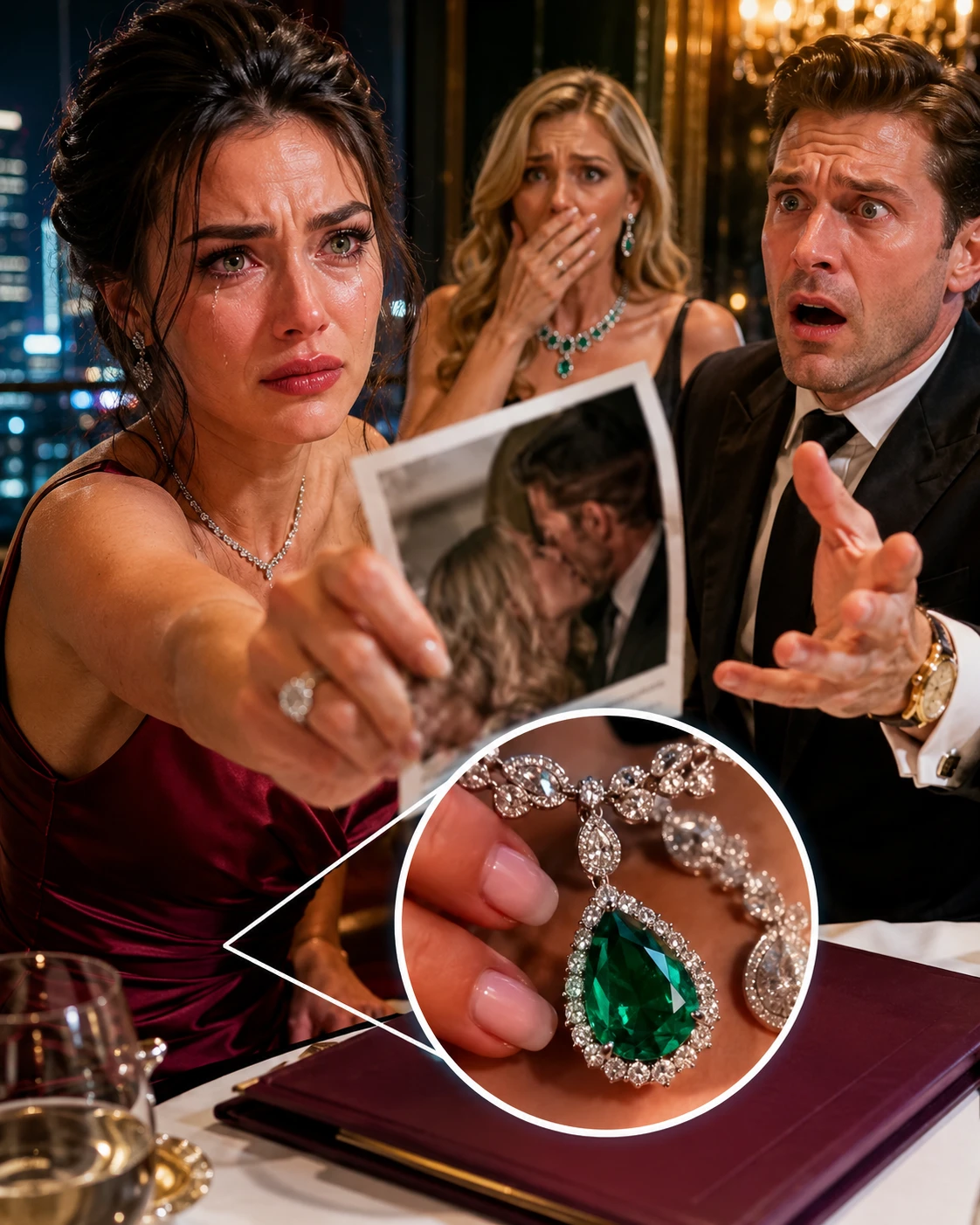
My husband handed me a velvet folder and said it was my “graceful exit package.”
His mistress sat beside him, wearing diamonds and the smile of a woman who had already measured my closet.
The folder was the color of bruised wine, soft enough to look expensive, heavy enough to feel final. Bennett Whitlock slid it across the white linen table with two fingers, as if he were offering me a menu instead of the demolition plan for my life.
We were in the private dining room of The Monarch, his favorite hotel in Manhattan, the one with black marble floors, smoked mirrors, and waiters trained to disappear before emotion could become inconvenient.
On my left, twenty floors below, Park Avenue glittered under rain.
On my right, Celeste Monroe crossed her legs slowly and let her diamond anklet catch the candlelight.
Bennett had chosen the room carefully. No shouting. No witnesses. No stains on the carpet. Just three glasses of untouched champagne, a lawyer with a silver pen, a mistress with a fresh manicure, and me—the wife he thought had become ornamental enough to discard.
Inside the folder was a settlement offer so insulting that even his lawyer, Henry Blum, avoided my eyes.
I read the first page.
Then the second.
Then I understood.
He wanted the townhouse. The Hamptons property. The Palm Beach condo. Full control of Whitlock Luxe Hospitality. My silence. My signature. My agreement never to speak publicly about our marriage, his affairs, his accounts, his cruelty, or the way my family’s recipes had become the foundation of his five-star empire.
In return, he offered me a one-bedroom apartment in Queens, a monthly allowance for eighteen months, and the privilege of keeping my wedding ring as “sentimental compensation.”
Celeste smiled wider.
Bennett leaned back, smooth and golden in his Tom Ford suit, his face calm with the confidence of a man who had never imagined consequences could wear lipstick.
“Evelyn,” he said, like my name bored him. “Dignity looks better than fighting.”
I closed the folder slowly.
The room went so quiet that I could hear the rain tapping against the glass like tiny fingernails.
For twelve years, I had stood beside Bennett Whitlock while he became the kind of man magazines called visionary. I had hosted his dinners, softened his temper, remembered his mother’s medication, charmed investors he secretly despised, and smiled in photographs while he took credit for ideas born at our kitchen table at two in the morning.
For twelve years, he mistook my grace for weakness.
That night, in a room built for rich people’s secrets, I finally let him.
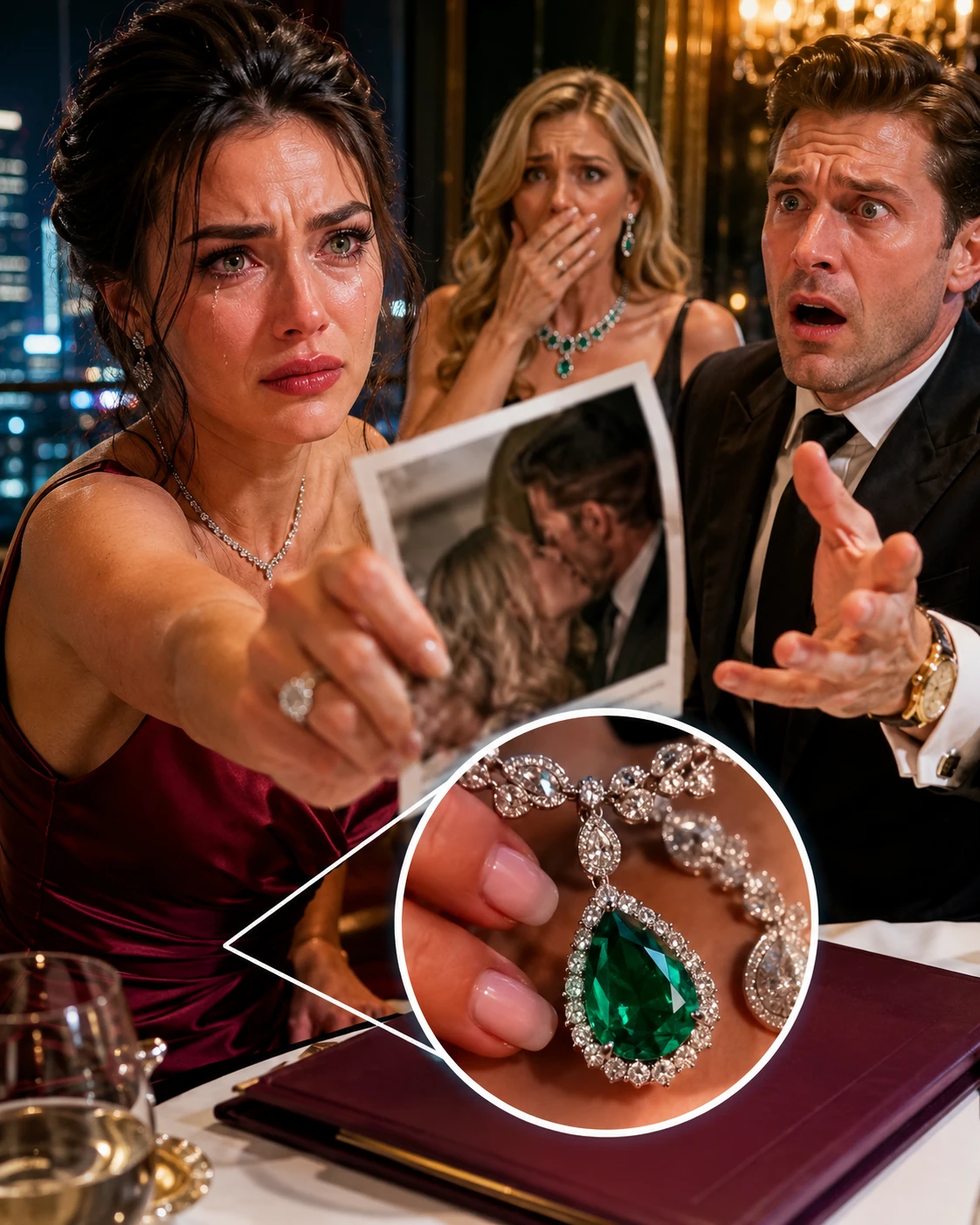
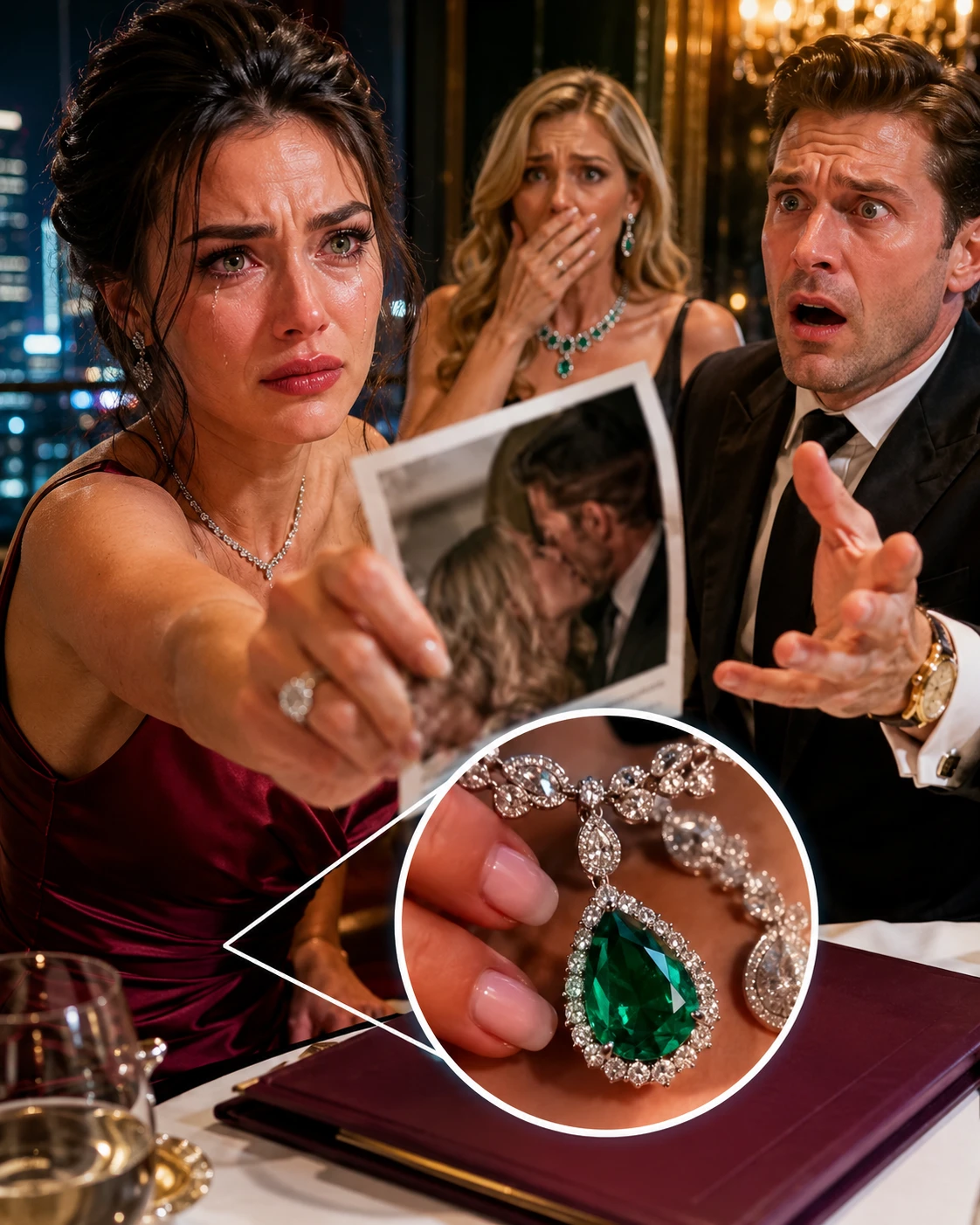
I looked at Celeste first. At the necklace around her throat. Colombian emeralds. Pear-shaped diamonds. A piece so extravagant it did not whisper wealth; it announced theft.
Then I looked at Bennett.
“Good,” I said. “Then watch me win quietly.”
CHAPTER 1: THE PRICE OF A BEAUTIFUL EXIT
Bennett laughed because men like him laugh first when they are afraid to ask what you mean.
It was not a loud laugh. Bennett never wasted volume. His laugh was controlled, polished, and sharpened at the edges. The kind of laugh used in boardrooms when someone junior has said something charmingly impossible.
Celeste looked at him for permission, then laughed too.
Henry Blum did not laugh.
That was the first small pleasure of the evening.
“Evelyn,” Bennett said, folding his hands on the table, “don’t make this uglier than it has to be.”
“I haven’t made anything yet.”
“You’ve been emotional.”
“I found out my husband has been sleeping with a woman young enough to think a Cartier receipt is a love letter. Emotion seems reasonable.”
Celeste’s smile twitched.
Bennett’s eyes cooled.
He had always hated when I refused to perform the version of myself he preferred. Soft. Gracious. Decorative. The wife with candlelit cheekbones and a useful silence. At charity galas, he liked to place his hand at the small of my back as if guiding me, when really he was displaying ownership.
The first year of our marriage, that touch felt protective.
By the tenth, it felt like a price tag.
“You signed a prenup,” Bennett said.
“I signed many things.”
Henry Blum’s pen stopped moving.
Bennett noticed. His jaw tightened.
“The offer is generous,” he said.
I opened the folder again and slid out the top page. “Generous?”
Celeste lifted one shoulder. “Most women would be grateful.”
I turned to her.
She was beautiful in the way expensive hotels are beautiful—smooth, designed, and slightly empty. Her blonde hair had been swept into a careless twist that had probably required two stylists. Her dress was black silk, neckline daring but tasteful enough for Bennett’s world. She smelled like jasmine and conquest.
“And what kind of woman are you, Celeste?”
Her eyes flashed. “The kind who knows when something is over.”
“No,” I said. “You’re the kind who thinks moving into a house means you own the foundation.”
The lawyer cleared his throat softly.
Bennett’s mouth flattened. “Enough.”
I placed the page back inside the folder and smoothed it with my palm.
“Why tonight?” I asked.
Bennett glanced toward the rain-streaked window. “Because the anniversary gala is tomorrow, and I won’t have whispers following me through the room.”
Of course.
Tomorrow night, Whitlock Luxe was celebrating the tenth anniversary of The Monarch, the flagship hotel that had turned Bennett from ambitious rich boy into American hospitality royalty. Vogue would be there. Forbes. Page Six. Every woman who hated me politely and every man who had once tried to touch my waist after too much bourbon.
He wanted me packaged and removed before the cameras arrived.
“How considerate,” I said.
Bennett mistook my calm for surrender and exhaled.
“I’m not trying to destroy you, Evie.”
I hated when he called me that now. Evie belonged to bakery mornings with my mother, flour on my cheek, sunlight on copper bowls. Evelyn was what I became when the world learned to charge admission.
“I want you comfortable,” he continued. “But you have to be realistic. The company is mine. The properties are mine. The public life is mine.”
“Is Celeste yours too?”
His eyes cut to hers. She lowered her lashes, pleased.
“Yes,” he said after a beat. “She is.”
A strange thing happened inside me then.
Not heartbreak. That had been happening quietly for years, a slow leak under the floorboards.
This was cleaner.
A door closed.
Behind it, I could still see the young Bennett, the one who once stood in my mother’s bakery in Boston with rain in his hair and said the cinnamon rolls tasted like a reason to stay alive. I could see him before the private jets, before the interviews, before he learned how easily charm could become a weapon.
I had loved him when he was only potential.
He betrayed me when he became proof.
I stood.
Henry half rose, startled by manners more than loyalty.
Bennett remained seated. He thought standing would imply uncertainty.
“Think before you do anything dramatic,” he said.
I picked up the velvet folder.
“Oh, I’ve been thinking.”
Celeste’s gaze flicked to the folder. “You’re taking it?”
“It was handed to me.”
“It’s confidential,” Bennett said.
“Then you should have been more careful whom you humiliated while presenting it.”
His face darkened. For one second, I saw him without the gloss. Not the man on magazine covers. Not the visionary. Just a spoiled boy furious that his toy had learned to speak.
“You don’t want a war with me,” he said.
I leaned down, close enough that only he could hear.
“Bennett, you couldn’t afford a war with me even if you liquidated your mistress.”
Then I walked out before he could answer.
The hallway outside the private dining room was paneled in dark walnut and lit by amber sconces. My heels sank soundlessly into the carpet. A waiter stepped aside with professional invisibility. In the elevator, my reflection stared back from four mirrored walls.
Thirty-seven years old.
Pearl earrings.
Red lipstick.
The face of a woman people described as composed because they never stayed long enough to see what composure cost.
My phone buzzed before the elevator reached the lobby.
BENNETT:
Don’t embarrass yourself.
A second message followed.
BENNETT:
The car will take you home. Pack what you need tonight. I’ll have staff handle the rest.
I looked at the words until they blurred, not from tears but from disbelief at his efficiency. He had scheduled my grief like a vendor delivery.
The elevator doors opened to the lobby of The Monarch.
Black marble gleamed beneath a chandelier shaped like frozen rain. A pianist played something old and expensive. Near the entrance, a wall of white orchids perfumed the air.
This hotel had been Bennett’s crown jewel.
But he had forgotten who taught him where to place the crown.
I stepped beneath the chandelier and called the one person Bennett had spent years trying to convince me I no longer needed.
Julian Mercer answered on the second ring.
He did not say hello.
He said, “How bad?”
My throat tightened for the first time all night.
Julian had been my father’s junior partner once, back when Hart Legal was a small Boston firm with scuffed floors and impossible standards. After my father died, Julian went to New York, became one of the most feared divorce and corporate attorneys in the country, and built a career out of making powerful men regret underestimating paper.
He was also the only man who had ever looked at me like my silence had a language.
“Velvet folder,” I said.
A pause.
Then his voice lowered. “Are you safe?”
“Yes.”
“Are you alone?”
“Almost.”
“Good. Don’t go home. Go to the Carlyle. Use the name Rose Hart. I’ll be there in twenty minutes.”
I looked toward the revolving doors, where Bennett’s black car waited at the curb like a hearse.
“Julian.”
“Yes?”
“He brought her.”
This time, the silence had teeth.
“I’m already in the car,” he said.
At the Carlyle, I checked in under my grandmother’s name.
Rose Hart had been the kind of woman who believed money should be quiet, bread should be warm, and men should not be trusted with either unless properly supervised. She had built Hart & Honey Bakery from a six-seat shop in Beacon Hill into a New England institution, then taught me how to read contracts before I learned to drive.
When she died, Bennett wore a black suit to the funeral and cried into my hair.
Three months later, he suggested we “modernize” her brand for hotel distribution.
Six months later, Hart & Honey pastries were served in every Whitlock property from Manhattan to Aspen.
Two years later, Bennett accepted an award for “reimagining American luxury breakfast.”
I clapped from the front row.
That was the thing about erasure. It rarely happens all at once. It happens in speeches. In biographies. In captions. In a husband saying, “My wife has always been my muse,” when what he means is, I stole her map and called it inspiration.
Julian arrived at 11:43 p.m.
He wore a charcoal overcoat, no tie, and the expression of a man who had already decided mercy was not on the agenda. His dark hair was threaded with early silver at the temples, his face sharper than I remembered, his eyes the same impossible blue-gray as a winter harbor.
He stopped just inside the suite.
For a moment, neither of us spoke.
Then his gaze dropped to the velvet folder on the coffee table.
“Is that it?”
“Yes.”
“Did you touch everything?”
“I’m not an amateur.”
A faint smile. “No. You never were.”
He opened his leather briefcase, removed gloves, evidence sleeves, a small scanner, and a silver laptop. Julian Mercer did not comfort first. He secured the battlefield. Strangely, that comforted me more than pity would have.
I watched him photograph the folder, the pages, the signatures, the embossed Whitlock seal.
When he reached the asset waiver, he went still.
“What?” I asked.
He looked up.
“He’s asking you to surrender claims to any derivative interests, trusts, licensing rights, intellectual property, and beneficial holdings connected to Whitlock Luxe.”
“Yes.”
“Evelyn.” His voice was careful. “He knows.”
“No,” I said. “He suspects.”
Julian’s eyes sharpened.
There, finally, was the part of the story Bennett did not know.
Years ago, before the hotels and the magazine covers, before Bennett became a man who mistook applause for oxygen, my grandmother had insisted on one thing.
“Love him if you want,” Rose Hart told me over tea in her kitchen. “But don’t ever hand a man the deed to your grandmother’s oven.”
So when Bennett wanted to license Hart & Honey recipes to his first hotel, Rose created a structure.
Hartwell Holdings, LLC.
A Delaware company with no public connection to me.
It owned the core recipes, the supply agreements, the bakery trademarks, several commercial kitchens, and a quiet but significant portion of the debt Bennett used to expand. Later, when Bennett needed emergency capital after a disastrous Miami project, Hartwell bought convertible notes through another entity.
Bennett thought he had built an empire.
In reality, he had built a ballroom on land my grandmother never sold him.
Julian had handled the paperwork after Rose died.
“You never told him,” he said.
“I was going to.”
“When?”
I looked at the city lights beyond the window.
“When I thought he still deserved to know.”
Julian’s expression shifted, something like sorrow passing through discipline.
“Then we don’t just have a divorce,” he said.
“No.”
“We have corporate exposure, fraudulent conveyance issues, possible breach of fiduciary duty, forged consent if he moved marital assets, and whatever he bought that woman with company funds.”
“The necklace,” I said.
Julian looked up.
“Celeste was wearing emeralds tonight. Colombian. Pear-shaped diamonds. Vintage clasp. Bennett bought them in April.”
“How do you know?”
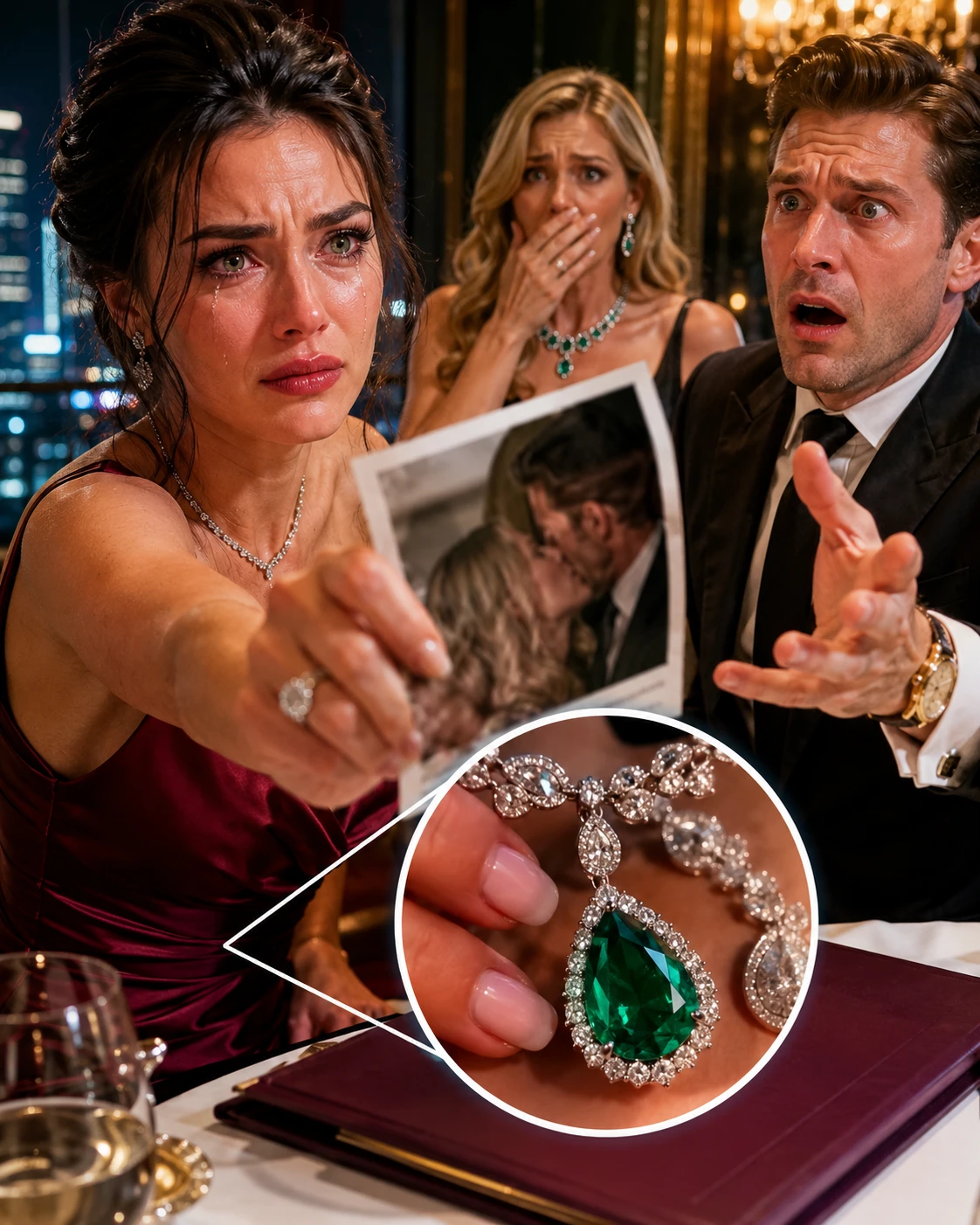
“Because he sent the invoice to our house by mistake. Then told me it was a client gift.”
Julian’s smile was not warm.
It was beautiful anyway.
“Did you keep it?”
“I keep everything.”
For the first time all night, he looked at me the way he used to before Bennett became a wall between us. Not with desire exactly, though that was there, quiet and dangerous. He looked at me with recognition.
“Good,” he said.
I took off my wedding ring and placed it beside the folder.
The diamond caught the lamp light, flawless and cold.
Bennett had proposed with cameras nearby. I had mistaken spectacle for devotion because I was young enough to believe love could survive being admired.
Julian zipped the evidence sleeve.
“Evelyn, once we begin, he will get ugly.”
“He already did.”
“No. He got arrogant. Ugly comes next.”
I sat on the edge of the sofa, suddenly exhausted.
“What do you need from me?”
“Everything. Emails, invoices, calendars, photographs, old drafts, voice notes, tax returns, access logs, staff names, banking records, anything tied to Celeste or transfers out of the company. And I need you not to react publicly.”
“I can do that.”
“I know.”
His certainty touched a bruise I had not known was there.
For years, Bennett called my calm unnatural. Julian called it evidence of discipline.
That is the difference between a man who wants to own you and a man who has bothered to see you.
Julian closed the folder.
“Tomorrow night, at the gala, he’ll expect you to be absent or broken.”
“Yes.”
“What are you going to do?”
I looked at the skyline, the city glittering like a knife collection.
“I’m going to wear white.”
CHAPTER 2: THE WOMAN UNDER THE MARBLE
The next morning, Bennett had my closet inventoried.
I learned this from Marta, our housekeeper, who called me from the pantry in a whisper sharp with fury.
“Mrs. Whitlock, Mr. Bennett told them to pack your clothes in garment bags and send them to storage. Storage. Like you’re winter curtains.”
I was sitting at the Carlyle breakfast table in a silk robe, drinking black coffee while Julian’s forensic accountant, Priya Shah, logged into three databases with the calm of a woman defusing a bomb.
“Let them,” I said.
Marta inhaled. “Let them?”
“Take pictures of everything first. Especially Celeste if she’s there.”
“She is.”
My hand stilled on the coffee cup.
“In my house?”
“She came with two women. Stylists, I think. She said the dressing room light is perfect.”
For a second, the old me rose hot and wounded. The wife. The woman who chose the wallpaper in that dressing room after three months of samples. The woman who kept Bennett’s cufflinks in velvet trays. The woman who knew which floorboard in the upstairs hall creaked and which hydrangeas bloomed blue in June.
Then I looked at the velvet folder sealed in evidence plastic on the desk.
“Put your phone in your apron pocket,” I said. “Video if you can. Don’t confront her.”
Marta’s voice lowered. “Mrs. Whitlock?”
“Yes?”
“Win.”
I smiled for the first time since The Monarch.
“I intend to.”
By noon, the internet knew.
Not the truth. Bennett’s version.
Page Six posted a blind item about a “hospitality king” separating from his “quietly troubled wife” after “years of strain.” A luxury gossip account on Instagram wrote that Bennett Whitlock had arrived at his townhouse with “new love Celeste Monroe” while his estranged wife was “reportedly being cared for by friends.”
Cared for.
As if I had collapsed into lavender blankets and sedatives.
By 2:00 p.m., Celeste posted a story from my dressing room.
The caption read:
New chapters require new light.
She was standing before my antique French mirror, wearing a cream slip dress and my grandmother’s pearl hair comb.
My grandmother’s.
I watched it three times, not because I enjoyed pain, but because evidence deserves attention.
Priya glanced over.
“Please tell me that’s yours.”
“It was Rose’s.”
“Did she have permission?”
“No.”
Priya downloaded the video before Celeste could delete it.
Julian looked at me across the suite.
“You all right?”
“No,” I said. “But I’m precise.”
That afternoon became a machine.
I opened the storage drive Bennett thought I had forgotten. Marriage makes people sloppy. Arrogance makes them searchable.
There were invoices.
The emerald necklace: $486,000, billed through Whitlock Luxe as “heritage design consultation.”
A Gulfstream weekend to St. Barts: $212,000, listed as “investor relations.”
A penthouse lease in Tribeca under Monroe Lane LLC, funded by a Whitlock subsidiary.
Wire transfers.
Encrypted messages.
A draft press release announcing Bennett and Celeste as “partners in life and vision,” dated three weeks before he handed me the folder.
Then Priya found the first real fracture.
“Evelyn,” she said quietly.
I crossed the room.
On her screen was a PDF consent form authorizing the sale of three paintings from our marital collection. A Rothko study. A Mitchell. A small Basquiat Bennett once bought after a fight because he thought expensive apologies aged better than sincere ones.
Total sale: $8.7 million.
My signature sat at the bottom.
Except I had never signed it.
Julian came to stand behind us.
“That’s not hers,” he said.
Priya zoomed in. “Digital certificate says executed from an IP address at The Monarch business center.”
“What date?” I asked.
“June 14.”
I remembered June 14.
I had been in Boston, sitting beside my mother during her second round of chemotherapy, holding a paper cup of terrible hospital coffee while Bennett texted me that he was “buried in board prep.”
He had forged my signature while my mother was fighting for her life.
Something ancient and cold moved through me.
Bennett had cheated. That was personal.
Bennett had stolen. That was business.
Bennett had done it while my mother was sick.
That was unforgivable.
Julian’s voice softened. “Evelyn.”
“Don’t.”
“I wasn’t going to pity you.”
I looked at him.
His face was controlled, but his eyes were not. There was anger there. Not noisy anger. Useful anger.
“What were you going to say?”
“That this changes the filing. We seek an emergency injunction.”
“Good.”
“It also means tonight matters more.”
Tonight.
The gala.
Bennett expected me to stay hidden while he debuted Celeste under chandeliers I had approved, before donors I had cultivated, in a hotel whose breakfast menu still carried my grandmother’s fingerprints.
At five o’clock, a messenger delivered my dress.
Julian was reviewing deposition strategy when the garment bag arrived. He looked up as I unzipped it.
White silk.
Long sleeves.
High neck.
Bare back.
Not bridal. Not innocent. Something colder. Something that belonged in a museum beside marble statues of women men had underestimated shortly before dying in myths.
Priya whistled.
“Respectfully,” she said, “that dress should come with legal counsel.”
“It does,” Julian said.
I glanced at him in the mirror. “Are you coming?”
“I was invited three months ago.”
“By Bennett?”
“By you.”
I had forgotten. I had invited Julian when Bennett was still pretending he did not hate anyone who knew me before him.
“Then come,” I said.
Julian’s gaze held mine in the glass.
“With you?”
“Yes.”
“That will start rumors.”
“Bennett started rumors. I’m arriving with punctuation.”
At 8:17 p.m., we pulled up to The Monarch.
Rain had stopped. Manhattan shone black and silver. Photographers crowded beneath the awning, their flashes turning the wet pavement into scattered diamonds.
Julian stepped out first.
The photographers recognized him instantly. Of course they did. Men who dismantle billionaires for a living develop their own kind of celebrity.
Then he offered me his hand.
For a moment, the world slowed.
I had entered hundreds of events on Bennett’s arm, trained to match his pace, his smile, his preferred angle. But Julian did not pull me forward. He waited. His hand was steady, palm warm, a question without pressure.
I took it.
The cameras exploded.
“Evelyn! Evelyn, over here!”
“Are the separation rumors true?”
“Mr. Mercer, are you representing Mrs. Whitlock?”
“Where is Bennett tonight?”
I smiled.
Not wide. Not wounded.
Just enough.
Inside, the ballroom smelled of champagne, orchids, and old money pretending to be philanthropy. A string quartet played near the staircase. Waiters carried caviar on mother-of-pearl spoons.
And there, beneath the central chandelier, stood Bennett.
Celeste was beside him in gold.
My gold, actually.
Not the dress. The idea.
For years, Bennett insisted I wear muted tones in public. Ivory. Navy. Pearl. “You’re most beautiful when you don’t compete with the room,” he used to say.
Celeste glittered like a challenge.
When Bennett saw me, his champagne flute stopped halfway to his mouth.
It was worth the entire evening.
Celeste saw Julian next.
Her expression shifted from triumph to calculation.
Bennett crossed the room with the practiced smile of a man approaching a live camera.
“Evelyn,” he said warmly, for the room. “I’m glad you came.”
“Are you?”
His smile tightened. “Of course.”
He leaned in as if kissing my cheek, then whispered, “What the hell are you doing?”
I turned my face slightly, offering the cameras my profile.
“Being dignified.”
Julian appeared at my side, calm as a blade.
“Bennett.”
“Mercer.” Bennett’s voice cooled. “Didn’t realize you were still orbiting old tragedies.”
“Only the profitable ones.”
Celeste stepped forward. “Evelyn, you look beautiful.”
“Thank you. So do my pearls.”
Her hand flew to the comb in her hair.
Bennett’s eyes sharpened.
The room noticed. Rich people always notice tension; they simply pretend it is part of the decor.
Before Celeste could respond, the gala chairwoman swept in, all diamonds and diplomatic panic.
“Evelyn, darling! We were worried you wouldn’t make it.”
“I wouldn’t miss Bennett’s anniversary.”
That line traveled.
I could feel it moving through the ballroom, carried by champagne breath and sharpened curiosity. Bennett’s publicist appeared near the bar, already typing with both thumbs.
Dinner began at nine.
Bennett seated me at table twelve.
Not the head table.
Table twelve.
With a venture capitalist’s third wife, a sleepy art dealer, and a senator who could not remember whether he had met me twice or seven times.
Julian was seated across the room.
Celeste was at Bennett’s right hand.
Public humiliation works best when dressed as etiquette. Bennett knew that. He had learned from families who could disinherit a daughter with a seating chart.
I sat at table twelve and ate three bites of sea bass.
I laughed at the senator’s joke.
I complimented the third wife’s bracelet.
I let Bennett believe I had accepted the downgrade.
Then he walked to the stage.
The room dimmed. The screens lit with images of The Monarch: its rooftop pool, its penthouses, its famous black marble lobby, its breakfast trays arranged with Hart & Honey croissants, scones, and honey cakes dusted in powdered sugar.
My grandmother’s honey cakes.
Bennett smiled into the microphone.
“Ten years ago, this hotel was only an idea,” he began. “A dream of bringing warmth back to American luxury.”
Julian’s eyes found mine across the room.
Warmth.
The man had turned theft into branding.
Bennett continued, thanking investors, designers, staff, his late father, and finally, with a pause delicate enough to seem emotional, me.
“Evelyn has been part of this journey from the beginning,” he said. “Though life takes unexpected turns, I will always be grateful for the grace she brought to our story.”
Cameras turned.
A hundred faces softened with the pleasure of witnessing civilized pain.
Then Bennett extended his hand toward Celeste.
“And tonight, as Whitlock Luxe enters its next chapter, I’m honored to introduce someone who shares my vision for the future.”
Celeste rose.
Applause began, uncertain but obedient.
She walked to the stage in gold, my grandmother’s pearl comb shining in her hair, Bennett’s hand closing around hers.
The screens behind them changed.
A new logo appeared.
WHITLOCK MONROE LIFESTYLE.
For one second, I heard nothing.
Not the applause.
Not the string quartet.
Not the quiet gasp from the gala chairwoman.
Whitlock Monroe Lifestyle.
He had given my life’s work a mistress’s last name.
My phone buzzed beneath the table.
A message from Julian.
DON’T MOVE.
I didn’t.
Bennett looked straight at me from the stage.
It was not enough that he had betrayed me. He needed me to witness my own replacement, publicly, under lights I had paid for with years of unpaid devotion.
Celeste leaned toward the microphone.
“Luxury,” she said, “isn’t about what we keep. It’s about what we’re brave enough to become.”
I almost laughed.
Instead, I lifted my champagne flute.
To anyone watching, it looked like a toast.
To Bennett, it looked like surrender.
To Julian, who knew me, it looked like a signature.
Across the ballroom, he stood and walked out.
By midnight, the emergency filings were complete.
By 8:00 a.m., a judge had frozen three Whitlock accounts, issued a preservation order on company records, and scheduled a hearing on the forged art sale.
By 9:15, Bennett called me seventeen times.
I did not answer.
At 9:22, Celeste deleted the dressing room video.
Priya already had five copies.
At 10:03, Page Six updated its story.
The headline read:
EVELYN WHITLOCK ARRIVES IN WHITE AMID DIVORCE RUMORS AS BENNETT DEBUTS NEW PARTNER.
The comments were vicious, then confused, then fascinated.
She looks too calm.
Why did he seat his wife at table twelve?
Wait, is that HER family bakery in the hotel?
Something about this feels messy.
No, something about this feels calculated.
At 10:17, Julian placed a mug of coffee beside me.
“No public statements,” he said.
“I know.”
“Bennett’s team will bait you.”
“I know.”
“Celeste will post something stupid.”
“I’m counting on it.”
His mouth curved.
We were standing in the Carlyle suite, surrounded by documents, laptops, and the soft morning light of a city that rewards patience only when it becomes power.
Julian’s hand brushed mine as he reached for a file.
It was brief.
Accidental, maybe.
But my whole body noticed.
I pulled back first.
He let me.
That was another difference.
Bennett took every silence as permission.
Julian understood restraint could be a vow.
CHAPTER 3: DIAMONDS LEAVE PAPER TRAILS
Bennett’s ugliness arrived right on schedule.
It began with kindness.
Flowers came to the Carlyle at noon. White roses. Two dozen. No card.
“Throw them away,” Julian said.
I read the invoice tucked behind the tissue paper.
“Company account,” I said.
Priya photographed it.
Then came the texts.
BENNETT:
You looked beautiful last night. I don’t want this to become cruel.
BENNETT:
Celeste had nothing to do with the seating. Don’t punish her.
BENNETT:
Call me. We can improve the offer.
BENNETT:
You’re being badly advised.
BENNETT:
Mercer wants your pain billable.
By afternoon, the threats stopped wearing gloves.
BENNETT:
You forget what I know about you.
I stared at that one for a while.
“What does he know?” Priya asked.
“That I loved him.”
She waited.
“That’s all he ever really had.”
At four, Bennett’s publicist leaked that I had been “unstable for months” and “refusing generous terms.” Anonymous friends described me as isolated, obsessive, jealous of Bennett’s success. One claimed I had “never had a head for business.”
My mother called from Boston after seeing it online.
“Evelyn Rose Hart,” she said, voice thin from treatment but still dangerous, “do I need to come to New York and slap a billionaire?”
I laughed despite myself. “No, Mom.”
“Are you eating?”
“Yes.”
“Are you crying?”
“No.”
A pause.
“You can cry, baby.”
“I know.”
But I couldn’t.
Not yet.
Crying belonged to rooms without enemies.
My mother exhaled. “Your grandmother would have put sugar in his gas tank.”
“She would have billed him for the sugar.”
“That too.”
Her voice softened. “I’m proud of you.”
“You don’t know what I’m doing.”
“I know you’re still standing.”
After we hung up, I went into the bathroom, locked the door, and sat on the marble floor.
For three minutes, I allowed myself to shake.
Not because I wanted Bennett back.
That was the strange mercy. The love was gone, or maybe it had been gone for years, buried under humiliations I kept renaming compromise.
I shook for the younger woman who had believed him.
For the nights I dressed carefully for dinners where he ignored me until someone important asked my opinion.
For the birthdays he forgot then rescued with jewelry.
For the way he had kissed my forehead in public and corrected my memories in private.
For every time I made myself smaller so his ego could fill the room.
Then I stood, washed my face, reapplied lipstick, and opened the door.
Julian was waiting in the hallway, not too close.
He held out a handkerchief.
I took it.
Neither of us mentioned tears.
Sometimes intimacy is not being asked to explain the evidence of your humanity.
The first deposition notice went out the next morning.
Henry Blum tried to delay.
Julian sent back a letter so elegant it might as well have worn cufflinks. He cited the forged signature, asset dissipation, spoliation risks, the public launch of Whitlock Monroe Lifestyle using disputed intellectual property, and Bennett’s attempt to coerce a waiver through a settlement offer presented in the presence of his affair partner.
Henry requested a call.
Julian declined.
“Why?” I asked.
“Because calls let cowards soften crimes with tone.”
By Friday, the first witness came forward.
Marta.
She arrived at Julian’s office wearing her Sunday coat and a face full of righteous terror. I hugged her before the lawyers could make it formal.
“I filmed everything,” she whispered.
She had.
Celeste in my dressing room, holding my grandmother’s comb.
Celeste telling the stylist, “Bennett said anything in here is basically abandoned.”
Celeste opening drawers.
Celeste slipping a pair of my diamond earrings into a clutch, then laughing.
“Borrowing from the museum,” she said on video.
Julian watched once.
Then again.
“Evelyn,” he said carefully, “those earrings?”
“My father gave them to me the day I passed the bar exam.”
He looked at Marta. “You did the right thing.”
Marta nodded, but her eyes filled. “Mrs. Whitlock was always kind. Even when he wasn’t.”
That sentence entered the record.
It mattered more than she knew.
By Monday, Priya traced the art sale proceeds.
The $8.7 million had moved from the auction house to a Whitlock subsidiary, then into three accounts: one in Delaware, one in the Cayman Islands, and one tied to Monroe Lane LLC.
From there, $486,000 purchased Celeste’s emerald necklace.
Another $1.2 million funded renovations at the Tribeca penthouse.
Another $3 million went toward debt service Bennett had hidden from the board.
That was the second fracture.
Whitlock Luxe was not as healthy as Bennett claimed.
The Miami property had hemorrhaged cash. The Aspen acquisition was overleveraged. The new lifestyle division was not expansion; it was a distraction. Bennett needed me to sign away claims quickly because discovery would reveal the empire was dressed in borrowed silk.
Julian explained it while rain crawled down the windows of his conference room.
“He’s using glamour to outrun insolvency.”
“Can he?”
“For a while. Unless the lender accelerates.”
I looked at him.
He waited.
“Hartwell owns the convertible notes from the Miami rescue,” I said.
“Yes.”
“And the covenants?”
“Require truthful financial disclosures and prohibit unauthorized transfer of core licensed assets.”
“Did he violate them?”
Julian’s eyes held mine.
“Yes.”
There it was.
Power, quiet as snow.
Bennett thought the divorce was about a wife wanting more.
He did not understand that the woman he tried to evict could call the debt beneath his throne.
I walked to the window.
Below, New York moved without caring. Yellow cabs. Black umbrellas. A woman in red crossing against the light. The city adored reinvention but respected ownership more.
“What happens if Hartwell issues a notice of default?” I asked.
“His board panics. His lenders circle. Investors demand answers. The lifestyle launch stalls. He loses control of the narrative.”
“Would it destroy the company?”
“Not if handled carefully.”
“I don’t want staff punished for his arrogance.”
“I know.”
“Can we remove him without burning everything?”
Julian’s smile was faint. “That depends how quietly you want to win.”
A week after the gala, Celeste posted again.
This time from the rooftop pool at The Monarch.
She wore a white swimsuit, oversized sunglasses, and the emerald necklace.
The caption:
Some women inherit rooms. Others become the view.
The internet did what the internet does.
Some praised her confidence.
Some called her cruel.
Some asked why she was wearing half a museum in a pool.
Then an anonymous account posted a side-by-side: Celeste’s emerald necklace and the listing from a private jewel auction in April.
Same necklace.
Same clasp.
Same certificate number visible in a zoomed screenshot from Celeste’s own post.
The anonymous account captioned it:
Interesting timing for a “client gift.”
I did not run the account.
Priya did.
With Julian’s approval.
Within six hours, the post had 2.8 million views.
By evening, financial journalists were asking Whitlock Luxe whether company funds had been used to purchase jewelry for Bennett’s romantic partner.
Bennett called at 11:31 p.m.
This time, I answered.
Not because I wanted to talk.
Because Julian nodded once.
I put the call on speaker.
“Evelyn,” Bennett said, voice low. “Take it down.”
“Take what down?”
“Don’t play stupid.”
“I’ve learned from the best.”
His breathing changed.
“You think this makes you look strong? You look bitter.”
“Do I?”
“You’re embarrassing both of us.”
“Bennett, you launched a company with your mistress while your wife sat at table twelve.”
Silence.
Then: “You should have signed.”
There it was.
Not regret.
Not shame.
Just irritation that the lock had not clicked.
“You forged my signature,” I said.
Another silence.
Shorter. Sharper.
“I don’t know what Mercer is telling you—”
“June 14. The Monarch business center. Three paintings. Eight point seven million dollars.”
He said nothing.
Julian wrote on a legal pad and turned it toward me.
KEEP HIM TALKING.
I leaned back.
“Was it worth it?”
Bennett’s voice dropped. “You don’t want to pull that thread.”
“Why?”
“Because your precious grandmother’s paperwork is not as clean as you think.”
That caught me.
Julian’s eyes narrowed.
“What does that mean?” I asked.
“It means everyone has secrets.”
“Then bring yours to court.”
His laugh returned, but weaker.
“You were never built for court.”
“No,” I said. “I was built in a bakery. We wake up earlier.”
I ended the call.
Julian saved the recording.
“What did he mean about Rose’s paperwork?” I asked.
“I don’t know yet.”
That was the first time Julian had said those words.
I hated them.
By morning, we knew.
Bennett had found something.
Not enough to win, but enough to wound.
Twenty-five years earlier, when Hart & Honey expanded from a single bakery to a production kitchen, my grandmother took a private loan from Bennett’s father, Conrad Whitlock. The loan was repaid. But buried in the old agreement was a clause granting Conrad a right of first refusal if Hart & Honey ever sold certain commercial assets.
Bennett’s argument was clever and poisonous.
He planned to claim Hartwell’s later licensing structure violated that clause, making my hidden ownership vulnerable. If he could tie the matter up in litigation, he could pressure me to settle.
“He can’t win on that,” Julian said.
“But he can delay.”
“Yes.”
“How long?”
“Long enough to hurt you. Long enough to scare partners. Long enough to make headlines.”
I looked down at the old document.
Rose Hart’s signature sat at the bottom, bold and looping.
She had survived men like Conrad Whitlock with a cash register, a rolling pin, and an instinct for danger. She would not have missed a clause like that.
Unless she wanted it there.
I stared at the page.
“Julian.”
He looked up.
“Where is the original?”
“The loan agreement?”
“Yes.”
“In storage, probably. Why?”
“My grandmother never signed anything important in black ink.”
He blinked.
“She used blue fountain ink,” I said. “Always. She said black copies too easily.”
Julian stood very still.
“And this signature is black.”
The room changed.
Priya requested the archival box from Boston. My mother, delighted to be useful and furious to be underestimated, sent my cousin to retrieve it from the safe behind the bakery office.
The original arrived by courier the next morning.
Blue ink.
Different clause.
No right of first refusal.
The document Bennett had found was altered.
Not by him.
By his father.
Conrad Whitlock had tried to steal leverage over Rose Hart decades before his son tried to steal everything else from me.
Rose had caught it.
And, because she was Rose, she had kept both copies.
In the archival box, beneath the original agreement, was a handwritten note.
If a Whitlock ever waves the black-ink version, smile first. Then call a lawyer.
For the first time in days, I laughed until I cried.
Julian read the note twice.
“I wish I’d met her,” he said.
“She would have liked you.”
“Why?”
“You listen before you decide.”
He folded the note carefully.
That evening, as we prepared the default notice, Julian and I stayed late in his office. The city outside was turning blue. His staff had gone home. Priya had left with three laptops and the expression of a woman looking forward to ruining someone’s weekend.
I stood near the bookshelves, holding Rose’s note.
Julian came up beside me.
“You’re thinking about mercy,” he said.
“I hate that you know that.”
“You always think about mercy at the exact moment someone stops deserving it.”
I looked at him. “Do you think that makes me weak?”
“No.”
“What does it make me?”
He was quiet for a long moment.
“Rare.”
The word entered me softly.
Bennett had called me dramatic, sensitive, difficult, cold, naive, ungrateful, depending on which version of my obedience had failed him that day.
Rare was different.
Rare did not ask me to shrink.
I looked at Julian’s mouth. He noticed. The air shifted, charged and disciplined.
He stepped back first.
“You’re still married,” he said.
“Legally.”
“That matters.”
“To you?”
“Yes.”
Of course it did.
Because Julian Mercer, who could destroy a man with a footnote, would not take what had not been freely offered.
The ache in that restraint surprised me.
“After?” I asked.
His eyes darkened.
“After, Evelyn, I will ask you to dinner so properly it will feel Victorian.”
I smiled.
“Will there be flowers?”
“No roses.”
“Good.”
“Probably legal stationery.”
I laughed, and for one stolen moment in the ruins of my marriage, something warm survived.
CHAPTER 4: A SETTLEMENT WRITTEN IN ICE
Mediation was scheduled for a Thursday morning at a private arbitration center in Midtown, the kind of place designed to make rich people feel civilized while deciding how much damage they can afford.
Bennett arrived with Henry Blum, two corporate attorneys, and Celeste.
Of course he brought Celeste.
She wore navy this time, hair smooth, no emerald necklace. Someone had advised restraint. It did not suit her. She looked like a champagne bottle forced into a tax seminar.
I arrived with Julian, Priya, and three bankers from Hartwell’s trustee office.
Bennett noticed the bankers first.
His confidence flickered.
Good.
We sat across from each other at a long glass table.
Between us: water bottles, legal pads, untouched coffee, and the velvet folder.
I had brought it back.
Bennett’s eyes dropped to it.
“You’re sentimental,” he said.
“I’m organized.”
The mediator, a retired judge named Caroline Voss, looked at both of us over rimless glasses. She had the calm impatience of a woman who had watched wealthy men confuse volume with truth for forty years.
“Let’s begin,” she said.
Henry opened with performance.
He described Bennett as heartbroken but practical. He called the marriage “functionally over for years.” He suggested that my demands were being inflated by “outside counsel with personal motives.” He implied that I had little involvement in Whitlock Luxe beyond social support.
Julian took notes.
I watched Bennett.
He looked relaxed again, buoyed by familiar music. Lawyers speaking in expensive circles. Women being reduced to adjectives. His life had rewarded him for mistaking repetition for reality.
Then Henry made his mistake.
“My client is prepared,” he said, “to increase the offer to two million dollars, inclusive of all claims, provided Mrs. Whitlock signs a full confidentiality agreement and releases any alleged interest in intellectual property, debt instruments, licensing rights, and related entities.”
Judge Voss turned to Julian. “Mr. Mercer?”
Julian opened a black folder.
Not velvet.
Leather.
“Mrs. Whitlock rejects the offer.”
Henry sighed as if disappointed by a child.
Julian continued.
“Before discussing any marital settlement, we need to address Mr. Whitlock’s unauthorized sale of marital art assets, the alleged forgery of Mrs. Whitlock’s signature, the diversion of proceeds to entities benefiting Ms. Monroe, the misuse of corporate funds, the disputed launch of Whitlock Monroe Lifestyle using licensed assets not owned by Whitlock Luxe, and Mr. Whitlock’s apparent breach of loan covenants held by Hartwell Holdings.”
The room went quiet.
Celeste looked at Bennett.
Bennett looked at me.
I looked at the velvet folder.
Judge Voss removed her glasses. “Mr. Blum?”
Henry’s face had gone still in the way lawyers go still when clients have lied creatively.
“We dispute those characterizations.”
“I assumed you would,” Julian said.
He passed around the first packet.
Invoices.
Transfers.
Screenshots.
The forged signature.
Celeste’s deleted dressing room video.
The jewelry auction certificate.
The loan documents with black and blue ink.
Rose’s handwritten note, scanned and authenticated.
Henry flipped pages, growing paler.
Celeste stopped pretending not to read.
Bennett did not touch the documents. He stared at them as if they were an animal he expected to obey.
Judge Voss looked at me.
“Mrs. Whitlock, are you alleging that your husband forged your signature?”
“I am alleging the document bearing my signature is false. The forensic report supports that.”
“And you’re alleging corporate funds were used for personal expenditures involving Ms. Monroe?”
“Yes.”
Celeste spoke for the first time.
“I didn’t know anything about corporate funds.”
Everyone turned to her.
Bennett’s head moved slowly. “Celeste.”
She swallowed.
There it was—the first hairline crack in the romance of stolen things.
Celeste had thought she was sitting beside a king. Now she realized she might be sitting beside discovery.
“I thought they were gifts,” she said.
Julian’s pen moved.
Bennett’s voice lowered. “Stop talking.”
Judge Voss looked at him sharply. “Mr. Whitlock, do not instruct a witness in my mediation room.”
Celeste’s face flushed.
Witness.
Not partner.
Not muse.
Witness.
The word changed her posture.
Bennett felt it too. His hand tightened around his pen.
Julian placed another document on the table.
“Hartwell Holdings has prepared a notice of default. We have not yet issued it.”
Bennett’s eyes snapped to mine.
“You wouldn’t.”
I smiled faintly.
The sentence was almost nostalgic. How many men throughout history had said that to women holding proof?
“You’re threatening the company,” he said.
“No. You did that when you used it as your personal wallet.”
“You don’t understand the consequences.”
“I understand them better than you understood the covenants.”
His face reddened.
Henry leaned toward him, whispering urgently.
Bennett ignored him.
“This is revenge,” he said.
I let the accusation sit there, ugly and small.
“No,” I said. “Revenge would be me burning your life because you hurt me. This is accounting.”
Judge Voss looked down to hide what might have been a smile.
We broke into separate rooms after that.
Mediation is a strange theater. People who have shared beds are placed in conference rooms and translated into numbers by strangers. Love becomes property. Betrayal becomes leverage. Years become line items.
In our room, Julian leaned against the window while Priya updated the asset chart.
“They’re panicking,” she said. “Henry asked for forty minutes.”
“He’ll need more,” Julian said.
I sat at the table, staring at my hands.
No ring.
The indentation had already begun to fade.
Julian noticed.
“Second thoughts?”
“No.”
“Pity?”
“Some.”
“For him?”
“For the woman I was when I thought being chosen was the same as being valued.”
Julian’s expression softened.
“You were valued.”
“Not by him.”
“No. By everyone who knew what you were carrying.”
I looked away because kindness, when you are braced for war, can feel like a wound reopening.
After an hour, Judge Voss came in alone.
“Mr. Whitlock is willing to offer twenty million, the Palm Beach condo, and continued health coverage for your mother’s treatment, in exchange for confidentiality and release of all corporate claims.”
My body went cold.
Health coverage.
Bennett had put my mother’s cancer on the table like a bargaining chip.
Julian moved before I could speak.
“Judge, with respect, if Mr. Whitlock attempts to interfere with Mrs. Hart’s medical coverage, we will treat it as coercive conduct and seek immediate sanctions.”
Voss nodded. “I expected that response.”
I stood.
“Tell him something for me.”
Julian’s eyes warned patience.
I ignored him.
“Tell Bennett my mother beat stage three cancer once already, raised me after my father died, and still scares grown men with one eyebrow. If he thinks her health is the weak point, he has never understood the women in my family.”
Judge Voss’s face softened.
“I’ll convey the legal version.”
“Thank you.”
After she left, I went to the window.
My hands were shaking.
This time, Julian did not stay back.
He came beside me, close enough that his sleeve brushed mine.
“Breathe,” he said.
“I am.”
“No. You’re surviving. Breathe.”
So I did.
In through the nose.
Out through the mouth.
The city blurred, then steadied.
“I want him gone,” I said.
“From the company?”
“From everything he used to hurt people.”
Julian nodded.
“Then we stop negotiating like you want money.”
I turned.
“What do I want?”
“Control.”
The final mediation session began at four.
Bennett looked changed when we returned. Less golden. More human in the worst way. Celeste sat farther from him now, hands clasped tightly in her lap.
Henry did not perform this time.
Julian placed our terms on the table.
Bennett would resign as CEO of Whitlock Luxe within thirty days.
An interim board committee would investigate misuse of funds.
Hartwell Holdings would refrain from issuing the default notice if Bennett cooperated fully, repaid misappropriated funds, and released all claims to Hart & Honey intellectual property and related licensing.
The divorce settlement would include my full ownership of the Boston house, the Hamptons property, my personal jewelry, half the marital assets after forensic accounting, and no nondisclosure agreement preventing truthful statements in legal, financial, or regulatory matters.
Celeste would return all personal property taken from my residence.
The emerald necklace would be placed in escrow pending determination of ownership.
Bennett read the terms.
Then he laughed.
Not because it was funny.
Because his mind could not survive the alternative.
“You expect me to hand you my company?”
I looked at him for a long moment.
“Bennett, it was never only yours.”
His eyes burned.
“You sat beside me for twelve years while I built this.”
“No. I stood beside you while you forgot who gave you the recipe.”
Celeste flinched.
Henry closed his eyes briefly.
Bennett leaned forward.
“You think America wants to watch a bitter ex-wife tear down a self-made man?”
That was when I knew he still did not understand the country whose attention he purchased so carefully.
America loves a self-made man.
But America is obsessed with the woman who has receipts.
Julian slid one final page across the table.
“What is that?” Bennett asked.
“A draft statement,” Julian said. “For the board.”
Bennett scanned it.
His face drained.
The statement did not mention the affair. It did not call him cruel. It did not describe Celeste, the gala, table twelve, the velvet folder, or my mother’s illness.
It simply announced that Bennett Whitlock would take a leave of absence pending review of financial irregularities and unauthorized asset transfers.
Clean.
Cold.
Fatal.
“You can’t make me sign this,” he said.
“No,” I said. “But the board can make you wish you had.”
His phone buzzed.
Then Henry’s.
Then Celeste’s.
Then Priya’s.
Priya looked at her screen and smiled.
“What?” Bennett snapped.
Julian checked his phone.
A news alert had gone live.
Not from us.
From the Wall Street Journal.
WHITLOCK LUXE BOARD MEMBERS QUESTION CEO’S USE OF FUNDS AMID DIVORCE PROCEEDINGS.
Bennett looked at Henry with murder in his eyes.
Henry raised both hands. “Not from me.”
Celeste whispered, “Oh my God.”
I watched Bennett realize what powerful men always realize too late.
Loyalty bought with fear becomes very expensive when fear changes sides.
One of his board members had leaked.
Maybe two.
Maybe all of them.
The room became smaller around him.
Bennett looked at me with something close to hatred.
“You planned this.”
I shook my head.
“No. I prepared. There’s a difference.”
At 6:12 p.m., Bennett signed a temporary standstill agreement.
Not the final surrender.
Men like him do not fall all at once.
But his hand trembled.
I saw it.
So did Celeste.
That mattered.
CHAPTER 5: THE BAKERY BELONGED TO ME
The final hearing was held three weeks later.
By then, the story had become impossible to ignore.
Not because I gave interviews. I did not.
Not because I cried on camera. I refused.
It went viral because silence creates a vacuum, and people filled it with details Bennett could not control.
The gala seating chart leaked.
The dressing room video leaked, with Celeste holding my grandmother’s pearl comb.
The emerald necklace invoice leaked.
A clip of Bennett’s speech—“the grace she brought to our story”—played beside footage of Celeste launching Whitlock Monroe Lifestyle in front of pastries from Hart & Honey.
TikTok called it Table Twelve Gate.
Facebook moms called it The Bakery Wife Revenge.
Reels turned my white dress into a symbol I never asked to become.
Women stitched videos saying, “Never confuse quiet with available for destruction.”
A pastry chef in Ohio posted, “He offered her crumbs. She owned the bakery.”
That caption took on a life of its own.
By the time we walked into court, someone had printed it on sweatshirts.
I pretended not to know.
My mother knew.
She ordered six.
The courtroom was not glamorous. No chandeliers. No champagne. No orchids. Just wood benches, fluorescent light, and the beautiful discomfort of facts having nowhere decorative to hide.
Bennett arrived alone.
No Celeste.
He looked thinner. His suit was perfect, but perfection had started to look like effort. His hair was still golden, his face still handsome, but the shine had gone nervous.
Julian sat beside me.
Across the aisle, Bennett avoided looking at the velvet folder in our evidence box.
That folder had become more than paper.
It was the moment he revealed intent.
Coercion dressed as elegance.
Humiliation wrapped in velvet.
Exhibit A.
Judge Marlene Whitaker presided with the expression of a woman allergic to nonsense. She had already reviewed the emergency motions, forensic reports, and financial disclosures. Today was about temporary orders and the disputed asset transfers.
Henry Blum looked as if he had not slept.
When Julian stood, the room seemed to sharpen.
He did not raise his voice. He did not need to. He walked the court through the timeline with surgical restraint.
June 14: forged digital consent from The Monarch business center.
June 16: sale of marital art assets.
June 19: transfer to Monroe Lane LLC.
April through July: corporate expenditures categorized falsely.
August: formation documents for Whitlock Monroe Lifestyle.
September: presentation of settlement agreement requiring release of all derivative claims and confidentiality, in the presence of Bennett’s affair partner.
Gala: public announcement of new business venture using disputed assets.
Each fact clicked into place.
No melodrama.
No adjectives.
Just a staircase Bennett had built for himself, step by arrogant step.
Henry argued that Bennett’s actions were business decisions, that the marital estate was complex, that my role in Hartwell required further investigation, that emotions had escalated what should have been a private matter.
Judge Whitaker looked unimpressed.
“Mr. Blum,” she said, “are you suggesting Mrs. Whitlock’s emotional response forged her own signature from a hotel business center while she was in Boston?”
Someone in the back row coughed.
Henry adjusted his glasses. “No, Your Honor.”
“Good. Continue carefully.”
Then Bennett testified.
That was his mistake.
He could not resist being persuasive.
On direct, he was polished. He spoke of pressure, growth, complicated structures, misunderstandings, his desire to protect the company. He described me as intelligent but uninvolved in day-to-day operations.
Julian rose for cross-examination.
“Mr. Whitlock, when did you first learn of Hartwell Holdings?”
Bennett’s jaw tightened. “I don’t recall.”
“You don’t recall learning that an entity controlled key licenses for products served in every Whitlock Luxe hotel?”
“I knew there were legacy agreements.”
“Legacy,” Julian repeated. “Is that what you call Mrs. Whitlock’s family recipes?”
“Objection.”
“Sustained,” Judge Whitaker said. “Rephrase.”
Julian nodded.
“Mr. Whitlock, did you personally approve the use of Hart & Honey products in The Monarch?”
“Yes.”
“Did those products contribute to The Monarch’s brand identity?”
“They were one part of a larger concept.”
“Did you tell Food & Wine in 2018 that the honey cakes were, quote, ‘the emotional signature of the hotel’?”
Henry objected.
Julian had the article.
The judge allowed it.
Bennett’s lips thinned. “I may have.”
“Were those honey cakes based on Rose Hart’s recipe?”
“Yes.”
“Did you create that recipe?”
“No.”
“Did Celeste Monroe?”
A pause.
“No.”
“Yet you announced Whitlock Monroe Lifestyle using imagery of those products.”
“It was branding.”
“Branding of assets you did not own.”
“I had rights.”
“Limited licensing rights subject to covenants, correct?”
Bennett said nothing.
“Correct?” Julian repeated.
“Yes.”
There are silences that feel like doors opening.
That was one.
Julian moved to the forged signature.
Bennett denied knowledge. He blamed an assistant. Then a consultant. Then “automated authorization.” Each answer made him smaller.
Finally, Julian placed the velvet folder before him.
“Mr. Whitlock, do you recognize this?”
Bennett stared at it.
“Yes.”
“What is it?”
“A settlement proposal.”
“Presented by you to Mrs. Whitlock?”
“Through counsel.”
“In a private dining room?”
“Yes.”
“With Ms. Monroe present?”
His face colored. “Yes.”
“At that meeting, did you tell Mrs. Whitlock that dignity looked better than fighting?”
Henry objected.
Judge Whitaker allowed it.
Bennett looked at me for the first time.
“Yes,” he said.
Julian’s voice remained calm.
“And the proposed settlement required Mrs. Whitlock to waive claims to assets, intellectual property, licensing rights, and beneficial holdings that you now admit were material to Whitlock Luxe operations?”
“It was standard language.”
“Standard for whom?”
No answer.
“Standard for a wife? Or standard for a witness you needed silent?”
The courtroom went still.
“Objection,” Henry said, but quietly.
“Sustained,” the judge said. But she had heard it.
Everyone had.
Bennett stepped down looking less like a king than a man walking away from a mirror.
Then came the twist none of them saw coming.
Julian called our final witness.
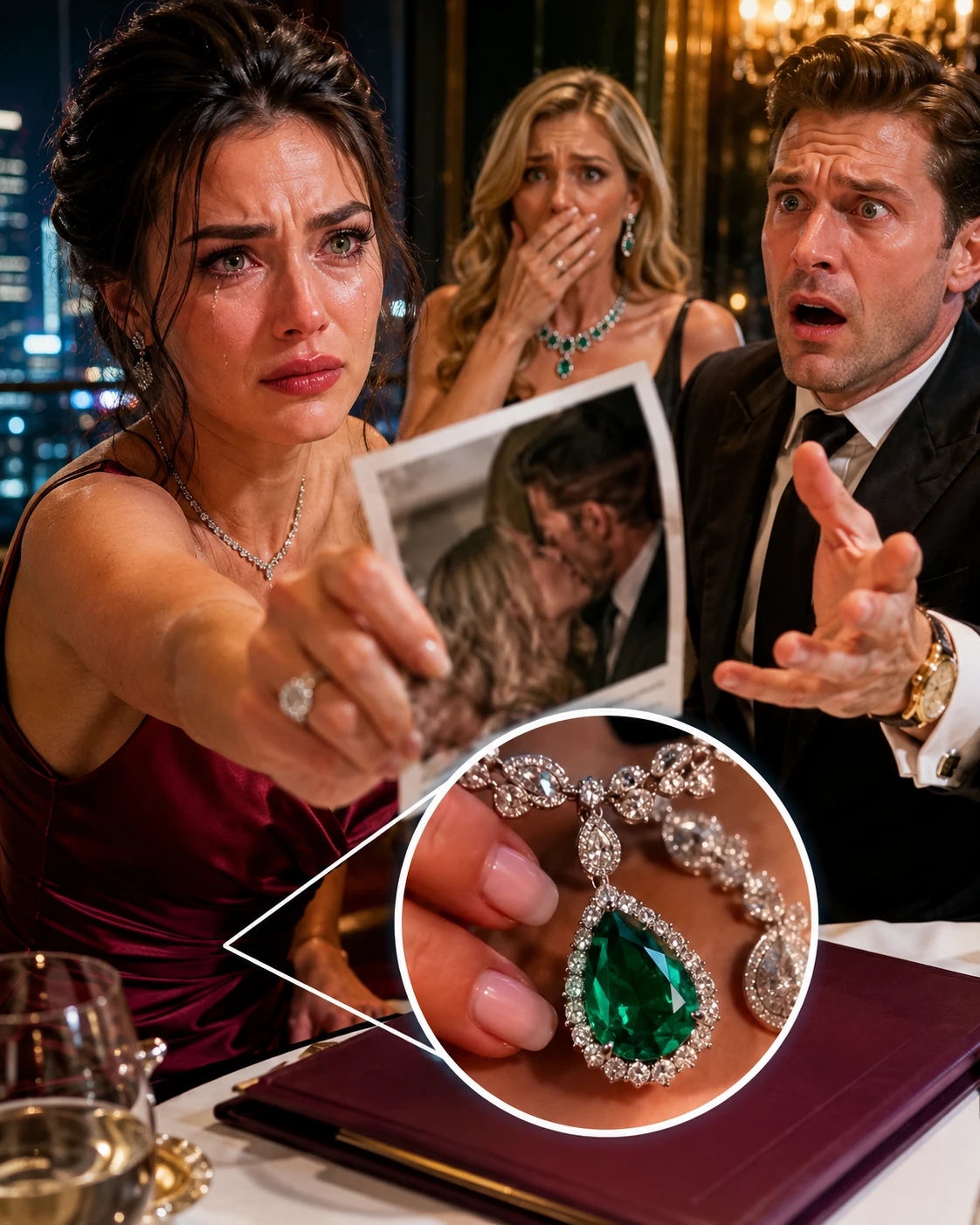
Celeste Monroe.
A rustle moved through the courtroom.
Bennett turned so fast his chair scraped the floor.
Celeste entered in a gray suit, no jewelry except small pearl studs. Without the diamonds, she looked younger. Not innocent. Never that. But frightened enough to be honest.
Henry stood. “Your Honor, we were not informed—”
“She is listed on the amended witness disclosure,” Julian said.
Judge Whitaker checked. “She is. Proceed.”
Celeste took the oath.
I watched Bennett watch her.
There was no love in his face.
Only calculation, betrayal, ownership slipping.
Julian approached gently. That was the cruelty of it. He did not need to frighten her. Bennett had already done that.
“Ms. Monroe, did Mr. Whitlock tell you his marriage was over before September?”
“Yes.”
“When?”
“January.”
My chest did not tighten.
Good.
“Did he tell you Mrs. Whitlock had agreed to the divorce?”
“Yes.”
“Did she?”
“Not that I know of.”
“Did Mr. Whitlock give you access to the Whitlock residence?”
“Yes.”
“Did he tell you that you could take items from Mrs. Whitlock’s dressing room?”
Celeste swallowed. “He said she wouldn’t need them.”
Bennett closed his eyes.
“Did you take a pair of diamond earrings?”
“Yes.”
“Where are they now?”
“I returned them to counsel.”
Julian nodded.
“Ms. Monroe, did you receive gifts from Mr. Whitlock, including an emerald necklace?”
“Yes.”
“Did you know those gifts were purchased with company or marital funds?”
“At first, no.”
“At first?”
Her eyes flicked to Bennett.
“When did you learn?”
“After the gala. He told me not to worry because once Evelyn signed, everything would be covered.”
The courtroom shifted.
There it was.
The sentence.
Once Evelyn signed, everything would be covered.
Julian let it breathe.
“Did Mr. Whitlock ask you to attend the meeting where the settlement folder was presented?”
“Yes.”
“Why?”
Celeste’s voice broke slightly. “He said it would help her understand that it was over.”
“Did he use another phrase?”
She hesitated.
Bennett’s lawyer stood. “Your Honor—”
“Answer if you can,” Judge Whitaker said.
Celeste looked down.
“He said seeing me there would make her fold.”
Fold.
For one moment, I felt the whole room look at me.
Not with pity.
With recognition.
Every woman there knew that word. Maybe not from Bennett. Maybe from a boss, a father, an ex, a judge, a landlord, a man at a table who thought pressure was the same as power.
Fold.
I had been folded before.
Into smiles.
Into silence.
Into smaller versions of my own life.
But paper remembers every crease, and sometimes, when unfolded, it becomes a map.
Julian had only one question left.
“Ms. Monroe, did you provide my office with copies of text messages from Mr. Whitlock?”
“Yes.”
“Why?”
Celeste’s eyes filled, but she did not cry.
“Because he told me if things got bad, he’d say I extorted him. He said no one would believe me over him.” She looked at me then, really looked. “I believed him when he said she was weak. Then I watched her walk into that gala in white, and I realized he lies about women before he destroys them.”
Something in the courtroom softened.
Not forgiveness.
Not absolution.
But truth arriving from an unexpected mouth still counts as truth.
Bennett stared at Celeste like he had never seen her before.
That was because he had never seen her as a person.
Only as proof he could still acquire beauty.
Julian submitted the texts.
They were devastating.
Bennett boasting that I would “take the apartment and vanish.”
Bennett saying the settlement language had to be broad enough to “bury the bakery problem.”
Bennett telling Celeste, “Once she signs, Hartwell becomes irrelevant.”
And finally, the message that ended him.
BENNETT:
The velvet folder is theater. She cares too much about looking graceful to fight.
Judge Whitaker read it twice.
Then she looked at Bennett.
I will remember his face for the rest of my life.
Not because it satisfied me.
Because it freed me.
He looked afraid.
The temporary orders were issued that afternoon.
The court found sufficient basis to freeze disputed assets, refer the forged signature issue for further investigation, restrict Bennett’s access to certain accounts, order the return of personal property, and preserve all records tied to Whitlock Luxe, Monroe Lane LLC, and the art sale.
In parallel, Whitlock Luxe’s board accepted Bennett’s resignation as CEO pending investigation.
Hartwell Holdings issued a controlled notice of covenant breach but held acceleration in abeyance, allowing the company to stabilize under interim leadership.
That part mattered to me.
I did not want the bellmen, pastry chefs, housekeepers, managers, reservation agents, and drivers to pay for Bennett’s vanity. They had built the company too. More honestly than he had.
Outside the courthouse, reporters shouted questions.
“Evelyn, how do you feel?”
“Is this revenge?”
“Will you take over Whitlock Luxe?”
“Do you have a statement?”
Julian stood beside me but slightly behind, letting the cameras see I was not being handled.
I stopped at the top of the courthouse steps.
The air smelled like rain again.
New York loves a full-circle moment.
I looked into the cameras.
For weeks, I had said nothing.
Now I gave them twenty-one words.
“Grace is not silence. Grace is knowing when to let the evidence speak, and when to take your life back.”
Then I walked away.
The clip hit ten million views by morning.
By noon, the board called.
By Friday, I became interim chair of Whitlock Luxe.
Bennett sent one final text.
BENNETT:
Was it worth it?
I looked at it for a long time.
Then I typed back:
Ask the bakery.
And blocked him.
The final divorce took seven months.
Bennett fought, of course. Men like him call it fighting when consequences do not immediately apologize. But his leverage was gone. The forensic accounting expanded. Regulators asked questions. Investors demanded distance. His friends became busy. His invitations thinned. His name remained recognizable, but recognition is not the same as respect.
Celeste returned the earrings.
She also returned the pearl comb in person.
I met her in the lobby of Julian’s office on a cold December afternoon. She looked smaller without Bennett’s money around her, but perhaps more real.
“I’m sorry,” she said.
I took the velvet box from her.
“I believe you.”
Her eyes lifted, hopeful.
“I don’t forgive you yet,” I said. “But I believe you.”
She nodded, accepting the difference.
As she turned to leave, she paused.
“He said you had everything because of him.”
I looked down at my grandmother’s comb.
“No,” I said. “I forgot what I had because of him.”
That was the truest thing I had said in months.
In January, I returned to Boston for the reopening of the original Hart & Honey.
My mother was there, wrapped in a camel coat, cancer-free again and bossing around the florist. Marta came. Priya came. Half the staff from The Monarch came by train because they said they wanted to see “where the empire actually started.”
The bakery looked almost the same as it had when I was a child.
Brick walls.
Copper lights.
Wooden cases.
The smell of butter, honey, coffee, and morning.
We had added one thing.
A small framed note near the register, written in Rose Hart’s blue ink.
If a Whitlock ever waves the black-ink version, smile first. Then call a lawyer.
People took pictures of it all day.
Julian arrived ten minutes before closing.
He wore a navy overcoat and carried no roses.
Instead, he brought a stack of cream legal stationery tied with black ribbon.
I laughed the moment I saw it.
“You’re ridiculous.”
“I’m consistent.”
He looked around the bakery, his expression gentler than I expected.
“So this is where you learned to wake up earlier.”
“This is where I learned everything.”
My mother watched us from behind the counter with the subtlety of a woman holding a rolling pin.
Julian noticed.
“Should I be afraid?” he asked.
“Of her? Always.”
He smiled.
After closing, we walked through Beacon Hill under old streetlamps. Snow fell lightly, softening the brick sidewalks, settling on his shoulders and in my hair.
For a while, we talked about business. The board. The licensing restructure. The decision to rename the lifestyle division Hart House instead of Whitlock Monroe. The new employee profit-sharing plan. The pastry apprenticeship fund for young women from low-income families.
Then the conversation faded.
At the corner of Acorn Street, Julian stopped.
The snow made the world quiet.
“Evelyn,” he said.
There was something formal in his tone, and it made me smile before he even continued.
“Are you asking me to dinner so properly it feels Victorian?”
“I am attempting to.”
“Proceed.”
He stepped closer, not enough to crowd me, just enough to make the cold less convincing.
“Would you have dinner with me tomorrow night? Not as your attorney. Not as your strategist. Not as the man standing beside you in a war. As someone who has admired you longer than was convenient and respected you too much to make that your burden.”
The streetlamp caught the silver at his temples.
My heart did not race the way it had with Bennett.
It did not panic.
It did not try to earn.
It opened.
Quietly.
Like a door in a house I owned.
“Yes,” I said.
Julian’s smile was slow and devastating.
“Good.”
“Where?”
“Somewhere with terrible lighting and excellent food. No photographers. No velvet folders.”
“Perfect.”
He offered his arm.
I took it.
This time, no cameras flashed.
No one applauded.
No one turned pain into content or silence into speculation.
It was just snow, brick, breath, and the strange luxury of being seen without being displayed.
CONCLUSION: WHAT GRACE LOOKS LIKE
A year later, The Monarch served Hart & Honey breakfast under a new menu note.
Inspired by Rose Hart’s original recipes. Preserved by Evelyn Hart Whitlock.
I kept the Whitlock name for exactly one year after the divorce, not because I wanted Bennett’s shadow, but because I wanted to remove it on my own schedule. On the first anniversary of the day he handed me the velvet folder, I filed the paperwork and became Evelyn Rose Hart again.
The internet noticed.
Of course it did.
Someone reposted the old clip of me on the courthouse steps, and the comments filled with women telling stories of their own velvet folders.
Not always real folders.
Sometimes a text.
Sometimes a locked bank account.
Sometimes a husband who brought the mistress to mediation.
Sometimes a boss who smiled while stealing credit.
Sometimes a family that called obedience peace.
I read as many as I could.
Not because I wanted to be a symbol. Symbols are heavy. Women are asked to become them when people do not know how else to honor survival.
I read them because I knew what it meant to sit at table twelve while someone else tried to rename your life.
On the day my name changed, I went back to The Monarch alone.
Not for Bennett.
He was in Florida by then, consulting for men who still believed scandal was a weather pattern and not a climate. Celeste had moved to Los Angeles and started over quietly. I did not follow her, but once, through a mutual acquaintance, I heard she was working with a women’s legal aid fundraiser.
Good.
Let people become better after the wreckage. That does not erase the wreckage. It simply means the road does not have to end there.
At The Monarch, I walked through the black marble lobby beneath the chandelier shaped like frozen rain.
The staff greeted me warmly.
Not as Mrs. Whitlock.
Not as the wife.
As Ms. Hart.
In the private dining room where Bennett had offered me crumbs, I hosted dinner for twenty-two women from our new apprenticeship program. There were no cameras. No press. No speeches about vision.
Just food.
Warm bread.
Honey butter.
Roasted chicken.
Chocolate cake.
Laughter that did not need permission.
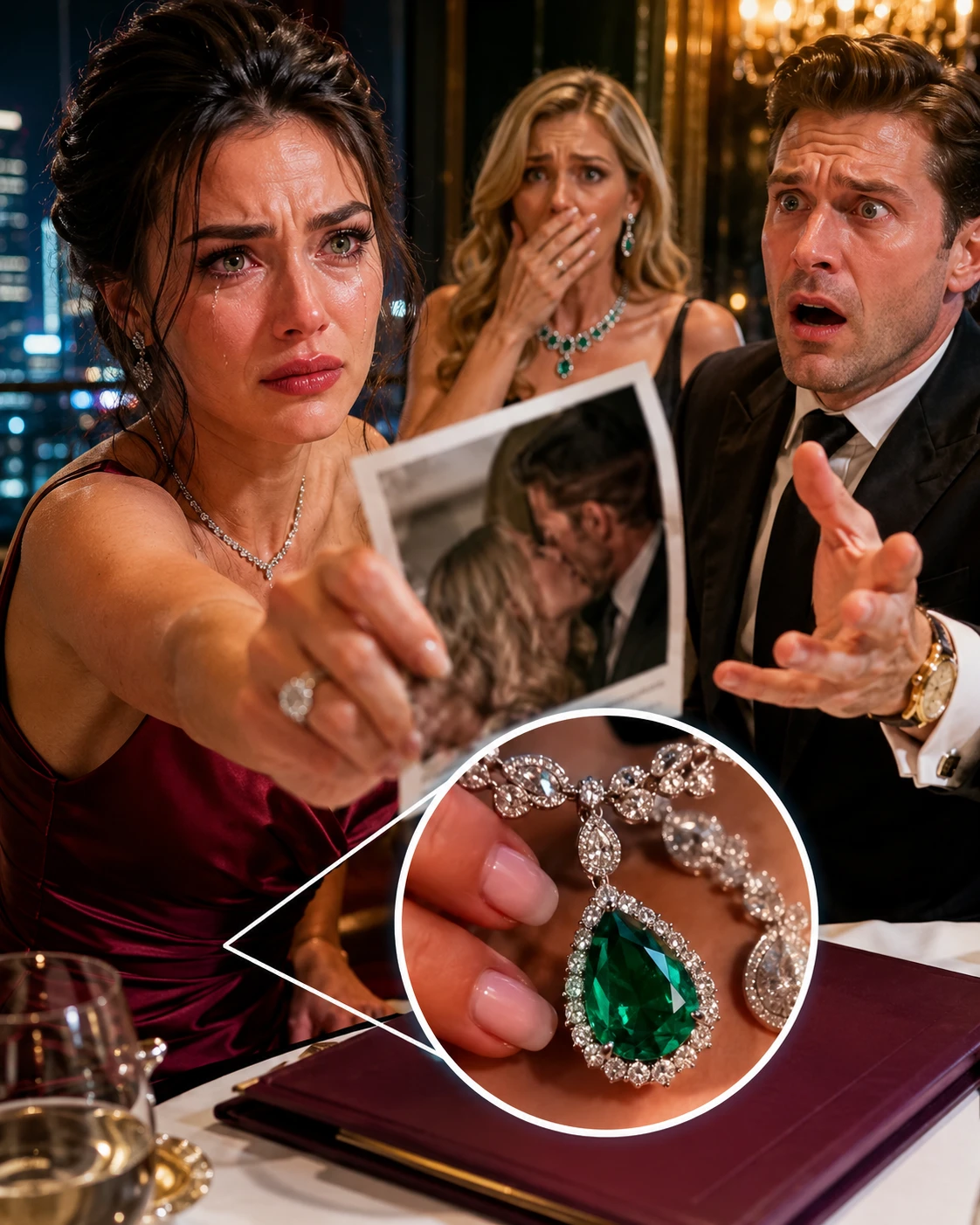
At the end of the night, Marta brought out a tray of small pastries dusted with powdered sugar.
Honey cakes.
My grandmother’s.
I lifted one and thought of Rose. Of my mother. Of every woman who hid a deed, kept a receipt, saved a note, remembered the original signature was blue.
Julian sat beside me, his hand resting near mine on the table.
We were not engaged.
Not yet.
There was no rush. I had learned the difference between a man trying to claim my future and one honored to be invited into it.
He leaned close and murmured, “You’re smiling.”
“I was thinking.”
“Dangerous.”
“Always.”
Across the table, one of the apprentices, a nineteen-year-old named Lila from Queens, asked, “Ms. Hart, is it true he offered you an apartment and eighteen months of allowance?”
The table went quiet, hungry for the legend.
I could have corrected the details.
I could have made it smaller, more tasteful, more dignified.
Instead, I picked up the velvet folder from the chair beside me.
Yes.
I had kept it.
Not as a wound.
As a ruler.
A way to measure the distance between what he thought I was worth and what I knew I owned.
I placed it on the table.
The young women stared.
“This,” I said, “is what disrespect looks like when it has a lawyer.”
They laughed.
Then I opened it.
Inside, the original insulting settlement was gone. In its place were copies of apprenticeship contracts, profit-sharing agreements, scholarship letters, and the deed to the expanded Hart & Honey training kitchen.
“This,” I said, “is what happens when you don’t sign away your life just because someone presents the cage in velvet.”
Lila looked at the folder, then at me.
“Were you scared?”
The honest answer rose easily.
“Yes.”
That mattered. I wanted them to know power is not the absence of fear. Sometimes power is a shaking hand that signs the correct document anyway.
“I was scared,” I said. “I was humiliated. I was angry. I was heartbroken in places I didn’t know could break. But I had proof, and I had patience, and I had women before me who taught me never to confuse crumbs with inheritance.”
Marta crossed herself dramatically. “Amen.”
Julian smiled into his wine.
I lifted my glass.
“To Rose Hart,” I said.
“To Rose,” the table echoed.
“And to every woman who has been told dignity means leaving quietly with less than she deserves.”
I looked around at their faces.
Young. Tired. Bright. Unfinished.
“May you be graceful when you want to be. Loud when you need to be. And impossible to rob in either condition.”
They cheered.
Outside, Manhattan glittered beneath the winter sky, all steel and appetite and second chances.
The city had not become kinder.
Men like Bennett had not vanished.
Velvet folders were still being slid across tables every day, dressed up as mercy by people who hoped humiliation would do the work of law.
But somewhere in Boston, my mother was locking the bakery safe.
Somewhere in New York, young women were learning contracts before recipes.
Somewhere on the internet, a stranger was typing, “I needed this today.”
And in the private dining room of the hotel he once used to shame me, I broke a honey cake in half and handed part of it to Julian.
He tasted it and closed his eyes.
“That,” he said, “is extraordinary.”
I smiled.
“I know.”
Because he had offered me crumbs.
But the bakery had always been mine.
“`