## PART ONE
### THE KEY MARKED SEVENTEEN
The electronic beeping inside Unit 17 was slow, measured, and patient—the sound of something that had been waiting longer than I had been alive.
FBI Special Agent Mara Voss raised one hand, stopping me beneath the dripping metal awning of the Route 9 storage facility.
“Stay behind me.”
I almost laughed, though nothing about the afternoon was funny.
“I have spent twenty-three years walking toward dangerous sounds,” I told her. “You’ll need a better argument than that.”
Mara studied me with a mixture of irritation and reluctant respect. She was in her early fifties, perhaps six years older than I was, with silver beginning to show at her temples. Her expression was controlled, but her right hand remained close to the pistol beneath her coat.
“Your father told me you would say something like that.”
The words tightened around my heart.
“Then start explaining how a dead man knew where I would be.”
She did not answer.
Rain rattled against the corrugated roof. Behind us, the storage facility’s narrow lanes stretched between rows of blue doors. No employees were visible. No cars passed on the county road beyond the chain-link fence.
The entire place felt abandoned.
Or cleared.
I inserted the brass key into the lock.
Mara caught my wrist.
“Wait.”
She removed a small instrument from her pocket and passed it along the doorframe. The beeping continued from inside.
“No radiation,” she murmured. “No detectable chemical agent.”
“That leaves explosives.”
“It also leaves a transmitter.”
I looked at her.
“A transmitter to whom?”
“That,” she said, “is what your father died trying to discover.”
The sentence struck me harder than the gravedigger’s warning.
“You believe he was murdered?”
“I believe Raymond Mercer’s heart stopped because someone wanted it to stop.”
My fingers tightened around the key.
Three days earlier, I had stood in a private room at St. Matthew’s Hospital and identified my father’s body. His eyes had been closed. His weathered face had appeared smaller than I remembered, as if death had already begun removing him from the world.
I had touched his cold hand.
I had kissed his forehead.
Now a stranger with an FBI badge was telling me that the coffin lowered into the ground was empty and that his death had been anticipated for twenty years.
“Open it,” I said.
Mara drew her weapon.
I lifted the metal door.
The beeping became louder.
Inside stood a wooden military footlocker, an old metal desk, and shelves filled with numbered archive boxes. A single red light blinked from a black device resting on the desk.
Mara approached it cautiously.
I remained near the door, scanning the rafters, the rear wall, the ventilation grate and every shadow large enough to conceal a person.
The Army teaches officers to read terrain. Rooms are terrain. Families are terrain. Grief is terrain too, though it offers no reliable map.
Mara examined the device.
“It’s not a bomb.”
“What is it?”
“A proximity alarm.”
“For us?”
Her face hardened.
“For whoever has been watching this unit.”
The red light stopped blinking.
A green light appeared.
Somewhere inside the walls, a mechanism clicked.
The back panel of the storage unit slid sideways, revealing a narrow hidden compartment.
Inside it hung my father’s Army dress uniform.
His medals shone beneath the dim ceiling light.
Below the uniform sat a portable television, a videotape recorder and a row of labeled cassettes. Beside them lay a leather ledger and a photograph in a silver frame.
I stepped closer.
The picture showed my father as a young captain, standing in front of a burned warehouse. Beside him was my mother, Evelyn, though she appeared barely twenty-five. Between them stood a little girl with dark hair, a soot-streaked face and a red coat.
The child was me.
At least, she had my eyes.
But I had never owned a red coat.
I had never stood in front of a burned warehouse.
I had been born in Newark, raised in a quiet house in Middletown and told that my childhood had been unremarkable.
“What is this?” I whispered.
Mara’s gaze remained on the photograph.
“Your first life.”
Before I could demand an explanation, tires screamed outside.
A black sedan shot around the corner and stopped across the lane.
Two men stepped out.
They wore dark suits and carried suppressed weapons.
Mara seized my shoulder and pulled me behind the metal desk as bullets struck the storage door. The sound was strangely soft, like heavy books being dropped in another room.
“Back exit?” I shouted.
“There isn’t one.”
“There is now.”
I kicked the thin interior panel beside the hidden compartment. It bent but did not break. I kicked again, this time driving through with my heel.
The sheet metal tore open.
Mara stared at me.
“Army engineering,” I said. “Move.”
She grabbed the ledger, the photograph and three videotapes. I seized the black alarm device and the envelope my father had left with the gravedigger.
We crawled through the opening into the neighboring unit while bullets chewed through the door behind us.
The adjacent unit contained old furniture wrapped in plastic. I overturned a bookcase against the connecting wall and led Mara through the front entrance just as one of the gunmen entered Unit 17.
We ran between the rows.
Mara fired twice, forcing the second man behind the sedan.
My SUV stood near the office, but Mara pulled me toward an old blue pickup parked beside the fence.
“Keys are under the visor.”
“You planned an escape vehicle?”
“Your father did.”
I slid behind the wheel. The engine coughed, protested and finally turned over.
As we crashed through the service gate, I glanced in the mirror. The two gunmen had returned to their sedan.
“They’re following.”
“They won’t for long.”
Mara reached beneath the seat and produced a small remote control.
“What did my father leave in the truck?” I asked.
“Insurance.”
She pressed the button.
Behind us, every exterior light at the storage facility went dark. The heavy security gate slammed closed directly in front of the sedan. The driver swerved, struck a concrete barrier and spun sideways.
I kept driving.
For several miles, neither of us spoke.
The rain intensified, blurring the highways and strip malls into streaks of gray.
Finally, I said, “Tell me where my father is.”
Mara looked out the passenger window.
“Your father is dead, Colonel.”
The truck drifted toward the shoulder before I corrected it.
“No.”
“I’m sorry.”
“He buried an empty coffin.”
“Yes.”
“Then whose body did I identify?”
“His.”
I stared at her.
“That makes no sense.”
“The funeral home removed Raymond’s body after the viewing and transferred it to a federal medical facility. The coffin taken to the cemetery was empty.”
“Why?”
“Because your father believed the people who killed him would exhume his body to make certain their work could never be discovered.”
The coldness in my chest spread.
“What work?”
“A toxin delivered in a medication he took every morning. It imitates a cardiac event and begins breaking down within hours.”
“My father took heart medicine.”
“Someone replaced it.”
I thought of the amber prescription bottle on his desk. My mother had found him in his chair shortly after breakfast. She had called me, sobbing so hard I could barely understand her.
“Who had access to the bottle?”
Mara did not answer.
I turned sharply toward her.
“My mother?”
“I don’t know.”
“You told me not to answer her call.”
“Because her phone has been compromised.”
“Is she in danger?”
“Yes.”
“Then we’re going to her.”
“No. We are going to a secure location.”
“My mother is standing at a cemetery surrounded by people who may have murdered my father.”
“And if we go to her now, you may lead those people directly to the evidence Raymond died protecting.”
I pulled onto the shoulder and stopped so suddenly the truck skidded in the mud.
“Listen to me carefully,” I said. “You have given me fragments, warnings and orders. I have followed them because my father’s handwriting was on that envelope. That is the only reason. Before this vehicle moves again, you will tell me what is happening.”
Mara held my gaze.
The rain drummed against the cab.
At last, she placed the leather ledger on the seat between us.
“Twenty-seven years ago, your father began investigating a group operating inside the military, federal law enforcement and several defense contractors. It was called the Sentinel Circle.”
“What did they do?”
“At first, they redirected money from classified accounts to fund operations Congress would never approve.”
“That happened throughout the Cold War.”
“Yes. But the Cold War ended. The money kept moving.”
She opened the ledger.
Pages of handwritten names, dates and dollar amounts filled the book. Some entries were accompanied by military units. Others listed charitable foundations, veterans’ groups and insurance companies.
Mara tapped one line.
I recognized the name immediately.
Lieutenant General Jonathan Caldwell.
My former division commander.
My mentor.
The man who had pinned the silver eagle of a colonel onto my uniform.
The man who had spoken at my father’s retirement ceremony.
“He was at the funeral,” I said.
“I know.”
“He stood beside my mother.”
“I know.”
“He told me my father was the finest man he had ever served with.”
Mara closed the ledger.
“That may be the first honest thing Jonathan Caldwell has said in thirty years.”
My phone buzzed again.
Another message from my mother.
**Natalie, please come home. I know about the red coat.**
The air seemed to leave the truck.
I looked at the old photograph.
“How could she know I just saw this?”
Mara reached for my phone.
I pulled it away.
“That message came from her number.”
“Numbers can be copied.”
“But those words?”
Mara’s expression changed.
For the first time, she looked frightened.
“Your mother is not asking you to come home,” she said quietly. “Someone is telling us they already have her.”
## PART TWO
### THE WOMAN IN THE RED COAT
The safe house stood on a wooded property outside Princeton, hidden behind a sagging barn and an orchard that had not produced apples in years.
It belonged to no government agency on paper.
Mara parked the truck inside the barn, closed the doors and led me through a tunnel connecting the barn to a small stone house.
Inside, the rooms were clean but old-fashioned. A rotary telephone sat on a side table. A wood-burning stove heated the living room. There were no computers, smart televisions or wireless devices.
“My father chose this place too?” I asked.
“He bought it through a trust in 2003.”
“Without telling my mother?”
Mara removed her wet coat.
“I’m not convinced there was anything your father did without telling Evelyn.”
My mother’s name sounded almost accusatory in her mouth.
I placed the photograph on the kitchen table.
“Who is the child?”
Mara’s eyes moved toward me.
“You already know.”
“I know she looks like me.”
“She is you.”
“I was never at that fire.”
“You were six years old. Trauma can remove entire rooms from a person’s memory.”
“I remember being six. I remember my first-grade teacher, Mrs. Hanley. I remember my father building a tree house that leaned so badly my mother wouldn’t let me climb into it.”
“Do you remember your fifth birthday?”
I opened my mouth.
Nothing came.
Mara continued.
“Do you remember learning to ride a bicycle?”
“My father taught me.”
“Where?”
“In our driveway.”
“What color was the bicycle?”
I searched my memory and found only a vague image: my father’s hands gripping the back of a seat, his voice telling me not to look down.
Then came something else.
Smoke.
A woman screaming.
The scrape of metal against concrete.
I pushed the image away.
“You’re manipulating me.”
“I’m asking questions.”
“Then answer mine. Why were you waiting at the storage facility?”
Mara hesitated.
“Raymond contacted me eleven months ago. He said the Sentinel Circle had discovered that an old witness was still alive.”
“What witness?”
“You.”
The word was absurd.
“I was a child.”
“You saw something.”
“What?”
“We don’t know.”
A bitter laugh escaped me.
“So my father built an operation around a memory I don’t possess?”
“He built it around the fact that someone believed you did.”
Mara selected the first videotape from the stack.
A label in my father’s handwriting read:
**NATALIE—BEGIN HERE.**
She inserted it into the recorder.
The screen flickered.
My father appeared seated behind his desk.
He wore the brown sweater my mother had given him for Christmas, and his hair was slightly disordered, as though he had been running his hands through it.
For one impossible second, I expected him to look up from the television and see me.
“Hello, Peanut,” he said.
My knees nearly gave way.
No one had called me that since childhood.
I sat on the edge of the sofa.
“If you’re watching this,” he continued, “then the plan failed in one way and succeeded in another. I am dead. You are alive. As your father, I would have preferred the reverse. As a soldier, I understand why it had to be this way.”
I pressed my fist against my mouth.
Mara remained standing behind me.
My father leaned closer to the camera.
“You are going to learn things about me that will make you question every memory we shared. Some of what you discover will be true. Some of it was placed where you would find it. You must not decide too quickly which is which.”
He looked older than he had at breakfast the week before.
Or perhaps I had refused to notice.
“Trust Mara Voss,” he said. “She has more reason than anyone to hate me, and that is why you can believe her.”
I turned toward Mara.
She looked away.
On the screen, my father continued.
“Do not trust General Caldwell. Do not return to the house unless Evelyn gives you the name of your first dog.”
“We never had a dog,” I whispered.
My father seemed to pause, as if he had heard me.
“Exactly,” he said on the tape.
The screen went black.
For several seconds, the only sound in the room was the ticking of a wall clock.
I faced Mara.
“Why do you have reason to hate him?”
She removed her FBI badge and placed it on the table.
“My father was Special Agent Andrew Voss. My mother was named Rebecca.”
The names meant nothing to me.
“They investigated the Sentinel Circle with Raymond in 1986,” she continued. “The case ended when a warehouse in Elizabeth exploded. Fourteen people were killed.”
“The photograph.”
“Yes.”
“Were your parents inside?”
“My father died at the scene. My mother died two days later.”
“I’m sorry.”
Mara’s expression tightened.
“I was eleven years old.”
A memory moved at the edge of my mind: an older girl holding my hand beneath a table, whispering that we had to stay quiet.
I looked again at the photograph.
“You were there.”
“Behind the camera.”
Something in her voice made my skin prickle.
“How did I know your parents?”
Mara sat across from me.
“Because they were yours too.”
The room tilted.
“No.”
“My parents had two daughters. I was eleven. My sister was six.”
I stared at her face, searching for similarities I did not want to find.
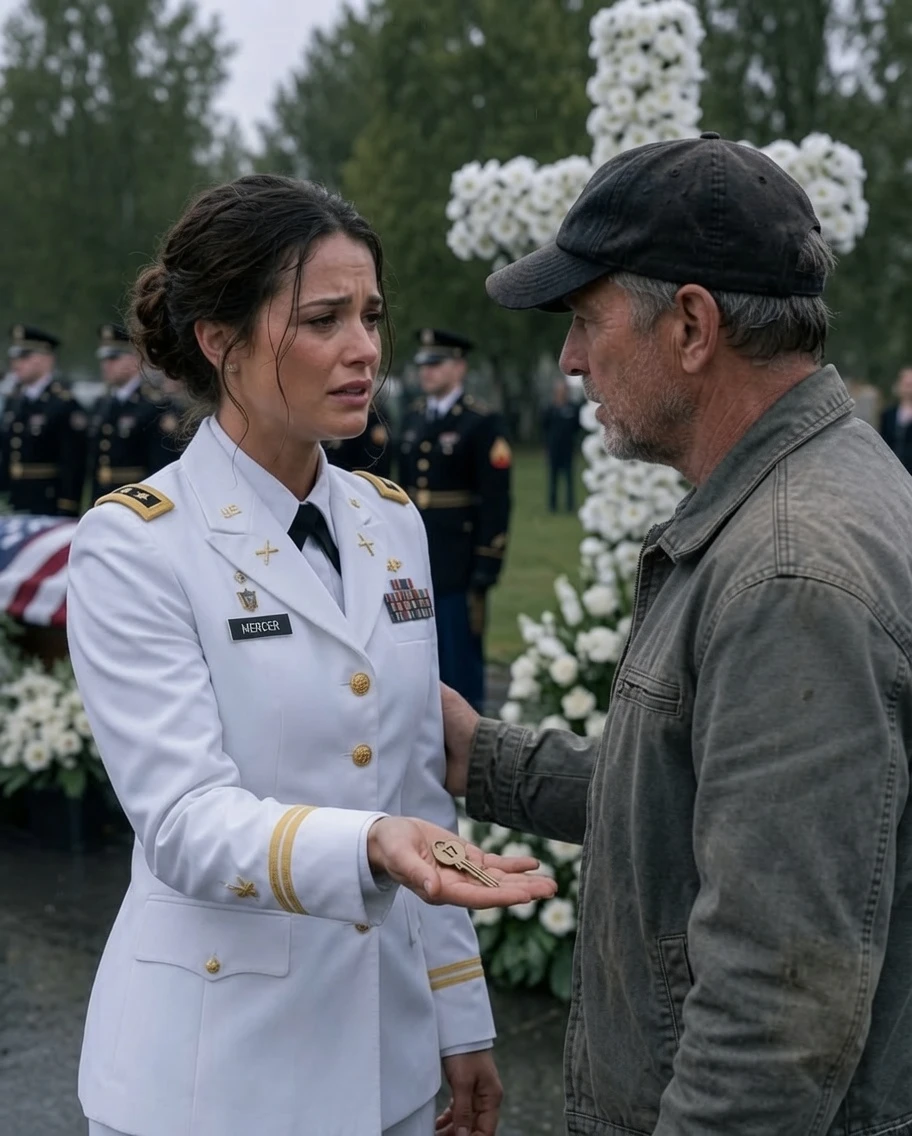
Her eyes were gray-green.
Mine were the same.
“No,” I repeated.
“Your birth name was Natalie Voss.”
“My parents are Raymond and Evelyn Mercer.”
“They raised you.”
“They are my parents.”
“I didn’t say they weren’t.”
“You just told me my entire life is false.”
“I told you the people who loved you changed your name to keep you alive.”
I stood so quickly the chair fell backward.
“You expect me to believe my father stole a child from the wreckage of an explosion?”
“He didn’t steal you.”
“Then where were you?”
The question wounded her.
I saw it immediately.
Mara’s composure cracked, revealing grief that had never been given permission to age.
“I was taken to relatives in Oregon,” she said. “You were placed with Raymond and Evelyn under an emergency protection order. By the time I learned you had survived, your records were sealed. Raymond said contacting you would expose you.”
“And you accepted that?”
“I was fourteen when I found out. What power do you imagine I had?”
“You became an FBI agent.”
“And I spent thirty years trying to reach you without leading the Sentinel Circle to your door.”
She opened a folder from the footlocker.
Inside was a copy of a birth certificate.
**Natalie Rebecca Voss.**
Below it lay a photograph of two little girls sitting on a porch. The older one had her arm around the younger.
The younger girl wore a red coat.
My legs weakened.
I sat again.
A sound escaped me, half breath and half sob.
Mara reached across the table but stopped before touching my hand.
“I remember you hated peas,” she said. “You hid them in your napkin and tried to feed them to a stray cat. You called me Mimi because you couldn’t say Mara.”
A sharp image pierced the darkness in my memory.
A girl singing during a thunderstorm.
A chipped blue cup.
The smell of Ivory soap.
“Mimi,” I whispered.
Mara closed her eyes.
When she opened them, they were wet.
“Yes.”
The telephone rang.
Both of us froze.
Mara lifted the receiver.
She did not speak.
A woman’s breathing came through the line.
Then my mother’s voice.
“Ask her about the dog.”
I took the receiver.
“Mom?”
“Oh, sweetheart.”
The familiar endearment nearly broke me.
“Are you safe?”
“For the moment.”
“What was the name of my first dog?”
A pause.
Then she said, “Mercury.”
The answer made no sense.
“We never had a dog.”
“That was the name you gave the stuffed shepherd Raymond bought after the fire. You slept with it for two years.”
Mara nodded.
The password.
“Where are you?” I asked.
“At home.”
“Are you alone?”
“No.”
A man’s voice sounded faintly behind her.
My mother continued in a calm, unnatural tone.
“General Caldwell came to help me after the funeral. He believes you have something that belongs to him.”
“Let me speak to him.”
“Natalie, listen instead. Your father hid a second ledger in the study. Caldwell does not know where it is.”
“Do you?”
“Yes.”
“Tell me.”
“I can’t. He’s listening.”
The line crackled.
Then my mother said, “Do you remember the marks Raymond made on the kitchen wall as you grew?”
“Yes.”
“The answer is behind the year you stopped growing.”
The line went dead.
I turned to Mara.
“I’m going home.”
“That is exactly what Caldwell expects.”
“He has my mother.”
“And he will kill both of you if you walk through the front door.”
“Then we won’t use the front door.”
Mara studied me for a long moment.
“You sound like Raymond.”
“I’m beginning to understand why that may not be a compliment.”
## PART THREE
### THE HOUSE OF FALSE MEMORIES
The house where I had grown up looked smaller through night-vision binoculars.
Rainwater slid down the familiar brick walls. Light glowed from the study and kitchen. General Caldwell’s sedan stood in the driveway beside my mother’s Buick.
A second vehicle waited around the corner.
Caldwell had brought men.
Mara and I approached through the woods behind the property. As a child, I had believed those trees stretched forever. I knew every trail, every fallen log and every place where my father had once hidden Easter eggs.
Now I counted windows and lines of fire.
We reached the old toolshed near the rear fence.
“My father built a tunnel from here?” I whispered.
“He called it a drainage channel.”
“Of course he did.”
Beneath a workbench, I found a metal ring embedded in the floor. We lifted a narrow hatch.
The passage below smelled of damp earth and machine oil.
It ended beneath the pantry.
Mara climbed out first.
The kitchen was empty.
Voices came from the study.
Caldwell spoke with the mild patience I remembered from briefing rooms.
“Evelyn, Raymond is dead. Whatever loyalty you owed him ended this morning.”
My mother answered, “Loyalty does not end when breathing does.”
“You always were sentimental.”
“And you always mistook cruelty for intelligence.”
Mara touched my shoulder, warning me to wait.
Through the half-open study door, I saw my mother seated in my father’s chair. Caldwell stood beside the fireplace, still wearing the black suit from the funeral.
He was seventy-one but remained broad-shouldered and commanding. Generations of soldiers had straightened when he entered a room.
I had once been proud to be among them.
One of his men stood near the window. Another guarded the hallway.
Caldwell picked up my father’s framed photograph from the desk.
“Raymond could have died peacefully,” he said. “I gave him that choice for thirty years.”
“You poisoned him.”
“I corrected an old mistake.”
My mother’s face remained composed.
“The mistake was trusting you.”
“No. The mistake was letting him leave Elizabeth with the child.”
My hand moved toward my pistol.
Mara shook her head.
Not yet.
Caldwell continued.
“Natalie should never have reached adulthood.”
My mother looked directly toward the pantry.
For one terrible second, I thought she could see me.
“She became more than any of you,” my mother said. “That is what frightened you. Not what she remembered. What she represented.”
“She represents unfinished business.”
“No, Jonathan. She represents survival.”
A noise came from upstairs.
The guard near the hallway turned his head.
Mara moved.
She entered silently behind him, locked one arm around his throat and lowered him before he could shout. I stepped into the study and aimed at the man by the window.
“Hands where I can see them.”
He reached for his weapon.
I fired into the wall beside his head.
Plaster exploded across his face.
“Try again.”
He raised his hands.
Caldwell did not move.
My mother closed her eyes in relief.
“Natalie,” Caldwell said, almost warmly. “I wondered how long it would take you.”
“You murdered my father.”
“Your father murdered himself the day he chose guilt over duty.”
“Step away from my mother.”
He did.
Mara entered and restrained the second guard.
I approached Caldwell.
For years, this man had reviewed my evaluations, advised me before promotions and called every Christmas. When my marriage ended, he had sent a handwritten letter telling me that service sometimes demanded more than families could endure.
Now I saw the calculation behind every kindness.
“Did you arrange my career?” I asked.
“I protected it.”
“You monitored me.”
“I kept you close.”
“Because you thought I remembered the warehouse.”
“I needed to know if you did.”
“What happened there?”
He smiled faintly.
“You truly don’t know.”
“Tell me.”
“That building held records your biological father intended to deliver to Congress. Raymond was ordered to recover them. The operation went badly.”
“My parents were killed.”
“Many people were killed.”
“By whom?”
Caldwell’s gaze shifted briefly toward Mara.
“Ask your sister who gave the order.”
My mother rose from the chair.
“Don’t listen to him.”
Caldwell’s smile widened.
“The Mercers have spent decades wrapping lies in affection. It is what they do best.”
Mara searched the room.
“The second ledger, Evelyn.”
My mother went to the kitchen doorway and pointed toward the wall where faint pencil marks recorded my childhood height.
Dates and initials appeared beside each line.
The final mark had been made when I was seventeen.
I pressed the wood panel.
Nothing happened.
“Behind the year you stopped growing,” I murmured.
The number seventeen.
I removed the brass key from my pocket.
A tiny keyhole had been concealed inside the upper pencil mark.
The key turned.
A narrow section of wall opened, revealing a metal cylinder.
Caldwell lunged.
My mother stepped between us.
He struck her hard enough to throw her against the table.
I tackled him before he could reach the cylinder.
We crashed into the hallway.
At seventy-one, Caldwell was still strong, but anger had made him careless. I drove my forearm across his throat and pinned him to the floor.
“You taught me never to fight angry,” I said.
He stared up at me.
“I taught you everything that made you useful.”
“No. My father did.”
His expression changed.
“You don’t know what Raymond was.”
Police sirens rose in the distance.
Mara froze.
“I didn’t call them.”
Neither had I.
Caldwell began laughing.
“Those aren’t police.”
Blue lights appeared through the front windows.
Men in tactical gear surrounded the house.
The insignia on their sleeves belonged to a federal response unit.
But Mara’s face told me they were not allies.
“They’re with him,” she said.
My mother clutched the edge of the table.
“Take the cylinder and go.”
“I’m not leaving you.”
“Yes, you are.”
The front door shook beneath a heavy impact.
My mother grabbed my face in both hands.
“Listen to me. Raymond and I had one purpose after the fire—to give you enough years to become the woman you were supposed to be. We succeeded. Do not waste those years trying to save an old woman who already had the life she wanted.”
“You are my mother.”
“Yes,” she whispered. “And that is why you must obey me once in your life.”
The door began to splinter.
Mara pulled open the pantry passage.
My mother took Caldwell’s pistol from the floor and aimed it toward the hallway.
“Go.”
I hesitated.
Then she smiled.
It was the same smile she had worn on my first day at West Point, when she had hidden her fear so I would not carry it with me.
“Sweetheart,” she said, “your father did not teach you how to retreat. He taught you how to choose the ground where you win.”
Mara dragged Caldwell into the tunnel.
I took the cylinder and followed.
The hatch closed above us as armed men stormed into the kitchen.
A single gunshot echoed through the house.
Then silence.
I stopped crawling.
“Mom!”
Mara covered my mouth before I could shout again.
Caldwell smiled in the darkness.
“That,” he whispered, “is what happens to people who love Raymond Mercer.”
## PART FOUR
### THE MAN BEHIND THE OPERATION
My mother was not dead.
We learned that thirty minutes later from a radio transmission intercepted by Mara. Caldwell’s men had taken her alive, believing she knew where we were going.
They were correct.
The metal cylinder contained a strip of microfilm, an antique compass and coordinates written on the back of my original birth certificate.
The coordinates led to a decommissioned communications bunker beneath Fort Monmouth.
My father had worked there in the late 1980s.
Caldwell laughed when he saw the numbers.
“Raymond always did enjoy returning to the scene of his sins.”
We drove south in the old pickup while Mara held him at gunpoint from the rear seat.
“You can stop this,” I told him. “Order your men to release my mother.”
“They no longer take orders from me.”
“Then who commands them?”
“The Sentinel Circle has survived because no single person commands it.”
“That is convenient.”
“It is the truth. Governments change. Presidents leave office. Generals retire. Money survives all of them.”
Mara leaned forward.
“Who replaced Raymond’s medication?”
Caldwell looked toward the dark highway.
“Someone he trusted.”
“Evelyn?”
I struck the steering wheel.
“Stop trying to turn me against her.”
“I don’t need to. The truth will do that.”
At Fort Monmouth, we entered through a maintenance gate whose lock opened with the same brass key.
Seventeen again.
The underground bunker smelled of rust and standing water. Old communication boards lined the walls. My flashlight passed over faded maps and warning signs from another era.
At the center of the main chamber stood a table.
On it rested an urn, a tape recorder and a sealed envelope.
My father had arranged his own final briefing.
Mara secured Caldwell to a metal chair.
I pressed play.
Raymond’s voice filled the bunker.
“Natalie, if you reached this room, Jonathan Caldwell is likely with you. He has always mistaken confidence for foresight.”
Caldwell’s face darkened.
“Evelyn may also be in danger,” the recording continued. “The transmitter from Unit 17 has been broadcasting everything since you removed it. Every conversation. Every confession. Every name.”
I looked at the black device I had carried from the storage unit.
A green light continued to blink.
Mara smiled for the first time.
“Live transmission?”
“To six separate Justice Department servers,” my father said from the tape, answering her as if he were in the room. “And one newspaper editor who despises being ignored.”
Caldwell strained against his restraints.
“You self-righteous coward.”
My father’s recorded voice continued calmly.
“Jonathan, if you are listening, you poisoned the wrong bottle.”
Caldwell stopped moving.
I stared at the tape recorder.
“My heart medication was never in the bottle on my desk,” Raymond said. “I switched the pills after noticing the tamper mark. The poison you arranged did not kill me.”
Hope struck me so suddenly it was painful.
I turned toward the shadows.
“Dad?”
The bunker remained silent.
Then my father said, “Unfortunately, something else did.”
The hope collapsed.
“Six months ago, I was diagnosed with pancreatic cancer. The doctors gave me less than a year. I chose not to tell my family because I needed my decline to appear sudden. Jonathan believed his poison worked. That belief made him careless.”
Tears blurred the room.
My father had been dying during our final Sunday dinner.
He had listened to my complaints about paperwork and told me to take a vacation.
He had asked for a second piece of pie.
He had known there would not be another Christmas.
“I took the poisoned medication after arranging for federal doctors to preserve the evidence,” he continued. “It accelerated a death that was already approaching. I am not asking forgiveness for that decision. Soldiers do not ask permission from those they love before stepping between them and danger.”
“You had no right,” I whispered.
The recording went on.
“The empty coffin ensured my body remained beyond the Circle’s reach. The funeral brought every surviving member into one place. Unit 17 gave them something to chase. Natalie gave them someone to underestimate.”
Caldwell looked toward the bunker entrance.
We heard vehicles above us.
Mara raised her weapon.
Footsteps descended the stairwell.
Four armed men entered, dragging my mother between them.
Blood marked her forehead, but she was walking.
One of the men held a pistol against her neck.
“Release General Caldwell,” he ordered.
I stood between them and the table.
My mother looked at me.
“I’m all right.”
“You were shot.”
“Raymond placed a blank cartridge in the first chamber of the pistol. It created enough smoke for me to surrender without appearing cooperative.”
Even now, my parents were revealing layers of plans within plans.
The gunman pressed the barrel harder against her skin.
“Untie him.”
Mara moved toward Caldwell.
I caught her eye.
She understood.
My father’s voice continued from the tape.
“There is one final truth, Natalie. But you must survive this room before you hear it.”
I lifted both hands.
“All right. No one needs to die.”
Caldwell watched me carefully.
“You were always the reasonable one,” he said.
“No,” I replied. “I was always the patient one.”
The black transmitter blinked faster.
Three.
Two.
One.
Every light in the bunker went out.
Emergency shutters slammed down across the exits.
The old communication boards came alive with a deafening burst of static.
I moved in darkness.
I had memorized every position in the room.
I struck the nearest gunman’s wrist, took his weapon and drove him into the table. Mara tackled the second. My mother dropped to the floor as the man holding her fired blindly.
The muzzle flash revealed his location.
I shot him in the shoulder.
The fourth man ran toward the stairs but collided with the sealed shutter.
When the emergency lights returned, all four men were down.
Mara stood over Caldwell.
He stared at me with something close to disbelief.
“I recommended you for command,” he said.
“You recommended me because you believed gratitude would make me obedient.”
Sirens approached above ground.
Real sirens this time.
The transmitter had done its work.
Federal agents entered the bunker twelve minutes later. Caldwell and his men were taken into custody.
My mother sat beside me while a medic cleaned the wound on her forehead.
I wanted to embrace her, accuse her and ask a thousand questions.
Instead, I held her hand.
“You knew he was dying.”
“Yes.”
“You let me believe it was sudden.”
“He made me promise.”
“And the poison?”
“We knew someone would attempt it. We did not know who would physically replace the pills.”
“Was it Caldwell?”
My mother looked toward the sealed envelope on the table.
“No.”
The answer chilled me.
“Then who?”
“Raymond explains it.”
I picked up the envelope.
Across the front, my father had written:
**FOR MY DAUGHTERS. THE WHOLE TRUTH.**
Mara stood beside me.
Together, we opened it.
## PART FIVE
### WHAT A FATHER OWES HIS CHILD
Inside the envelope was a final videotape.
My mother asked the agents to leave us alone.
The three of us sat before the old television: Evelyn Mercer, the woman who had raised me; Mara Voss, the sister I had forgotten; and me, a colonel who had commanded thousands of soldiers but could no longer command her own breathing.
My father appeared on the screen wearing his dress uniform.
His face was thinner than before.
“I have spent most of my life deciding which truths other people were strong enough to hear,” he began. “It is a habit shared by soldiers, fathers and cowards. I have been all three.”
He lowered his eyes.
“The Sentinel Circle was not created by Jonathan Caldwell.”
Mara leaned forward.
“I created it.”
The words landed softly.
That made them worse.
“In 1984,” he continued, “I was a young intelligence officer assigned to move money, equipment and personnel through channels that could not survive public examination. We told ourselves we were protecting the country. Some operations did. Others protected careers, corporations and men who liked exercising power without accountability.”
My mother began crying quietly.
I felt no tears.
Only emptiness.
“Your biological father, Andrew Voss, discovered that classified funds were being transferred into private accounts. He planned to expose us. Your mother, Rebecca, helped him copy the records.”
Mara’s hand tightened around mine.
“The warehouse in Elizabeth was used to store those records. I was ordered to recover them before Andrew could testify. Jonathan Caldwell commanded the team. I authorized the entry.”
My father stopped speaking for several seconds.
When he continued, his voice had changed.
“I knew families were inside. I was told they had been evacuated. I chose to believe what made the mission easier.”
The burned warehouse returned to me in fragments.
A red coat.
Mara’s hand dragging me beneath a table.
My biological mother pushing us toward a service door.
A man shouting.
A flash of white light.
“I did not plant the explosives,” Raymond said. “Caldwell did. But my authorization put everyone in that building. Fourteen people died because I signed a page and accepted a convenient lie.”
I pulled my hand away from Mara.
The man I had mourned was not merely a witness to my tragedy.
He had helped create it.
“After the explosion, I found you beneath a collapsed stairwell,” he said. “You were holding your mother’s wedding ring. You asked me why the good soldiers had hurt everyone.”
My breath caught.
The memory opened completely.
A young officer kneeling in smoke.
His hands bleeding.
His eyes filled with horror.
My own small voice asking the question.
My father—Raymond—carrying me through fire.
“I had no answer,” he said. “I still do not.”
Mara stood abruptly.
“You knew,” she said to my mother. “Both of you knew what he had done.”
Evelyn nodded through tears.
“I learned after we took Natalie.”
“And you stayed with him?”
“I stayed because he confessed. Because he gave the surviving records to your father’s attorney. Because Caldwell killed the attorney and two federal investigators. Because Raymond spent the next thirty years trying to dismantle what he had built.”
“He took my sister.”
“He saved her.”
“He kept her from me.”
“To keep both of you alive.”
Mara paced across the bunker.
“You don’t get to call that love.”
“No,” my mother said. “But you may call it fear. We were terrified every day.”
On the screen, Raymond continued.
“Mara, I owe you an apology no recording can contain. I separated you from Natalie because Caldwell believed only one Voss daughter survived. If you had reunited, he would have found you both. I watched from a distance as you joined the Bureau. I was proud of you, though I had no right to be.”
Mara covered her face.
“To Natalie,” he said, “I owe something more difficult than an apology.”
He removed a small amber prescription bottle from his pocket.
“The poison in this bottle was placed there by me.”
I stared at the screen.
My mother inhaled sharply, though she had apparently known.
“My cancer was progressing. The operation required Caldwell to believe he had killed me. No one replaced my medication. No one betrayed our family. I created the tamper mark, swallowed a measured dose and made certain the evidence would implicate the delivery network Caldwell used.”
I felt sick.
“You killed yourself,” I whispered.
“No,” my mother said softly. “He was dying.”
“He chose the day.”
“Yes.”
“He made me identify his body.”
Her silence was an answer.
On the recording, my father looked directly into the camera.
“I know what you are thinking, Peanut. You are thinking I turned my death into an order and expected you to follow it. You are correct.”
Anger finally broke through my numbness.
“You used me.”
“Yes,” the recording said.
I froze.
“I used your training, your courage and your love for me. I believed you would survive where others might not. It is the ugliest decision I ever made after the warehouse.”
He held up a document.
It was the original authorization for the 1986 operation.
His signature appeared at the bottom.
“I could have destroyed this and allowed you to remember me as a hero. Instead, it will be released with every Sentinel record. My name will stand beside Caldwell’s. My pension may be seized. My medals may be revoked. The history books, if they mention me at all, may call me a criminal.”
He placed the paper down.
“But you once told a young lieutenant that integrity is not proving you never failed. It is refusing to hide the cost when you do.”
I remembered the conversation.
I had repeated words he had taught me as a child.
Now I understood why he had taught them.
“I did not raise you because I believed good deeds could erase the dead,” he said. “Nothing erases them. I raised you because when I carried you from that building, you wrapped your arms around my neck and trusted me. I spent the rest of my life trying to become the man that child believed was carrying her.”
My tears came then.
Not gently.
I bent forward as years of memory collided inside me: my father cheering at a school concert, teaching me to change a tire, waiting outside the hospital when I miscarried, refusing to criticize my former husband even after the divorce, standing at attention when I received my first command.
The same man had signed the order that destroyed my first family.
Both truths existed.
Neither canceled the other.
“The brass key is stamped seventeen,” he said, “not because of the storage unit or the mark on the wall. Seventeen people ultimately died because of the Circle’s first operation—fourteen at the warehouse and three investigators afterward. Unit 17 was never a hiding place. It was a memorial.”
Mara sat beside me again.
On the television, my father’s image began to flicker.
“My ashes are in the urn before you. Do not place them in the cemetery beside an empty grave. Scatter them where you believe I belong. That choice is yours, not mine.”
He smiled faintly.
“Evelyn, thank you for giving a guilty man a life he did not deserve.”
My mother pressed her fingers to her lips.
“Mara, I hope you and your sister reclaim the years I took from you.”
Mara wept openly.
“And Natalie…”
My father looked into the camera one final time.
“You were never part of an operation. You were my daughter. That was the only truth in my life that required no cover story.”
The tape ended.
For a long time, none of us moved.
Outside the bunker, dawn began illuminating the narrow windows near the ceiling.
The Sentinel records were released over the following weeks.
General Jonathan Caldwell was charged with murder, conspiracy, obstruction of justice and treason-related offenses. Twelve former officials, three defense executives and two federal agents were arrested.
My father’s name appeared in every report.
Some newspapers called him the architect of the Circle.
Others called him the whistleblower who destroyed it.
I refused every request for an interview.
The Army opened an inquiry into his actions and reviewed my own career for improper influence. I cooperated fully. There were days when I believed everything I had earned would be taken from me.
It was not.
Caldwell had monitored my promotions, but the review found no evidence that he had created them. My record belonged to me.
That mattered more than I expected.
Mara and I spent months learning how to be sisters.
It was not easy.
Love does not instantly fill an absence of forty years. Sometimes we sat across from each other and found nothing to say. Sometimes one of us remembered a fragment from childhood and the other completed it.
She still hated peas.
I still hated thunderstorms.
My mother sold the house in Middletown. Too many walls contained secrets.
On the first anniversary of my father’s funeral, the three of us drove to the ruins of the warehouse in Elizabeth. The site had become a small riverside park, though no marker identified what had happened there.
I carried the urn.
Mara carried seventeen white roses.
My mother carried the photograph of the little girl in the red coat.
We stood beside the water as morning fog lifted from the river.
“Have you decided?” my mother asked.
I opened the urn.
For a year, I had struggled with where my father belonged.
A military cemetery seemed too honorable.
A forgotten field seemed too cruel.
In the end, I understood that his life could not be reduced to either punishment or praise.
I scattered half his ashes into the river where the warehouse had stood.
The water accepted them without judgment.
I kept the other half.
Mara watched me close the urn.
“What will you do with those?”
“Take them home.”
She looked surprised.
“After everything?”
I gazed across the river.
“He caused the fire,” I said. “He also carried me out of it.”
My mother slipped her hand into mine.
Mara laid the roses one by one along the bank.
When she reached the seventeenth, she paused.
“There were eighteen victims,” she said.
I frowned.
“The reports listed seventeen.”
“I don’t mean the dead.”
She placed the final rose on the ground.
“Raymond spent forty years inside that warehouse. He never truly escaped it.”
I looked down at the brass key in my palm.
For most of my life, I had believed my father taught me how to survive dangerous missions.
Only after his death did I understand what he had really been teaching me.
A person can love someone without defending every choice they made.
A person can forgive without pretending there was nothing to forgive.
And sometimes the most honorable thing a daughter can do for her father is refuse to bury the truth with him.
Months later, a memorial was erected beside the river.
It contained the names of the seventeen people whose deaths had been concealed.
At the bottom were additional words requested by Mara and me:
**THE TRUTH CAME LATE, BUT IT CAME.**
There was no statue of Raymond Mercer.
No rank.
No list of medals.
Only a small brass key embedded beneath the inscription.
On its surface was the number seventeen.
Visitors often assumed it represented the number of people who died.
They were not wrong.
But to my sister, my mother and me, the key represented something else.
It represented the locked room inside every family—the place where guilt, love and memory wait together in darkness.
My father had spent his life believing he alone should decide when that room was opened.
In the end, he gave me the key.
And for the first time, the choice belonged to me.