I thought getting rid of Arthur's old couch would be the hardest part.
I was wrong.
The hard part came the following morning, when a young man stood outside my front door holding something wrapped in yellowing tape.
He looked uncomfortable.
Not frightened.
Just uncertain about whether he should have come.
I recognized him immediately.
His name was Josh, and the afternoon before, he had carried away the couch my husband had refused to replace for twenty years.
I opened the door wider.
"Is something wrong with the couch?"
Josh glanced at the package in his hands.
"No, ma'am. The couch is fine."
"Then what happened?"
He held the package toward me.
"I found this inside it."
I looked down.
The paper was old, and the tape had started to darken around the edges.
Across the wrapping, someone had written my name.
Monica.
I knew those letters.
I had seen them on birthday cards, grocery lists, and little notes left beside my morning coffee.
Arthur's handwriting.
My dead husband's handwriting.
For a moment, I forgot Josh was standing there.
"Where did you get that?"
"From underneath the couch."
I stared at him.
He cleared his throat.
"I think I should give you your money back."
I shook my head without really understanding why.
Then I stepped aside.
"Come into the kitchen."
He followed me inside.
I placed the package on the table, but I couldn't bring myself to touch the tape.
Arthur had been dead long enough for people to stop asking how I was doing every time they saw me.
Not long enough for me to stop expecting him to answer when I called from another room.
And now his handwriting had come back into my house.
On something I had never seen before.
I looked at Josh.
"Tell me exactly what happened."
He nodded.
But before I explain what he told me, I need to admit something about that couch.
I had hated it.
I had spent twenty years telling Arthur that we needed a different one.
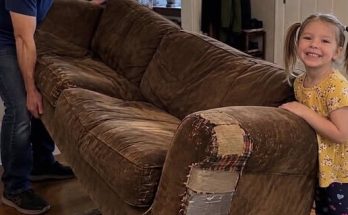
The thing was brown.
Not a pleasant brown, either.
It had the tired, faded color of furniture that had seen too many afternoons and too many spilled drinks.
The middle cushion had sunk so far that sitting down felt like lowering yourself into a hole.
One arm had three separate repairs.
Arthur had done every one himself.
He had patched the fabric, strengthened the frame, and done whatever else he thought might give it another few years.
A few years became twenty.
I couldn't understand his attachment to it.
We had the money to replace it.
We had talked about replacing it.
I had even pointed out perfectly good couches when we were shopping for other things.
Arthur always managed to change the subject.
"That one looks comfortable," I would say.
He would examine it as if he were considering a serious investment.
"Doesn't look very sturdy."
"Arthur, ours is falling apart."
"Still holding us, isn't it?"
"Only because neither of us can get back up."
That always amused him.
He found the couch funny.
I found it embarrassing.
Whenever someone visited, I warned them about the middle cushion.
Whenever I tried to stand, I had to lean forward, push against the arm, and sometimes rock myself into motion.
Arthur said it was good exercise.
I told him he could exercise on his own.
He would laugh.
Then he would pat the cushion beside him.
"Come sit over here, Mon."
"I'll disappear into that thing."
"Then I'll have to pull you out."
I always sat down.
That was the part I didn't like admitting.
I complained, but I sat.
I would settle beside him while he watched television, and before long his arm would rest around my shoulders.
The middle of the couch tilted us toward each other.
He considered that one of its advantages.
I considered it poor furniture design.
Neither of us ever won the argument.
Arthur was like that about almost everything.
He repaired instead of replacing.
A loose handle.
A stubborn drawer.
A lamp that stopped working.
He would sit with whatever had broken and examine it until he understood what needed fixing.
Sometimes I thought he enjoyed the repair more than the object itself.
He believed that a damaged thing could still have a useful life.
I wasn't always so patient.
I liked things that worked without a struggle.
I liked chairs that supported you.
I liked drawers that opened on the first pull.
And I liked the idea that a living room could change without it becoming a family debate.
But Arthur would grin at me from that dreadful couch.
And I would lose my determination.
For twenty years, that was how it went.
Then Arthur died.
Nothing about the couch changed.
The middle still sagged.
The repaired arm still looked terrible.
The cushions still pulled you toward the center.
But I stopped complaining.
I stopped noticing the discomfort.
Instead, I started sleeping there.
The first night, I told myself it was because I couldn't settle upstairs.
I had gone into our bedroom and looked at the empty space beside my pillow.
His side of the bed was untouched.
His things were still where he had left them.
I stood there longer than I care to remember.
Then I carried a blanket downstairs.
Arthur's blanket.
I lay on the couch where he usually sat and turned on the television.
I didn't watch much.
I just listened.
The sound filled the room enough that the silence didn't seem quite so large.
At some point, I fell asleep.
The following night, I did the same thing.
And the next.
Soon, the bedroom became somewhere I went to change clothes.
The living room became where I spent my nights.
Sometimes I woke with the remote pressed against my back.
Sometimes my neck hurt.
Sometimes I found myself reaching across the cushion before I was fully awake.
There was never anyone there.
I knew that.
Of course I knew that.
But the blanket still smelled familiar, and the couch still held the shape of all those evenings together.
It was enough to make sleep possible.
Our daughter Aurora noticed before I was willing to admit there was a problem.
She was twenty-nine.
She had Arthur's way of making a serious point without sounding serious at first.
She also had my habit of refusing to leave a difficult conversation unfinished.
That combination could be exhausting.
I loved her for it.
One afternoon, she found me sitting on the couch with the blanket folded beside me.
She looked at the cushions.
Then she looked at me.
"You're still sleeping down here?"
"I sleep better here."
"Mom."
"What?"
"You spent years threatening to throw this thing away."
"People can change their minds."
She pressed a hand into the middle cushion.
It sank.
"Apparently the couch hasn't changed its mind about collapsing."
I almost smiled.
Almost.
Aurora sat beside me.
The cushion pulled her toward the middle, just as it always had.
She noticed.
"Good grief."
"Now you understand."
"I understood when I was little."
She shifted the blanket away from her leg.
Then her voice changed.
"Mom, you can't keep doing this every night."
I looked at the television.
"I'm fine."
She didn't argue immediately.
That was something she'd learned from her father.
She waited until I had nowhere else to put my attention.
"Dad wouldn't like knowing you're sleeping with that remote stuck under you."
I let out a laugh.
It surprised me.
For a second, I could hear Arthur saying almost the same thing.
Aurora smiled, but only briefly.
Then she took my hand.
"You don't have to leave everything the way he left it."
I looked around the room.
His chair was empty.
His blanket was beside me.
The couch was still there.
I had made myself believe that keeping those things untouched was another way of keeping him close.
Aurora wasn't asking me to stop loving him.
I knew that.
She was asking me to live in the house again.
Not just occupy the part where he had spent his evenings.
I looked at her hand around mine.
She didn't squeeze.
She didn't tell me what to do next.
She waited.
And I realized I had been waiting too.
Waiting for something to feel less wrong.
Waiting for the bedroom to stop looking empty.
Waiting for a reason to move forward that wouldn't feel like leaving Arthur behind.
I had no idea how to do that.
But I could start with a couch.
That evening, after Aurora left, I took a photograph of it.
The brown fabric looked worse on the screen than it did in person.
The sagging middle was impossible to hide.
I almost laughed at the thought of anyone wanting it.
Then I wrote a short advertisement.
Used brown couch.
Forty dollars.
I looked at the price.
It seemed reasonable for something so old.
Then it seemed ridiculous to put a price on the place where I had spent so much of my marriage.
I hovered over the listing.
I nearly canceled it.
Three times, I went back and considered removing it altogether.
Each time, I pictured Arthur sitting there.
I could almost hear him protesting.
"There's life left in that thing, Mon."
And there was.
Just not the life I had been trying to hold on to.
I left the advertisement up.
The following afternoon, someone came to buy it.
His name was Josh.
He brought a friend named Liam to help him move it.
And he brought his little girl.
Emma.
She didn't inspect the stains or the repairs.
She didn't seem to care that the cushions were tired.
She climbed onto the couch as though it were the nicest piece of furniture she had ever seen.
Then she stretched her arms along the cushions.
"Daddy, we can sit here together!"
Josh smiled at her.
I watched them both.
He was polite and careful, the sort of man who seemed concerned about taking up too much of someone else's time.
He explained that he had recently gone through a divorce.
He was furnishing an apartment for himself and Emma.
They didn't have much furniture yet.
He told me they had been sitting on the floor to watch cartoons.
Emma looked at the television.
Then she looked at the couch.
I knew exactly what she was imagining.
A soft place beside her father.
Somewhere they could settle together.
Somewhere ordinary evenings might begin to feel normal.
I had spent twenty years seeing everything wrong with that sofa.
She had needed only a few seconds to see what it could give her.
Josh counted out forty dollars.
I accepted the bills.
Then I looked at Emma.
She was still sitting proudly in the middle.
I took twenty dollars and handed them back.
"Keep this."
Josh frowned.
"Are you sure?"
"Get her a little treat."
He looked toward his daughter.
Then back at me.
"That's very kind."
I shook my head.
It wasn't kindness that made me do it.
Not entirely.
I wanted that couch to become something happy again.
I wanted Emma to have the same ordinary evenings I had once taken for granted.
Liam and Josh carried it toward the door.
For one foolish second, I wanted to tell them to put it down.
I wanted to say I had changed my mind.
That it belonged here.
That Arthur would come looking for it.
But I said nothing.
Emma followed them outside.
I stood at the door as they loaded the couch.
Then I watched it disappear down the street.
The living room looked strangely large afterward.
There was an empty space where the brown couch had stood.
I could see more of the floor.
I could see the wall behind it.
It looked like the room belonged to someone else.
I stood there with the twenty dollars Josh had paid me.
Just twenty dollars.
That was what remained in my hand.
I folded the money and put it away.
Then I went upstairs.
That night, I slept in our bedroom.
Not easily.
Not peacefully.
But I stayed there until morning.
I thought I had finally said goodbye to Arthur's couch.
The next day, Josh knocked on my door.
And brought part of it back.
Not the cushions.
Not the frame.
Something Arthur had hidden inside.
Click here to continue reading: PART 2: The Young Father Found a Hand-Sewn Opening Beneath Our Couch, and the Package He Carried Had My Name Written Across It
I Sold the Couch My Husband Refused to Replace, Never Imagining a Stranger Would Bring Something Back the Very Next Morning
Part 1 of 12