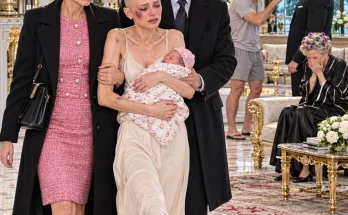
I used to believe that nine years of marriage meant something when life became difficult.
I believed that if I ever fell apart, my husband would be the person holding me together.
I was wrong.
The day I learned I had breast cancer, my daughter was sleeping against my arm.
Charlotte was six weeks old.
I was forty-three.
It had taken nearly ten years for me to become a mother, and I still sometimes woke up surprised to find a baby sleeping beside our bed.
I had wanted her for so long.
There had been years when I wondered whether motherhood would ever happen for me.
Then Charlotte arrived.
For six weeks, I had been exhausted, happy, frightened, and completely in love with someone who weighed only a few pounds.
I thought the hardest part was behind me.
Then I found myself sitting across from Dr. Aris, listening to words that seemed to belong to somebody else's life.
Breast cancer.
He spoke carefully.
There would need to be an operation.
Chemotherapy would follow.
Treatment would take months, and there were things we could not know until more testing and medical decisions had been completed.
I watched his mouth move.
I heard everything.
Somehow, I understood almost nothing.
Charlotte made a small sound in her sleep.
I looked down at her face.
Her eyes were closed, and one tiny hand rested against the fabric of my blouse.
I remember thinking that she had no idea what was happening.
She didn't know what cancer meant.
She didn't know that her mother was sitting in a doctor's office wondering how many birthdays she would live to see.
That thought frightened me more than the operation.
More than chemotherapy.
More than anything Dr. Aris had explained.
Daniel sat in the chair beside me.
We had been married for nine years, and I knew the way he behaved when something upset him.
Sometimes he became quiet.
Sometimes he asked too many questions.
I waited for him to reach for my hand.
He didn't.
Instead, he shifted forward in his chair and asked Dr. Aris about the price of treatment.
At first, I thought I had misunderstood him.
Dr. Aris explained that the hospital could help us examine insurance benefits and expected expenses.
Daniel listened, then asked another question.
"Is she going to be able to keep working?"
I turned toward him.
He continued before I could answer.
"We depend on both incomes. We can't just lose hers."
The room suddenly felt smaller.
I had just been told that I needed treatment for a serious disease, and my husband was discussing my paycheck.
I wanted him to ask whether I was going to survive.
I wanted him to ask what he could do to help.
I even wanted him to look frightened.
Instead, he looked annoyed.
I reminded him that we were still learning what treatment would involve.
He glanced at me.
Then he returned his attention to the doctor.
I sat there holding Charlotte and feeling embarrassed about something I had not chosen.
That is difficult to explain.
I hadn't done anything wrong.
I hadn't caused my illness.
Yet somehow, Daniel's questions made me feel as though I had created an expensive problem for our family.
I told myself he was overwhelmed.
People responded badly to frightening news.
Maybe he needed time.
Maybe he was trying to understand the practical consequences because he couldn't bear thinking about the medical ones.
I wanted that explanation to be true.
During the drive back to our home in Dublin, Ohio, Daniel said very little.
Charlotte slept in her car seat.
I watched houses and stores pass outside my window.
At one point, I asked whether he thought we should tell his mother.
He said we would discuss everything later.
That was all.
I spent the evening trying to behave normally.
Charlotte needed feeding.
There were bottles to wash.
Baby clothes waited in the laundry basket.
The ordinary work of caring for a newborn continued, even though my life had changed completely.
I stood beside her crib longer than usual that night.
I watched her breathing.
Then I went into our bedroom and found Daniel looking through paperwork.
I wanted to ask him to hold me.
Instead, I asked whether he was coming to bed.
"Not yet," he said.
I didn't know then that he had already begun making decisions without me.
Two days passed.
I was still trying to understand my diagnosis when Evelyn Carter arrived at our house.
Evelyn was Daniel's mother.
She was sixty-nine, always carefully dressed, and very particular about how other people lived.
She had never made much effort to hide her opinion of me.
During my pregnancy, she had repeatedly reminded me that forty-three was an unusual age to have a first child.
She questioned what I ate.
She questioned the things we bought for the nursery.
She questioned whether I would have enough energy to raise a baby.
If Charlotte cried while Evelyn was visiting, Evelyn often behaved as though the sound proved I was doing something incorrectly.
I had learned to smile and ignore her.
Looking back, I regret how often I confused keeping the peace with allowing someone to mistreat me.
That afternoon, Evelyn came into the nursery wearing an expensive outfit and carrying herself as though she had arrived to inspect something.
She looked at Charlotte first.
Then she looked at me.
"Your family knows about the cancer?"
I told her they did.
My parents had been worried from the moment I called them.
My mother had already offered to come help with Charlotte while I attended appointments.
My father had asked what the doctors needed us to do next.
They hadn't mentioned money.
They hadn't asked whether I would be able to work.
Evelyn gave a small nod when I told her they knew.
"That makes things easier."
I looked at her.
"What does?"
She took out her phone.
I watched her find my mother's number.
I had no idea why she needed to call Margaret when I was standing directly in front of her.
Then she placed the call on speaker.
My mother answered after a few rings.
"Hello, Evelyn."
Evelyn didn't ask how she was.
She didn't ask whether my mother had been sleeping or worrying about my diagnosis.
She went straight to the reason she had called.
"Margaret, you and Robert need to come take Rebecca home. Daniel can't be expected to spend his life supporting a sick woman."
I stood completely still.
For a moment, I wondered whether my exhaustion had made me hear something incorrectly.
But Evelyn continued.
She said Daniel had a new baby to consider.
She said I could no longer contribute the way a wife was supposed to.
She spoke about my illness as though I were a damaged appliance that had become too expensive to repair.
Then she said something I would remember for the rest of my life.
"Your daughter isn't useful to this household anymore."
I felt the blood leave my face.
There was a short silence from the phone.
My mother finally spoke.
"Evelyn, I want to be certain I understood you."
Evelyn repeated her demand.
She wanted my parents to collect me.
She wanted me out of Daniel's home.
And she wanted it done quickly.
My mother didn't raise her voice.
"Where is Daniel?"
Evelyn looked toward the dining room.
"He's right here."
I turned.
Daniel appeared in the doorway carrying a thick folder.
I recognized the way he held it.
He had already arranged the papers inside.
He had prepared for this conversation.
He walked to the coffee table and put the folder down.
For a second, nobody spoke.
Then I saw the heading on the first document.
Divorce Petition.
I looked at my husband.
"You're divorcing me?"
He kept his eyes on the papers.
I asked again.
"Daniel, is this really what you're doing?"
He finally looked up.
He said he had spent two days thinking about our situation.
He said medical bills could destroy years of financial work.
He said he wasn't willing to lose everything because treatment might or might not succeed.
I listened.
I wanted him to stop.
I wanted him to say he had panicked and made a terrible mistake.
But his expression remained hard.
"We have a baby now," he said. "I have to think about the future."
I stared at him.
"What about mine?"
He didn't answer.
I reminded him that we were married.
That we had promised to stay together when life became difficult.
That I hadn't even started treatment.
Daniel rubbed his forehead.
"Rebecca, I can't spend the rest of my life paying for something that might not work."
Something inside me went quiet.
Not because I was no longer afraid.
I was more frightened than I had ever been.
But I finally understood that my husband wasn't planning to stand beside me.
He was planning to leave before my illness became inconvenient.
Evelyn looked pleased.
She said Daniel was finally making responsible decisions.
I could feel tears on my cheeks.
I hated that they were watching me cry.
Then Charlotte started crying in her crib.
I crossed the nursery and lifted her.
She pressed her face against me, searching for comfort the way she always did.
I held her close.
I looked back at Daniel.
"What happens to Charlotte?"
He folded his arms.
"She'll stay here."
I couldn't speak for a moment.
He continued.
His mother would move into the house.
She would help with the baby.
He would keep working.
Everything would remain stable for Charlotte.
Except her mother would be gone.
I looked at Evelyn.
She stood beside Daniel without a trace of embarrassment.
"You need to accept what your condition means," she told me.
I held Charlotte tighter.
I had spent six weeks learning the smallest details about my daughter's life.
How she moved her head when she was hungry.
How she settled when I held her against my shoulder.
How she sometimes made a little sound just before falling asleep.
And these two people were discussing her as though she were another household possession.
I looked at Daniel.
"Charlotte is coming with me."
He gave me a thin smile.
He said a court would decide whether someone receiving chemotherapy was capable of raising a baby.
I felt frightened again.
Not of the cancer this time.
Of him.
Of what he was willing to do.
Then my mother's voice came through the phone.
"Rebecca, listen carefully. Don't put your signature on those papers."
I looked toward the coffee table.
The folder was still there.
My mother continued.
"Your father and I are on our way."
Evelyn ended the call.
She acted as though nothing important had happened.
Within minutes, she was opening kitchen drawers and discussing where she would keep her belongings.
I sat in the nursery with Charlotte in my arms.
The divorce papers remained on the table.
And for the first time that afternoon, I stopped trying to persuade Daniel to love me.
I had something more important to protect.
My daughter.
Click here to continue reading: PART 2: My Mother-in-Law Thought She Had Taken My Home and Baby, Until My Father Arrived With Two Attorneys and Asked One Question
I Thought My Husband Would Help Me Fight Cancer, Until His First Question Revealed What He Was Really Afraid Of
Part 1 of 15