Chapter 1: The Chrome Under the Sink
For five unbroken years of our marriage, my husband sanitized our upstairs bathroom three times every single day. He spent exactly forty minutes on each session, kneeling on the white linoleum with a heavy bristle brush and a jug of industrial disinfectant, scouring the grout until the room carried the eye-stinging stench of chlorine. Nobody found it sinister. My mother thought it was eccentric; my sister remarked in family group chats that I had married the cleanest man in Northern Ohio. It was an affectionate domestic joke—until the evening Dosha Ryall, a veteran forensic pathologist at the Lucas County Coroner’s Office, stepped inside to wash her hands and re-emerged with the face of a woman who had seen an open grave.
Dosha and I had been inseparable since 1993, when we both flunked out of a grueling associate nursing program. She went on to finish medical school and spend twelve years examining tissue samples and crime scenes; I took a degree in library science and spent my days organizing the branch on Sylvania Avenue. Because my health had been failing since 2021, I rarely hosted guests. Entertaining required standing upright, and standing upright had become an agonizing chore. But that Thursday in February, I had managed to bake a modest chicken casserole, and Dosha had driven over to share an early dinner.
My husband, Ubaldo Gingerich, was at the kitchen sink, quietly drying a set of ceramic plates. He was a man of muted tones—a quality control technician who worked across the Maumee River in Northwood, steady-handed, soft-spoken, and utterly devoid of temper.
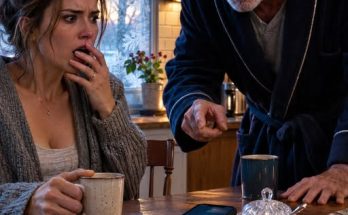
Dosha had excused herself to the hallway restroom before we dished up the plates. When she walked back into the kitchen, she did not have her purse. That was the tiny, jarring detail that struck me first: she had taken her bag down the hall with her, but her hands were now completely empty.
Her gaze fixed on me, skipping over Ubaldo entirely. Her skin was ashen, drained of all color, and when she grabbed my wrist, her fingers were shockingly cold. Dosha naturally ran hot—she was the kind of person who cracked car windows in January.
“Get your coat,” she whispered, her voice tight and razor-thin. “Get out of the house. Right now.”
I blinked, confused by the sudden theater of it. “Dosha, what are you talking about? The chicken is—”
“Do not ask questions, Maricella. Walk out the door. Now.”
Her grip was iron. She pulled me toward the foyer with an urgency that paralyzed my ability to protest. As we crossed the threshold, I looked back over my shoulder. Ubaldo remained standing beside the double basin, a yellow dish towel loosely looped through his fingers. He did not ask where we were going. He did not drop the towel or raise his voice. He simply watched us vanish into the freezing Ohio twilight with an impassive, unblinking calm that would haunt me for years to come.
I was in my stocking feet. The frozen gravel of the driveway bit into the soles of my wool socks before Dosha shoved me into the passenger seat of her sedan, slammed the door, and engaged the locks with a sharp mechanical thud. She backed out onto Sylvania Avenue so fast the tires skidded on the black ice.
For eleven minutes, neither of us spoke. The sedan’s defroster roared against the windshield, filling the cabin with dry, suffocating heat. Every time I opened my mouth to plead for an explanation, Dosha simply gripped the steering wheel at ten-and-two and muttered, “Wait. Just wait until we’re clear.”
She pulled into the far corner of a Denny’s parking lot off Reynolds Road, parking under the sodium-vapor security lamps with the nose of her car pointed toward the exit. She killed the engine. The silence inside the vehicle was deafening.
“I need you to listen to me without interrupting for four minutes,” Dosha said, turning her torso toward me. Her voice shook, an unnatural tremor for a woman who autopsied accident victims for a living. “Your bathroom. The plumbing under that sink.”
“What about it?” I asked, trembling from a mixture of cold and creeping terror. “The pipe leaked last summer. He fixed it.”
“Maricella, the P-trap beneath that basin is brand-new, polished chrome. The plumber’s compound on the slip nuts is fresh, and the manufacturing stamp on the collar is from this year. But the shut-off valves directly above it are twenty years old, corroded, and green with copper oxidation.”
“He likes to keep things working,” I stammered, pulling my cardigan tightly across my chest. “He’s particular about maintenance.”
“Nothing else in that house has been maintained!” she snapped, her knuckles whitening against the dashboard. “The faucet in your kitchen has had a rhythmic drip for eighteen months. The hallway baseboards are scuffed to the drywall. The storm door sticks. Yet that bathroom is maintained like an operating theater. It is scrubbed three times a day, stripped of every particle of biological matter, and the drainage system has been systematically replaced.”
“Dosha, you’re not making any sense. He’s just obsessive about cleanliness.”
“I have seen that exact behavioral signature once before in my entire professional career,” she said, leaning closer, her dark eyes pinning me to the headrest. “In 2019, I testified in an exhumation case in East Toledo. An eighty-one-year-old pensioner whose daughter had spent four years taking care of him. The whole house was piled high with trash, rotten food, and neglected laundry—except for the ground-floor bathroom, which looked like an architectural showroom. She was washing away heavy metal residue. She was boiling away the evidence of chronic systemic ingestion.”
My heart hammered violently against my ribs. “What are you saying?”
“I am saying,” Dosha breathed, her eyes welling with an agonizing sorrow, “that your husband is not cleaning to protect you from germs, Maricella. He is cleaning to destroy a crime scene—and if you ever step back into that house, you will not live to see your forty-first birthday.”
Chapter 2: The Architecture of an Unseen Sickness
To understand why I didn’t immediately believe her, you have to understand who I was, and who my husband had always seemed to be.
I was thirty-nine years old. For nearly a decade, I had served as the branch manager for the neighborhood public library. My mind worked in catalog numbers, shelving taxonomies, and grant schedules. I was a practical Midwestern woman whose idea of high drama was a dispute over the branch’s curbside parking spaces or a tear in the binding of a rare local history ledger. Before 2021, I was vibrant. I ran a half-marathon in 2017—slowly, clumsily, finishing in two hours and eleven minutes, but I crossed that finish line on my own two legs.
Ubaldo was forty-three. We had married in 2015 at a quiet civic ceremony. He was never romantic in the cinematic sense, but he was extraordinarily reliable. If my car’s alternator failed, he spent his Saturday rebuilding it on a tarp in the garage. If my mother’s clothes dryer began to squeal, he arrived with his toolbox before Sunday dinner. In eleven years of cohabitation, he had never once raised his voice at me.
The illness had not arrived like a lightning strike; it crept into my life like a slow leak in an attic roof.
It started in April of 2021, during an outdoor wedding reception in Perrysburg. I was standing in the grass waiting for the photographer to arrange the bridal party when an intense, suffocating heat flared across the bottom of my feet. It was not the ordinary ache of high-heeled shoes. It was a searing, chemical heat—as if I were standing barefoot on a sheet of tin baking in the desert sun.
By July, my thick auburn hair began shedding in handfuls. It didn’t fall out in dramatic patches, but in a steady, dispiriting drift that choked the shower drain and coated my pillowcase each morning. Then came the gastrointestinal turmoil: sudden bouts of violent nausea, followed by months where food lost its essential flavor. Salt tasted like dry chalk; citrus tasted like aluminum foil. Finally, the fatigue settled into my bones—a heavy, leaden exhaustion that made lifting a box of paperbacks feel like hauling wet cement.
Over four agonizing years, I consulted three primary care physicians and two specialists. The first checked my blood count, discovered a mild vitamin D deficiency, and told me that women approaching forty often experienced stress-related somatization. The second diagnosed me with fibromyalgia and prescribed sleep aids that left me groggy but did nothing for the fire in my feet. The third, an earnest young neurologist, finally performed a punch biopsy on my ankle and confirmed small-fiber peripheral neuropathy of “idiopathic origin”—the clinical term for we know the nerve endings are dying, but we have no idea why.
That diagnosis had become my defensive armor. When patrons at the circulation desk asked why I sat on an ergonomic stool, I offered my practiced script: “Oh, it’s just fibromyalgia. Quite manageable.”
Manageable. It was the cowardly word I repeated hundreds of times to avoid the humiliation of being seen as fragile. And beneath that polished script lay a venomous, quiet self-doubt: What if the doctors are right? What if I am inventing this misery to excuse my own exhaustion?
That night in the Denny’s parking lot, Dosha drove me directly to the emergency department at Mercy St. Anne Hospital. It was nearly one in the morning by the time we reached an intake cubicle. Because Dosha was an officer of the county coroner, she understood the precise jurisdictional boundaries: she could not order tests for a living friend without facing professional disbarment and tainting potential evidence.
“Tell them your symptoms clearly,” she instructed outside the sliding doors. “Tell them you have burning neuropathy, unexplained alopecia, and that you have reason to suspect an environmental heavy metal exposure. Do not mention Ubaldo. If you walk in there claiming your quiet husband is poisoning your casseroles, they will admit you to psychiatric observation.”
The emergency physician on duty was an overworked attending in her late thirties. She listened attentively, nodded with professional sympathy, and ordered a standard blood toxicology screen. We sat in a curtained bay until four-twenty in the morning, listening to the sterile hum of the monitors and the distant cries of the pediatric ward.
When the physician finally returned, she carried a printout and a look of gentle condescension.
“The comprehensive heavy metals panel is entirely negative, Mrs. Gingerich,” she said, sitting on the edge of the wheeled stool. “Your lead, arsenic, mercury, and cadmium levels are well within the normal baseline.”
“Did you test for thallium?” I asked, my voice cracking from exhaustion. Dosha had whispered that word to me three times in the waiting room.
The doctor offered a faint, tired smile. “Thallium is an exotic send-out test. It isn’t part of an acute hospital screen. In the United States, confirmed cases of thallium exposure are virtually non-existent outside of industrial chemical incidents. Your clinical picture aligns closely with atypical neuropathy compounded by severe acute anxiety.”
She slipped a pamphlet across the bedside tray. It contained the twenty-four-hour helpline for county outpatient psychological services.
I stared at that glossy pamphlet under the fluorescent lights, feeling an overwhelming wave of shame. You fool, the inner voice mocked. You fled your own home in your socks because of a shiny pipe under a sink.
“You see?” I whispered to Dosha as the doctor left the room. “There’s nothing in my blood. I’m going home.”
Dosha grabbed my coat before I could slide off the gurney, her eyes burning with fierce resolution. “You are not going back to that house. If standard hospitals don’t look for thallium, we find someone who will.”
Chapter 3: The Calendar in the Keratin
For four days, I lived in my mother’s guest bedroom, wearing borrowed flannel pajamas that smelled of lavender and mothballs.
My husband sent eleven text messages over that period. I read every single one of them dozens of times, searching for a fracture in his composure, an admission of guilt, a flash of malice. There was none.
Did Dosha upset you? he texted on Friday morning. I know your health has been hard on your nerves lately. Don’t worry about the house. Rest as long as you need.
On Sunday, he sent a photograph of the newly tightened kitchen sink faucet: All fixed. No more drips. Come home when you’re ready, sweetheart.
It was the response of a devoted, long-suffering spouse handling a sick wife’s emotional breakdown. My own sister, Cresenzia, called me from Bowling Green to urge caution.
“Maricella, please don’t burn your life down over Dosha’s professional paranoia,” she pleaded over the line. “Forensic pathologists look at murder all day long; to a hammer, everything looks like a nail. Ubaldo takes care of you. Who cleans a house for a sick spouse like that?”
On Tuesday morning, Dosha arranged a secure telephone consultation with Dr. Ada Feist, a renowned clinical toxicologist at the University of Michigan Medical Center in Ann Arbor. Dr. Feist was sixty-one years old, a woman whose entire career had been dedicated to the subtle biological traces left by rare chemical agents.
For forty minutes, Dr. Feist interrogated me with surgical precision. She did not ask about my marriage, my emotional stability, or my marriage counseling history.
“When the sensation in your feet flares, does it worsen under hot water?” she asked.
“Yes. A hot shower feels like boiling grease on my ankles.”
“Have you experienced any changes in your night vision or your perception of primary colors?”
“Colors seem desaturated at dusk. Everything looks gray.”
“And your hair loss—did it occur in round patches like alopecia areata, or was it a diffuse shedding that spared the axillary and facial hair initially?”
“Diffuse. Like it was simply detaching from the scalp.”
There was a long, heavy pause on the Michigan end of the line. The rustle of paper came through the speaker.
“Mrs. Gingerich,” Dr. Feist said evenly, “I am going to explain the physiology of thallium sulfate. To the human body, a thallium ion is virtually indistinguishable from a potassium ion. The cellular pumps that regulate every nerve impulse, every muscle contraction, and every hair follicle uptake thallium readily, believing it to be potassium. But once thallium crosses that threshold, it binds irreversibly to mitochondrial enzymes. It starves the cell from within.”
A chill spread through my chest, cold and suffocating.
“Because the longest nerves in the body require the greatest metabolic support,” Dr. Feist continued, “the symptoms always manifest first at the furthest perimeter: the soles of the feet. It causes a painful, burning sensorimotor polyneuropathy. Next, it strikes rapid-turnover cells—the keratin matrix of the hair follicle. Finally, it attacks the autonomic nervous system and the retina.”
“Is it… can it be cured?” I choked out.
“It can be bound with an oral pigment called Prussian blue, but nerve damage of this duration is often permanent,” she said softly. “However, before we discuss therapy, we require forensic confirmation. Standard blood tests are useless; the half-life of thallium in circulating blood is less than three days. It deposits rapidly into bone, tissue, and hair. Human hair grows approximately one centimeter per month. As the shaft grows, it absorbs whatever chemical markers are present in the capillary bed. Your hair is thirty centimeters long, Mrs. Gingerich. It is a thirty-month calendar of your domestic environment.”
“I can cut a lock right now,” I said eagerly.
“Absolutely not,” Dr. Feist countered. “If you cut it yourself, any defense attorney will argue that you harvested it with contaminated scissors or stored it in a tainted vessel. The chain of custody must be pristine. We need a personal artifact—an object bearing your shed hair that has remained isolated from recent contamination, collected under lawful authority.”
That afternoon, I sat in the modest conference room of the Toledo Police Department’s Financial and Crimes Division. Across the metal table sat Detective Apollonia Schrock, an eighteen-year veteran with tired gray eyes and a reputation for resolving complex financial conspiracies.
“Here is my legal dilemma, Mrs. Gingerich,” Detective Schrock said frankly, spreading her hands over an empty manila folder. “I cannot obtain a search warrant for your home based on a plumbing fitting and an informal phone call with a Michigan academic. If I march up to a judge right now, he will laugh me out of chambers. We have no confirmed crime, no biological sample, and no physical evidence of an illicit substance.”
“Then what am I supposed to do?” I cried, my voice echoing off the cinderblock walls. “Wait until the nerve damage stops my heart?”
Detective Schrock leaned forward, her gaze leveling on mine with an intense, unvarnished gravity.
“You have lawful right of entry to that residence,” she said deliberately. “The hairbrush on your bedroom vanity is your personal property. And more importantly—if he is dosing you through food or drink, we need an active sample of whatever he serves you.”
I felt the blood leave my face. “You want me to go back.”
“I cannot order you to do it,” the detective replied. “As an officer of the law, I cannot place a civilian in known jeopardy. But if you want charges that will hold up before a grand jury, we need the vehicle of transmission. You go home. You behave normally. If he gives you something to consume, you feign taking it, you preserve the liquid, and you bring it to me.”
My breath caught in my throat. The thought of sleeping beneath the same roof as Ubaldo made my stomach heave. But the alternative—living the rest of my life as a discarded, doubting invalid while he walked free—was a fate far worse than death.
“I will do it,” I said.
Chapter 4: The Porcelain Trap
I pulled into our gravel driveway at four-fifteen on Wednesday afternoon.
Before the ignition had even stopped humming, the side door flew open. Ubaldo hurried down the steps without his jacket, his breath pluming in the winter air. When he reached the driver’s side, he opened the door and pulled me into an embrace so tight I could feel the plastic buttons of his flannel shirt pressing into my collarbone.
He began to weep. Genuine, warm tears tracked down his clean-shaven cheeks.
“I thought you were never coming back,” he whispered into my hair, his chest heaving with ragged sobs. “I thought you were letting your sickness convince you that our marriage was broken. Don’t ever leave like that again, Maricella. Please.”
It was the most terrifying ninety seconds of my existence. Held in his arms, feeling the steady thrum of his heartbeat, I questioned my own sanity all over again. How could a man who cried like a child in the winter cold be methodically destroying my body?
Inside, the house was immaculate. The kitchen smelled faintly of lemon oil and baked bread.
Detective Schrock’s operational rules were burned into my memory: Do not search his drawers. Do not touch his computer. Do not alter your routine by one millimeter. Accept whatever he gives you, but do not swallow a single drop.
Every evening since the summer of 2021, Ubaldo had observed an unvarying ritual. At precisely nine-fifteen, while I sat on the living room sofa with an electric blanket over my burning feet, he brewed a mug of hot peppermint tea. He always served it in a heavy blue stoneware mug that retained heat for hours.
At nine-twenty, the kettle whistled. Ubaldo brought the steaming mug into the living room, setting it on a wooden coaster beside me.
“Drink it while it’s hot, honey,” he said gently, brushing a strand of loose hair from my forehead. “It helps with the stomach spasms.”
“Thank you, sweetie,” I managed to say, forcing my trembling lips into a grateful smile.
I lifted the mug to my mouth, letting the steam bathe my face. The sharp scent of menthol dominated, but beneath it—or perhaps it was only the trick of a terrified imagination—there was an underlying, metallic flatness, like the smell of wet pennies. I rested the rim against my lower lip, tilted the ceramic, and allowed a minuscule bead of the hot liquid to touch my tongue. I immediately pressed my tongue against the roof of my mouth, swallowing nothing, before lowering the vessel back to the coaster.
At ten o’clock sharp, Ubaldo stood up and smoothed down his trousers.
“Time to get the upstairs ready for tomorrow,” he remarked cheerfully.
He walked down the hall, entered the bathroom, and clicked the door shut behind him. Seconds later, the high-pitched whine of running water echoed through the floorboards, followed by the steady, rhythmic scritch-scratch of a nylon bristle brush against ceramic tile.
I had forty minutes.
Working with frantic, silent efficiency, I reached between the cushions of the armchair and retrieved a vacuum-sealed, stainless-steel travel thermos I had smuggled inside my library tote that afternoon. I popped the silicone seal. My hands shook so violently that the blue mug clattered against the stainless rim, a sharp metallic click that sounded to my ears like a gunshot.
I paused, freezing in place. Upstairs, the scrubbing continued unabated.
I poured three-quarters of the tea into the thermos, twisted the insulated cap down until it locked, and buried the cylinder deep into the crevice beneath the couch cushions. Then, I sat back on the sofa, resting the nearly empty blue mug in my lap, staring at the television screen without comprehending a single image.
For four consecutive nights, I performed that waking nightmare.
The third night was the most harrowing. Ubaldo did not immediately retreat to his cleaning. Instead, he sat on the opposite end of the couch, watching me with quiet, unblinking focus.
“You haven’t touched your tea, Maricella,” he observed softly. His voice remained perfectly level, but his eyes were narrowed, tracking the level of the steam rising from the blue mug. “Is it too sweet?”
My throat constricted until I could barely draw air. A cold sweat broke across the nape of my neck.
“It was just a little too hot,” I lied, my voice wavering. “I was letting it cool down.”
He rose from the cushion, walked over, and sat directly on the armrest above me. He reached down and laid his hand over mine, his fingers warm and dry against my cold, clammy skin.
“Take a sip,” he murmured, his face inches from mine. “You need the fluids. Your skin looks so dry lately.”
I knew, with absolute, terrifying clarity, that if I hesitated, the game was over.
I raised the mug with two hands to conceal the shaking. I tilted it back, took a mouthful of the scalding liquid, and held it in the pocket of my cheek. I looked directly into my husband’s eyes, closed my throat, and bobbed my larynx in a theatrical simulation of a swallow.
“There,” I whispered, coughing slightly to sell the performance. “Delicious.”
Ubaldo stared at me for three long, agonizing heartbeats. Then, the tension vanished from his jaw. He patted my shoulder with familiar domestic affection.
“Good girl,” he said, checking his wristwatch. “I’ll go finish the tub.”
The moment the bathroom door clicked shut and the water began to gush, I lunged toward the kitchen, spat the mouthful of tea into a paper towel, wrapped it in foil, and shoved it into the pocket of my cardigan. My heart was pounding so hard I could hear the blood roaring in my ears.
The next morning, under the gray dawn sky of an Ohio February, I pulled into the parking lot of the Kroger supermarket on Alexis Road. I climbed out of my car, walked to an unmarked dark sedan parked near the bottle return, and handed Detective Schrock a brown paper grocery sack containing four nights of tea samples, the foil-wrapped paper towel, and the wooden-handled boars-hair brush I had carried out of my home in my work satchel.
Schrock took the bag, her face grim. “Go stay at your mother’s, Maricella. Do not go back to that house. Not for clothes, not for medication, not for anything.”
“Did we get it?” I asked, my voice cracking in the freezing wind.
“If it’s in there,” she replied, “we’ve got him.”
Chapter 5: The Geography of Greed
The laboratory analysis took eleven long, excruciating days.
During that interval, I returned to my post at the library. Work was the only tether keeping me anchored to reality. I cataloged incoming fiction shipments, approved timecards, and managed the registration for the annual children’s summer reading initiative. My assistant manager, Tarcilla Ripka, noticed the new tremor in my hands and quietly took over the physical shelving, never asking why my eyes were red or why a strange gray sedan was occasionally parked across the avenue.
On a bleak Thursday afternoon in early March, Detective Schrock telephoned my office extension.
“I need you to come down to the downtown precinct, Maricella,” she said without preamble. “The State Highway Patrol crime lab in Bowling Green just released their preliminary findings.”
When I entered the interrogation observation room twenty minutes later, the detective did not offer a seat. She gestured toward a set of glossy black-and-white charts pinned to the corkboard on the wall. They looked like seismic readouts—jagged, mountain-like graphs with distinct vertical spikes.
“The tea you recovered was laced with dissolved thallium sulfate,” Detective Schrock stated, her voice flat, clinical, and devastating. “Each serving contained an estimated eighty to one hundred milligrams. Not enough to kill an adult immediately, but more than enough to maintain a state of profound, degenerative physical collapse.”
I reached out, bracing myself against the edge of the conference table as the room seemed to tilt.
“And your hair,” Schrock continued, pointing a ballpoint pen at the seismic peaks on the corkboard. “Dr. Feist’s colleagues completed a segmental laser-ablation analysis. Your hair shaft was dissected into two-millimeter segments. Across sixty months of biological growth, there are eleven distinct, elevated bands of thallium deposition.”
I stared at the paper. Eleven sharp mountain peaks, separated by smooth, low plateaus.
“This was not an occupational accident,” Schrock said. “An industrial exposure produces an unbroken plateau of toxicity. Eleven peaks mean eleven distinct, premeditated administration cycles. He poisoned you in three-to-five-week waves, backed off, waited for your symptoms to stabilize, and then administered another series.”
The horror took the air straight from my lungs. The plateaus—the flat valleys between those eleven peaks—were the months I had felt slightly better. The month in October 2022 when I managed to walk two miles along the river trail. The weeks when I had cried with gratitude because I thought my body was healing, while he stood behind me on the tailgate of his truck, resting his gentle hand against the back of my neck.
He had scheduled my suffering. He had decided when I could walk, and when I would crawl.
“Where did he get it?” I choked out, tears finally burning my eyes. “Thallium was banned from consumer rodenticides fifty years ago.”
“He didn’t buy it on the street,” Detective Schrock replied, pulling a separate sheaf of corporate documents from a red folder. “He took it from work. His employer, Advanced Optical Technologies in Northwood, manufactures infrared military guidance lenses and ultra-dense chalcogenide glass. High-purity thallium compounds are an essential dopant in that fabrication process.”
She turned the page, revealing a spreadsheet stamped with corporate inventory seals.
“I contacted their corporate safety director on Tuesday morning. When an industrial facility discovers a heavy metal deficit, they don’t wait for a grand jury subpoena; they cooperate immediately to avoid federal environmental sanctions. Over the past five years, Ubaldo was responsible for quarterly quality audits. Across eleven separate inventory cycles, approximately forty-one grams of thallium sulfate disappeared from the secondary vault.”
“Forty-one grams?”
“Never more than three to six grams per quarter,” Schrock explained. “He understood the facility’s balance-calibration tolerances. He scraped off just enough to stay within the accepted statistical margin of measurement error. To the accounting department, it looked like standard evaporation and handling loss. He used his professional training as a quality inspector to turn himself into an untraceable domestic phantom.”
“Why?” The question was a ragged scream that tore out of my throat. “We weren’t wealthy! We lived in a modest split-level on a librarian’s salary and a technician’s wage! What could he possibly gain from destroying me?”
Detective Schrock looked at me with an expression of profound, weary pity. She pushed a final document across the laminate tabletop. It was a certified decree from the Lucas County Court of Common Pleas, dated October 14, 2019.
“Did you ever authorize a transaction with a financial restructuring firm called Buckeye Settlement Liquidation LLC?” she asked.
“No,” I whispered. “I’ve never heard of them.”
“In 1996, when you were nine years old, you suffered severe orthopedic injuries in a municipal pool collapse,” the detective laid out the history methodically. “Your parents negotiated a structured settlement annuity. That annuity pays you $3,100 per month for life, with an automatic cost-of-living adjustment. It also carries a commuted death benefit: if you die before age sixty-five, the remaining present value of the underlying trust transfers to your primary beneficiary as a lump-sum distribution.”
I nodded slowly. “I named Ubaldo as my beneficiary right after we bought our home in 2015. Every married couple does that.”
“Yes,” Schrock said grimly. “And under Ohio domestic relations law, a structured settlement arising from a childhood personal injury is classified as separate, non-marital property. If Ubaldo had divorced you, he would have received zero percent of that monthly stream. The only event that could convert that monthly stipend into his personal windfall was your certified death from natural causes.”
“The 2019 court order,” I managed to say, my eyes scanning the forged legal jargon. “What is it?”
“In early 2019, your husband secretly lost nearly two hundred thousand dollars in an unregistered commercial storage investment scheme operated by an acquaintance from his fantasy sports league. He was facing personal bankruptcy. To cover the shortfall, he walked into a factoring brokerage, produced forged powers of attorney bearing your signature, and sold your monthly payments through the year 2031 in exchange for an immediate, discounted cash lump sum of $194,000.”
My mind spun in wild, sickening circles. “But… the money. The $3,100 has arrived in my checking account on the first of every month without interruption for seven years!”
“Because Ubaldo established an automated recurring electronic transfer from his personal credit union account to yours for that exact amount,” Schrock revealed, tapping the bank ledger with her knuckle. “He was running a domestic Ponzi scheme. He used the factored lump sum to cover his investment debts, and then paid you your own monthly allowance out of his paycheck to ensure you never logged into the annuity portal or examined a statement.”
She closed the file with a decisive snap.
“He could only sustain that shell game for so long, Maricella. His personal savings were running out. By 2021, the only way out of his financial trap was your commuted death benefit—a lump-sum payout of $410,000.”
Chapter 6: The Confession of an Automaton
The Toledo Police Department arrested Ubaldo Gingerich on Wednesday, March 26, at two-fifteen in the afternoon.
They did not take him in our quiet driveway. They apprehended him on the floor of the Northwood optical plant, in front of sixty coworkers, while he was wearing his white lint-free cleanroom jumpsuit and safety goggles.
Detective Schrock allowed me to read the full interrogation transcript weeks later, though I could only stomach watching four minutes of the synchronized video recording.
When Schrock placed the forged 2019 structured settlement petition on the metal desk before him, Ubaldo did not jump. He did not ask for a lawyer. He adjusted his wire-rimmed glasses, folded his hands neatly over the legal documents, and sat in absolute silence for nine uninterrupted minutes.
Finally, the detective leaned across the table.
“Did you think you were going to get away with this, Ubaldo? Did you think nobody would notice forty-one grams of poison missing from an optical lab?”
Ubaldo looked directly into the camera lens with the flat, uninflected gaze of a man discussing a malfunctioning lawnmower engine.
“I never woke up and decided to do it,” he said in a quiet, conversational tone. “I just never found the right time to stop.”
That was his entire defense.
He had not hated me. He had not operated out of wild, jealous passion or sadistic fury. He had simply viewed my slow, agonizing physical decline as an administrative necessity—a protracted technical problem to be managed with the same meticulous, emotionless precision he applied to calibrating optical refractive indices.
Dr. Feist later deduced the most chilling detail of all from the chronological timeline. The first elevated spike in my hair occurred during the last week of March 2021. But Ubaldo had begun his obsessive three-times-a-day bathroom scrubbing regimen in January of that same year—eight full weeks before the first dose of poison touched my lips.
He had researched the biological excretion pathways of heavy metals beforehand. He knew that thallium is expelled through sweat, urine, and hair follicles. He knew that the plumbing traps, the tile grout, and the shower tracks would accumulate forensic evidence over time. And so, like the trained quality control technician he was, he had built, tested, and rehearsed his sanitation protocol months in advance, embedding it into our domestic routine so thoroughly that by the time my nerves began to disintegrate, the cleaning seemed like an old, harmless habit.
Rather than face a jury trial where forty-one coworkers and three forensic toxicologists were prepared to testify, Ubaldo Gingerich entered a negotiated guilty plea to charges of attempted aggravated murder, felonious assault, and grand theft by deception.
On a freezing morning the following February, I stood at the podium in Courtroom 4B of the Lucas County Courthouse to deliver my victim impact statement.
I had written eleven drafts across six months. The final version contained exactly three hundred and eighty words. I had removed every word of sentimentality, every question of why, and every mention of the word love.
Ubaldo sat ten feet away at the defense table, wearing an orange county jumpsuit, his gaze lowered toward his fingernails. He never looked up. In the second row of the gallery, his elderly mother sat weeping quietly into a handkerchief, flanked by my sister, who still carried the guilty, haunted look of a woman who had spent months defending a monster.
“You took forty-one grams of metal to solve an arithmetic problem,” I read aloud, my voice steady, resonant, and clear in the wood-paneled quiet of the room. “You stole the nerves from my feet, you stole the hair from my head, and you stole twelve years of my memories. But you did not get the bathroom clean enough. The truth survived the bleach.”
The judge sentenced him to twenty-two years at the Mansfield Correctional Institution, without the possibility of parole until he reaches the age of sixty-five.
Epilogue: What the Grout Retained
In August, six months after the sentencing, I finally put the house on Sylvania Avenue up for sale.
I walked through the empty rooms one last time accompanied by a real estate agent named Claire, who carried a plastic clipboard and an air of cheerful efficiency. I used an ash-wood cane with a brass handle—a permanent concession to the small-fiber neuropathy that the doctors could halt, but never fully reverse.
Prussian blue therapy had flushed the thallium from my organs, but nerve tissue does not regenerate easily. I still have about eight bad days every month, days when my feet feel as though they are submerged in embers and my hands refuse to turn a door key. But I can walk. I can work. And I manage my library branch with a fierce, quiet joy that makes every returned book feel like a small victory.
Claire led me through the living room, past the corner where the couch had stood, and up the stairs. She stopped at the doorway of the upstairs bathroom, peeking inside with admiration.
“Oh, this room is magnificent, Maricella,” she said, running her hand along the sparkling white subway tile and the gleaming chrome fixtures. “It looks like it was installed yesterday. Honestly, in a neighborhood with homes this age, a bathroom in this condition will sell the house within forty-eight hours.”
“Yes,” I said, standing in the hallway, refusing to cross the threshold. “He was very proud of his work.”
The house sold four days later, for twelve thousand dollars above the asking price, to a young couple relocating from Cleveland. They never requested an environmental swab of the floorboards, and there was no legal requirement to disclose that an optical technician had used the drainage system to wash away five years of quiet homicide.
Every other Wednesday evening, Dosha Ryall and I meet for an early dinner at an Italian bistro near the university.
She has never once uttered the phrase I told you so. She took an enormous professional gamble that Thursday evening; if she had been mistaken about that chrome P-trap, her career as a county medical examiner would have been shredded by ethics panels, and our friendship would have ended in a haze of mutual resentment.
“I didn’t guess, Maricella,” she told me once, swirling the red wine in her glass. “People think forensic pathology is about brilliant hunches. It isn’t. It’s about pattern recognition. You see ten thousand rooms of human misery across twelve years, and one day you walk into a room where the shapes don’t fit the human narrative. A clean room in a dying house is an unnatural object. It demanded an explanation.”
Once a year, Dosha delivers a guest lecture to newly inducted criminal investigators at the Ohio Peace Officer Training Academy.
She projects a single high-resolution slide onto the lecture hall screen: a close-up photograph of a polished chrome P-trap nestled between two corroded, copper-green shut-off valves beneath a standard porcelain sink.
She lets the recruits sit in the darkened auditorium and stare at the plumbing for two full minutes.
“Look at the fittings,” she tells the quiet room. “Tell me what is wrong with this picture.”
She lets them guess about water pressure, pipe diameter, and installation codes. And then, without ever speaking my name or revealing the address, she tells them how an ordinary woman survived five years of poison because an arrogant man forgot that chrome does not age at the same speed as human flesh.
I still keep my half-marathon medal in the top drawer of my nightstand. Some mornings, when the burning in my soles makes the walk from the bed to the kitchen feel like an expedition, I take that bronze disc out and hold it in my palm.
I did not run fast in 2017, and I will never run again. But I am here. I am upright. And every breath I draw in this clean, imperfect world is a sentence my husband never planned for me to finish.
Like and share this post if you find it interesting.