I had spent years believing that the truth would eventually speak for itself.
Sitting beside Daphne at the hospital, I finally understood how wrong that belief could be.
The truth didn't always speak.
Sometimes it waited while louder people told their version of events.
Sometimes it sat quietly beside a frightened child.
And sometimes it needed someone willing to defend it.
I looked at my daughter.
Her seventh birthday had begun with hope.
She had woken up wondering whether her father had contacted us.
She had carried her stuffed rabbit and put on her pale pink dress.
She had helped arrange balloons in her grandparents' backyard.
Then Gideon's present arrived.
A silver necklace.
A blue sapphire.
A handwritten card from the father she loved.
I remembered how she had smiled when I fastened the chain.
That smile was what I wanted to keep.
Not Valerie's face.
Not the handbag.
Not my mother's voice from the porch.
But every time I tried to return to the happy part of the morning, the rest of it followed.
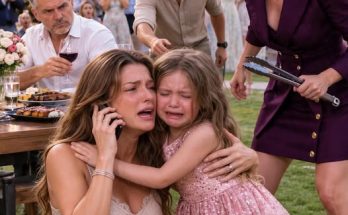
Weston reaching for the box.
Daphne holding on.
My sister grabbing her dress.
The necklace falling into the grass.
Then the blow.
I closed my eyes for a moment.
I could still hear Daphne crying.
I could still feel the grass beneath my knees.
The memory had become so sharp that I almost expected to open my eyes and find myself back beneath the oak tree.
But I wasn't there.
We were at the hospital.
And I had to keep my attention on the child beside me.
Daphne was quiet.
I had learned over the years that her silence didn't always mean she was comfortable.
Sometimes it meant she was thinking.
Sometimes it meant she was trying not to worry me.
That was something she had learned during Gideon's long absences.
She knew I missed him.
She knew I sometimes worked late.
And she seemed to believe that being easy to care for would somehow make everything better.
I loved her for her kindness.
But I hated the idea that she might feel responsible for making my life easier.
She was seven.
She should have been allowed to need things.
Comfort.
Attention.
Reassurance.
Even the freedom to cry without explaining herself.
I moved closer.
“You don't have to pretend you're all right for me.”
She looked at me.
Her eyes were tired.
“I know.”
I wasn't certain she did.
So I stayed beside her.
I didn't ask her to tell the story again.
I didn't ask whether she remembered every movement.
She had already explained enough.
I had seen the important parts myself.
And I didn't want her birthday to become something she had to describe over and over simply because the adults who hurt her might refuse responsibility.
I thought about the word responsibility.
It was a word I used often in my work.
When financial records didn't agree, I couldn't solve the problem by deciding which person I liked best.
I had to examine the facts.
Who had approved something?
Who had changed a figure?
Who had access to a record?
What actually happened?
I approached numbers carefully.
I didn't let someone else's confidence replace evidence.
Yet with my family, I had done almost the opposite.
I had accepted explanations because I wanted relationships to remain intact.
I had ignored patterns because acknowledging them would have required difficult decisions.
And I had allowed Valerie to treat my husband like a man who had deserted us.
Not because I believed her.
Because arguing had become exhausting.
I thought of all the times I had ended a conversation instead of correcting another insult.
All the times I had told myself Daphne didn't understand.
All the times I had decided that keeping the peace was worth a little discomfort.
A little discomfort.
I almost laughed at how inadequate those words sounded now.
There had been nothing little about what happened in the backyard.
My sister had struck a child.
My parents had defended her.
And I had carried my daughter away from her own birthday party.
That was the reality.
No carefully chosen explanation could make it smaller.
I looked at Daphne's dress.
The place where her necklace had rested was empty.
I knew the chain had broken.
I knew the pendant had fallen.
I couldn't say where every piece had ended up after we left.
I had been too concerned about getting Daphne away.
I hadn't stopped to collect the necklace.
I hadn't stopped to search for the card.
The gift box had been at the center of Weston's argument with Daphne.
And everything had happened too quickly afterward.
I remembered seeing the silver against the grass.
That was all I could say with certainty.
I wanted to have it back.
Not because it would undo the violence.
It wouldn't.
Not because I thought a repaired necklace could repair the family.
It couldn't.
I wanted it because Daphne had loved it.
Because Gideon had chosen it.
Because for a brief moment, that small blue stone had made the distance between father and daughter feel less important.
Then I remembered my father's request.
The camera.
He had asked me to turn on the backyard camera that morning.
I pictured the yard again.
The patio.
The oak tree.
The place where I had been arranging food.
The area where Daphne had been sitting with her stuffed animals.
For the first time since we reached the hospital, I tried to separate what I had seen from what I hoped the camera might have seen.
That distinction mattered.
I didn't know whether the camera faced the oak tree.
I didn't know whether its view was blocked.
I didn't know whether it had captured the children arguing.
I didn't know what happened to any recording after we left.
But I knew my father had made that request.
And I knew it was something I couldn't afford to dismiss.
If the camera had recorded the confrontation, there might be an account that didn't depend on anyone choosing words afterward.
A record of where Weston stood.
A record of what Valerie did.
Possibly even the moment Daphne fell.
I had no way to know yet.
Still, the possibility remained.
And I knew I needed to be careful not to confuse possibility with proof.
That was something I had learned from years of forensic accounting.
A promising clue was not a conclusion.
An assumption could lead someone away from the truth just as easily as an outright lie.
I reminded myself of that.
Then I looked at Daphne again.
She had not asked about the camera.
She had not asked whether anyone would believe her.
She had asked whether her father would know she loved his present.
That difference mattered.
While I was thinking about evidence, my daughter was thinking about love.
While I worried about what my relatives might claim, she worried about a necklace.
I felt ashamed of how easily the adults' behavior threatened to occupy every corner of my mind.
Daphne needed care now.
The other questions would remain.
I didn't have to solve them all at once.
I reached for her hand.
She took mine.
Her fingers were small and warm.
I remembered holding that same hand while helping her arrange the pink balloons.
Only a few hours separated those moments.
But the afternoon felt divided into two different lives.
Before Valerie raised the handbag.
After.
Before, I had believed I could manage the family's hostility.
After, I knew managing it wasn't enough.
I couldn't predict whether my mother would ever admit she was wrong.
I couldn't predict whether my father would regret ordering us away.
I couldn't predict whether Valerie would apologize.
But none of those uncertainties changed my responsibility.
I had to keep Daphne safe.
I had to take her injury seriously.
I had to tell Gideon what happened.
And I had to stop allowing my relatives to decide whether their behavior was harmful.
They had already demonstrated their judgment.
My mother had watched her granddaughter get hurt.
Then she defended it.
I thought about her standing on the porch.
The glass in her hand.
The distance between her and the grass.
She could have come down.
She could have asked whether Daphne was hurt.
She could have told Valerie to step away.
She did none of those things.
Instead, she offered a verdict.
Daphne deserved it.
I had heard that clearly.
I didn't need a camera to explain those words to me.
There was no generous interpretation that made them acceptable.
My mother had chosen a side.
And it wasn't the side of the child who was bleeding.
I looked down at my own hands.
They had stopped trembling as badly.
But I still felt unsettled.
I remembered lifting Daphne.
I remembered how she leaned against me.
I remembered the urgency of getting her into the car.
Those memories were painful, but they were also reminders.
I had taken her away.
I had chosen medical attention over another argument.
I had refused to leave her standing in front of Valerie.
At least I had done that much.
I wished I had acted sooner.
I wished I had noticed the danger before the handbag moved.
But wishing wasn't going to protect Daphne now.
Decisions would.
I thought again about what my family might say.
Perhaps Valerie would describe herself as defending Weston.
Perhaps my father would insist I had embarrassed everyone.
Perhaps my mother would tell relatives that Daphne behaved badly.
I didn't know.
None of them had said those things to me at the hospital.
I wasn't going to pretend they had.
But their behavior in the yard gave me reason to fear how they might explain it.
They had already blamed my child while she was crying.
That was enough to make me cautious.
I didn't want to repeat their mistake by inventing certainty where I had none.
If I wanted the truth respected, I needed to respect it myself.
That meant remembering what I witnessed.
Separating it from what I suspected.
And refusing to exaggerate anything simply because I was angry.
The facts were serious enough.
Valerie grabbed Daphne's dress.
Valerie broke the necklace.
Valerie struck her with the handbag.
My father grabbed my arm.
My mother defended the punishment.
Daphne was hurt.
I carried her away.
Those things needed no embellishment.
I looked at the empty place around her neck.
Then I looked at her face.
She had been trying so hard to understand what happened.
Why Weston wanted her present.
Why Valerie was angry.
Why Grandma had not helped.
I couldn't give her satisfying answers to every question.
But I could make sure she never believed the violence was something she earned.
“Daphne.”
She turned toward me.
“You know your birthday wasn't ruined because of anything you did.”
She looked down for a moment.
Then back at me.
“I wanted everybody to be happy.”
“I know you did.”
Her voice became smaller.
“I didn't want Weston to cry.”
“I know.”
I held her hand.
“You were trying to keep something Daddy gave you. That wasn't wrong.”
She nodded slowly.
I didn't know whether the words had settled inside her.
I only knew I would repeat them whenever she needed to hear them.
I wasn't going to become impatient with her questions.
I wasn't going to tell her to forget.
And I wasn't going to ask her to act cheerful to make adults comfortable.
Those habits had already caused enough damage.
I thought about the invitation.
The little drawing on our kitchen table.
Three people holding hands.
Mommy.
Daddy.
Daphne.
My daughter had understood our family more clearly than the adults who kept trying to define it.
She knew who loved her.
She knew her father hadn't deserted her.
She knew the necklace meant something.
And she had refused to let Weston take the card connected to that love.
There was something heartbreaking about her courage.
She had stood up for the truth.
Then an adult punished her for it.
I couldn't change what happened.
But I could make sure the lesson she took from it wasn't that telling the truth was dangerous.
I wanted her to know she was right to speak.
Right to say the present belonged to her.
Right to defend her father's love.
And right to expect protection.
The camera remained in my thoughts.
So did the necklace.
Two objects from the same afternoon.
One had been broken.
The other might contain something important.
I couldn't yet say more.
I didn't know how the question of the recording would be answered.
I didn't know what the coming days would bring.
But I knew what had changed in me.
I was no longer willing to accept family peace as an excuse for family cruelty.
I had believed those things could exist together.
Now I understood the price of pretending they could.
Daphne had paid it.
And I would not ask her to pay it again.
Click here to continue reading: PART 10: My Family Had Called My Husband an Absent Father for Years, but His Birthday Gift Revealed How Little They Understood About Love
Four Days Before My Daughter Turned Seven, My Sister Reminded Me Why I Had Stopped Defending My Husband to Our Family
Part 9 of 12