I wanted certainty.
That was the hardest part.
I wanted to know exactly what the backyard camera had recorded.
I wanted to know whether the image included the oak tree.
I wanted to know whether it showed Weston grabbing for Daphne's gift.
I wanted to know whether Valerie's handbag was visible at the moment she swung it.
I wanted answers.
But wanting them didn't mean I had them.
I was still at the hospital with my daughter.
I hadn't seen any recording.
I hadn't examined anything from the camera.
All I had was the memory of my father's request and what I had witnessed in the yard.
I forced myself to keep those things separate.
The camera was a possibility.
My memory was firsthand.
And Daphne's injury was real.
I had spent years working through complicated financial records.
One thing I knew was how dangerous it could be to begin with the conclusion you wanted and then arrange everything around it.
I couldn't do that here.
I was angry.
I was frightened.
I wanted my sister held responsible.
Those feelings were understandable.
But they didn't give me permission to claim a recording showed something I hadn't seen on it.
I wouldn't do that.
I would remember the camera.
I would treat it as important.
But I wouldn't build an imaginary answer around it.
That was one of the few things I could control.
I looked at Daphne.
She had done her best to explain what happened.
She didn't speak like someone trying to deceive me.
She spoke like a frightened little girl who couldn't understand why adults had become so angry.
Weston wanted the box.
She held on.
He fell.
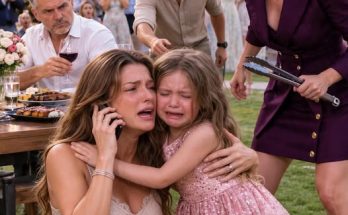
Valerie accused her.
Then the necklace broke.
That was the sequence she remembered.
It matched what I had seen.
I hadn't needed to question her repeatedly.
I had been there.
I saw Weston reaching for the present.
I saw him lose his balance.
I saw my sister approach Daphne.
I saw the dress in Valerie's hand.
I saw the silver chain come apart.
And I saw the handbag strike.
Those weren't rumors.
They weren't explanations someone gave me afterward.
They were things that happened in front of me.
That mattered.
I thought about how quickly my father had dismissed them.
He had arrived while Daphne was already crying.
I had hoped he would help.
Instead, he grabbed me.
He told me to get my child under control.
I could still feel the disbelief of that moment.
I had looked at him expecting concern.
What I found was anger.
Not anger at Valerie.
Anger at the disturbance.
As though Daphne's crying had interrupted something more important.
As though my role as her mother was to make the problem disappear.
I thought about the guests.
Corbin's business associates were expected at two.
The backyard had been arranged to impress them.
My father wanted the food ready.
He wanted the setting to look expensive.
He wanted the afternoon to go smoothly.
And when his granddaughter was struck, he reacted as though she was the one threatening that appearance.
I wondered whether he would ever understand what that revealed about him.
I couldn't know.
Perhaps he would regret it.
Perhaps he would defend his behavior.
Perhaps he would refuse to discuss it.
I wasn't going to invent his answer.
But I had to make decisions based on what he actually did.
He had not protected Daphne.
He had ordered us away.
Those choices were enough to change how I saw him.
I thought about my mother next.
For years, she had been the person who softened the family's demands with pleasant language.
When she wanted me to prepare food, she called it helping.
When she wanted Gideon's name avoided, she called it preventing an awkward conversation.
When she wanted Corbin's guests accommodated, she insisted Daphne's birthday would still be the focus.
She could make almost anything sound reasonable.
That had been one of the reasons I kept agreeing.
I was used to hearing her describe obligations as small favors.
I was used to being told I was overthinking things.
I was used to having my objections treated as unnecessary conflict.
But the afternoon had stripped away that familiar softness.
When Daphne was hurt, my mother didn't speak gently.
She said the child deserved it.
There had been nothing ambiguous about her meaning.
I wished there had been.
I wished I could remember concern in her face.
I wished she had hurried from the porch.
I wished she had asked whether Daphne was all right.
But I couldn't replace what happened with what I wanted to remember.
My mother stayed where she was.
She defended Valerie.
And she watched me carry my daughter away.
I thought about the relationship Daphne had believed she shared with her grandmother.
The handmade invitation.
The pink flowers.
The care she had put into drawing them.
She had wanted Priscilla to be happy.
She had wanted her grandparents to celebrate with her.
I remembered telling her Grandma would appreciate the drawing.
At the time, I had believed that was a harmless reassurance.
Now I wondered whether I had been reassuring Daphne about something I didn't truly understand myself.
I had wanted my mother to be loving.
I had wanted her to enjoy her granddaughter.
I had wanted her to see the good in the family Gideon and I had built.
Those wishes had become substitutes for looking at her actions.
I couldn't keep doing that.
I had to distinguish between the mother I wanted and the woman who stood on the porch.
That difference hurt.
It felt like losing something.
Not a person exactly.
A belief.
The belief that no matter how harsh my parents were with me, their love for Daphne would stop them from crossing certain lines.
That belief had kept me returning.
It had kept me answering calls.
It had kept me helping Valerie.
It had kept me agreeing to family gatherings.
I had told myself the conflict belonged to the adults.
But Saturday proved the adults were willing to bring Daphne into it.
And once that happened, the old arrangement was finished.
I didn't know how every future conversation would unfold.
I couldn't know whether my family would acknowledge what they had done.
But I knew I wasn't going to ask Daphne to pretend she was safe with them.
That decision didn't require permission.
It didn't require consensus.
And it didn't require my parents to understand.
I was her mother.
Protecting her was my responsibility.
I looked at the empty place around her neck.
It still troubled me.
I kept returning to the pendant.
The blue sapphire.
The broken chain.
Such a small object had carried so much meaning.
It was Gideon's gift.
It represented a father who had tried to make his daughter's birthday special despite being away.
Then Valerie destroyed the moment.
I wanted to know where the necklace was.
I wanted to know whether the pieces remained beneath the oak tree.
I wanted to know whether someone had picked them up.
But I didn't have those answers.
And I couldn't allow the uncertainty to distract me from Daphne.
The necklace mattered because she mattered.
Not the other way around.
I reminded myself of that.
If the necklace couldn't be recovered, Gideon's love would still exist.
If the chain couldn't be repaired, Daphne would still be his daughter.
If Valerie refused to apologize, the assault would still have been wrong.
I didn't need the adults to agree on those truths.
I needed to live by them.
The camera returned to my mind.
I wondered whether my father remembered asking me to turn it on.
I wondered whether he had thought about the camera after the confrontation.
I wondered whether he understood why it might matter.
I had no answers.
And I wasn't going to assign him motives I couldn't prove.
He had asked me to turn it on.
That was the established fact.
Everything else remained uncertain.
I thought about how differently I would have approached the situation if it involved my work.
If a client told me a financial discrepancy existed, I wouldn't immediately announce what caused it.
I would identify the relevant records.
I would examine what was available.
I would pay attention to the difference between original information and someone's later explanation.
I would be careful about missing details.
And I would refuse to turn suspicion into certainty.
The same discipline mattered now.
Perhaps even more.
Because the consequences weren't about numbers on a page.
They were about a child.
My child.
I couldn't make her injury into a story that served my anger.
I had to keep it grounded in what happened.
The facts were already devastating.
No exaggeration was necessary.
I remembered Valerie's face when Daphne defended Gideon.
She looked furious.
My daughter had insisted her father was coming home.
She hadn't insulted her aunt.
She hadn't threatened anyone.
She had said something she believed.
Then Valerie swung the handbag.
That choice belonged to Valerie.
I couldn't allow anyone to move the responsibility elsewhere.
Not onto Weston.
Not onto Daphne.
Not onto me for refusing to help at the boutique.
Not onto Gideon for being deployed.
None of those things caused an adult to lose the right to control her own actions.
Valerie was responsible for what she did.
I thought about the phrase my father used.
He wanted me to control my child.
I had heard those words while Daphne was holding her injured face.
At the time, I could barely process them.
Now they sounded even worse.
He was asking the wrong person to control the wrong behavior.
Daphne had not raised a handbag.
Daphne had not grabbed another child's clothing.
Daphne had not broken a necklace out of anger.
She had tried to keep her birthday present.
That was what she had done.
My father knew his granddaughter was hurt.
But he wanted her quiet.
The more I considered that, the more I understood how much had to change.
I had spent my adult life trying to be reasonable with unreasonable expectations.
I had thought compromise meant making allowances.
But there are things that cannot be compromised.
A child's right not to be assaulted is one of them.
A child's right to believe her father loves her is another.
A child's right to ask for help without being blamed is another.
Those things were not negotiable.
I didn't care how uncomfortable my family found that.
I looked at Daphne.
She was the person most affected by everything.
Yet she was also the person with the least control over what happened next.
She couldn't decide how Valerie described the confrontation.
She couldn't decide whether my parents apologized.
She couldn't examine a backyard camera.
She couldn't make Gideon return from an assignment.
Those were adult matters.
I didn't want her carrying them.
I wanted her to be allowed to be seven.
To color pictures.
To love her stuffed rabbit.
To ask when Daddy might come home.
To enjoy a birthday present without fearing someone would take it.
I had to protect those ordinary things.
They might sound small.
But they were the foundation of the childhood I wanted for her.
I leaned toward her.
“You don't have to figure out why everybody acted that way.”
She looked at me.
“Okay.”
I continued.
“That's for the adults to deal with.”
She nodded.
I could see that she was listening.
I didn't want to overwhelm her with more words.
So I stopped.
We sat quietly.
The silence was different from the silence I had practiced around my family.
That silence had been avoidance.
This silence was care.
I wasn't refusing to speak because I was afraid of an argument.
I was giving Daphne room to rest.
I felt the distinction clearly.
For years, I had mistaken silence for peace.
Now I understood that real peace required safety.
It required trust.
It required the freedom to tell the truth without being punished for it.
My family's backyard had offered none of those things that afternoon.
I couldn't keep pretending otherwise.
I thought once more about the camera.
I didn't yet have the recording.
I didn't know whether it would answer the questions I had.
But remembering it had already reminded me of something important.
The truth existed beyond the version my relatives wanted to tell.
What happened had happened.
Their anger couldn't erase it.
Their social standing couldn't erase it.
Their refusal to acknowledge it couldn't erase it.
And my decision to protect Daphne no longer depended on convincing them.
That was the reversal I hadn't expected.
I had always wanted my family to understand.
Now I understood that I could act without their understanding.
I could believe my daughter.
I could support her.
I could tell Gideon the truth.
And I could refuse to return to the old arrangement.
No more treating Valerie's insults as harmless.
No more pretending my parents' indifference was merely a difference in personality.
No more asking Daphne to endure cruelty because the people delivering it shared our blood.
Those decisions were mine.
I didn't have to wait for anyone else to make them.
I looked at Daphne's hand resting near mine.
I reached for it.
She held on.
The questions about the recording remained.
But I had finally stopped asking the question that had kept me trapped for years.
How could I make my family approve of us?
I had a different question now.
What did Daphne need from me?
And for the first time, I was willing to let the answer change everything.
Click here to continue reading: PART 12: My Daughter’s Seventh Birthday Ended Nothing Like We Planned, and I Finally Understood the Difference Between Having Relatives and Being Protected by Family
Four Days Before My Daughter Turned Seven, My Sister Reminded Me Why I Had Stopped Defending My Husband to Our Family
Part 11 of 12