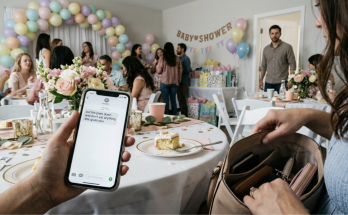
I had tried to remember the baby shower without remembering the dessert.
It didn't work.
Every time I thought about Michaela, I saw the blue plate.
Not her decorations.
Not the celebration.
Not the excitement surrounding her pregnancy.
The plate.
I could picture it so clearly that sometimes I wished I had never seen it.
But forgetting would not change what happened.
I knew that now.
The hardest part was remembering how ordinary the afternoon had seemed before Fred became concerned.
I had gone because Michaela was my sister.
I wanted to celebrate her baby.
I wanted her to feel supported.
And I had no intention of bringing old family disagreements into the room.
That was how I usually approached gatherings.
Smile.
Help where needed.
Avoid arguments.
Make sure nobody could say I had ruined the occasion.
I had been doing those things for so long that they felt natural.
Then a dessert changed everything.
The tart contained walnuts.
My family knew I was seriously allergic.
My medication was missing.
And Fred discovered messages suggesting both circumstances had been discussed before I understood what was happening.
I could not make those facts less frightening by calling them a mistake.
But I still wanted to understand how we got there.
I kept returning to Grandma's letter.
She had named three earlier incidents.
The cookies when I was little.
The camping trip.
And the incident before my wedding.
I had remembered each one separately.
Grandma hadn't.
She saw something connecting them.
That was what frightened me.
I sat at the kitchen table with her letter.
Fred was nearby.
I asked him whether he thought I had been foolish.
He looked surprised.
"Why would you say that?"
I told him I had accepted explanations for years.
I had believed people when they said there was no reason to worry.
I had even become embarrassed when Grandma asked questions.
Fred didn't answer immediately.
Then he said I had been trying to trust my family.
I looked down.
Trust.
It was such a simple word.
I used to think it meant refusing to doubt someone.
Now I was learning that trust could not survive on my willingness to ignore everything uncomfortable.
I thought about the cookies.
I had been young.
I didn't remember every detail of that day.
I wasn't going to pretend I did.
But I remembered being frightened by an incident involving food.
I remembered adults explaining what had happened.
I remembered wanting everyone to stop talking about it.
And I remembered Grandma remaining concerned.
At the time, I thought she was making things worse.
I wanted the event to disappear.
I didn't want to be the child everyone had to watch.
I didn't want people checking every bite.
I wanted to eat what the other children ate.
That was a childish wish.
An understandable one.
But it made me especially willing to accept reassurance.
If someone said the danger was over, I wanted to believe them.
Grandma understood the danger differently.
She knew reassurance did not replace careful preparation.
She checked ingredients.
She made sure my medication was available.
She asked questions even when other people acted impatient.
I used to roll my eyes sometimes.
I wish I could tell her how grateful I am now.
Then I thought about the camping trip.
That memory had always made me uncomfortable.
My emergency medication had disappeared.
I remembered the helpless feeling of needing something important and not knowing where it was.
I remembered the confusion.
And I remembered the explanation that followed.
Someone had misunderstood.
Something had been misplaced.
There had been no reason to make a larger issue of it.
That was how I allowed myself to remember it.
I didn't want to accuse anyone.
I didn't want the trip to become a family argument.
So I accepted that it was over.
But Grandma had written about the missing medication.
She remembered.
She had asked what happened.
She had not been satisfied by the answers.
I looked at the letter.
I wondered whether she had recognized something I couldn't see.
I couldn't know exactly what she believed.
She had written that she didn't want to think someone in our family could intentionally endanger me.
That mattered.
She had struggled with the same terrible possibility I was struggling with now.
She wanted an innocent explanation.
But repeated incidents had made it harder for her to accept one.
I touched the paper.
For years, I thought I was the only person who remembered feeling frightened.
Grandma had remembered too.
The third incident happened before my wedding.
That one was harder to think about.
My wedding was supposed to be a happy part of my life.
It was when Fred and I were beginning something together.
I had wanted everyone to be pleased.
I had wanted Mom and Michaela to feel included.
I had wanted Grandma there.
And I had wanted the allergy issue to remain a small part of the preparations.
But Grandma's letter showed that she had not forgotten what happened.
She included it alongside the cookies and the camping trip.
Not as a random memory.
As part of the pattern that concerned her.
I couldn't reconstruct every detail from the letter alone.
I didn't want to fill gaps with guesses.
But I knew she considered it important.
And I knew she had continued asking questions afterward.
I looked at Fred.
He had known me through that part of my life.
He knew how seriously I needed to take my allergy.
He knew how uncomfortable I became when relatives treated precautions as unnecessary.
I asked whether he thought I had changed since our wedding.
He smiled faintly.
He said I had become more willing to speak up.
I almost laughed.
More willing.
I had still needed him to discover messages before I could accept that something might be deliberately wrong.
But I understood what he meant.
I had started learning to ask questions.
Slowly.
Sometimes badly.
Often after I had already apologized.
Fred had encouraged me to take my medical needs seriously.
He never treated an allergy pen as an inconvenience.
He never suggested I should eat something uncertain to avoid hurting someone's feelings.
Those things had mattered.
I just hadn't understood how much.
The baby shower had made the contrast impossible to ignore.
Michaela's messages referred to the pens.
Mom's message referred to the first serving.
And their conversation connected my presence at the shower to keeping me away from Gregory Ashby.
I thought about the screenshot again.
Fred had seen it while working on the speaker.
Michaela's family iPad was open.
A notification appeared.
He noticed my name.
At first, I had been upset that he hadn't immediately told me everything.
I wanted to know why he waited.
He explained that he wanted to preserve the evidence before anyone could delete it.
Now I understood his concern.
If he had confronted Michaela the moment he saw the notification, she might have denied the messages.
The iPad might have been closed.
The conversation might have disappeared.
He couldn't know what would happen.
He made a decision based on the need to preserve what he found.
I was grateful he had the screenshots.
Without them, I might still be trying to convince myself the blue plate was meaningless.
I might still believe my medication had simply been misplaced.
And I might not understand why Michaela was so determined to keep me away from Ashby.
I looked toward the folder.
The trust documents were there.
The estimated value was about $2.8 million.
The questioned payments totaled roughly $286,000.
The Friday authorization involved another $125,000.
Those numbers gave the family conflict a financial dimension.
But they didn't prove the purpose of the dessert by themselves.
Gregory had said that clearly.
The financial records could establish requests, access, transactions, and legal restrictions.
The police needed to examine the messages and the missing medication.
I knew why separating those questions mattered.
I didn't want to let my anger decide something the evidence hadn't established.
But I also wasn't going to minimize the danger.
That was the balance I kept trying to find.
Fred asked whether I wanted to review the screenshots again.
I hesitated.
I knew what they contained.
I had read them enough times.
Yet I wanted to make certain I hadn't imagined the wording.
We looked at the preserved messages.
Mom had wanted Michaela to make sure I received the first serving.
Michaela had acknowledged having the allergy pens.
Other messages referred to walnuts and Gregory Ashby.
And the conversation discussed keeping me away from his office until Friday.
I read the sequence slowly.
It was difficult to look at.
There was no affectionate way to interpret a message about taking someone's emergency medicine.
There was no harmless reason for my family to conceal the existence of the trust.
But motive still needed to be established.
I looked at Fred.
"Do you think they expected me to get sick?"
He didn't answer immediately.
Then he said that was one of the things investigators needed to determine.
I nodded.
It was a hard answer.
But it was honest.
I wanted him to tell me there was no other explanation.
I wanted certainty.
Yet he couldn't know what Mom or Michaela intended beyond what the records showed.
He could only tell me what he saw.
And what he saw had been serious enough to make him act.
I put the phone down.
I felt exhausted.
The problem with remembering something frightening is that your body sometimes reacts as though it is happening again.
I looked at the water glass beside me.
My hands felt unsteady.
I took a drink.
Then I checked where my allergy pens were.
They were there.
Available.
Exactly where they should have been.
I felt relieved.
Then angry that such a basic precaution had become emotionally difficult.
I had always known walnuts were dangerous for me.
I had always known I needed emergency medication.
What I hadn't expected was to wonder whether people who knew those facts had deliberately interfered with my safety.
I couldn't fix that uncertainty with a conversation.
I couldn't make it disappear by forgiving Michaela in advance.
I needed the investigation to proceed.
And I needed to cooperate honestly.
I thought about the report I had filed.
At first, the idea of involving law enforcement in a family matter felt almost impossible.
I had imagined Mom's reaction.
I had imagined Michaela crying.
I had imagined being accused of humiliating my pregnant sister.
Those thoughts had nearly stopped me.
But then I remembered the missing medication.
If I ignored that, what was I teaching myself?
That my life mattered only when nobody else was inconvenienced?
That I had to accept danger to prove I loved my family?
I couldn't believe that anymore.
Grandma hadn't believed it.
Fred didn't believe it.
And slowly, I was learning not to believe it either.
I read the final section of Grandma's letter.
She wanted me to have Willow Creek because she wanted me to feel secure.
I had always thought of the cottage as a place filled with ordinary happiness.
Apple pies.
A familiar kitchen.
Summer afternoons.
A fence that needed painting.
Now it carried another meaning.
Grandma wanted me to have a place where nobody could use belonging as a reward for obedience.
I felt the truth of that in a way I hadn't before.
My mother could be angry.
Michaela could be upset.
They could disagree with Grandma's decisions.
But their feelings did not erase my right to safety.
And they did not change what Grandma had written in the trust.
I folded the letter.
Fred reached for my hand.
I told him I wished I had listened to Grandma sooner.
He didn't try to correct me.
He let me say it.
That helped more than reassurance.
I needed to acknowledge my regret without being told to stop feeling it.
I had dismissed Grandma's concerns.
I had accepted explanations.
I had tried to protect everyone from uncomfortable questions.
And I had almost allowed the same pattern to continue after the baby shower.
But I hadn't continued.
That mattered too.
I had listened when Fred showed me the evidence.
I had filed a report.
I had spoken with Gregory.
I had attended the review.
I had denied signing the agreement.
And I had made clear that I never authorized the disputed settlement.
Those were decisions I had made myself.
I didn't need Mom's approval.
I didn't need Michaela to agree.
I needed to keep telling the truth.
That evening, I looked at Grandma's photograph.
She was standing outside Willow Creek.
The cottage behind her.
Her face relaxed.
I wondered whether she knew how much I would miss her.
I wondered whether she knew her letter would become something I reached for whenever I began doubting myself.
She had left me a warning.
But she had also left me a kind of permission.
Permission to take danger seriously.
Permission to ask questions.
Permission to stop apologizing for protecting myself.
I put the photograph down.
Then I placed the letter back in its envelope.
I still wanted to know what the two recordings contained.
I still wanted the August signature examined.
I still wanted the trust transactions fully accounted for.
But I no longer wanted to force myself into a quick explanation simply because uncertainty was uncomfortable.
I could wait for evidence without surrendering my judgment.
And I could remember Grandma's warnings without turning every memory into something I could prove.
That was how I intended to keep going.
Click here to continue reading: PART 11: The Two Recordings Grandma Left Behind Made Me Understand How Carefully She Had Prepared for a Fight She Hoped Would Never Happen
I Thought My Sister Had Made an Honest Mistake Until My Husband Asked Why My Emergency Medication Was Missing
Part 10 of 15