PART 2
I did not answer immediately.
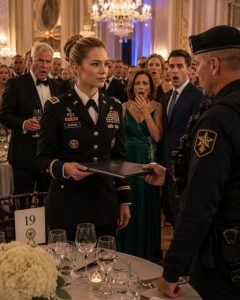
The folder in Colonel Hayes’s hand seemed to weigh more than paper ever should. Its red classification strip caught the chandelier light, flashing like a warning. Around me, no one moved. The ballroom had become a portrait of interrupted pride: champagne glasses paused halfway to mouths, forks resting untouched, smiles stiffened into confusion.
My father stood near the microphone, still holding his whiskey. His face had changed in a way I had never seen before. Not anger. Not disappointment.
Uncertainty.
“General Dawson?” Colonel Hayes prompted quietly.
I took the folder. “Give me thirty seconds.”
“Yes, ma’am.”
The words carried across the ballroom with impossible clarity.
Ma’am.
Not Alyssa.
Not “my daughter.”
Not the punchline.
My fingers closed around the folder’s edge. Years of command taught a person how to stand inside silence without flinching. But nothing in my career had prepared me for standing in front of my family while their version of me collapsed in real time.
My mother’s eyes moved from my face to my uniform pin hidden beneath my blazer, then back again. Ethan took one step forward, then stopped.
“Alyssa,” he said softly.
I looked at him. In his expression, I saw shock, but not cruelty. That mattered more than I expected.
“I need a private space,” I told Colonel Hayes.
“The hotel manager has opened a conference room on the second floor.”
I nodded, then turned to Mara. She still sat beside my table, phone clutched against her chest, guilt and concern written all over her face.
“Thank you,” I said.
Her eyes glistened. “I should have told you years ago.”
“You told me tonight.”
That was all I had time to give her.
As I moved toward the ballroom doors, the crowd parted without being asked. Nobody laughed now. Nobody whispered loudly enough for me to hear. But I felt every stare. Some were embarrassed. Some curious. Some already rewriting the story they planned to tell later.
My father stepped into my path.
“Alyssa.”
His voice was careful, too careful.
I paused.
“Is this some kind of presentation?” he asked. “Part of the gala?”
The question might have hurt if it had surprised me.
“No,” I said.
His throat moved as he swallowed. “Then what is happening?”
“Duty.”
I walked past him.
For sixteen years, he had removed my name from programs, awards, alumni newsletters, and family conversations. But no one could remove me from the path I had chosen. Not anymore.
The hallway outside the ballroom was cooler and dimmer. Hotel staff stood pressed against the walls, wide-eyed but professional. Colonel Hayes walked beside me, his jaw tight.
“What do we have?” I asked.
He lowered his voice. “A data courier connected to the Lake Meridian systems review failed to arrive at the operations center. Package was recovered ten minutes ago by local federal liaison. No breach confirmed, but Washington wants your authorization before analysis proceeds.”
“Why here?”
“The courier’s last confirmed location was inside this hotel.”
I stopped walking.
Behind me, the muffled sounds of the ballroom faded into a dull murmur.
“This hotel?”
“Yes, ma’am.”
“During this gala?”
His silence was answer enough.
The conference room upstairs smelled of polished wood and coffee. A laptop waited on the table beside a secure communications device. Two officers moved efficiently, checking connections, sealing blinds, confirming the room was clear.
I opened the folder.
Inside were pages I could not fully discuss with anyone outside that room, but one photograph made my chest tighten.
A hotel service corridor.
A man in a gray suit.
And behind him, partially visible near a catering cart, was my brother Ethan.
Not speaking to the man.
Not touching the package.
Just there.
I studied the image too long.
Colonel Hayes noticed. “You recognize someone?”
“My brother.”
The room went very still.
He did not ask the obvious question. Good officers rarely did.
“Does Washington know?” I asked.
“Not yet. We wanted your eyes first.”
I looked again. Ethan’s posture in the photo was tense, shoulders raised, head turned as if he had heard his name. He looked less like a conspirator than a man who had stumbled into the wrong hallway at the wrong second.
Still, facts did not bend for family.
“Find out why he was there,” I said.
“Yes, ma’am.”
“And quietly.”
Colonel Hayes nodded.
For the next twenty minutes, the world shrank to procedure. I gave authorization, reviewed the initial timeline, asked questions, rejected assumptions, demanded confirmation. My voice sounded steady. My hands did not shake. That was another thing service had taught me: emotion could wait in the hall if lives depended on it.
But when the first secure review ended, emotion came back and took its seat beside me.
“General,” Colonel Hayes said, “there is another matter.”
I looked up.
He placed a small evidence bag on the table. Inside was a folded hotel notecard. On it, written in dark blue ink, were five words.
Table 19. She was erased.
I read it twice.
The room seemed to tilt.
“Where was this found?”
“Inside the recovered courier envelope.”
My mouth went dry. “That message was included with the security package?”
“Yes, ma’am.”
“Who wrote it?”
“We don’t know.”
For a moment, I heard my father’s laughter again. Then the shattering glass. Then Mara’s apology.
Table 19. She was erased.
This was no longer only about a misplaced courier.
Someone had used a classified concern to point directly at my private wound.
That made it personal.
And personal things were dangerous when mixed with national ones.
“I need to return to the ballroom,” I said.
Colonel Hayes hesitated. “Ma’am, your family may be connected to—”
“I know exactly what they may be connected to. That’s why I need to see their faces before someone else questions them.”
He studied me, then gave a single nod. “Two officers will remain near you.”
“No visible pressure. This is still a civilian event.”
“Yes, ma’am.”
When I reentered the ballroom, conversation died again, but this time it did not vanish completely. It thinned into uneasy fragments. People looked down at plates, at programs, at each other.
My father had left the stage. My mother sat alone at a front table, one hand over her necklace. Ethan stood near a window, staring out over Chicago’s lights.
I went to him first.
He turned before I reached him.
“Alyssa,” he said, and then stopped, as though my name had become unfamiliar.
“Why were you in the service corridor at 8:41 tonight?”
His eyes widened. Not with guilt. Recognition.
“You know about that?”
“Yes.”
He looked past me toward the officers near the door. “I got a text.”
“From whom?”
“I thought it was from Dad.”
My breath caught, but I kept my face still.
“Show me.”
He pulled out his phone with clumsy fingers and opened the message. The sender was labeled Dad, but the number was not my father’s.
Ethan read it aloud, voice low. “Need you by the service corridor. Private matter about Alyssa. Don’t tell your mother.”
A cold line moved down my spine.
“What happened when you got there?”
“Nothing. I waited maybe two minutes. A man came through carrying an envelope. He looked at me like he expected me to say something, but I didn’t know him. Then a waiter dropped a tray nearby. When I turned back, the man was gone.” Ethan’s face tightened. “Alyssa, am I in trouble?”
“That depends on whether you’re telling me everything.”
Hurt flickered in his eyes. “I am.”
I wanted to believe him. That was the problem.
“Did Dad send this?”
“I don’t know.”
“Did you ask him?”
“No. After what happened in there, I didn’t know what to ask anyone.”
We stood side by side by the window. Beyond the glass, traffic moved along Michigan Avenue in streams of white and red light. The city carried on, indifferent to every family secret unfolding above it.
Ethan looked down at his shoes. “I didn’t know.”
“About what?”
“Your rank. Your career. Any of it. Mom and Dad always said you preferred privacy. They said you didn’t come home because you looked down on us.”
I closed my eyes for a second.
There were lies that shouted.
Then there were lies that moved into a house, sat at the dinner table, and learned everyone’s favorite songs.
“I wrote,” I said.
Ethan stared at me.
“I sent birthday cards. Graduation gifts. Letters when you got your first job. I never heard back.”
His face drained slowly. “I never got them.”
The words landed between us with the force of something breaking.
Across the ballroom, my father watched us.
Ethan followed my gaze. “Alyssa…”
“Not now,” I said gently.
But my voice was not cold.
That surprised both of us.
My mother approached next. Her emerald gown shimmered, but her face looked pale and small.
“Alyssa, sweetheart,” she began.
The old endearment nearly undid me. She had not called me sweetheart in fifteen years.
“Did you know?” I asked.
Her lips parted.
I did not explain. I did not need to.
She glanced toward my father before answering. That glance told me too much.
“I knew there were disagreements,” she said.
“Disagreements?”
Her eyes filled. “Your father believed military life would change you.”
“It did.”
She flinched.
“It made me disciplined. It made me capable. It made me understand responsibility in ways I never imagined.”
“I know that now.”
“No,” I said quietly. “You know it because officers walked into a ballroom and saluted me. That isn’t the same thing.”
Her tears slipped free, silent and polished beneath the chandelier light.
“I missed you,” she whispered.
The words should have warmed me. Instead, they opened a door to a room full of years.
“Then why didn’t you call?”
She pressed a hand over her mouth.
Behind her, my father was coming toward us.
“Because I asked her not to.”
His voice was steady, but the confidence had thinned.
My mother turned away as if struck by shame. Ethan stared at him.
I faced my father.
There he was: Richard Dawson, respected donor, former school board president, man of firm handshakes and clean speeches. A man who had convinced half a city he valued excellence, while making an exception for the daughter who chose the wrong kind.
“Why?” I asked.
He lifted his chin. “You left.”
“I enlisted.”
“You walked away from the future we built for you.”
“The future you chose.”
“You were brilliant,” he said, frustration sharpening his voice. “Medical school, research, hospital leadership—any of it could have been yours. Instead you disappeared into a system that sends orders and expects obedience.”
“I became a commander.”
He looked at the officers near the door, then back at me. “Apparently.”
Apparently.
Even now, he could not give the word room to stand.
Ethan stepped forward. “Dad, did you keep her letters from me?”
My father’s jaw tightened.
“Answer him,” I said.
People nearby were pretending not to listen and failing.
My father lowered his voice. “This is not the place.”
“You chose the place,” I said. “You chose the microphone.”
A tremor passed across his face.
“Yes,” he said at last. “Some letters came. I thought distance would help everyone move on.”
Ethan recoiled. My mother closed her eyes.
I had imagined this moment in airports, barracks, field hospitals, command centers, and lonely hotel rooms across the world. In those imagined scenes, I had shouted. I had demanded apologies. Sometimes I had walked away without a word.
But real pain was quieter.
“You stole years,” I said.
My father looked older suddenly. Not forgiven. Not ruined. Just old.
“I thought I was protecting the family.”
“No,” I said. “You were protecting a story.”
His eyes flickered.
That struck closer than anger would have.
Before he could answer, Colonel Hayes entered the ballroom and approached with controlled urgency.
“General Dawson.”
My family turned at the title again, as though each time it rearranged the furniture of reality.
“What is it?” I asked.
“The recovered envelope contained more than the package. We found copies of old correspondence addressed to you. Personal letters. Some opened, some never delivered.”
My mother gasped.
My father went still.
I felt the room recede.
“Where are they?”
“Upstairs.”
I looked at my father. “Did you send anything to me?”
His face gave me the answer before his mouth did.
“No.”
Ethan whispered, “Then who did?”
The question moved through me like a draft under a locked door.
I followed Colonel Hayes back upstairs. Ethan came with me without asking. My mother remained behind, crying softly at the table. My father did not move.
In the conference room, the evidence was arranged neatly on a side table.
My breath caught.
There were envelopes with my name written in different hands. Some old and yellowed at the edges. Some newer. A few bore military forwarding marks. One had childish handwriting, the letters uneven and enthusiastic.
To Alyssa. From Ethan.
He saw it at the same time I did.
“I was ten,” he whispered.
The envelope had been opened.
Inside was a drawing of two stick figures standing beside a crooked house. One figure wore a helmet. The other held a sign that read COME HOME SOON.
On the back, in pencil, was a message.
Mom says you are busy saving people. Dad says you forgot us but I don’t think you did. I got an A in science. I hope you are not lonely.
Ethan sat down hard in the nearest chair.
I could not speak.
For years, I had believed silence meant indifference. He had believed silence meant abandonment. Between us stood a man sorting mail like fate.
Colonel Hayes gave us a respectful distance.
There were other letters. One from my mother, never mailed, apologizing for a Thanksgiving argument I barely remembered. Another from my grandmother, who had died while I was overseas. Her handwriting wavered badly near the end.
Your father is stubborn, but blood has a way of finding its road back.
I pressed my fingers to my eyes.
Ethan’s voice broke. “I thought you didn’t want me.”
I lowered my hand.
He looked younger than his thirty-two years. The polished executive, the golden son, the man under the spotlight—gone. In his place was a little boy holding an unanswered drawing.
“I thought you didn’t need me,” I said.
He shook his head. “I needed you all the time.”
The conference room door opened slightly. My father stood there.
No one invited him in.
He entered anyway, slowly, as if each step cost him something.
“I didn’t know those were in the package,” he said.
“That is not the first sentence you should have chosen,” Ethan said.
My father absorbed that.
Then he looked at me. “I made mistakes.”
I almost laughed, but there was no humor left in me.
“Mistakes are missed birthdays,” I said. “Mistakes are words said in anger. This was a system.”
His eyes reddened. “I was afraid.”
That stopped me.
He looked away, toward the dark window. His reflection stood beside mine, similar in the shape of the brow, the stubborn line of the mouth.
“My father served,” he said. “He came home different. Quiet. Angry. Lost in rooms where the rest of us could not reach him. I promised myself my children would have stable lives. Safe lives.”
“You never told me that.”
“You were eighteen. You thought courage solved everything.”
“No,” I said. “I thought honesty mattered.”
He nodded once, as if the blow had been deserved.
“I saw your choice as a rejection,” he said. “Of me. Of your mother. Of everything I built. Then, after a while, admitting I was wrong meant admitting how much damage I had done.”
“So you kept doing it.”
“Yes.”
There was no defense in the word.
Ethan stood. “And tonight? The joke? The email to remove her from recognition?”
My father’s mouth tightened. “Pride becomes habit.”
The answer was ugly because it was true.
Colonel Hayes cleared his throat. “General, we need to address the unknown sender. Whoever placed these letters with the courier had access to personal family material and restricted movement inside the hotel.”
My father stiffened. “Restricted?”
“Yes.”
I turned to him. “Did anyone else know about the letters?”
He hesitated.
“Dad,” Ethan said.
My father’s gaze dropped. “I kept them in a locked storage room at the house.”
“Who had access?”
“Your mother. The house manager. And… Clara.”
The name struck me softly, unexpectedly.
Clara Dawson.
My father’s older sister.
My aunt.
She had sent me care packages during my first deployment until they suddenly stopped. I had assumed, as I assumed so much, that family loyalty had shifted without ceremony.
“Aunt Clara is in Arizona,” Ethan said.
My father shook his head. “She came back last month. She wanted to attend tonight. I told her it would be complicated.”
A memory surfaced: a silver-haired woman near the ballroom entrance when I arrived, turning away before I could see her face.
“Where is she now?” I asked.
My father looked genuinely confused. “I don’t know.”
Colonel Hayes’s phone vibrated. He glanced at it, then handed it to me.
A security still from the hotel lobby filled the screen.
There was Clara Dawson, older and thinner than I remembered, standing beside the missing courier in the gray suit. She was not frightened. She was not hiding.
She was handing him something.
My pulse slowed, the way it always did when a situation sharpened.
“Find her,” I said.
But before Colonel Hayes could move, the secure device on the conference table rang.
Everyone looked at it.
Only three groups had that number.
Colonel Hayes answered and put it on speaker. “Hayes.”
A woman’s voice came through, calm and familiar despite the years.
“Hello, Colonel. I imagine Alyssa is standing beside you.”
My father gripped the back of a chair.
“Aunt Clara,” I said.
There was a pause. Then a soft exhale.
“You sound exactly like your grandmother when you are angry.”
“Where are you?”
“Somewhere close enough to know Richard finally ran out of speeches.”
My father’s face hardened. “Clara, what have you done?”
“What you should have done years ago,” she replied. “I returned what did not belong to you.”
“The courier package?” I asked.
“That was never in danger, Alyssa. Not from me.”
Colonel Hayes leaned toward the device. “Ma’am, you interfered with a secure transfer.”
“No,” Clara said. “I exposed one.”
The room stilled.
“What does that mean?” I asked.
Her voice softened. “The man carrying that envelope was not the assigned courier.”
Colonel Hayes froze.
I looked at him. “Confirm.”
His expression changed as he checked his phone, then another officer’s message. “We’re verifying now.”
Clara continued, “I recognized him because I saw him two nights ago speaking with someone from the alumni committee. I followed him tonight because I knew he was not hotel staff. When he dropped the envelope, I put something inside that would make sure Alyssa looked closely.”
“My letters,” I said.
“Your history,” Clara corrected. “There is a difference.”
Ethan gripped the table edge. “Why didn’t you just tell us?”
“Because your father has spent years making truth sound unreasonable.”
My father flinched.
Colonel Hayes received another message. His face went pale in a way I had rarely seen in trained officers.
“General,” he said, “the assigned courier has been located.”
“Alive?”
“Yes, ma’am. Disoriented but safe in a service elevator maintenance area.”
“And the man in the gray suit?”
“Unknown. Not on the approved transfer list.”
The air in the room tightened.
Clara’s voice lowered. “Alyssa, listen carefully. The gray-suited man did not come for your military file. He came because someone told him your family would distract you tonight.”
“Who?”
Another pause.
Then Clara said, “That is why I called. I found his discarded badge.”
“Name?”
“No name. Just an access code.”
Colonel Hayes lifted his head sharply. “Read it.”
Clara recited the numbers.
An officer typed quickly. The room waited.
The result appeared.
Colonel Hayes looked at me, and for the first time that night, I saw alarm break through his discipline.
“The code belongs to a temporary event credential,” he said.
“Whose?” I asked.
He turned the screen toward me.
The credential photo showed a familiar woman with careful makeup, pearl earrings, and an emerald gown.
My mother.
PART 3 — FINAL PART
For a moment, the conference room had no air.
My mother’s photograph glowed on Colonel Hayes’s screen, her smile frozen in the soft, flattering light used for gala credentials. Pearl earrings. Emerald gown. A face I had once searched for in airport crowds after long deployments. A face that had taught me how to braid my hair, how to press flowers between book pages, how to stand straight when adults were talking.
Now that same face appeared beside a temporary access code connected to an unknown man, a missing courier, and a classified security package.
Ethan whispered, “No.”
My father’s voice came next, rough and immediate. “That’s impossible.”
I said nothing.
The hardest part of command was never making decisions under pressure. It was refusing to protect your heart from facts before you understood them.
Colonel Hayes looked at me. “General, we need to secure Mrs. Dawson.”
“My mother is not to be handled like a suspect in front of a ballroom full of civilians,” I said.
His eyes held mine. “Understood. But we cannot ignore this.”
“I’m not ignoring it.”
I turned toward the door.
My father moved first, stepping into my path. His face had lost all of its public polish. “Alyssa, wait. Your mother would never—”
“You don’t know what people will do when they’re afraid,” I said.
The words were not cruel. They were simply true.
His mouth closed.
Ethan stood beside me. “I’m coming.”
“No,” I said.
“Alyssa—”
“I need you to stay here and help Colonel Hayes. If Clara calls again, keep her talking. Find out where she is.”
He looked as if he wanted to argue, but something in my expression stopped him. For the first time that night, my younger brother did not look at me as a stranger. He looked at me as someone he trusted.
“All right,” he said quietly.
I went back downstairs alone, with one officer trailing far enough behind to avoid drawing attention.
The ballroom was trying to pretend nothing had happened.
That was what rooms full of respectable people did when truth entered uninvited. They adjusted their jackets, refilled their glasses, and spoke in lowered voices around the shape of a scandal. The band had stopped playing. The slideshow had frozen on a photograph of Ethan receiving an award. Onscreen, my brother smiled beneath a banner that read LEADERSHIP THROUGH SERVICE.
The irony might have made me laugh on another night.
My mother sat at the front table, both hands folded around a glass of untouched water. She looked small beneath the chandeliers, the emerald gown suddenly too bright for her pale face.
When she saw me approaching, she stood.
“Alyssa,” she said.
No sweetheart this time.
Just my name.
I stopped in front of her. “I need you to come with me.”
Her eyes flickered toward the room. “Why?”
“Because your event credential was used to access a restricted service corridor.”
She went perfectly still.
My father had worn guilt like armor. My mother wore it like a crack in glass.
Around us, conversations softened.
My mother touched the pearls at her throat. “Alyssa, I can explain.”
The floor seemed to tilt beneath me.
“You need to do that upstairs.”
She nodded once.
Then she did something I did not expect.
She reached for my hand.
For one second, instinct almost made me pull away. Too many years had passed. Too many letters had vanished. Too many empty chairs at family tables had quietly trained me not to reach back.
But her fingers trembled.
So I let her hold on.
We crossed the ballroom together under a hundred watchful eyes. No one laughed now. No one called my title a fantasy. No one looked away quickly enough to hide their curiosity.
At the doorway, my mother paused and looked toward the stage where my father’s microphone still stood.
“I should have stopped him,” she whispered.
I did not ask which time she meant.
Upstairs, Colonel Hayes had already turned the conference room into a place of movement and quiet urgency. Officers murmured into secure lines. Ethan stood near the table, his jaw tight. My father stood alone by the window, facing the city, both hands in his pockets.
When my mother entered, everyone turned.
She did not look at my father.
She looked at me.
“I gave my badge to a man tonight,” she said.
My father spun around. “Margaret.”
She lifted one hand, silencing him. It was a small motion, but it carried years of swallowed words.
“I thought he was from the school foundation,” she continued. “He said there had been a problem with Alyssa’s recognition materials. He said a donor wanted to make a private correction before the ceremony.”
“A correction?” I asked.
Her eyes filled. “He said your name had been omitted. He said there was still time to add it.”
The room fell silent.
Ethan’s expression changed first, confusion softening into pain.
My mother pressed her fingers against the back of a chair. “I knew about the old email. Not at the time, not when Richard sent it. But years later, I found a printed copy in his office. I confronted him. He said it was done, that bringing it up would only reopen things. I let myself believe silence was peace.”
Her voice caught.
“Tonight, when that man told me there was a chance to fix one small piece of it, I gave him my badge.”
Colonel Hayes asked, “Did you know him?”
“No. He knew my name. He knew Alyssa’s table number. He knew about the recognition removal.” She looked at my father then. “He knew too much.”
My father sank slowly into a chair.
“How did he know?” Ethan asked.
No one answered.
Then the secure phone rang again.
Every head turned.
Colonel Hayes activated the speaker. “Hayes.”
Aunt Clara’s voice came through. “I am in the hotel chapel on the mezzanine. And before anyone starts barking orders, I’m not running. My feet hurt, and I’m seventy-one.”
Despite everything, Ethan let out a breath that almost became a laugh.
“Clara,” I said, stepping closer to the phone, “are you alone?”
“Yes. Though I suspect not for long. The man in the gray suit came looking for the badge he dropped.”
Colonel Hayes signaled two officers immediately.
“Stay where you are,” I said.
“I planned to. There’s a very stern statue of Saint Michael in here keeping me company.”
“Why the chapel?”
“Because your grandmother used to light candles there every time she visited Chicago.”
My father looked up sharply.
Clara’s voice softened. “And because some truths are easier to tell near the people who loved us before we learned how to disappoint one another.”
No one moved.
Colonel Hayes muted the phone and turned to me. “We need to bring her in safely.”
“I’ll go.”
“General—”
“She’ll talk to me.”
My mother stepped forward. “I’m going too.”
I almost refused. Then I saw her face.
She was afraid. But for once, she was not hiding behind my father’s certainty.
“Stay behind me,” I said.
The hotel chapel was tucked beyond a quiet mezzanine corridor, hidden between conference suites and an alcove of tall windows overlooking the river. The door was half open. Warm candlelight spilled across the carpet.
Inside, Aunt Clara sat in the second pew, silver hair pinned loosely at the back of her head, a navy shawl wrapped around her shoulders. Time had sharpened her cheekbones and softened everything else. Her eyes, when they found mine, were the same as I remembered—clear, assessing, unsentimental, and kind in a way that did not ask permission.
“Well,” she said, “look at you.”
I stopped at the aisle.
For a moment, I was twenty-three again, receiving a box of homemade cookies at a desert airfield with a note that said, You are still someone’s child. Eat.
Then the boxes stopped.
Her smile faded. “I tried to keep writing.”
“I thought you stopped.”
“I thought you were ordered not to answer.”
My mother made a small sound behind me.
Clara looked past me. “Margaret.”
“Clara,” my mother said, barely above a whisper.
There was no embrace. Not yet.
Colonel Hayes’s officers moved quietly to secure the side doors. I sat beside Clara in the pew.
“Tell me everything.”
She folded her hands over her shawl. “It started with your grandmother’s old trunk.”
“My grandmother?” I asked.
“Your father asked me to clear some things from the house before the sale of the lake property. In the attic, I found a storage box with your letters. Yours to them. Theirs to you. Ethan’s drawings. My packages returned. Your grandmother’s last letter.”
My throat tightened.
Clara glanced toward my mother. “I also found a folder marked West Crest Alumni. Inside were emails, drafts, donor notes. Enough to prove Richard didn’t just remove you once. He maintained the erasure.”
My mother bowed her head.
My father had not come with us, but I felt him in every word.
“I planned to confront him privately,” Clara continued. “Then I learned the gala was tonight, and you were attending. I also learned, from an old friend on the alumni committee, that someone had been asking questions about you.”
“Who?”
“A temporary contractor. Said he was helping with donor security. Gray suit. Polite smile. Eyes like locked doors.” Clara reached into her purse and removed a plastic sleeve. Inside was an event credential with no name, only a barcode and a smudged thumbprint. “He dropped this when I followed him.”
Colonel Hayes accepted it carefully.
Clara looked at me. “I saw him take Margaret’s badge. I saw him enter the corridor. Then he came out with the courier envelope.”
“He intercepted the real courier,” Colonel Hayes said from the aisle.
“I guessed as much when I found a young man unconscious behind a maintenance door.” Clara’s expression tightened. “I called hotel security from a house phone. Then I did something foolish.”
“You put the letters in the envelope,” I said.
“Yes.”
“Why?”
Her gaze did not waver. “Because I knew if that envelope reached official hands, every person in that room would suddenly care about what was inside it. And I wanted someone to care about what had been done to you.”
The candles along the wall flickered, sending little pools of gold against the dark wood.
A lifetime of discipline rose in me, ready to say she had crossed a line, endangered an investigation, complicated a secure transfer.
But beside that truth stood another.
She had cared enough to act when everyone else had called silence peace.
I exhaled slowly. “You should have called me.”
“I didn’t have your number.”
The simplicity of it struck harder than accusation.
My mother covered her mouth.
For sixteen years, the people who loved me had been separated not by distance, but by a locked drawer and a stubborn man’s pride.
Colonel Hayes’s radio whispered. He listened, then stepped closer.
“General, we have the gray-suited man detained in the service level. He claims he was hired to retrieve embarrassing family documents for a private client.”
“A client?” I asked.
“Name withheld. But preliminary search of his phone shows messages from someone using a foundation account.”
Clara’s eyes narrowed. “The alumni foundation?”
“Yes.”
My mother looked confused. “Why would the foundation care about Alyssa?”
I already knew the shape of it before Hayes answered.
“The gala donor board planned to announce a new civic leadership endowment tonight,” he said. “Apparently, General Dawson was nominated months ago by several alumni, including Mara Ellison, as the inaugural honoree.”
My chest tightened.
Mara.
Hayes continued, “But someone suppressed the nomination file.”
My mother’s face crumpled. “Richard.”
“No,” said Clara.
Everyone looked at her.
She sat straighter. “Richard buried Alyssa’s name years ago, yes. But not this nomination. He didn’t know about it.”
“How can you be sure?” I asked.
“Because the old fool would have panicked much earlier.”
Despite the tension, a fragile breath of humor moved through the chapel.
Clara’s expression became grave again. “There is another person with reason to keep Alyssa off that stage.”
“Who?” Ethan asked from the doorway.
I turned. He had joined us, my father behind him.
My father looked smaller in the chapel doorway than he had ever looked in the ballroom.
Clara’s gaze settled on him, then moved to Ethan. “The person who built tonight’s public story around Ethan.”
Ethan blinked. “Me?”
“No, sweetheart. Not you.” Clara’s voice softened. “Your company.”
Ethan went pale. “That doesn’t make sense.”
Colonel Hayes checked his tablet. “The endowment sponsor is Northbridge Civic Partners.”
Ethan stared. “That’s one of our corporate philanthropy divisions.”
A silence followed, delicate and dangerous.
He pulled out his phone, scrolling rapidly. “I don’t oversee that unit directly. It reports to—” He stopped.
“To whom?” I asked.
His eyes lifted.
“Victor Hale.”
The name landed with recognition. Victor Hale had stood beside Ethan earlier in the ballroom, a silver-haired executive with a polished smile and the habit of touching people’s shoulders as if claiming them. I remembered him laughing the loudest at my father’s joke.
Ethan’s thumb moved across his screen. “He pushed hard for tonight’s alumni feature. Said it would strengthen our public image.”
Colonel Hayes asked, “Could he access foundation accounts?”
“Yes. Through corporate sponsorship coordination.”
My father spoke for the first time. “But why target Alyssa?”
Ethan looked at me, devastated by what he was beginning to understand. “Because if the endowment honored you instead of the company’s chosen success story, Victor’s campaign changes. He has been using tonight to position our firm for a federal community infrastructure grant.”
I finished the thought. “And having a senior military official unexpectedly tied to the event could raise scrutiny.”
“Especially,” Ethan said slowly, “if he had something to hide.”
Colonel Hayes’s phone buzzed again. He stepped away, listened, then returned.
“The detained man just identified his client as Victor Hale.”
My father closed his eyes.
Not because he had caused this piece.
Because he finally understood that his old lie had created the perfect hiding place for someone else’s scheme.
A family erasure had become a professional opportunity.
Victor had not needed to invent shame. He had only needed to use what was already there.
The chapel doors opened wider as hotel security escorted Mara inside. Her face was flushed from running, and her curls had escaped their careful pins.
“I found something,” she said, breathless.
Colonel Hayes moved toward her. “Ma’am, this is a controlled—”
“She’s with me,” I said.
Mara held out her phone to Ethan. “The alumni committee archive. Victor requested changes to the program file three weeks ago. He removed Alyssa’s nomination packet and replaced it with the corporate leadership segment.”
Ethan stared at the screen, then whispered, “He used my name.”
Mara nodded, tears shining in her eyes. “And he used your father’s old email as justification. He told the committee Alyssa’s own family had requested she not be publicly recognized.”
My father gripped the pew in front of him.
There are moments when regret is too large for words. It enters the body instead. It bends the shoulders. It lowers the eyes. It makes powerful men look suddenly breakable.
My father looked at me.
“I handed him the knife,” he said.
No one corrected him.
Downstairs, applause suddenly rose from the ballroom. Strange, uncertain applause, swelling and fading.
Ethan looked toward the sound. “What’s happening?”
Mara glanced at her phone again. “They’re stalling. The headmaster is trying to continue the program.”
Colonel Hayes turned to me. “Victor Hale is still in the ballroom.”
The night sharpened again.
“Then we go back,” I said.
My mother caught my arm. “Alyssa, what are you going to do?”
I looked from her to my father, to Ethan, to Clara, to Mara.
A lifetime of missing pieces stood gathered in candlelight.
“I’m going to tell the truth,” I said.
When we returned to the ballroom, the headmaster was onstage, his smile stretched thin as he thanked donors for their patience. Victor Hale stood near the front, speaking quietly to two men in suits. He looked calm until he saw Ethan walking beside me.
Then his expression changed.
Not fear.
Calculation.
He moved as if to leave through the side entrance, but Colonel Hayes’s officers were already there.
The headmaster faltered mid-sentence as we approached the stage. The room turned, sensing the story had shifted again.
Ethan climbed the steps first. He took the microphone from the headmaster gently, with an apologetic nod.
“Good evening,” he said.
His voice shook on the first word but steadied on the second.
“I was supposed to stand here tonight as an example of success. I was prepared to accept that attention, because I believed the story being told about my family was true.”
The ballroom fell utterly silent.
Ethan looked at me below the stage.
“I believed my sister had chosen distance. I believed she didn’t write, didn’t call, didn’t care.” His throat moved. “Tonight I learned that was not true.”
My father stood at the foot of the stage, face gray.
Ethan continued, “I learned that letters were hidden. Achievements were erased. A nomination honoring her service was suppressed. And I learned my own professional image was used by someone who hoped family silence would cover institutional dishonesty.”
Victor Hale’s smile vanished.
A murmur spread across the room.
Ethan turned toward him. “Victor, I’ve already forwarded the committee records to our legal department and the proper authorities. You will not speak for me, my company, or my family again.”
Victor’s jaw tightened. “Ethan, you’re emotional. This is not the forum—”
“No,” Ethan said, his voice clear now. “This is exactly the forum you chose.”
The words moved through the ballroom like a clean wind.
Colonel Hayes gave a small signal. Two officers and hotel security stepped toward Victor. No spectacle. No shouting. No struggle. Just procedure. Proper channels. Quiet consequence.
As Victor was escorted out, people craned their necks, whispering. But the whispers felt different now. Not hungry.
Awake.
Ethan looked down at me. “Alyssa, will you come up here?”
For a second, my feet did not move.
I had commanded operations larger than anything this room could imagine. I had stood before foreign officials, congressional committees, grieving families, exhausted troops. I had made decisions that carried weight far beyond my own name.
But climbing those six carpeted steps toward my brother felt like crossing the longest distance of my life.
He handed me the microphone.
The room waited.
My father did not look away.
My mother pressed both hands to her heart.
Mara stood near Clara, crying openly now.
I looked out at the faces—classmates, teachers, donors, strangers, people who had laughed when my father laughed because laughter was easier than doubt.
“My name is Alyssa Dawson,” I said.
The microphone carried my voice to every corner of the room.
“I did attend West Crest High. I did leave Chicago at eighteen. I did choose military service. I became a doctor first, then an officer, then a commander. I have spent most of my adult life in places where titles matter less than whether you show up when people need you.”
No one moved.
“I was not included in tonight’s program. For years, I was not included in many things. Some of that began inside my own family.” I glanced at my father. “Some of it was later used by others for their own purposes.”
My father’s eyes filled.
“But I did not come here tonight to be restored by applause,” I continued. “Applause is kind. Recognition is meaningful. But no room, no program, and no title can give a person back to herself if she has not already fought to remain whole.”
A woman near the back wiped her eyes.
I looked at Ethan.
“What matters tonight is not that people finally learned my rank. What matters is that my brother learned I never forgot him.”
Ethan lowered his head.
“What matters is that my mother found the courage to stop being silent.”
My mother wept without covering her face.
“What matters is that my aunt decided old letters were not trash, but evidence of love interrupted.”
Clara gave a tiny nod.
“And what matters is that truth, when finally spoken, can still arrive in time to change the ending.”
The ballroom remained silent for one heartbeat.
Then Mara began clapping.
One pair of hands.
Small. Defiant. Certain.
Ethan joined her.
Then my mother.
Then, slowly, the room rose.
The applause did not feel like the earlier applause for success, polished and automatic. This was uneven. Human. Some people clapped with embarrassment. Some with tears. Some because they understood too late that dignity should not need proof before being offered.
At the foot of the stage, my father did not clap.
He climbed the steps instead.
A ripple passed through the room.
He stopped a few feet away from me, beneath the harsh stage lights that left no shadow deep enough to hide in.
For the first time in my life, Richard Dawson looked at a microphone as if it frightened him.
Ethan offered it.
My father took it with both hands.
“I owe my daughter an apology,” he said.
His voice cracked on daughter.
He stopped, swallowed, and began again.
“I owe her more than an apology. I owe her the truth in front of the same people who heard me mock her.” He turned toward the room. “Alyssa Dawson did not invent her accomplishments. I diminished them because I was afraid, proud, and unwilling to admit I had misunderstood her courage.”
He looked at me.
“I kept letters from her. I kept letters from all of us. I told myself I was protecting my family from pain, but I was protecting myself from being wrong.”
My mother closed her eyes.
“I cannot return the years,” he said. “I cannot repair tonight with words. But I can stop lying.”
His hand trembled around the microphone.
“Alyssa, you became someone extraordinary without my approval. More than that, you remained compassionate without my example. I am sorry.”
The room blurred.
Not because apology solved everything.
It did not.
Sixteen years did not vanish because a proud man finally told the truth under chandeliers. Forgiveness was not a switch. Trust was not restored by public confession. Love did not become simple just because everyone finally wanted it to be.
But something locked had opened.
And sometimes the opening was the miracle.
I stepped closer.
“I hear you,” I said.
His face crumpled with relief and pain.
Not I forgive you.
Not yet.
But I hear you.
For tonight, it was enough to begin.
The official program never resumed the way it had been planned.
Instead, the headmaster returned to the stage with shaken humility and announced that the alumni board would conduct a full review of its records and recognition process. Mara was invited to speak. She did so nervously, but with a fire that made people lean forward.
She explained how student archives had been altered. How nominations could be buried by people with influence. How institutions, like families, sometimes mistook silence for order.
Then she looked at me and smiled through tears.
“Some names do not disappear,” she said. “They wait for someone brave enough to read them aloud.”
Near midnight, long after most guests had left, my family gathered in a small hotel lounge overlooking the river.
No chandeliers now. No stage. No microphone.
Just a round table, five cups of coffee, and a box of old letters.
Clara had insisted on bringing them down herself. She placed them in the center of the table as carefully as if they were living things.
Ethan picked up the childhood drawing again. His thumb traced the words COME HOME SOON.
“I remember making this,” he said. “I used the green marker because you said green was the color of field tents.”
I smiled faintly. “I told you that?”
“You told me everything. Until you didn’t.”
“I never stopped wanting to.”
He nodded, eyes wet. “Me neither.”
My mother opened one envelope with trembling fingers. “This one is mine.”
She read only the first line before stopping.
Dear Alyssa, I do not know how to be on your side without feeling like I have betrayed your father.
She lowered the page, ashamed.
I took it gently. “You can read the rest another time.”
She shook her head. “No. I want you to know. I want you to know all of it. Even the parts that make me look weak.”
Clara leaned back. “Weakness is pretending not to know better. This is something else.”
My mother gave a watery laugh. “You always did know how to insult and comfort at the same time.”
“It’s a gift.”
For the first time all night, we laughed together.
Softly.
Carefully.
Like people testing whether a bridge would hold.
My father sat apart from the table, hands wrapped around his coffee. He had not reached for the letters. Perhaps he knew he had no right to touch them first.
After a long silence, he said, “There’s something else.”
The laughter faded.
He looked at Clara. She seemed to know what was coming, and for once, she did not rescue him from saying it.
My father reached into his jacket and removed a small envelope, worn at the corners. He placed it in front of me.
“I kept this in my wallet for twenty-one years.”
My name was written across it in handwriting I recognized instantly.
My grandmother’s.
I looked up.
“She gave it to me after your commissioning ceremony,” he said. “She told me to give it to you the day I was proud enough not to make your life about my fear.”
His mouth twisted.
“I never found that day.”
My fingers hovered over the envelope.
All evening, hidden things had emerged like bones from thawing ground. I was almost afraid of one more truth.
But my grandmother’s handwriting waited with patient grace.
I opened it.
Inside was a photograph and a letter.
The photograph showed me at twenty-two, standing stiffly in dress uniform, face serious, chin lifted too high. Beside me stood my grandmother, tiny and proud, her hand tucked around my arm. On my other side, slightly behind us and half out of frame, was my father.
I had never noticed him there before.
In the photograph, he was looking at me.
Not with anger.
Not disappointment.
With fear, yes.
But also wonder.
I unfolded the letter.
My dearest Alyssa,
Your father does not know how much he looks like you when he is scared. He turns fear into rules. You turn it into motion. Both of you are stubborn as winter roots.
He is wrong to ask you to live small so he can feel safe. But he loves you in the tangled way wounded people love, with both hands full of rope.
One day, perhaps, he will learn that children are not lost because they leave home. Sometimes they leave because home gave them enough strength to serve somewhere larger.
When that day comes, do not let pride steal another hour from either of you.
Blood has a way of finding its road back.
I read the last line three times.
Blood has a way of finding its road back.
The same words Clara had quoted upstairs.
I looked at her.
She smiled sadly. “Mother wrote versions of that sentence to all of us. She had too much faith and terrible handwriting.”
I laughed, but it broke halfway into a sob.
My mother reached for me.
This time, I let her.
She came around the table and held me the way she had when I was young and feverish, one hand at the back of my head, the other pressed between my shoulders. For a moment, I did not stand like a general. I stood like a daughter who had been strong for so long she had forgotten strength could include being held.
“I’m sorry,” she whispered into my hair. “I’m so sorry, Alyssa.”
I closed my eyes.
Across from us, Ethan wiped his face openly. Clara pretended not to notice while noticing everything.
My father remained seated, crying silently.
When my mother stepped back, I picked up the photograph and walked to him.
He looked up as if expecting judgment.
I handed it to him.
“I don’t remember you standing there,” I said.
He took the photo with shaking fingers. “I left before you saw me.”
“Why?”
His eyes stayed on the picture. “Because your grandmother said if I couldn’t bless you, I should at least witness you.”
The words sank deep.
Not enough to excuse him.
Enough to make him human.
I sat beside him.
For a long while, neither of us spoke.
Then he said, very quietly, “May I write to you now?”
The question was so small, so unlike the man who once commanded rooms, that my chest ached.
“Yes,” I said. “But send the letters.”
He nodded, a broken smile touching his mouth. “I will.”
“And Dad?”
He looked at me.
“You’re going to counseling.”
Ethan made a sound that was definitely a laugh disguised as a cough.
My father blinked.
Clara raised her coffee. “Finally, someone outranks him.”
The laugh that followed was not loud. It was not easy.
But it was real.
By morning, the city had washed itself in silver.
The storm that had threatened all night finally passed without breaking, leaving the streets shining and the air crisp enough to make every breath feel new. I stood outside the West Crest Hotel in civilian clothes, my overnight bag at my feet, watching taxis drift along the curb.
Colonel Hayes joined me with two coffees.
“Thought you might need this, ma’am.”
I accepted one. “Any update?”
“Victor Hale is cooperating through counsel. The assigned courier is recovering well. The package is secure. Your aunt has been advised not to conduct independent counterintelligence operations in hotel chapels.”
I smiled. “How did she take that?”
“She asked if we had a suggestion box.”
“That sounds like Clara.”
Hayes’s expression softened. “The official report will be complicated.”
“Truth usually is.”
“Yes, ma’am.”
He hesitated before leaving. “For what it’s worth, the officers who came into that ballroom last night didn’t make you impressive. They only made the room catch up.”
I looked at him, surprised.
Then I nodded. “Thank you, Colonel.”
After he left, Mara hurried through the revolving door carrying a folder and two pastries wrapped in napkins.
“I know generals probably eat classified oatmeal or something,” she said, breathless, “but the bakery across the street had apple turnovers.”
I took one. “Generals accept pastries from reliable sources.”
She laughed.
Then her eyes became serious. “The alumni board voted early this morning. They’re creating an independent archive review. They asked me to chair it.”
“That’s good.”
“They also want to rename the new endowment.”
I raised an eyebrow.
She opened the folder and handed me a single printed page.
THE ELEANOR DAWSON ROAD BACK SCHOLARSHIP
For students whose paths of service, courage, and unconventional leadership deserve to be seen.
For a moment, I could not read past my grandmother’s name.
Mara smiled gently. “It won’t be named after rank or résumé. Clara suggested your grandmother. Ethan seconded it. Your mother cried. Your father said yes before anyone finished asking.”
I pressed the page to my chest.
There it was—the final unexpected turn, not applause for me, not a plaque with my title, not a delayed correction trying to stuff sixteen years into a ceremony.
Something better.
A road forward for someone else.
The hotel doors opened again.
Ethan came out first, carrying the box of letters. My mother followed, wrapped in a beige coat, her hair loose around her face. Clara emerged behind her wearing sunglasses too large for the morning and looking extremely pleased with herself.
My father came last.
He paused when he saw me.
The old version of him might have filled the space with instructions, plans, declarations. This version simply approached and held out a sealed envelope.
My name was written on the front.
Alyssa.
Not Dr. Dawson.
Not General Dawson.
Just Alyssa.
“I wrote the first one,” he said.
I took it.
“Already?”
“I had a long night.”
I looked at the envelope, then at him. “I’ll read it on the plane.”
He nodded. “There will be more.”
My mother slipped her arm through mine. “And calls. Real ones. Too many, probably.”
“I can handle too many.”
Ethan stepped closer, holding the old drawing. “I was thinking…”
“That sounds dangerous.”
He smiled. “Maybe next month, when you’re free, we could go to the lake house before it sells. Just us. All of us. One weekend. No speeches.”
Clara snorted. “In this family? Ambitious.”
But Ethan kept looking at me.
The lake house. Summers. Fireflies. My grandmother humming in the kitchen. My father teaching us to skip stones before fear hardened into control. My mother cutting peaches into a blue bowl. Ethan following me everywhere, asking questions until I pretended to be annoyed.
A place where the road back had first begun, long before any of us knew we would need it.
“I’d like that,” I said.
Ethan’s smile trembled.
Then, without ceremony, he hugged me.
He was taller than I remembered. Or maybe I had remembered him forever as the boy with the green marker and the crooked house. His arms closed around me carefully at first, then fiercely.
“I’m proud of you,” he said.
The words found the child in me who had waited at mail call, the young officer who had pretended not to care, the commander who had learned to stand alone, the woman who had walked into a ballroom expecting nothing and found a buried family waiting beneath the floor.
I hugged him back.
“I’m proud of you too,” I said.
When my car arrived, no one seemed ready to move.
Clara finally clapped her hands. “All right. Let the woman go save civilization or reorganize a filing cabinet or whatever generals do before lunch.”
“I review threat assessments,” I said.
“Exactly. Filing cabinets with drama.”
My mother laughed and wiped her eyes.
I opened the car door, then turned back one last time.
My family stood together on the sidewalk in the morning light: imperfect, shaken, unfinished, but present.
For years, I had imagined returning home as a victory or not at all. I had thought the only satisfying ending would be one where everyone finally saw exactly who I had become.
But standing there with my father’s first real letter in my hand, my brother’s childhood drawing in the box beside him, my mother smiling through tears, and my grandmother’s name ready to guide students none of us would ever meet, I understood something I had missed.
Being seen was powerful.
Being found was something else entirely.
I stepped into the car.
As it pulled away from the West Crest Hotel, the city opened around me, bright and restless and alive. In the rear window, my family grew smaller, but this time they did not disappear.
My phone buzzed before we reached the corner.
A message from Ethan.
Don’t forget lake weekend. Also, I still expect you to explain what generals actually do.
A second message followed from Clara.
Tell him generals eat apple turnovers and intimidate foolish men. I checked.
Then one from my mother.
I love you, sweetheart. I should have said it sooner. I will say it often now.
I held the phone close for a moment before answering.
I love you too.
The words did not fix the past.
They did something braver.
They began the future.
And in the quiet back seat of that morning car, with Chicago shining outside the window and my grandmother’s letter folded safely over my heart, I finally felt the road beneath us turning toward home.
THE END