I used to believe that a mother should always leave her door open for her children.
At sixty-eight, I learned how dangerous that belief could become.
Especially when the child standing outside your house was no longer asking to come in.
He was expecting it.
I was sitting on my front porch when Jeffrey arrived with his wife, Monica.
I had a paperback open across my knees.
The morning was quiet enough that I heard his car before I saw him.
I didn't get up.
I didn't wave.
I just turned another page.
Then I heard the familiar sound of his key turning in my front door.
Once.
Twice.
A pause.
Then another attempt.
The lock didn't move.
I had changed it.
For the first time in years, my son couldn't walk into my home simply because he wanted to.
He looked through the glass storm door and spotted me sitting there.
"Mom? What are you doing?"
I glanced up.
"Morning, Jeffrey."
He pulled the key out and examined it.
"Something's wrong with your lock."
"Nothing's wrong with it."
He tried again anyway.
I watched his shoulders tighten.
"Then why isn't my key working?"
"Because I had the locks replaced."
He stopped moving.
"You did what?"
"I had new locks installed."
For a moment, he looked more confused than angry.
As though the idea of me making that decision without consulting him was too strange to understand.
Monica came closer.
She removed her sunglasses and looked between us.
"You actually changed the locks?"
"I did."
"Why would you do that?"
I closed my book gently.
I hadn't planned a speech.
I hadn't prepared an argument.
I only knew I wanted one thing to be different.
"I decided people should ask before coming into my home."
Jeffrey stared at me.
"I'm not people, Mom. I'm your son."
"I know who you are."
"Then open the door."
I looked at his hand resting against the glass.
He was still holding that useless key.
There had been a time when seeing my son at the door would have made me hurry to welcome him.
I would have offered coffee.
Asked whether he had eaten.
Wondered what he needed before he even said it.
That morning, I stayed in my chair.
"We can speak from here."
His face changed.
"You're really going to make us stand outside?"
"You're welcome to have a conversation with me on the porch."
Monica gave a short, unpleasant laugh.
"This is absurd."
I didn't answer her.
Jeffrey leaned toward the door.
"Mom, we're not doing this out here."
"Why not?"
"Because we're family."
I looked at him for a long moment.
Family.
He used that word whenever he needed something.
It was a word I had always treated as an obligation.
Maybe that was where I had gone wrong.
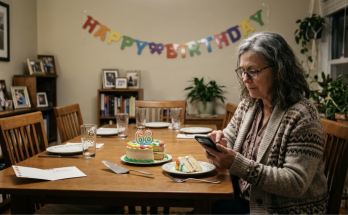
"Yesterday, you couldn't come to my birthday dinner because Monica wasn't feeling well."
His eyes narrowed.
"Seriously? We're back to that?"
"Yes."
"It was one dinner."
One dinner.
I remember how casually he said it.
As though that explained everything.
I had turned sixty-eight.
I had prepared a birthday meal and set the table for five.
Five places.
One for me.
One for Jeffrey.
One for Monica.
And two for my grandchildren, Oliver and Stella.
By the end of the evening, I was the only person sitting there.
Jeffrey had said Monica had a migraine.
I had accepted his explanation because that was what I always did.
I didn't ask too many questions.
I didn't complain.
I didn't want to be the difficult mother.
Then I learned where they had actually gone.
Bellini's.
A restaurant.
Not a hospital.
Not a pharmacy.
A restaurant.
And they had used the credit card I had given them for emergencies.
I looked at Jeffrey.
"How much did you spend at Bellini's?"
He glanced toward his wife.
Monica folded her arms.
"What does that have to do with anything?"
"Quite a lot, actually."
Jeffrey sighed.
"Mom, can you stop?"
"Was dinner expensive?"
"Why are you asking?"
"Because I would like to understand how you could afford an evening at a restaurant but couldn't spare an evening with me."
He looked away.
I continued.
"Did you spend a hundred and fifty dollars? Two hundred?"
"That's not the point."
"It is to me."
Monica stepped forward.
"We have two children. Sometimes we want an evening without them."
I nodded.
"Of course you do."
Her expression changed slightly.
She hadn't expected agreement.
"Then you should understand."
"I understand needing time together."
I looked at Jeffrey.
"What I don't understand is why that evening needed to be paid for with my emergency card."
Jeffrey rubbed his forehead.
"All right. We shouldn't have charged dinner to it."
That was the closest thing to an admission I had heard.
I waited.
He continued.
"But freezing the card was excessive."
I said nothing.
"You could've called and talked to me."
I looked down at the book resting on my lap.
Then I looked back at him.
"You called me from the restaurant when the payment stopped working."
He opened his mouth.
Nothing came out.
I remembered that telephone call.
I remembered the irritation in his voice.
He hadn't asked whether I was all right.
He hadn't asked how my birthday had gone.
He had wanted his card working again.
That was the whole conversation.
A problem had appeared.
And he expected me to fix it.
Monica turned toward the driveway.
"Jeffrey, this is getting us nowhere."
He looked at her.
She gave him a look I recognized.
It was the expression people exchanged when they had already discussed something and didn't want to explain it to the person standing nearby.
"Tell her why we're here," Monica said.
I lifted my head.
"There's another reason?"
Jeffrey shifted from one foot to the other.
I waited.
He finally spoke.
"We need access to the money."
"What money?"
"The money market account."
There it was.
I had known they were upset about the credit card.
I hadn't realized that wasn't their biggest concern.
The birthday dinner had brought us to this moment.
But the money was what had brought them to my door.
I set my paperback on the little table beside my chair.
"What about the account?"
Jeffrey looked irritated.
"We can't use it."
"That's correct."
"What did you do?"
"I transferred my funds into an account held in my name."
He stared at me.
"All of it?"
"The money that belonged to me."
Monica shook her head.
"That's not how we understood the arrangement."
I turned toward her.
"Then perhaps we should discuss what the arrangement actually was."
She didn't respond.
The money had come from two places.
Bruce's life insurance.
And the sale of his boat.
Bruce was my husband.
He had been gone for three years.
Even now, saying that felt strange.
Three years sounded like a long time.
Some mornings, it still felt as though he had simply stepped into the next room.
The insurance proceeds were supposed to help protect my future.
The boat had been something Bruce loved.
Selling it had been difficult.
But keeping it no longer made sense after he died.
I had taken part of that money and made it available as an emergency reserve for our family.
At the time, I thought it was a loving decision.
Jeffrey and Monica had children.
They had expenses.
And I knew that unexpected things could happen.
A medical bill.
A broken appliance.
A necessary repair to their home.
I wanted them to know they wouldn't be abandoned if life became difficult.
That was all.
I had never intended the account to pay for ordinary spending whenever their household budget became uncomfortable.
But somewhere along the way, my intentions stopped mattering.
They began treating the money as available.
Not occasionally.
Not carefully.
Available.
I looked at my son.
"When we arranged that account, what did I tell you it was for?"
He frowned.
"Family expenses."
"Emergencies."
"That's basically the same thing."
"No, Jeffrey. It isn't."
He made an impatient sound.
I continued.
"An unexpected medical expense is an emergency. A necessary repair that cannot be delayed is an emergency."
Monica looked away.
"Household bills can be emergencies."
"Sometimes."
I let that word settle.
"That doesn't make every expense my responsibility."
Jeffrey stepped closer to the door.
"We have payments coming out of that account."
"Then you'll need to make other arrangements."
"You can't expect us to sort everything out immediately."
I studied his face.
He sounded genuinely shocked.
Not because I had lost money.
Not because I was frightened about retirement.
Because the money he had counted on was no longer available.
"Those payments are yours to manage," I said.
"We've been using that account."
"I know."
"You knew that."
"Yes."
"Then how can you suddenly stop it?"
I took a slow breath.
I had asked myself almost the same question the night before.
How could I change something that had been happening for so long?
How could I say no now when I had said yes so many times?
Looking back, those were the wrong questions.
I should have asked why I believed an arrangement could never change simply because someone had grown comfortable with it.
"Because I no longer agree to it."
Jeffrey shook his head.
"You can't make decisions like this without talking to us."
I felt something settle inside me.
Not anger.
Something quieter.
"These are my accounts, Jeffrey."
He stared.
"I understand that."
"Then you understand I can decide how my money is used."
Monica stepped closer.
"You're doing this because we missed your birthday."
"No."
"Of course you are."
"I started thinking seriously because of what happened on my birthday."
I looked at both of them.
"But the problem didn't begin yesterday."
Jeffrey frowned.
"What's that supposed to mean?"
"It means I've been paying for things I never agreed to pay for."
Monica's bracelet caught the light as she folded her arms again.
I noticed the diamonds.
Then her handbag.
Then the SUV waiting in my driveway.
I wasn't angry that they owned nice things.
People were entitled to enjoy what they earned.
What bothered me was the expectation that I should keep contributing whenever they wanted more than they could comfortably afford.
Monica followed my eyes.
"What are you looking at?"
"Nothing that belongs to me."
Her face tightened.
"You make it sound like we're taking advantage of you."
I rested my hands on the arms of my chair.
"I'm telling you what I'm willing to pay for from now on."
"You're making us look selfish."
"I haven't asked anyone else to judge you."
That was true.
I hadn't called relatives.
I hadn't told the neighbors.
I hadn't asked anybody to take sides.
I had simply changed my financial arrangements and replaced my locks.
Yet standing there, Jeffrey and Monica behaved as though I had publicly humiliated them.
For a moment, the three of us were quiet.
Then Jeffrey spoke.
"Do you understand what this does to me?"
I looked at him.
"What does it do?"
"It's embarrassing."
That word stayed with me.
Embarrassing.
He was embarrassed because his mother's credit card had stopped paying for his purchases.
He was embarrassed because he could no longer depend on money he hadn't earned.
I wanted to ask him whether embarrassment was really the worst thing that had happened in our family that week.
Instead, I thought about my birthday table.
Five places.
Four empty.
A meal prepared for people who had chosen to be somewhere else.
"How do you think I felt last night?" I asked.
He said nothing.
"How do you think it felt eating birthday dinner by myself?"
Jeffrey turned his face away.
I watched him.
I had spent years giving him explanations whenever he was disappointed.
I explained why I couldn't visit.
Why I was tired.
Why I needed time.
Why I couldn't always help.
Even when I was the one being hurt, I made sure he felt understood.
That morning, I stopped explaining.
I let the question remain between us.
He didn't answer.
And I didn't rescue him from the silence.
Click here to continue reading: PART 2: When My Son Brought Up His Dead Father to Make Me Feel Guilty, I Remembered What My Husband Had Wanted for Me
My Son Arrived at My Front Door Expecting His Old Key to Work, but I Had Finally Made One Decision Without Him
Part 1 of 15