I kept thinking about the difference between being needed and being loved.
Margaret had helped me see it.
Bruce had tried to warn me about it.
And Jeffrey had forced me to confront it.
For years, I'd treated those two things as though they meant the same thing.
If my son needed me, I mattered.
If I could solve his problems, I was doing my job.
If I could make his life easier, I was being a good mother.
I hadn't realized how much of my own peace I'd attached to those beliefs.
Now the money was no longer available to him in the same way.
And I had to face a question I'd avoided.
Would Jeffrey still want the same relationship with me when I wasn't paying for so much of his life?
I didn't know.
That was the hardest part.
The financial decisions were clear.
The emotional ones weren't.
I could protect my savings.
I could change the locks.
I could stop the credit card.
But I couldn't make my son understand why I needed to do those things.
He would have to decide that for himself.
One morning, I sat at the kitchen table with my paperback.
It was the same book I'd been reading when Jeffrey arrived at the storm door.
I had almost finished it.
That surprised me.
For a long time, I could barely read a few pages without being interrupted.
Or interrupting myself.
Thinking about bills.
Worrying about Jeffrey.
Wondering whether Monica would call.
Now I had time to sit quietly.
I should have been pleased.
I was.
But I also felt sad.
I hadn't realized how little time I'd allowed myself simply to exist without being useful to somebody.
I looked toward the living room.
Bruce's chair was visible through the doorway.
I remembered all the evenings we'd spent there.
Sometimes we talked for hours.
Sometimes we barely spoke.
He read.
I read.
We drank coffee.
It was enough to be together.
I missed that.
Not the money we had.
Not the things we owned.
The ordinary companionship.
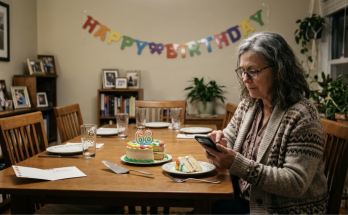
That was what I'd wanted on my birthday.
I hadn't expected a celebration that cost hundreds of dollars.
I hadn't asked for presents.
I had cooked a meal and set the table.
Five places.
Four empty chairs.
I could still picture them.
Jeffrey had called to say Monica was ill.
I had believed him.
I had been disappointed, but I'd tried to be understanding.
Then I learned about the restaurant.
Bellini's.
The emergency card.
The interrupted payment.
And the call demanding that I make the card work again.
I remembered sitting there afterward.
Feeling foolish.
Feeling forgotten.
Wondering whether I was being unreasonable because I was so hurt.
I wasn't angry that Jeffrey and Monica wanted an evening together.
Parents needed time away from their children.
I understood that.
What hurt was that my son hadn't respected me enough to be honest.
And that when the financial arrangement stopped working, he suddenly had time to contact me.
I had been useful again.
Just not important enough to spend the evening with.
That thought had stayed with me.
I closed my book.
Then I stood up and walked into the kitchen.
There was nothing I needed to do.
I opened a cupboard.
Closed it.
Then laughed quietly at myself.
For years, whenever I felt uncomfortable, I found something useful to occupy my hands.
A meal.
A bill.
An errand.
Something that needed attention.
Now I was learning to sit with feelings I couldn't immediately fix.
I returned to the table.
My phone was beside my coffee.
No new messages.
I didn't call Jeffrey.
I wanted to.
I wanted to hear his voice.
But I also wanted him to have the space he'd said he needed to work out his finances.
I had to let him do that.
He was a grown man.
A husband.
A father.
He needed to decide how to manage his household without depending on my savings.
That didn't mean I stopped loving him.
It meant I was finally allowing him responsibility for his own decisions.
I thought about Monica.
She had been angry during our conversation.
She'd accused me of withdrawing support.
She'd suggested the children would suffer.
I had found that painful.
But I didn't want to spend my days resenting her.
She was Jeffrey's wife.
Oliver and Stella's mother.
Someone who had her own worries and frustrations.
I could acknowledge that without agreeing to pay her household expenses.
For years, I'd been afraid that setting limits would damage our relationship beyond repair.
Now I understood that refusing money and rejecting a person were different things.
I wasn't refusing Monica a place in my family.
I was refusing an arrangement I could no longer accept.
I hoped she would eventually understand that.
But I couldn't force her to.
A few days later, I spoke with Margaret again.
She asked whether I'd been reading.
I laughed.
"Yes."
"Good. You've always loved your books."
"I know."
"You stopped making time for them."
I looked at the paperback beside me.
"You're right."
She asked about the botanical gardens.
I told her I'd enjoyed the visit more than I expected.
She sounded pleased.
"We should go again."
"I'd like that."
After we finished talking, I sat quietly.
I thought about how easy that conversation had been.
Margaret hadn't needed money.
She hadn't asked for anything complicated.
She wanted to know how I was.
And she wanted to spend time with me.
It was such a simple thing.
Yet it reminded me of what I'd been missing.
I didn't need every relationship to be free of problems.
That wasn't realistic.
Families disagreed.
People became frustrated.
Sometimes they disappointed each other.
But I wanted the people in my life to remember that I had feelings, too.
That I had a future.
That my time mattered.
That my home wasn't a place they could enter without asking.
And that my savings weren't available simply because somebody wanted something.
I didn't think those expectations were unreasonable anymore.
That was a change.
I had spent years questioning myself whenever Jeffrey was unhappy.
Now I could feel sorry that he was struggling without believing I had to solve the struggle.
The difference mattered.
I thought about the house purchase again.
Jeffrey and Monica had hoped to use my money toward a down payment.
They hadn't discussed it with me first.
They'd made inquiries.
Explored options.
And assumed I'd eventually agree.
I wondered what they were doing now.
Perhaps reconsidering the purchase.
Perhaps reviewing their own spending.
Perhaps feeling angry with me.
I didn't know.
And for once, I didn't try to find out.
Their finances belonged to them.
Mine belonged to me.
That was the arrangement I wanted.
I looked at the notes from Daniel.
The account review was moving forward.
There were still details to discuss.
The authorized-user arrangements.
The beneficiary information.
The possible trust for Oliver and Stella.
I hadn't signed anything I didn't understand.
I hadn't promised money I might need for myself.
And I hadn't reversed the decisions I'd already made.
I was proud of that.
Quietly proud.
Not because I'd defeated anybody.
There wasn't a winner in this situation.
My son was hurt.
His wife was angry.
I was disappointed.
Our family had been forced to look at things we'd avoided for years.
There was nothing pleasant about that.
But sometimes an uncomfortable truth was better than an arrangement everyone pretended was working.
I thought about Oliver.
His voice message.
His question about whether I was still coming to soccer.
I remembered how relieved he sounded when I said yes.
Then Stella.
Her small hand in mine.
Her question about pancakes.
Those memories helped me understand something important.
The children didn't need me to be a second checking account for their parents.
They needed me to be their grandmother.
They needed consistency.
Kindness.
Attention.
The familiar things that made them feel loved.
I could provide those things without reopening the credit card.
I could be present in their lives while keeping my finances protected.
That was what I wanted the trust discussion to support.
Not a way to make their parents feel punished.
A way to provide for the children without repeating the same mistakes.
I knew I needed legal advice before making any final arrangement.
I was comfortable with that.
I had stopped believing every decision needed to be made immediately.
Some things deserved time.
Careful thought.
And clear information.
Bruce would have approved.
I smiled as I remembered him sitting at his desk.
Reading documents.
Checking numbers.
Asking questions.
He had spent years preparing for a retirement we hadn't been able to enjoy together.
I couldn't change that.
But I could honor the care he'd put into protecting our future.
Not by giving everything away.
By making sure the money served the purpose we'd intended.
I walked into his study.
The filing cabinet stood in the corner.
I opened the second drawer.
Then I took out his notebook.
I didn't need to search for the page anymore.
I knew where it was.
Eleven months before his death.
The note about my future.
The warning about Jeffrey.
I read it slowly.
Bruce had loved our son.
I had never doubted that.
But he had seen the way Jeffrey sometimes expected us to make things easier for him.
And he'd understood that after his death, I might find it difficult to refuse.
He'd been right.
For three years, I'd struggled with exactly that.
I didn't want to disappoint Jeffrey.
I didn't want to feel alone.
And I didn't want anyone accusing me of being selfish.
So I kept helping.
Even when I was uncomfortable.
Even when the requests became ordinary.
Even when I began worrying about how much money was leaving my accounts.
I had told myself it was love.
Part of it was.
But part of it was fear.
Fear that if I stopped giving, I would stop being needed.
And if I stopped being needed, perhaps I would stop being important.
I looked down at Bruce's handwriting.
I wished I could tell him that I'd finally understood.
Not everything.
I still had a great deal to learn.
But enough to begin making different choices.
I returned the notebook to the folder.
Then I closed the drawer.
That evening, I sat on the porch again.
The front door was behind me.
The new lock was secure.
My paperback lay open across my knees.
I thought about Jeffrey standing outside the storm door with his old key.
He had expected the door to open.
When it didn't, he'd been angry.
He hadn't understood that I wasn't trying to keep him out of my life.
I was trying to make him recognize that my home belonged to me.
The same was true of the money.
I wasn't trying to make him suffer.
I wasn't trying to humiliate Monica.
I wasn't trying to hurt Oliver or Stella.
I wanted an arrangement that allowed us to remain family without expecting me to surrender my financial security.
I knew that might take time.
Jeffrey had become accustomed to asking.
I had become accustomed to giving.
We were both learning something unfamiliar.
But I couldn't return to the old arrangement simply because the new one felt uncomfortable.
That would only bring us back to the same place.
Another request.
Another argument.
Another evening when I wondered whether my son valued me for anything beyond what I could provide.
I didn't want to live like that.
I wanted something better for all of us.
I wanted Jeffrey to manage his household with confidence.
I wanted Monica to understand that my financial independence wasn't a threat to her family.
I wanted Oliver and Stella to grow up knowing I loved them.
And I wanted to spend my remaining years with enough peace to enjoy the life Bruce and I had worked so hard to build.
I couldn't guarantee any of those outcomes.
But I could make choices that gave them room to happen.
I looked down at my book.
Then I turned another page.
The house was quiet.
My phone wasn't ringing.
Nobody was standing outside demanding access to an account.
For once, I wasn't waiting for somebody else's problem to determine what happened next.
I had made my decisions.
The rest of my family would have to make theirs.
And for the first time, I understood that loving them didn't mean making those decisions for them.
Click here to continue reading: PART 13: When My Son Finally Came to Talk Without Asking for Money, I Realized How Much Damage Our Old Arrangement Had Done to Us Both
My Son Arrived at My Front Door Expecting His Old Key to Work, but I Had Finally Made One Decision Without Him
Part 12 of 15