At 8:04 the next morning, my brother called me screaming from my driveway.
“CLAIRE! WHAT THE HELL DID YOU DO?”
I held the phone away from my ear and stared through the kitchen window.
Dylan stood barefoot on the cold pavement in yesterday’s jeans, his hair wild, his face nearly purple with rage. Behind him, a tow truck had hooked itself to the pickup that had spent the night half-buried inside what used to be my sunroom.
Beside the tow truck stood a police officer.
My father’s car came flying around the corner thirty seconds later.
That was when I knew the morning was about to get interesting.
But none of us understood yet how much worse it was going to become.
Less than twelve hours earlier, my family had still believed I was the weak one.
The responsible one.
The boring one.
The daughter who paid bills quietly, fixed problems, swallowed insults, and eventually gave in because keeping the peace was easier than fighting.
They had mistaken my silence for surrender.
That mistake began at Dylan’s twenty-fifth birthday dinner.
After Mom died seven years earlier, her $68,000 life insurance policy had been divided equally between Dad and me.
Dad put his $34,000 into savings.
I used mine toward a down payment on a modest three-bedroom house on Delmare Street.
Nothing fancy.
But it was mine.
I worked dispatch for a trucking company and earned about $48,000 a year. I skipped vacations, packed lunches, drove the same car for years, and learned how to stretch every paycheck until eventually I paid off my dark-gray SUV.
Then I built the thing I loved most about the house.
My sunroom.
I ordered a kit, watched tutorials, made mistakes, redid entire sections, and spent countless weekends fitting tempered glass into aluminum framing.
By the time it was done, I had invested nearly $12,000.
Mom’s jade plant sat by the east-facing glass.
She had owned it for years.
After she died, caring for it became one of those tiny rituals that somehow kept grief from swallowing me whole.
Every morning, I checked its soil before work.
Every night, I saw it silhouetted against the sunset.
Meanwhile, I helped Dad and Dylan constantly.
Dad’s phone bill: $85 every month.
Dylan’s auto insurance: $140.
I paid both.
Neither thanked me.
I didn’t complain.
Then Dylan turned twenty-five.
Dad hosted dinner at his rental house. Dylan’s girlfriend Megan was there, along with two men from the tire shop where Dylan worked part-time.
I brought Dylan a canvas jacket and a $200 gift card.
He opened the jacket.
“Cool.”
Then the gift card.
“Thanks.”
Then he looked at me.
“I want your SUV.”
I laughed because I thought he was kidding.
Nobody else laughed.
“You barely use it,” Dylan said. “You drive to work and home. I actually have places to be.”
“No.”
His jaw tightened.
“Claire, I’m serious.”
“So am I.”
He leaned back in his chair.
Then came the line I would remember for a very long time.
“It was bought with Mom’s money anyway.”
“It wasn’t,” I said. “Mom’s money went into the house. I paid for the SUV.”
Dylan smiled.
“Then give me the house.”
One of his friends coughed into his hand.
Megan stared at her plate.
Dad placed his fork down carefully.
“Don’t be selfish,” he said. “Your brother is asking for one thing.”
I looked at him.
“One thing?”
“He needs a reliable vehicle.”
“He has a truck.”
“That truck is falling apart.”
“That isn’t my responsibility.”
Dad’s expression hardened.
“You’ve always thought you were better than him.”
That hurt more than I wanted it to.
“I’ve spent two years paying his insurance.”
Dylan blinked.
Dad’s eyes sharpened.
Apparently, Dylan hadn’t known.
I continued.
“And your phone bill.”
Dad’s face changed.
Only for a second.
But I saw it.
Embarrassment.
Then anger.
“Family helps family.”
“I have.”
“Then keep helping.”
The words hung there.
Something inside me quietly broke.
Not dramatically.
No shouting.
No tears.
Just a clean internal snap.
“If you want something from me,” I said, “ask. Don’t decide that it already belongs to you.”
I stood.
Dad laughed under his breath.
“There she goes. Saint Claire.”
I left.
At home, I made tea.
I checked Mom’s jade plant.
Then I went to bed.
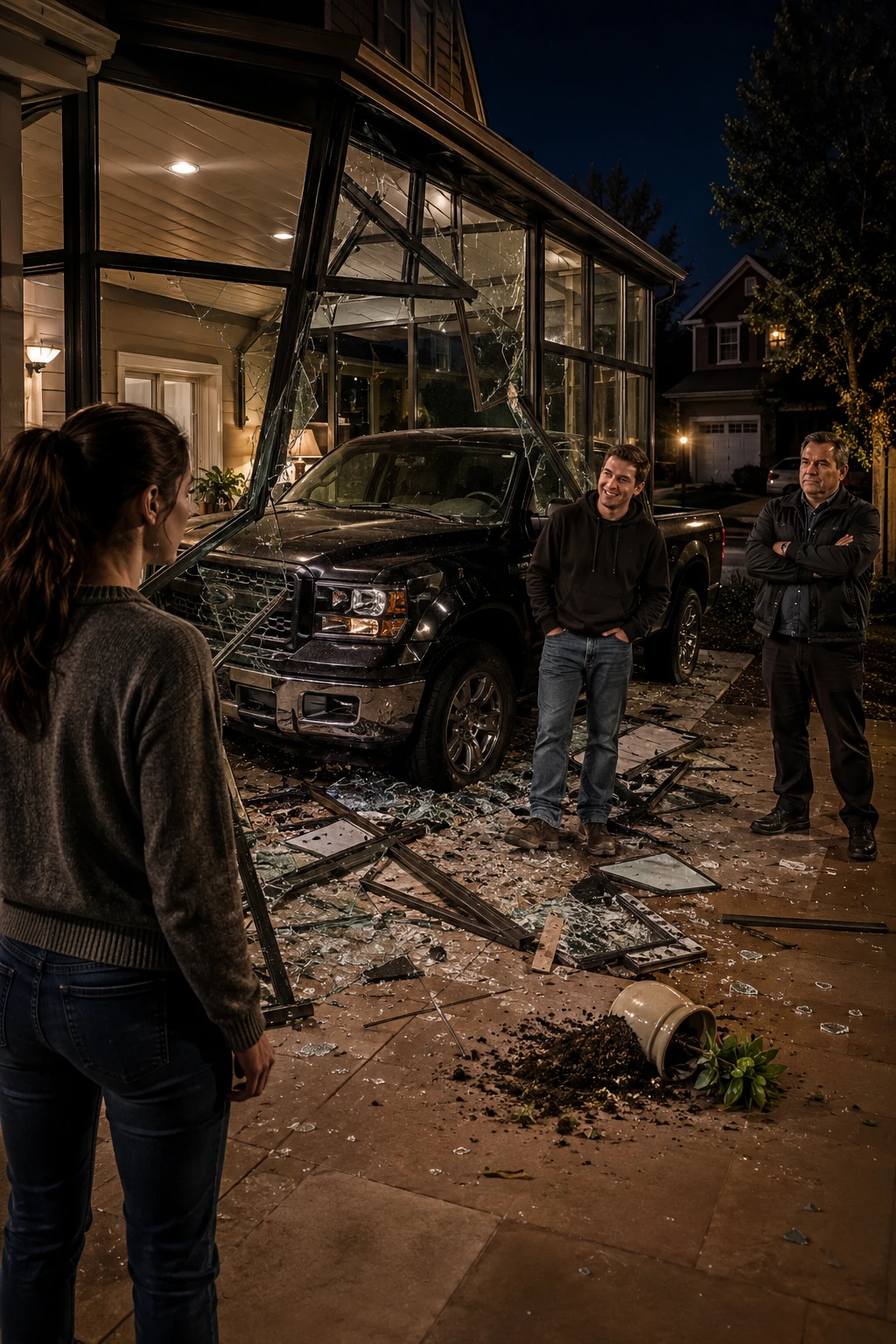
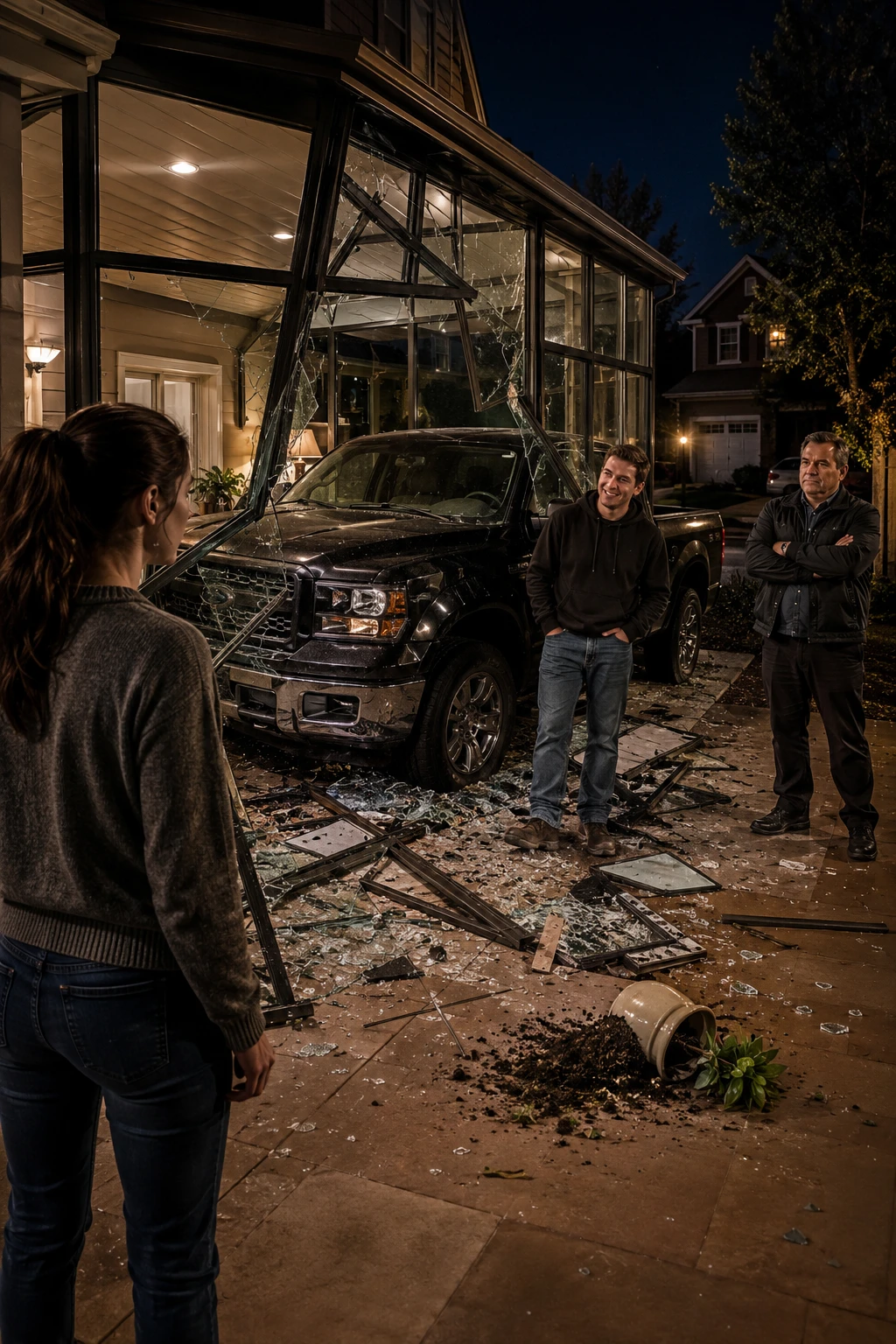
At 10:14 p.m., a metallic explosion ripped through the back of my house.
I ran into the kitchen.
Dylan’s truck was halfway through my sunroom.
Glass glittered everywhere.
Aluminum beams were twisted around his hood.
The ceramic tiles I had laid myself were split beneath his front tires.
And Mom’s jade plant lay upside down in a pile of soil.
For several seconds, I couldn’t breathe.
Dylan climbed from the cab.
He looked at the destruction.
Then smiled.
“Guess my foot slipped.”
That was when I noticed Dad’s car parked at the curb.
He entered through the gate only after Dylan had climbed out.
He surveyed the wreckage without surprise.
Then he looked at me.
“A stingy nobody like you doesn’t deserve nice things.”
They left.
Just walked away.
I knelt in the glass.
My hands were shaking, but I carefully lifted the jade plant from its shattered pot.
Then I did what dispatch had trained me to do.
Document first. React later.
I photographed everything.
Tire tracks.
Damage.
Broken glass.
The truck’s position.
License plate.
Time stamps.
Then I called the police.
I called my insurance company.
And I called my next-door neighbor, Mrs. Alvarez.
She answered sleepily.
“Claire?”
“Do your garage cameras see my backyard gate?”
Silence.
Then: “Yes.”
My heart started pounding.
“Can you check tonight?”
Twenty minutes later, she knocked on my door wearing slippers and holding her tablet.
The footage showed Dylan’s truck turning into my driveway.
But it showed something else too.
Dad’s car had arrived four minutes earlier.
He walked into my backyard.
He inspected the sunroom.
Then Dylan arrived.
The two of them talked beside the truck.
Dad pointed directly toward the glass wall.
Dylan climbed in.
Thirty seconds later, he reversed into my house.
The officer who arrived watched the video twice.
“That doesn’t look accidental,” he said.
“No.”
“Do you want to pursue charges?”
I looked at the jade plant sitting inside an old mixing bowl on my kitchen counter.
“Yes.”
That led to 8:04 a.m.
Dylan had returned for his truck.
Instead, he found police and a tow operator.
He was screaming into the phone when Dad arrived.
“Get out here!” Dad yelled toward my house. “Fix this!”
I stepped onto the porch.
The officer turned.
“Ma’am, stay there, please.”
Dad pointed at me.
“This is family business.”
The officer’s expression didn’t change.
“Property damage is police business.”
Dylan shouted, “She’s lying! I slipped!”
Mrs. Alvarez appeared on her porch.
“With your father directing traffic?”
Dylan went silent.
The officer told Dad and Dylan they needed to answer questions.
Dad immediately tried a different tactic.
“Claire,” he said softly, “we can work this out.”
It was astonishing how quickly cruelty became tenderness when consequences arrived.
“No.”
His face hardened again.
“You’re really going to ruin your brother’s life over a room?”
“You ruined the room.”
Dylan stepped toward me.
“You think you’re so damn smart.”
The officer moved between us.
That should have been the end.
It wasn’t.
Because when the tow operator started pulling Dylan’s truck from the wreckage, something fell from beneath the passenger seat.
A battered black metal box.
It hit the pavement and popped open.
Papers scattered everywhere.
Dad froze.
Not Dylan.
Dad.
The reaction was so immediate that everyone noticed.
He lunged forward.
“Those are mine.”
The officer blocked him.
“Sir.”
“It’s personal.”
One page had landed beside my foot.
I picked it up.
The first thing I saw was my mother’s name.
Evelyn Mercer.
Then a bank logo.
Then a number.
$34,000.
My stomach tightened.
Dad snatched the paper from my hand.
“You don’t need to see that.”
The officer looked at him.
“Why are your documents in your son’s truck?”
Dylan stared at Dad.
“What documents?”
Dad said nothing.
Megan arrived ten minutes later.
Apparently Dylan had called her too.
She pushed through the small crowd gathering near the driveway.
“What happened?”
Then she saw the papers.
Her face went white.
Not surprised.
Terrified.
Dad noticed.
“You,” he said.
Megan backed away.
Dylan turned toward her.
“What?”
She started crying.
“I’m sorry.”
“For what?”
Dad moved toward her.
“Don’t.”
The officer stopped him.
“Sir, stay where you are.”
Megan looked directly at me.
“Claire, there’s something you need to know.”
Dad shouted, “Shut your mouth!”
Everyone went still.
Megan had been dating Dylan for almost three years.
She knew his passwords.
His habits.
His secrets.
And apparently, weeks earlier, she had found Dad and Dylan going through old financial documents in the garage.
She had photographed them because something felt wrong.
“What documents?” I asked.
She swallowed.
“Your mom’s insurance paperwork.”
I stared at her.
“That policy was settled seven years ago.”
“No,” Megan whispered. “Not that policy.”
Dad closed his eyes.
My blood went cold.
“There was another one.”
Nobody spoke.
Megan pulled out her phone.
“She had a second life insurance policy through her employer.”
My knees almost gave out.
“How much?”
Megan looked at Dad.
Then at me.
“Two hundred and fifty thousand dollars.”
I laughed once.
A strange, empty sound.
“That’s impossible.”
Megan showed me a photograph.
My mother’s name.
Her employer.
Policy number.
Beneficiary designation.
The original beneficiary had been:
Claire Mercer and Dylan Mercer, equal shares.
I looked at Dylan.
He was staring at the phone too.
He hadn’t known.
His face told me that much.
Then Megan swiped to the next image.
A beneficiary-change form.
Submitted twelve days before Mom died.
The beneficiaries had been changed.
To one person.
Gordon Mercer.
My father.
Dylan whispered, “Dad?”
Dad looked suddenly old.
The officer took the phone.
Megan continued.
“I found emails too. Your mom was trying to reverse it.”
Dad shouted, “You have no idea what you’re talking about!”
“I read them.”
“She was confused!”
“She wrote to HR saying she had never authorized the change.”
The world tilted.
Mom had died after a fast, brutal illness.
During her final month, she had been heavily medicated.
Dad had handled almost everything.
Bills.
Forms.
Phone calls.
Documents.
And apparently something else.
The police officer called for a supervisor.
Dad stopped arguing.
That frightened me more than his shouting had.
Dylan looked at him.
“You stole from us?”
Dad said nothing.
“You stole Mom’s insurance?”
Still nothing.
Then Dylan’s anger exploded.
He shoved Dad.
The officer grabbed Dylan.
“Back up!”
“You told me Claire got everything!” Dylan screamed.
I turned toward him.
“What?”
Dylan looked at me, breathing hard.
“He said Mom left you the house money because you were her favorite. He said you had more money hidden away. He said you owed me.”
I stared at Dad.
Every ugly moment suddenly rearranged itself.
The resentment.
The entitlement.
The constant comments about me having more.
Dad had spent years feeding Dylan a lie.
Keeping us angry at each other.
Because as long as Dylan blamed me, nobody looked too closely at him.
The destroyed sunroom hadn’t really been about my SUV.
It had been about a story Dad had built for years.
A story where I was selfish, Dylan was cheated, and Dad was innocent.
But the final shock came three weeks later.
The investigation expanded quickly.
The second insurance policy existed.
The beneficiary-change signature was suspicious.
HR had records of Mom disputing it.
And the payout had indeed gone to Dad.
But detectives found another document.
One that nobody expected.
A letter.
Handwritten by my mother.
It had been stored with an attorney Dad apparently never knew she had consulted.
The attorney contacted me after learning about the investigation.
I sat in his office with my hands clenched together while he placed an envelope in front of me.
My name was written on it.
Claire.
Mom’s handwriting.
I started crying before I even opened it.
The letter was dated nine days before she died.
She wrote that she believed Gordon had altered her insurance paperwork.
She had reported it.
But then she wrote something stranger.
“Claire, if Gordon ever tells Dylan that you received more than he did, do not believe him.”
I read the sentence three times.
Then continued.
“There is something Gordon does not know.”
My heart stopped.
The attorney slid another document toward me.
A DNA report.
For several seconds, I didn’t understand.
Then I saw the names.
My mother.
Dylan.
And another man.
Not Gordon.
I looked up.
The attorney spoke quietly.
“Your mother discovered the truth shortly before she became ill.”
I couldn’t breathe.
“Dylan isn’t Dad’s son?”
“No.”
I thought that was the twist.
It wasn’t.
The attorney turned the page.
The biological father’s name was Thomas Vale.
I knew that name.
Everyone in our town did.
Thomas Vale had owned three car dealerships and a large commercial property company.
He had died two years earlier.
Without children.
Or so everyone believed.
His estate—worth millions—had been tied up in probate because no direct heir had been identified.
I stared at the attorney.
“No.”
He nodded.
“Your mother apparently had a brief relationship with Mr. Vale during a separation from your father. Dylan is very likely his biological son.”
My mind flashed to my brother barefoot in my driveway, screaming because his broken pickup was being towed.
Dylan.
The tire-shop employee.
The man demanding my paid-off SUV.
The brother who had driven a truck through my sunroom because he believed I had stolen the life he deserved.
He might have inherited millions.
But Mom’s final paragraph changed everything.
“Do not tell Dylan unless you absolutely must. Gordon has spent his life teaching him that love means being given things. If Dylan ever learns what Thomas left behind, I’m afraid money will finish what Gordon started.”
I closed my eyes.
Months passed.
Dad was charged in connection with the insurance fraud and the destruction of my property.
Dylan took a plea agreement for the sunroom incident.
He paid restitution.
He lost his job.
Megan left him.
For the first time in years, he had nobody fixing his problems.
And strangely, that changed him.
He got another job.
Then a second one.
He started making payments.
One afternoon, nearly a year after the crash, Dylan stood outside my newly rebuilt sunroom.
He looked thinner.
Older.
Humiliated.
“I was awful to you,” he said.
I didn’t answer.
“I believed Dad because it was easier than admitting I was jealous.”
Still I said nothing.
He looked through the glass toward Mom’s jade plant.
It had survived.
New leaves had grown from the damaged stems.
“I don’t expect you to forgive me.”
He placed an envelope on the patio table.
Inside was the final restitution payment.
Then he turned to leave.
“Dylan.”
He stopped.
I had spent months wondering whether to tell him.
Mom had wanted to protect him from the money.
But maybe the secret wasn’t mine to keep.
“There’s something you need to know.”
I told him everything.
Thomas Vale.
The DNA test.
The estate.
The possibility that Dylan was the legal heir to millions.
He didn’t speak for almost a minute.
Then he sat down hard.
Finally, he laughed.
Not happily.
“I destroyed your house over a used SUV.”
“Yes.”
“And I might be a millionaire.”
“Possibly.”
He covered his face.
Then he did something I never expected.
He cried.
Not because of the money.
Because of Mom.
“I wish she had told me.”
I sat beside him.
“I think she was afraid of what the money would do to you.”
He wiped his eyes.
“She was right.”
Six months later, the DNA evidence and probate proceedings established Dylan as Thomas Vale’s biological son and primary heir.
The inheritance was enormous.
Just over $6.3 million after taxes, claims, and legal expenses.
Dad heard about it from prison.
He immediately wrote Dylan a twelve-page letter.
Apologies.
Excuses.
Memories.
Promises.
And, buried on page nine, a request for money.
Dylan mailed the letter back unopened.
Then he came to my house.
He handed me a small box.
Inside were keys.
I stared at him.
“What are these?”
“A car.”
“No.”
He laughed.
“Relax. Not for you.”
He pointed toward the driveway.
Parked beside my old dark-gray SUV was a brand-new pickup.
He looked at it for a moment.
Then handed the keys to a stunned young man standing beside him.
One of his coworkers.
A single father whose truck had died the week before.
The man started crying.
Dylan looked at me.
“I figured if I’m going to learn how to give somebody something, I should probably start by giving it to someone who actually needs it.”
I smiled.
Mom’s jade plant stood in the sunlight behind us.
Alive.
Growing.
And in that moment I finally understood something.
The most valuable thing my brother inherited wasn’t six million dollars.
It was the chance to discover, before it was too late, that our father had lied to him about what he deserved.
Dad had spent twenty-five years teaching Dylan that love meant taking.
Mom’s final secret gave him enough money to take anything he wanted.
But losing everything first had taught him something far more important.
For the first time in his life, Dylan chose to give.