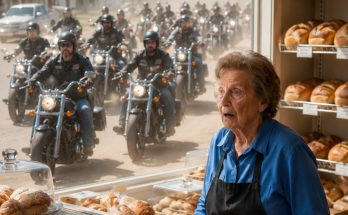
The moment Mason opened the bakery door, the noise on Main Street disappeared.
Not because the street had been loud.
Because ninety-six riders straightened at once.
Eleanor stopped beneath Daniel’s brass bell.
The morning air carried exhaust, cooling metal, fallen leaves, and the cinnamon drifting from the bakery behind her.
Maple Glen had assembled on both sidewalks.
Sheriff Harold Price stood beside his cruiser with his arms folded.
Ed Mercer had abandoned the hardware store completely.
Marjorie from the florist held the same bucket she had brought outside nearly an hour earlier, though the flowers were beginning to lean.
Eleanor looked at Mason.
“What did you tell these people to do?”
“Nothing.”
“That answer makes me nervous.”
“Good.”
He stepped down from the bakery entrance.
Eleanor followed.
The riders formed a loose semicircle without military precision or theatrical timing. They simply moved enough to let her see them.
Mason raised his voice.
“This is Eleanor Whitaker.”
A murmur moved through the group.
Several people smiled.
One man removed his cap.
A woman near the front wiped at one eye before Eleanor had done anything.
Eleanor leaned toward Mason.
“I dislike whatever you’ve arranged.”
“You’ll survive.”
She gave him a look.
“That sounded familiar,” he added.
Before Eleanor could answer, the woman in medical scrubs stepped forward.
She appeared to be in her early forties, with close-cropped hair and a silver ring through one eyebrow.
“My name’s Keisha Warren.”
Eleanor remembered.
“You were thrown out by your family.”
Keisha looked startled.
Then she glanced at Mason.
“You told her?”
“We’ve covered some ground.”
Keisha smiled.
“Mason gave me a job answering phones when I was nineteen.”
Eleanor nodded.
“He says you gave him one too.”
“Against my better judgment.”
Keisha laughed.
“I believe that.”
She told Eleanor she had eventually become an emergency-room nurse.
The job at Caldwell Cycle Works had paid for food while she finished prerequisites.
Second Mile later helped with tuition.
“Now I work with young people coming into the ER who don’t have safe homes.”
Eleanor felt Mason watching her.
She looked at Keisha.
“That’s difficult work.”
“Yes.”
“Thank you for doing it.”
Keisha swallowed.
“No. That’s what I wanted to say to you.”
Eleanor frowned.
Keisha continued.
“Mason told me, years ago, that when someone shows up hungry, you feed them before you make them prove they deserve help.”
Eleanor looked sharply at Mason.
He lifted both hands.
“I paraphrased.”
“You’ve been quoting me?”
“For decades.”
“That is a terrible responsibility.”
Laughter rippled through the riders.
Another man came forward.
Aaron.
He had been seventeen when Mason met him after juvenile detention.
Now he owned a small electrical contracting company employing twelve people.
“Four came through Second Mile,” he said.
Eleanor looked at him.
“You hire them?”
“If they show up.”
“And if they don’t?”
“I go find them once.”
“Once?”
“Sometimes twice.”
Eleanor smiled.
“That seems sensible.”
Aaron nodded toward Mason.
“He found me four times.”
Mason shrugged.
“You were irritating.”
“You still hired me.”
“You were good with wiring.”
The group laughed again.
Then came Miguel.
He had learned to read fluently at twenty-three.
He now taught evening literacy classes at a community center while managing one of Mason’s repair locations.
He shook Eleanor’s hand with both of his.
“He made me read job manuals out loud.”
“That sounds cruel.”
“It was.”
Mason protested.
“You skipped half the sentences.”
“I was improving efficiency.”
Eleanor laughed.
More people spoke.
Not all told dramatic stories.
That mattered to Eleanor.
One man had not been homeless.
He had been twenty, directionless, and drinking too much.
A woman had grown up in a stable house but dropped out of college after panic attacks made classrooms unbearable.
Another rider had been a social worker who volunteered with Second Mile and later joined its board.
A retired teacher tutored participants for GED exams.
A landlord offered apartments after deciding that Mason’s program handled problems more responsibly than several conventional tenants.
The riders represented every side of the network.
Some had received help.
Some had provided it.
Many had done both.
Eleanor listened until individual stories began forming a pattern she could barely comprehend.
A meal became a job.
A job became training.
Training became stability.
Stability became the ability to help someone else.
Nothing moved in a straight line.
People relapsed.
Quit.
Returned.
Failed tests.
Changed careers.
Made bad choices.
Apologized.
Started again.
Mason had not built a parade of perfect outcomes.
He had built somewhere mistakes did not automatically end the story.
That, more than anything, overwhelmed Eleanor.
A broad man near the rear stepped forward.
“Nate Fowler.”
“The motorcycle-parts customer?”
Nate looked at Mason.
“You told her that?”
“It was relevant.”
“It absolutely was not.”
Eleanor smiled.
Nate had never needed Second Mile’s housing or training.
His motorcycle-parts company supplied the shops.
When he learned what Mason was doing, he began donating damaged but repairable bikes for apprentices to rebuild.
“Kids learn on something real,” Nate said. “Then we sell the finished bikes and put the money back into the program.”
Eleanor glanced at the rows of machines.
“How many out here started that way?”
Nate turned.
Hands went up across the crowd.
Nearly thirty.
Eleanor stared.
Several of the motorcycles that had frightened Maple Glen that morning had once been broken equipment used to teach young people a trade.
She began laughing.
Mason looked concerned.
“What?”
“This is ridiculous.”
“In what way?”
“I thought you had brought an army.”
“We did.”
“Half your army is educational equipment.”
Nate looked offended.
“Those bikes run beautifully.”
“I’m sure they do.”
The tension on Main Street broke.
Townspeople began edging closer.
Sheriff Price crossed toward the bakery.
“Everything all right, Ellie?”
Eleanor looked at Mason.
Then at the riders.
Then at Harold.
“Apparently a boy I fed twenty-one years ago has returned with ninety-six examples of why I should never underestimate breakfast.”
Harold removed his hat.
“Well.”
“That was approximately my reaction.”
Mason offered Harold his hand.
Introductions spread.
Within minutes the strange occupation of Main Street became less threatening and more chaotic.
Children asked about motorcycles.
Ed Mercer discovered one rider had grown up two counties away.
Marjorie began handing out flowers because she had been holding them long enough and saw no reason not to.
Eleanor remained near the bakery entrance.
Mason came beside her.
“You okay?”
“No.”
“That seems fair.”
She folded her arms.
“Why ninety-seven?”
He smiled.
“You counted.”
“Obviously.”
“We expected eighty-four.”
“What happened?”
“People heard where we were going.”
“So thirteen invited themselves?”
“More or less.”
Eleanor looked at him.
“You told them about the bakery.”
“For years.”
“What exactly?”
Mason leaned against the brick wall.
“That the first person who helped me didn’t start by asking whether I deserved it.”
Eleanor looked away.
“That sounds prettier than it was.”
“No.”
“I was grieving. I was lonely. I needed something to do.”
“Those things can all be true.”
“I didn’t rescue you.”
“I know.”
His answer surprised her.
Mason continued.
“You fed me. Gave me a room. Taught me work. Let me talk when I was ready.”
He looked toward Keisha and Aaron.
“I did the rest.”
Eleanor nodded slowly.
“Yes.”
“I needed years to understand that.”
“Good.”
He smiled.
“I knew you’d say that.”
Eleanor studied him.
There was something else in his posture.
Something unfinished.
“You haven’t told me everything.”
Mason sighed.
“How do you still know?”
“You make the same face.”
“What face?”
“The one where you’re arguing with yourself.”
He laughed.
“That’s unfair.”
“Age has its advantages.”
Mason looked toward a black touring motorcycle parked beside the curb.
A rectangular leather case was strapped behind the seat.
He became serious.
“There’s another reason we came.”
Eleanor’s stomach tightened.
“Do I need to sit down again?”
“Possibly.”
“I dislike that answer.”
Mason walked toward the motorcycle.
He unlocked the leather case and removed a large cream-colored envelope thick enough to hold more than a letter.
Several riders noticed.
Conversation quieted.
Eleanor watched him return.
“What is that?”
“Something I’ve been working on for three years.”
“You have successful businesses. Surely you can afford smaller envelopes.”
Mason smiled nervously.
That bothered her more than the envelope itself.
He held it out.
Eleanor did not take it.
“What’s inside?”
“Plans.”
“For what?”
“A building.”
“Yours?”
“If things go right, ours.”
Eleanor’s hands remained at her sides.
“No.”
“You haven’t opened it.”
“I recognize dangerous words.”
Mason lowered the envelope.
“At least look.”
“Does it involve money?”
“Yes.”
“Absolutely not.”
“It isn’t money for you.”
“Worse.”
Ruth had come outside and now stood several feet away.
She murmured, “Open the envelope, Ellie.”
Eleanor looked at her.
“You are an unreliable ally.”
“I’m curious.”
“Curiosity is how people end up with responsibilities.”
Mason laughed.
Then his expression softened.
“Please.”
That single word changed her mind.
Eleanor took the envelope.
It was heavier than expected.
She turned it over.
No name was written on the front.
Inside she found photographs first.
An empty industrial property.
Brick.
Large windows.
A loading bay.
Another photograph showed an interior stripped to bare walls.
Then came architectural drawings.
Classrooms.
Workshop bays.
A kitchen.
Offices.
Small counseling rooms.
An open commons area.
Eleanor’s fingers slowed.
She looked at Mason.
“What is this?”
“A training center.”
“Where?”
“Indianapolis.”
Eleanor looked back at the drawings.
One area was labeled AUTOMOTIVE AND MOTORCYCLE TECHNOLOGY.
Another: ELECTRICAL AND BUILDING TRADES.
Another: CULINARY AND BAKING.
Her eyes stopped there.
The plan included industrial ovens, prep tables, storage, classroom seating, and a small café facing the street.
Eleanor looked at Mason.
“You put a bakery in it.”
“We put a teaching kitchen in it.”
“You put bread racks in the drawing.”
“The architect got tired of me changing things.”
Eleanor turned another page.
Housing offices.
Education coordinators.
Medical partnerships.
Counseling.
Legal clinics.
Job-placement staff.
Everything Mason had described as scattered pieces of Second Mile now existed under one roof on paper.
“How much of this is real?”
“The building is under contract.”
“You bought it?”
“The organization did.”
“You have an organization?”
“Nonprofit.”
“Of course you do.”
Mason pointed toward the photographs.
“Funding is committed for renovation. Nate’s company is donating equipment. Two unions signed training agreements. The community college is partnering on certifications.”
Eleanor looked at the riders.
Several nodded.
“You’ve planned all of this.”
“For three years.”
“Then why are you showing me now?”
Mason’s nervousness returned.
There it was again.
The argument with himself.
He reached into the envelope.
“There’s one more page.”
Eleanor took it.
Unlike the architectural drawings, this sheet contained no floor plan.
It contained a position description.
She read the first line.
Then read it again.
DIRECTOR OF COMMUNITY AND RESIDENT SUPPORT.
Eleanor looked up.
“No.”
Mason smiled weakly.
“You didn’t finish.”
“I finished enough.”
“Please read it.”
“I run a bakery.”
“I know.”
“I’m sixty-six.”
“I know.”
“I live in Maple Glen.”
“I know.”
“You are doing a poor job of appearing informed.”
Several riders laughed.
Mason did not.
“Read the responsibilities.”
Eleanor reluctantly looked down.
The position was not administrative in the way she had expected.
The director would establish the culture of the residential and training programs.
Oversee the communal kitchen and meal policies.
Mentor staff.
Help shape intake practices.
Train volunteers.
Spend time with participants.
Ensure that nobody became reduced to a file number, behavior report, or failure.
Eleanor’s chest tightened.
She looked at Mason again.
“You wrote this for me.”
“Yes.”
“You cannot invent a job because you feel guilty about taking twenty-one years to visit.”
“This isn’t guilt.”
“Then what?”
“Experience.”
Mason stepped closer.
“We have professionals who know counseling. Education. Law. Housing. Addiction treatment. Employment.”
He paused.
“What we don’t have enough of are people who understand how dignity feels in practice.”
Eleanor shook her head.
“I made bread.”
“You gave people room to remain human while they were struggling.”
“One person.”
Mason turned toward the riders.
Eleanor followed his gaze.
Keisha.
Aaron.
Miguel.
Devon, whom Eleanor now recognized near the back.
The retired teacher.
The social worker.
Nate.
Others whose names she had already forgotten but whose faces she would not.
Mason spoke quietly.
“I learned it from you.”
Eleanor’s throat tightened.
“They learned it from each other.”
He looked back at her.
“We want you to lead that part.”
Eleanor stared at the paper.
The bakery behind her smelled of butter and cinnamon.
Daniel’s window frame rested beneath her fingertips.
Maple Glen filled the street.
Every reason to say no stood around her.
So did every reason she had not yet allowed herself to understand.
Mason waited.
Eleanor finally whispered, “You came here expecting an answer?”
“No.”
“When?”
“Whenever you’re ready.”
“That could take months.”
“I took twenty-one years.”
She looked up sharply.
Mason smiled.
“You’re allowed some time.”
Eleanor should have laughed.
Instead she looked again at the drawings.
At the teaching kitchen.
At the small rooms where frightened young people would sit across from people trained not to mistake fear for defiance.
At the café where someone might walk in hungry.
For the first time that morning, the impossible offer stopped looking entirely impossible.
Then the bakery door flew open behind them.
“Mom?”
Eleanor turned.
Caroline stood beneath the brass bell, breathless and pale, staring at the motorcycles, the crowd, the papers in Eleanor’s hands, and Mason Caldwell standing at her side.
“What in God’s name is happening?”
Click here to continue reading: PART 12: Mason’s Plans Offered Eleanor a New Life in Indianapolis, but Caroline Arrived Before Her Mother Could Decide What Home Meant Now
Ninety-Seven Engines Rolled Into Maple Glen at Dawn, and Eleanor Whitaker Knew the Morning Had Come Looking for Her
Part 11 of 15