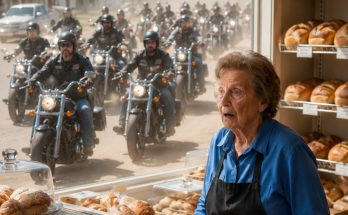
The crowd began thinning shortly after ten.
Not quickly.
Nobody seemed eager to be the first to leave.
Riders lingered beside motorcycles finishing coffee. Maple Glen residents remained on the sidewalk exchanging phone numbers with people they had regarded suspiciously three hours earlier. Children negotiated for one more photograph. Sheriff Price had given up pretending he was there in an official capacity and was discussing engines with Nate.
Eleanor stood in the bakery doorway with a dish towel over one shoulder.
She was tired.
Not the familiar physical tiredness of a long bake.
Something deeper.
Twenty-one years of wondering had been answered before breakfast.
She had learned Cole’s real name.
Learned that he had survived.
Learned that survival had become work, work had become skill, skill had become opportunity, and opportunity had become a way of opening doors for other people.
Then, before nine o’clock, she had agreed to help him build the next one.
It was too much for one morning.
Caroline came beside her.
“You look exhausted.”
“I hosted a motorcycle rally.”
“You fed one.”
“Same thing.”
Caroline leaned her shoulder against the doorframe Daniel had built.
“Are you regretting saying yes?”
Eleanor considered lying.
“No.”
Her daughter smiled.
“I’m terrified.”
“That sounds more accurate.”
“I have no idea what I’m doing.”
“Neither did Dad when you opened the bakery.”
“Your father thought baking soda and baking powder were interchangeable.”
“And yet you married him.”
“That should tell you how young I was.”
Caroline laughed.
Eleanor watched Mason farther down the sidewalk.
He was helping the young rider she had seen earlier tighten something on a motorcycle.
“You like him,” Caroline said again.
“This time I know what you mean.”
“And?”
Eleanor took a breath.
“I love the boy.”
Caroline waited.
“I think I could love the man too.”
Her daughter rested her head briefly against Eleanor’s shoulder.
“I’m glad he came back.”
“So am I.”
Even saying it felt strange.
For years Eleanor had imagined the return in vague shapes.
A letter.
A telephone call.
A man entering alone and quietly asking whether she remembered him.
Never this.
Never ninety-seven motorcycles.
Never architectural drawings.
Never an entire network of people carrying versions of the same lesson.
Mason finished with the motorcycle and walked toward them.
“Everything all right?”
“No,” Eleanor said.
He smiled.
“I’m beginning to understand that means yes.”
“Don’t become overconfident.”
Caroline held up the folder.
“When do you close on the building?”
“December, assuming inspection and final financing go the way they should.”
“When do renovations begin?”
“Immediately after.”
“When would Mom actually start?”
Eleanor looked at Caroline.
“Did I hire an agent?”
“No. You raised one.”
Mason answered.
“Planning could start whenever she wants. The building probably won’t be ready for programs until late spring.”
“That gives you time,” Caroline said.
“For what?”
“To hire somebody at Willow Hearth.”
Eleanor grimaced.
“I knew you were plotting.”
Mason looked toward the bakery.
“You don’t have to change anything immediately.”
“I know.”
“And if you need help recruiting—”
“No.”
He stopped.
“I choose who touches my ovens.”
“Yes, ma’am.”
Eleanor pointed at him.
“We discussed that.”
He smiled.
One of the riders called his name.
Mason raised a hand.
Then he turned back.
“There’s something I want to make clear.”
Eleanor waited.
“If you decide after a month that the center isn’t where you belong, you can walk away.”
“That was already part of the arrangement.”
“I know. I’m saying it again.”
“Why?”
His expression became serious.
“Because I don’t want my gratitude to become another obligation you have to carry.”
Eleanor looked at him for a long moment.
That answer told her more about Mason Caldwell than the businesses, the motorcycles, or the training center had.
The boy she remembered would have been terrified to offer somebody the freedom to leave.
The man understood that freedom was what made staying real.
“Good,” she said.
Mason exhaled.
Eleanor continued.
“But I am not planning to disappear before sunrise.”
His face changed.
She regretted the joke immediately.
“Mason.”
He shook his head, smiling.
“No. I deserved that.”
Eleanor took his hand.
“I’m here.”
His fingers tightened around hers.
For a moment neither spoke.
Then Ruth emerged from the bakery carrying the empty coffee urn.
“If everyone intends to have an emotional breakthrough, could someone also rinse this?”
Mason took it immediately.
“Yes, ma’am.”
Ruth smiled at Eleanor.
“I like him.”
“So does everyone, apparently.”
Mason carried the urn inside.
Ruth leaned closer.
“You’re going to do it?”
“Yes.”
“The training center?”
“Yes.”
Ruth nodded as though confirming a library reservation.
“Good.”
“That is all you have to say?”
“What did you want? A speech?”
“I expected concern.”
“You’re sixty-six.”
“Caroline used that against me too.”
Ruth looked offended.
“I’m seventy-two. Sixty-six sounds irresponsibly young.”
Eleanor laughed.
Ruth squeezed her arm.
“You came alive today.”
The words quieted Eleanor.
“I was alive yesterday.”
“You know what I mean.”
Eleanor did.
For years she had not been unhappy.
That was important.
She had customers she loved, friends who annoyed her properly, a daughter she admired, work that mattered, mornings she genuinely enjoyed.
But some portion of her life had remained arranged around what had ended.
Today something had opened in the other direction.
Toward what had not happened yet.
Eleanor looked through the window.
Mason was rinsing the coffee urn incorrectly.
She pushed open the door.
“Not like that.”
He glanced up.
“I’m rinsing it.”
“You’re flooding the electrical base.”
He jerked it away from the water.
“Oh.”
Eleanor grabbed a towel.
“You own three repair shops?”
“Technically.”
“Disturbing.”
Mason laughed.
Caroline entered behind them.
“This is why the center needs her.”
“Apparently.”
The final riders began preparing to leave around ten forty-five.
Helmets went on.
Jackets zipped.
Engines turned over one by one.
Maple Glen residents moved back from the curb.
The sound returned to Main Street, but it no longer felt threatening.
Eleanor stood outside beside Mason.
He had not put on his helmet yet.
“How long are you staying?”
He hesitated.
“In town?”
“Yes.”
“Tonight, if that’s all right.”
Eleanor stared.
“You came without a hotel?”
“I have one.”
“Then why are you asking permission?”
Mason smiled.
“I don’t know.”
Eleanor understood.
Some questions survive adulthood.
“Come for dinner.”
His smile disappeared.
“Really?”
“Yes.”
“Upstairs?”
“Unless you prefer eating in the alley.”
He looked at the apartment windows above Willow Hearth.
“I haven’t been up there.”
“No.”
“Not once.”
“I know.”
He nodded.
“Dinner sounds good.”
“Six.”
“I’ll be early.”
“Do not arrive at three forty.”
“No promises.”
She narrowed her eyes.
He laughed and put on his helmet.
Before mounting the motorcycle, he reached inside his jacket and touched the place where he had stored the old note.
Eleanor saw the movement.
“You’re not losing that.”
“I won’t.”
“If you do, I’m not waiting another twenty-one years for an explanation.”
“Understood.”
He climbed onto the bike.
The riders arranged themselves again along Main Street.
Not all ninety-seven would travel together from there. Some were heading north. Others east. A few had family nearby. But for several blocks, they formed the same long procession that had entered town that morning.
Mason started his engine.
Then he stopped.
He lifted his visor.
“Mrs. Whitaker?”
“Yes?”
“I never paid you back.”
Eleanor frowned.
“If this morning was supposed to be payment, I refuse it.”
He smiled.
“I figured.”
“You don’t repay kindness.”
“No?”
“No.”
Eleanor looked toward Keisha, Aaron, Miguel, Devon, and the others.
“You pass it along.”
Mason’s expression softened.
“I can do that.”
“You already did.”
He lowered the visor.
The motorcycles rolled away.
This time Eleanor did not count them.
She watched until the final bike disappeared beyond the traffic light.
Then she returned to work.
The bakery looked as though a storm had passed through it.
Cups everywhere.
Crumbs under every table.
Napkins on chairs.
A smear of frosting on the window.
Caroline stood with both hands on her hips.
“This will take hours.”
Eleanor picked up a tray.
“Then stop standing there.”
They cleaned together.
Ruth stayed.
Ed sent one employee over with a mop.
Marjorie brought sandwiches at noon despite Eleanor pointing out that a bakery possessed food.
Nobody discussed the morning continuously.
That helped.
Extraordinary things became part of life faster when ordinary tasks were allowed to surround them.
At one thirty, Eleanor reopened the register.
She pulled out the drawer.
The place where Mason’s note had lived for twenty-one years was empty.
The forty-one dollars remained.
Eleanor took the bills out.
Caroline noticed.
“What will you do with those?”
Eleanor counted them.
Forty-one exactly.
For years the money had belonged to a promise.
Now the promise had returned for itself.
The money needed another purpose.
She opened a fresh envelope.
On the front she wrote FOOD — NO QUESTIONS.
Caroline watched.
“Is that for Indianapolis?”
“Eventually.”
Eleanor placed the forty-one dollars inside.
“For now, it’s for here.”
She put the envelope beside the register.
“What does that mean?”
Eleanor closed the drawer.
“It means if someone comes in hungry and can’t pay, we start with forty-one dollars.”
Caroline smiled.
“That won’t last long.”
“No.”
“What then?”
“We add more.”
Her daughter nodded.
No ceremony.
No plaque.
No photograph.
Just a beginning.
At six that evening, Mason knocked on the upstairs apartment door eight minutes early.
Eleanor opened it.
He stood there holding flowers in one hand and a grocery-store chocolate bar in the other.
Eleanor stared at the chocolate.
“What is that?”
“I finally bought one for myself.”
She laughed so hard she had to hold the doorframe.
Mason looked pleased with himself.
Caroline, already inside, called from the kitchen.
“Did he bring wine?”
“No.”
“I don’t know what kind she likes,” Mason called back.
“Smart,” Caroline answered.
Eleanor stepped aside.
Mason hesitated.
Only briefly.
Then he entered.
Dinner lasted three hours.
They talked about Daniel.
About Luis.
About the years Eleanor had missed.
About Mason’s sister.
About Caroline’s family.
About the Indianapolis building.
About whether the teaching kitchen needed six ovens or eight.
Eleanor argued for eight.
Mason accused her of expanding the budget already.
Caroline sided with Eleanor.
At one point Mason laughed with his whole head thrown back, and Eleanor suddenly imagined the sixteen-year-old he might have been if fear had not occupied so much of his childhood.
She could not give him those years back.
Neither could he.
That was not what healing meant.
The past remained true.
So did everything that had grown after it.
Before Mason left, Eleanor handed him a paper bag.
He looked inside.
A braided sweet loaf.
His hands went still.
“You remembered.”
“Of course.”
“I haven’t made one in years.”
“You’ll make one in Indianapolis.”
He looked up.
“With you?”
“With me correcting you.”
“Some things never change.”
“Plenty do.”
Mason held the bag carefully.
Then he hugged her.
When he left, Eleanor stood in the hallway listening to his footsteps descend the stairs.
The brass bell rang below when he exited through the bakery.
For a heartbeat, the sound carried her back twenty-one years.
This time there was no empty storage room waiting in the morning.
No unsigned note.
No uncertainty about whether he had somewhere to go.
Eleanor slept later than usual.
At four fifteen she came downstairs.
The bakery was dark and peaceful.
She turned on the kitchen lights.
Set water to boil.
Measured flour.
Outside, Maple Glen remained quiet.
For years Eleanor had believed kindness mattered because a person should do it without expecting to know the result.
She still believed that.
Most people never saw what happened after the meal, the ride home, the extra chance, the quiet sentence spoken at the correct moment.
Most good things disappeared from sight.
That did not mean they disappeared.
Sometimes they traveled through lives you would never meet.
Sometimes they became jobs, apartments, classrooms, second chances, phone calls answered at three in the morning.
Sometimes they returned twenty-one years later on ninety-seven motorcycles.
Eleanor began kneading.
Under her palms, the dough tightened and changed.
Not because she forced it.
Because she knew when to press and when to let it rest.
She thought of Mason teaching someone else that same patience.
She thought of the Indianapolis building with its unfinished walls and empty teaching kitchen.
She thought of people who would eventually enter those doors frightened, defensive, hungry, ashamed, angry, exhausted, or all of those things at once.
They would find rules.
They would find consequences.
They would find work.
They would find people trained to help with problems Eleanor could not solve.
And before any of that, if she had anything to say about it, they would find food.
No form.
No explanation.
No proof that they deserved it.
The condition was simple because the first lesson had always been simple.
Nobody walks through our doors hungry.
Not one person.
Not ever.
Eleanor shaped the first loaf and placed it on the tray.
Then she began another.
The End
Read more original stories on Feel Every Story.
Ninety-Seven Engines Rolled Into Maple Glen at Dawn, and Eleanor Whitaker Knew the Morning Had Come Looking for Her
Part 15 of 15