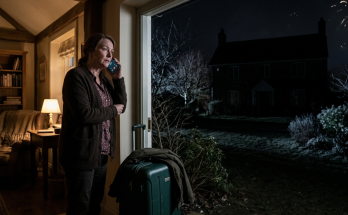
By six thirty that evening, cars were already lining both sides of the street.
I watched them arrive from the cottage window.
Black sedans. Polished SUVs. One low silver sports car David admired so loudly that I could hear him from across the yard. Men stepped out wearing dark coats over tailored suits. Women crossed the driveway in heels, lifting long dresses clear of the damp pavement.
The house glowed behind them.
My house.
I had promised myself I would stop repeating those words as if ownership alone could undo what had happened between us.
Still, every time a stranger entered through the front door without knowing who I was, something inside me tightened.
At seven, music started.
I made soup.
Not because it was New Year’s Eve food, but because it was already in the refrigerator and I did not want anything complicated.
Soup, toasted bread, and tea.
I carried the bowl to the little table beneath the window.
Across the lawn, the dining room curtains were open. I could see waiters moving through the room carrying trays. Sarah stood near the fireplace wearing cream silk. David had one hand at her waist while they welcomed guests.
They looked successful.
They looked settled.
They looked exactly like a couple hosting a party in their own home.
For years, I had blamed them for pretending.
That night I finally admitted I had participated in the performance.
Every time someone called the house theirs and I remained quiet, I had helped.
Every time Sarah said she would repay something and I answered that there was no hurry, I had helped.
Every time I retreated to the cottage rather than endure another argument, I had helped.
I had confused surrender with peace because surrender produced fewer raised voices.
The phone buzzed beside my bowl.
Sarah.
Mom, could you turn off the lights facing the backyard? They’re affecting the photographs.
I read it twice.
Then typed: Of course.
I stood and switched off the exterior lights.
The cottage dimmed.
At eight forty-two, another message appeared.
Please stay inside for a while. Guests are using the patio.
No greeting.
No apology.
No recognition of how absurd the instruction was.
I placed the phone facedown.
Outside, someone laughed close to the cottage wall.
Another person said, “What is this little building?”
A woman answered, “Probably the guesthouse.”
I almost opened the door.
Not to confront them.
Simply to see what would happen if the inconvenient woman appeared in the guesthouse doorway and introduced herself as the owner of everything they could see.
Instead I remained seated.
There was no point humiliating strangers who had been told someone else’s version of my life.
The people responsible were inside.
At nine fifteen, I opened the bedroom closet and removed the suitcase I had packed two days earlier.
My practical clothes were inside.
Two pairs of shoes.
Medication.
Toiletries.
Documents.
Three framed photographs.
A small blue sweater Sarah wore when she was seven.
And a stack of letters Michael had written during the first year of our marriage.
I had packed and unpacked that suitcase twice.
Leaving sounded powerful when discussed in Patricia’s office.
Standing beside the bed where I had slept for two years, it felt less like power and more like amputation.
I sat beside the suitcase.
Michael’s photograph was on the nightstand.
He was fifty-eight in it, standing knee-deep in ocean water because Sarah had dared him to walk into the surf wearing his trousers.
His grin was enormous.
“You would hate this,” I told him.
The photograph offered no answer.
I picked it up.
“I know what you’d say.”
Michael had never tolerated self-pity for long, especially mine.
He would have asked why I kept behaving as though my choices belonged to other people.
Then he would have said something annoying about courage being mostly an action you take before the courage arrives.
I placed the photograph in my bag.
At ten, the music became louder.
Someone opened a back window in the main house, and voices traveled clearly across the winter air.
David was speaking.
“Everybody, glasses up!”
Cheers followed.
I could not distinguish every word of his toast, only fragments.
Great year.
Big changes.
Success.
Family.
Our home.
That phrase reached me clearly.
Our home.
I looked around the cottage.
The walls were close enough that I could touch both sides of the kitchenette by stretching my arms.
I remembered the first night Sarah and David stayed in the main house.
Sarah had come to the cottage in pajamas carrying tea.
“This is weird,” she said.
“What is?”
“You being out here.”
“It’s temporary.”
“I know.”
She sat beside me.
“Once we find somewhere, you’ll move back.”
“Of course.”
She rested her head on my shoulder.
“Promise?”
I kissed her hair.
“I promise.”
That was twenty-three months earlier.
I wondered when she stopped remembering the promise.
More painfully, I wondered when I did.
At ten forty-five, I checked the black folder again.
Patricia had arranged everything she could lawfully arrange without creating a spectacle.
My ownership records were secure.
The financial authorizations were canceled.
Sarah’s access to my credit card would end.
My banking passwords were changed.
The smart-property administrator had been updated under my name.
Sarah and David had been users.
They had never been owners of the system, though David behaved as though he had installed the sun.
I had also prepared formal notice regarding their occupancy.
Patricia had warned me repeatedly that legal processes had to be followed properly.
I was not staging an illegal midnight eviction.
I was withdrawing permissions, protecting property, beginning formal notice, and leaving trained professionals to handle whatever came next.
That mattered.
Not because Sarah and David had treated me fairly.
Because I intended to.
At eleven fifteen, I zipped the suitcase.
At eleven twenty-five, I walked through the cottage one final time.
The mug Sarah gave me for Mother’s Day remained in the cupboard.
I almost took it.
Then left it behind.
A home should not become a museum of every object connected to someone you love.
At eleven thirty, I put on my coat.
I checked the windows.
Turned off the stove.
Closed the bedroom door.
Then I stood inside the entrance with my hand on the lock.
Fear arrived suddenly.
What if Sarah never forgave me?
The thought was so strong that my fingers loosened from the handle.
I imagined her discovering the sale.
Calling me selfish.
Telling friends I had abandoned her.
David would support that version.
Robert certainly would.
Perhaps Sarah would refuse to speak to me for years.
I could survive losing the house.
I was not sure I could survive losing my daughter.
Then music from the patio surged again.
A group of guests cheered.
Someone crossed the lawn close to the cottage and said, “I didn’t realize this place came with a separate guesthouse.”
A man answered, “David told me they’re probably renovating it next.”
I closed my eyes.
Renovating it next.
My fear changed shape.
What if I stayed?
What would they ask for next year?
Another signature?
Another account?
The deed?
Would there eventually be a conversation in which Sarah explained that maintaining two properties was too much for me and suggested assisted living?
For the first time, I understood that doing nothing was also a decision.
It simply happened to be the decision Sarah and David preferred.
I opened the door.
Cold air struck my face.
The lawn glittered with frost where party guests had not trampled it.
I carried my suitcase toward the driveway.
No one stopped me.
At the edge of the patio, a young waiter looked over.
“Ma’am, do you need help?”
The kindness of that stranger almost broke me.
“I’m fine, thank you.”
He nodded and went back inside.
I continued.
At eleven forty-seven, I paused beside the maple tree.
The main house stood fifty feet away, every window bright.
For twenty-nine years, that building had measured the seasons of my life.
Sarah’s childhood.
Michael’s illnesses.
Birthday cakes.
College acceptance letters.
Arguments.
Funerals.
Christmases.
Ordinary Tuesdays.
I had expected leaving it to produce some grand sensation.
Instead I felt tired.
And sad.
And certain.
No one came to the door.
No one saw me standing there.
My phone vibrated.
Patricia had sent a message.
Everything is prepared for Monday. Follow the plan. Don’t let tonight pull you back into the argument you’ve already settled with yourself.
I read the last sentence again.
Then typed: I won’t.
I walked to my car.
The suitcase went into the trunk.
I kept Michael’s watch with me.
Before starting the engine, I looked once more at the house.
Through an upstairs window, I saw Sarah cross the hallway carrying two champagne flutes.
She did not look toward me.
I turned the key.
The engine came alive.
At eleven fifty-two, I drove away.
The street was crowded enough that I had to move slowly between parked cars.
Several houses were holding parties. Through windows I saw children dancing, couples embracing, elderly people sitting together near fireplaces.
At the corner, I stopped at a red light.
For one irrational second, I nearly turned around.
Then Michael’s watch ticked beside me on the passenger seat.
Tick.
Tick.
Tick.
I drove through the intersection when the light changed.
At midnight, fireworks began behind me.
Red and gold flashes reflected in my mirrors.
I did not know it yet, but inside the main house Sarah was raising a champagne glass when her phone began vibrating.
The property security provider had detected administrative changes scheduled to take effect with the new year.
Her access privileges had been altered.
Several connected services she assumed belonged to her no longer recognized her authority.
The party music cut out when the smart-home account disconnected from David’s profile.
Some lights went dark.
Guests laughed at first, assuming the interruption was part of a midnight countdown mishap.
Then Sarah tried her management code.
Denied.
She entered it again.
Denied.
David attempted his.
Denied.
The laughter stopped.
At 12:01, my phone rang.
SARAH appeared across the dashboard.
I watched it for three seconds.
Then answered.
Her breathing came fast.
“Mom?”
“Yes?”
“What did you do?”
Fireworks burst over the highway ahead.
“I made some changes.”
“What changes? The system says our access has been revoked.”
I tightened my grip on the steering wheel.
“I know.”
“Turn it back on.”
“No.”
There was silence.
Perhaps in thirty-seven years, I had never given her that answer so simply.
“Mom, we have forty people here.”
“That was your choice.”
“What is wrong with you?”
The question hurt.
I let it.
“Nothing.”
“Then fix this.”
“No.”
“Mom!”
I could hear David speaking behind her, asking for the phone.
I said, “You’ll understand tomorrow.”
“Understand what?”
The road opened in front of me.
For the first time in years, I had no house waiting for me at the end of it.
The thought should have been terrifying.
Instead it felt like air entering a locked room.
“You’ll understand whose home you’ve been living in.”
Then I ended the call.