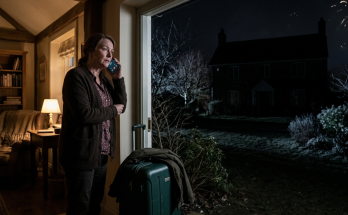
Three days before the occupancy deadline, I returned to the house alone.
David was at work.
Sarah had already removed almost everything she planned to take.
The moving company had scheduled my remaining stored furniture for pickup the following morning.
I went because Anita needed final confirmation about several fixtures.
Curtains.
Dining-room chandelier.
Built-in shelves.
The old brass weather vane above the garage.
Ordinary details.
Except nothing in that house felt ordinary anymore.
I entered through the kitchen.
For the first time in years, it smelled like dust instead of coffee.
The counters were nearly bare.
A roll of paper towels stood beside the sink.
The refrigerator contained bottled water, mustard, and half a carton of eggs.
Without Sarah’s flowers, David’s gadgets, caterers, visitors, music, deliveries, and arguments, the house seemed to exhale.
I stood there listening.
Pipes.
Furnace.
Wind against a loose branch.
The sounds Michael and I once heard every night.
I walked through each room.
The living room held only the sofa David intended to move later and two lamps.
Marks on the wall showed where photographs had hung.
I could identify each rectangle.
Sarah at sixteen in her graduation dress.
Michael and me in Maine.
A family photograph taken one Christmas when Sarah still had braces.
The room looked larger without them.
Not better.
Not worse.
Simply less ours.
I went upstairs.
My old bedroom was empty except for the bed frame.
I stood in the doorway.
For two years, I had avoided that room whenever possible.
Sarah and David used it after moving in because, as Sarah once said, it made no sense to leave the largest bedroom unused.
At the time, I told myself she was right.
Now sunlight fell across the bare floor.
I walked to the window where Michael used to stand every morning while tying his necktie.
He liked watching the maple move in the wind.
“You planted it too close to the house,” I told the memory of him.
He would have disagreed.
He disagreed every spring when I complained about the gutters.
I smiled.
Then cried.
No dramatic collapse.
Just tears.
Quiet and steady.
I let them come.
Selling did not require me to pretend leaving was easy.
Downstairs, the phone in my coat pocket buzzed.
Anita.
I answered.
“Tell me you’re not emotionally removing chandeliers.”
“I’m not.”
“Good. Buyers want the dining-room fixture.”
“They can have it.”
“Curtains in the main bedroom?”
“Leave them.”
“Outdoor fountain?”
“That monstrosity David installed?”
“Yes.”
“Please let someone else enjoy it.”
She laughed.
“Done.”
We finished the list.
Before ending the call, she said, “The Bennetts are excited.”
“I’m glad.”
“Maya asked if you would mind leaving any notes about the garden.”
That caught me.
“What kind of notes?”
“What comes up where. What needs pruning. Which plants matter.”
I thought of Michael’s roses.
My hydrangeas.
The herb bed Sarah helped me plant when she was twelve.
“I can do that.”
“Only if you want.”
“I do.”
After the call, I went to the garage.
Most of David’s things were packed.
Boxes of tools.
Golf clubs.
A bicycle.
The shelves along the back wall had been cleared.
That was where Michael kept his workbench.
After we converted the workshop outside, he used the garage for messier jobs.
Paint.
Engine oil.
Anything I banned from indoors.
I ran my hand along the scarred edge of the old bench.
The Bennetts had requested it remain.
Daniel said he liked woodworking.
I opened the center drawer.
Empty.
Second drawer.
A handful of screws.
Third.
A folded rag.
Then I noticed something unusual.
The bottom panel of the second drawer sat slightly higher on one side.
Michael had a habit of building hidden compartments.
Not sophisticated ones.
Little spaces beneath shelves or behind loose trim where he stored spare keys and emergency cash.
Mostly because he enjoyed showing them to Sarah.
I lifted the drawer out.
The false bottom came up with a butter knife from the kitchen.
Beneath it was a flat metal box.
My heart stopped.
I knew the box.
Blue enamel.
A scratch across the lid.
Michael once used it for fishing lures.
I carried it to the workbench.
My fingers trembled as I opened it.
No money.
No keys.
Letters.
Six envelopes tied with string.
Each had my name on the front in Michael’s handwriting.
Ellen.
Just that.
No dates.
I sat down.
For a full minute, I could not touch them.
Michael had been dead four years.
I thought I had found everything after the funeral.
Insurance documents.
Bank records.
Notes inside cookbooks.
Receipts for gifts he forgot he had already given me.
But not these.
I chose the first envelope.
Inside was one sheet of paper.
The handwriting slanted more than it had when he was younger.
Ellen, if you find these before I’m gone, put them back and pretend you never saw them.
I laughed through tears.
Exactly Michael.
The letter continued.
If I am gone, then I hope enough time has passed that reading me feels more comforting than cruel.
I stopped.
Pressed the paper against my chest.
Then continued.
He wrote that during his final year, after the second hospitalization, he had begun leaving letters for moments he feared he would miss.
Not birthdays.
Not anniversaries.
Decisions.
Times when, as he put it, I would probably be trying to figure out what he would have told me to do.
He wrote:
The irritating answer is that I would tell you to decide without me.
I closed my eyes.
Of course.
I read on.
You have spent our whole marriage asking what will keep everyone together. That is one of the best things about you. It is also the thing I worry people may use when I am not there to tell them to stop.
My breath caught.
The page blurred.
I wiped my eyes.
Michael had known me.
Not magically.
Not prophetically.
Just deeply.
The letter did not mention Sarah.
David barely existed in our lives when Michael wrote it.
There was no prediction about houses or money.
Only me.
If the house becomes too heavy, sell it.
If staying helps, stay.
If Sarah wants it someday and you want to give it, give it.
If you do not, do not let my memory become a weapon someone uses against you.
I had to put the letter down.
Robert’s voice returned.
Michael would have helped.
Sarah saying Dad wanted the house in the family.
Even my own guilt had spoken in Michael’s name.
But the actual man had already answered.
Do not let my memory become a weapon.
I cried then.
Not quietly.
I bent over the workbench and sobbed until my chest hurt.
Four years of missing him seemed to arrive at once.
I had wanted his permission so badly.
And he had left me something better.
Refusal to control me from the grave.
After a while, I opened the next letter.
It was shorter.
For when Sarah disappoints you.
I almost dropped it.
The heading was written in his crooked block letters.
Michael had clearly expected many possible disappointments.
He wrote:
She will.
You will disappoint her too.
Do not make either fact bigger than love, but do not make love so big that facts disappear.
I laughed and cried again.
No prophecy.
Just parenthood.
Sarah had been twenty-nine when he died.
Still, Michael knew us both.
The letter continued.
When she was twelve, she lied about breaking the hall window because she was scared of punishment. You wanted to hug her first. I wanted consequences first. We were both partly right and partly unbearable.
I remembered.
The soccer ball.
The shattered glass.
Sarah’s face.
Michael making her pay for part of the repair from saved birthday money.
Me sneaking her hot chocolate afterward.
He wrote:
Comfort does not cancel consequence.
Consequence does not cancel love.
Try to remember both.
I sat in the garage until the light shifted.
The third envelope said For when you feel guilty.
The fourth: For when you think you are too old to begin again.
The fifth: For the day you leave this house.
I did not open that one immediately.
I carried the box to the cottage.
The door creaked the same way it always had.
Most of my belongings were gone.
The walls looked pale where pictures once hung.
I sat at the little table.
Then opened the envelope.
Michael’s words were fewer this time.
So you’re leaving.
I hope you’re going somewhere because you chose it.
Not because someone pushed.
Not because you think memories live in walls.
Not because you owe me preservation.
A house is lumber, pipes, taxes, repairs, and whatever people do inside it.
We did good things there.
Some bad ones too.
Take what matters.
Leave the roof.
I laughed so hard I had to put the letter down.
Take what matters.
Leave the roof.
That was Michael.
At the bottom he had added:
And if the maple is still alive, tell whoever owns the place not to butcher it with one of those ridiculous flat-top trims.
I looked through the window.
The maple moved gently in the wind.
“You win,” I whispered.
I found stationery in the kitchen drawer.
Then I began writing notes for Maya.
Roses: prune in late winter.
Hydrangeas: do not panic when they look dead.
Mint: contained bed or it will conquer civilization.
Maple: my husband planted it. Please do not flat-top it. He will haunt us both.
I hesitated.
Then added:
The cottage was his workshop before it became a guesthouse. It deserves laughter again.
I folded the note.
At five, Sarah arrived unexpectedly.
She found me sitting in the cottage surrounded by letters.
Her face changed when she saw the handwriting.
“Dad?”
I nodded.
“Where?”
“Garage workbench.”
She sat beside me.
I handed her the second letter.
“For when Sarah disappoints you?” she read.
Then she laughed.
“He was subtle.”
“Never.”
She read silently.
Halfway through, her eyes filled.
At the end, she pressed the paper to her lips.
“He knew.”
“He knew us.”
Sarah stared toward the window.
“Do you think he’d hate me?”
“No.”
The answer came instantly.
She looked at me.
“You didn’t even think.”
“I don’t need to.”
“How do you know?”
“Because he loved you.”
“I hurt you.”
“So did he sometimes.”
Her eyebrows rose.
“Dad?”
“He was not a saint.”
“That’s not how I remember him.”
“That is because you weren’t married to him.”
She laughed through tears.
I took her hand.
“He would be disappointed in some things.”
She nodded.
“So am I.”
“I know.”
“He would also tell you to do better next.”
She looked at the letter again.
“Comfort does not cancel consequence.”
“Yes.”
“Consequence does not cancel love.”
“Yes.”
She squeezed my fingers.
“I needed that.”
“So did I.”
We sat until evening.
Then Sarah asked if there were more letters.
“Yes.”
“For me?”
“I don’t know yet.”
We opened the sixth envelope together.
On the front, Michael had written:
For when one of you needs the other more than pride needs to win.
Inside was a single page.
No speeches.
No instructions.
Only this:
Say what happened.
Say what hurt.
Say what changes now.
Then decide whether love is still useful.
If it is, use it.
Sarah read the final sentence twice.
Then looked at me.
“Is love useful?”
I looked around the cottage.
“Yes.”
“Even now?”
“Yes.”
Her face crumpled.
She leaned into me.
This time I did not worry that comforting her would erase anything.
The facts were already spoken.
The consequences were already moving.
So I held my daughter while she cried for her father, her marriage, the house, and perhaps herself.
When she calmed, she asked, “What changes now?”
I thought about the letter.
“You don’t get to assume I’ll say yes.”
She nodded.
“You don’t use me to avoid decisions with David.”
“Okay.”
“You ask before spending my money.”
A weak smile.
“Definitely.”
“And I stop solving things before you ask.”
Sarah looked at me.
“That one might be hardest for you.”
“I know.”
“What else?”
I took a breath.
“If something hurts, I say it before six months pass.”
She nodded slowly.
“Deal.”
Then she said, “Mine.”
I waited.
“I stop pretending not to notice when something benefits me.”
That was a hard one.
She knew it.
“I ask instead.”
“Yes.”
“And if you say no, I don’t recruit Dad’s ghost.”
I laughed.
“Please don’t.”
She smiled.
Then became serious.
“I don’t know what happens with David.”
“You don’t have to know tonight.”
“I know.”
We packed Michael’s letters together.
I kept five.
Sarah asked to copy the one about disappointment.
The original stayed with me.
At the cottage door, she paused.
“Mom?”
“Yes?”
“Are you still sure about selling?”
I looked toward the main house.
Then the maple.
Then Michael’s blue box beneath my arm.
For the first time, certainty felt peaceful instead of defensive.
“Yes.”
The next morning, David signed a lease on a furnished apartment.
He would be out before the deadline.
No court.
No sheriff.
No final battle.
Patricia called the development an excellent outcome.
I called it relief.
By evening, movers had taken the last of David’s large furniture.
The rooms emptied.
The house became what Michael had written.
Lumber.
Pipes.
Taxes.
Repairs.
And what people had done inside it.
The memories were coming with me.
The roof could stay.
Click here to continue reading: PART 15: David Left the House Without a Fight, but the Final Accounting Revealed What Repairing the Damage Would Actually Cost Everyone
On New Year’s Eve, My Daughter Asked Me to Disappear Before Her Guests Arrived at the House I Still Owned
Part 14 of 16