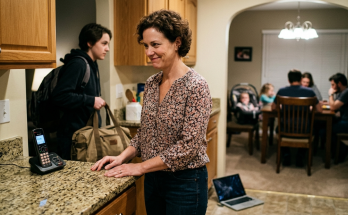
At 7:18 that morning, I was standing barefoot in our kitchen with one earring in, one heel beside the refrigerator, and an email from my director glowing on my phone. Ava sat on a stool at the island in pink pajamas, making her stuffed rabbit dance through the crumbs from her toast. Nothing about the room looked dangerous. Sunlight had just reached the edge of the sink. The coffee machine hissed. The dishwasher hummed behind me. My daughter was four years old, alive, impatient, and certain the entire morning existed for her entertainment.
“Mr. Bun-Bun says you’re boring again,” Ava announced.
She held the rabbit in front of her face and pitched her voice low, which made the accusation sound like it came from a tiny exhausted accountant.
“Mr. Bun-Bun can pay the mortgage,” I said, typing with both thumbs, “if Mr. Bun-Bun has that many opinions.”
Ava laughed so hard her shoulders bounced.
I looked up long enough to catch the expression I would later replay more times than I could count: her mouth open in laughter, pale hair tucked behind one ear, one sock halfway off her heel. Memory is cruel that way. It preserves things you never thought to study while you still had the chance.
My office meeting had been moved from nine-thirty to eight. I normally took Ava to Little Pines Daycare myself, partly because it was on my route and partly because her dairy allergy had trained me into rituals I trusted only when I performed them personally. Lunch checked. Emergency medication checked. Allergy card clipped inside the front pocket of her backpack. Teacher reminded if there had been any change in brands or ingredients at home.
We had lived with the allergy since she was eighteen months old. It was not a preference, not an upset stomach, not one of those childhood sensitivities people sometimes assumed could be handled with a little caution and luck. Dairy could close Ava’s airway.
Everybody close to us knew that.
Especially Mark.
My husband entered the kitchen already dressed for work, adjusting the cuff of his shirt. He worked for a construction firm across town and usually left before Ava and I did. That morning, he was later than usual.
“You’re still here?” I asked.
“Moved one appointment.”
He reached across Ava for his keys.
She slapped his wrist playfully. “No stealing my bunny.”
“Wouldn’t dream of it.”
My phone buzzed again. The director wanted the quarterly projections printed before the meeting. I glanced toward the clock and felt my stomach tighten.
“I’m going to be late.”
Mark looked at my laptop bag, then at Ava.
“I’ll take her.”
I stopped moving.
“You will?”
“It’s on my way.”
“It really isn’t.”
“Close enough.”
There was something light in his tone, almost teasing, as though I had turned daycare drop-off into a military operation.
“You sure?”
“Emily.” He smiled. “It’s daycare. I can manage.”
Ava lifted both arms triumphantly.
“Daddy takes me!”
I should have been relieved. Instead, I started giving instructions he had heard dozens of times.
“Her lunch is in the blue bag. The emergency injector is in the front zipper. Make sure Rebecca knows she ate at home, and please don’t let her take anything from the communal breakfast cart.”
Mark opened the refrigerator.
“I know.”
“And the new assistant started Monday, so mention the allergy to her too.”
“I know, Em.”
I heard the irritation beneath the second answer and stopped.
That had become one of the small tensions in our marriage: Mark hated being reminded of things he believed he already understood, while I had learned that being embarrassed by repetition was preferable to being sorry afterward.
Ava slid down from the stool and ran upstairs to change.
Mark poured coffee into a travel mug. His phone vibrated near the fruit bowl.
He looked at the screen immediately.
Not casually.
Immediately.
Then he flipped it facedown.
I noticed because he had been doing that more often.
Late messages. A locked screen where there had never been one. Work dinners that stretched beyond dessert. Once, two weeks earlier, I had come downstairs after midnight and found him standing alone in the dark kitchen texting. When he saw me, he had turned the phone against his chest before telling me it was a client issue.
I had believed him.
Marriage contains a thousand small opportunities to become suspicious of someone. If you accept every invitation, you destroy the thing yourself. I had decided trust mattered more.
“Everything okay?” I asked.
“Work.”
He picked up the phone and put it in his pocket.
Ava came thundering downstairs wearing purple leggings, a yellow shirt, and two different hair clips.
“Ready!”
Mark stared at her clips.
“You planning to start a new fashion movement?”
“They match.”
“They absolutely do not.”
“They match me.”
He looked at me.
I laughed.
For years afterward, that ordinary exchange would feel obscene in its normality.
I crouched and zipped Ava’s coat. I could smell strawberry shampoo in her hair.
“Be good for Miss Greenwood.”
“I’m always good.”
“That is a remarkable interpretation of history.”
She grinned.
“Can we get nuggets after daycare?”
“Maybe.”
“That means yes.”
“That means maybe.”
“Daddy says maybe means yes.”
I glanced at Mark.
“Daddy says a lot of things.”
He gave me a tired smile.
I kissed Ava’s forehead and held her half a second longer than usual, although I cannot pretend that was instinct or warning. I was just a mother leaving for work.
“Love you.”
“Love you more.”
“You always cheat.”
She ran toward the garage.
Mark followed, carrying her backpack.
At the doorway, he turned.
“Go. You’re going to miss your meeting.”
“Text me when you drop her off.”
“Okay.”
“Mark.”
He sighed, but he was smiling again.
“I’ll text you.”
I left through the front door while they went through the garage.
That was the last time I saw Ava healthy.
At 8:02, I was sitting in a glass conference room three floors above a parking garage, explaining revenue projections while pretending I had not spilled coffee on my sleeve. My phone lay face down beside my notebook.
At 8:19, during a question from our finance director, it buzzed.
A message from Mark.
Dropped off. All good.
Three words that later made me furious because nothing had been good.
I typed a heart and slipped the phone away.
The meeting ended at 9:06. I returned to my desk with thirty-seven unread emails, two missed internal calls, and the mild headache that usually appeared whenever I skipped breakfast.
At 9:41, my phone rang.
Little Pines Daycare.
I answered before the second ring.
“Hi, Rebecca. Everything okay?”
There was breathing on the other end.
Too fast.
Then Miss Greenwood spoke.
“Mrs. Carter?”
The use of my last name frightened me immediately. Rebecca had known us for almost two years. She called me Emily.
“What happened?”
“Ava became very sick.”
My chair rolled backward as I stood.
“What do you mean sick?”
“She was having trouble breathing. We gave her emergency medication. The ambulance—”
I gripped the edge of my desk.
“Did she have dairy?”
“I don’t know yet.”
“What did she eat?”
“Emily, the ambulance has already taken her to St. Matthew’s.”
For a moment, everyone around me seemed to become silent, though I could see mouths moving through the glass partitions.
“Is she conscious?”
Rebecca hesitated.
That hesitation was the first moment terror became something physical inside me.
“Rebecca.”
“They were working on her when they left.”
My purse fell from my desk when I grabbed it. I left everything else behind—laptop, notebook, coffee, coat.
I remember the elevator taking too long.
I remember pressing the lobby button after it was already lit.
I remember a man from accounting asking whether I needed help and me walking straight past him.
Everything after that came in fragments.
Red light.
Horn.
My own hands trembling on the steering wheel.
A driver shouting when I cut across a lane.
The hospital sign appearing between two buildings.
I called Mark twice.
No answer.
On the third attempt, he picked up.
“Where are you?”
His voice sounded strange.
“I’m here.”
“At the hospital?”
“Yes.”
“Is she okay?”
Silence.
“Mark, is Ava okay?”
“They’re working on her.”
“What happened?”
“I don’t know.”
“What did she eat?”
“I don’t know, Emily.”
His voice cracked.
“I dropped her off. She was fine.”
I pulled into the emergency entrance so badly one tire climbed the curb.
A security officer shouted that I could not leave my car there.
I left it there.
Inside, I gave Ava’s name to a receptionist who immediately stood and called someone.
That frightened me more than if she had made me wait.
A nurse came through the double doors.
“Mrs. Carter?”
“Yes.”
“Come with me.”
“Where’s my daughter?”
“This way.”
“Where is she?”
She did not answer.
Mark was standing at the far end of the corridor with his hands locked behind his head.
His tie was loose.
His face looked almost gray.
I ran toward him.
“What happened?”
He grabbed my shoulders.
“They’re trying.”
“What happened?”
“I don’t know.”
“You took her there.”
“She was fine when I left.”
“What did she eat?”
“Nothing unusual.”
“How do you know?”
He blinked.
“What?”
“How do you know she ate nothing unusual?”
Before he could answer, the doors behind him opened.
A doctor stepped into the corridor.
He removed his surgical cap before coming toward us.
That tiny movement told me everything before his mouth did.
People think tragedy arrives with noise.
Sometimes it approaches quietly in hospital shoes.
“I’m Dr. Patel.”
“No,” I said.
He stopped.
“I’m very sorry.”
“No.”
“We treated your daughter for a severe anaphylactic reaction. Her heart stopped before she reached us. We restored circulation briefly, but—”
“No.”
Mark made a sound beside me.
I could not look at him.
The doctor continued speaking because doctors have to finish sentences nobody should ever have to hear.
“We weren’t able to save her.”
I stared at him.
“That’s not possible.”
“I’m sorry.”
“She has medication.”
“We know.”
“The daycare knows.”
“Yes.”
“She was fine this morning.”
“I understand.”
“No, you don’t.”
My voice sounded oddly controlled.
“She was eating toast. She was arguing with a rabbit.”
Dr. Patel’s expression changed, not because what I said made sense, but because he had probably heard parents say similarly impossible things before.
“Can I see her?”
“Yes.”
Mark reached for my hand.
I pulled mine away without thinking.
Not because I blamed him.
Not yet.
Because suddenly one question had begun pushing through everything else.
Ava had survived accidental exposures before because we recognized them quickly.
Everyone knew what to do.
Everyone knew what she could not have.
So what had happened between my kitchen and that hospital?
As the nurse opened the door to the room where my four-year-old daughter lay completely still beneath a white blanket, another thought came with it.
Mark had been the last person in our family to see her before the reaction began.
And when I asked what Ava had eaten, he had answered before anyone had told us.
Click here to continue reading: PART 2: While Everyone Called Ava’s Death a Tragic Reaction, Mark’s Carefully Repeated Version of That Morning Began Leaving Details That Did Not Fit
The Morning Mark Offered to Handle Daycare Seemed Ordinary Until One Small Change in Ava’s Routine Became Impossible to Explain
Part 1 of 15