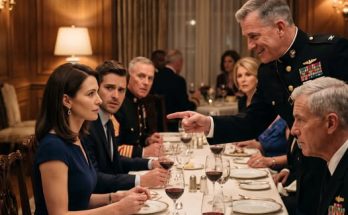
The first time Ethan Brooks took me to his parents’ house, he warned me in the car that his father had never entirely learned how to stop being an admiral. He said it with a smile, but both hands stayed fixed on the steering wheel. “He won’t interrogate you,” Ethan added after a moment. “Probably.” That last word told me more than the reassurance had.
I looked through the windshield at a row of bare November trees leaning over the road. “You could have stopped after the first sentence.”
“I’m trying to prepare you.”
“For dinner or a congressional hearing?”
That finally made him laugh. His shoulders loosened, and he reached across the console to squeeze my hand. “Dinner. Definitely dinner. Mom will save you if Dad starts asking questions. Natalie will encourage him because she enjoys watching me suffer.”
I knew the outline of the Brooks family already. Ethan’s mother, Margaret, had taught history before retiring. His younger sister, Natalie, worked in public policy and possessed what Ethan called a dangerous inability to leave an awkward silence alone. His father, William Brooks, had spent nearly four decades in the Navy before retiring as a four-star admiral.
That last detail had made me hesitate when Ethan first suggested meeting them.
Not because I was intimidated by rank. I had spent too much of my adult life around senior officers to be dazzled by stars on shoulders. What unsettled me was the possibility that Admiral Brooks might recognize something Ethan himself did not fully understand.
Ethan knew I served in the Navy. He knew I flew. He knew there were periods of my career I did not discuss and missions whose details were either restricted or simply private. He had never pushed past those boundaries. It was one of the things I liked about him.
But there were stories inside military communities that traveled without newspapers or television. Stories passed from ready rooms to operations centers, from commanders to instructors, names resurfacing years later in conversations that had nothing to do with the people who had lived them.
I had learned that the hard way.
Margaret Brooks opened the door before Ethan could knock. She was smaller than I expected, silver-haired, quick-moving, and immediately warm. She hugged her son, then took both of my hands as though she had known me longer than thirty seconds.
“So this is Claire.”
Her tone made Ethan groan. “Mom.”
“What? You’ve mentioned her approximately eight thousand times.”
“Six.”
“Eight thousand.”
She pulled me inside before he could defend himself.
The Brooks home smelled faintly of rosemary, roasted onions, and old wood. Family photographs covered one wall near the staircase. Ethan at twelve with braces. Natalie holding a violin. William Brooks in dress whites beside a much younger Margaret. Naval photographs appeared too, but not in the overwhelming way I had expected. They were mixed among school portraits, vacations, weddings, dogs, and ordinary life.
I liked that immediately.
Admiral Brooks entered from the dining room wiping his hands on a folded kitchen towel. Retirement had softened almost nothing about his posture. He was tall, spare, gray-haired, and carried himself with the unconscious economy of someone who had spent decades moving through narrow passageways and crowded command spaces.
“Claire Bennett.”
He did not phrase it as a question.
I shook his hand. “Admiral Brooks.”
“William, please. Anyone who calls me Admiral in this house risks being assigned cleanup duty.”
“Dad still calls the dishwasher ‘the galley support system,’” Ethan said.
William gave his son a flat look. “One warning.”
The exchange was ordinary enough. I began to relax.
Then Ethan mentioned that I had studied engineering before joining the Navy.
William’s eyes sharpened almost imperceptibly.
It lasted less than a second.
Most people would not have noticed. I did because years of flying had trained me to notice tiny changes before they became large ones: a vibration in a control surface, a hesitation in someone’s voice, a number on an instrument shifting where it should have held steady.
“What kind of engineering?” William asked.
“Aerospace.”
“Where?”
I told him.
He nodded once.
Margaret appeared from the kitchen and rescued the conversation by demanding that Ethan carry a platter. We moved toward the dining room. I told myself I was imagining things.
Then, while Natalie poured wine, she asked how Ethan and I had met.
“At a friend’s retirement party,” Ethan said. “Claire had just come back from Pensacola.”
My hand stopped halfway toward my water glass.
Only briefly.
William noticed.
I knew because I saw him look at me, not Ethan.
“Pensacola?” he asked.
“Training work,” I said.
It was entirely true and intentionally incomplete.
“What kind?”
Ethan glanced at his father. “Dad.”
William lifted a hand. “Conversation, not interrogation.”
I smiled. “Aviation.”
Again, that tiny pause.
His attention rested on my face as if he were comparing what he saw with something remembered from a document.
Then it vanished.
“Well,” he said, reaching for the potatoes, “that explains why Ethan suddenly knows the difference between an aircraft and an airplane.”
“I knew that already.”
“No, you didn’t,” Natalie said.
Dinner moved on.
Nobody asked about deployments. Nobody requested aircraft types. William spent ten minutes arguing with Natalie over whether a particular senator had misquoted naval history. Margaret told an embarrassing story about Ethan setting off a smoke detector while trying to make pancakes at fourteen.
I laughed more than I expected.
Yet every so often, when conversation drifted toward aviation, I found William looking at me.
Not suspiciously.
That would have been easier.
He looked as if he knew something and was deliberately deciding not to say it.
On the drive home, Ethan asked whether his family had frightened me away.
“Your mother tried to send us home with enough food for six people.”
“That means she likes you.”
“Natalie asked whether I believed you were emotionally mature.”
“That means she likes you too.”
“And your father watched me all evening.”
Ethan’s smile faded slightly. “He does that.”
“No. Not like that.”
“What do you mean?”
I considered telling him.
There was no classified secret in saying that a particular mission from years earlier had circulated farther through senior Navy channels than I wished. There was no legal reason to keep it from Ethan. My reluctance was harder to explain because it had nothing to do with regulations.
“I don’t know yet,” I said.
He accepted that.
That should have relieved me.
Instead, I spent the next two days wondering whether William Brooks had recognized my name.
Three weeks later, Natalie answered the question without answering it.
She invited me for coffee while Ethan was working late. We sat near the window of a crowded café where the espresso machine shrieked every few minutes and rain patterned the glass.
Natalie stirred cinnamon into her coffee and studied me with the same unembarrassed curiosity she brought to everything.
“So,” she said, “what do you actually do?”
I smiled. “I work for the Navy.”
“That is exactly the answer Ethan gives when someone asks.”
“Then he has been trained well.”
“He says you fly.”
“I do.”
Her spoon stopped.
“Military aircraft?”
“Yes.”
“What kind?”
“The kind I don’t discuss over coffee.”
Natalie blinked, then laughed once. “Okay. Fair.”
What mattered was what she did next.
Nothing.
She did not wheedle, tease, bargain, or start guessing. She took a drink and changed the subject to a disastrous meeting she had survived that morning.
Ten minutes later, while we were discussing whether Ethan had deliberately hidden his inability to assemble furniture, Natalie lowered her voice.
“My father knows something about you.”
I looked at her.
She leaned back. “I knew it.”
“Knew what?”
“That you noticed.”
“What did he say?”
“Almost nothing. That’s why I noticed.”
I waited.
Natalie glanced toward the next table before continuing. “The night you came over, after you and Ethan left, Mom said she liked you. Dad said, ‘So do I.’ Then he stood there looking at the front door for about five seconds like he was remembering something.”
“That’s it?”
“No. I asked whether he knew you. He said, ‘Not personally.’”
The espresso machine screamed behind us.
I felt an old coldness settle somewhere beneath my ribs.
“What exactly were his words?”
Natalie repeated them.
Not personally.
That distinction mattered.
If William had simply seen my name attached to routine orders or training records, he would probably have said he had heard of me. If someone had served under him, he might have remembered a unit.
Not personally implied something else.
It implied knowledge from a distance.
A report.
A briefing.
An incident.
A name carried through command channels.
Meridian.
I stared into my coffee until the surface stopped moving.
Natalie’s voice softened. “Is that bad?”
“No.”
It was not exactly a lie.
“Should I stop asking?”
“Yes.”
“Done.”
Again, no argument.
I liked her even more for that.
During the next three months, William Brooks never mentioned the subject.
We had dinner twice. Once at his house, once at a small Italian restaurant where Margaret and Ethan spent twenty minutes debating the correct way to cook garlic. William asked me about books, travel, engineering, Washington traffic, and whether Ethan still left cabinet doors open.
He never asked about Meridian.
That restraint slowly changed something in me.
I began to trust that whatever he knew, he understood it was mine to disclose.
Then Ethan called one Thursday afternoon.
“Dad’s seventieth birthday is next month.”
“Seventy? He’ll hate that.”
“He has already informed us that age is a design flaw.”
“That sounds like him.”
“We’re doing dinner in Washington. Private room. Nothing enormous.”
I heard hesitation in his voice.
“How not enormous?”
“Maybe thirty people.”
I closed my eyes.
“Ethan.”
“Mostly family.”
“How much family does your father have?”
“And a few old Navy friends.”
There it was.
“How old?”
A longer pause.
“Very old?”
I laughed despite myself.
Ethan lowered his voice. “Claire, you don’t have to come if this makes you uncomfortable.”
I looked through my office window toward the gray afternoon sky. On my desk sat a training schedule, a half-finished mug of coffee, and a photograph taken years before on a flight line—cropped carefully enough that no one seeing it casually would know where we had been.
I thought about William’s silence.
Whatever he knew, he had protected my right not to discuss it.
“I’ll come,” I said.
The evening of the birthday dinner, I almost changed my mind in the hotel elevator.
Ethan adjusted his tie beside me. “You’re quiet.”
“I’m usually quiet.”
“You’re quieter.”
The elevator numbers climbed.
“Professional observation?”
“Boyfriend observation.”
I looked at him.
He smiled and offered his hand.
When the doors opened, I took it.
The private dining room overlooked the city. Candlelight reflected in tall windows. Conversations overlapped beneath the clink of glasses and silverware. I recognized military posture before uniforms were mentioned: retired officers sitting straighter than civilians, old habits embedded too deeply to leave with retirement papers.
William spotted us and came over.
“Claire.”
Something in his expression asked a question he did not say aloud.
I answered it with a small nod.
I was fine.
For now.
We had been there less than ten minutes when Ethan touched my elbow.
“Claire, there’s somebody Dad wants me to introduce you to.”
A large man in his sixties turned from a conversation near the bar. He wore a dark suit, a Marine Corps lapel pin, and the relaxed confidence of someone accustomed to rooms making space for him.
“Colonel Richard Coleman,” Ethan said. “Retired Marine Corps. Dad’s known him forever.”
Coleman shook my hand firmly.
His gaze moved over me once, measuring.
“What do you do, Claire?”
The question was harmless.
The way he waited for the answer was not.
“I fly for the Navy.”
His eyebrows lifted.
Then one corner of his mouth rose.
I knew that smile.
I had seen versions of it throughout my career.
It was the expression of a man who had already decided that whatever I said next would need to be proven.
Across the room, William Brooks stopped speaking to the person beside him and looked directly at us.
Coleman gave a small chuckle.
“You fly?”
I held his gaze.
“Yes.”
He took a sip of bourbon.
“Well,” he said, settling more comfortably into the conversation, “this should be interesting.”
And from the far end of the room, Admiral William Brooks kept watching.
Click here to continue reading: PART 2: At the Admiral’s Birthday Table, One Colonel Turned a Casual Question Into a Test He Had Already Decided I Would Fail
The Quiet Detail in Ethan’s Family Dinner Invitation That Told Me His Father Had Already Recognized Something I Never Discussed
Part 1 of 16