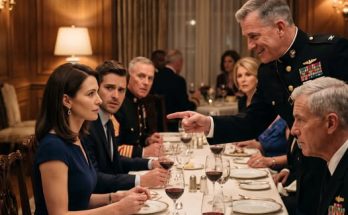
Colonel Richard Coleman’s first mistake was believing I did not recognize what he was doing. His second was assuming politeness meant I would cooperate. We were still standing near the bar when he shifted his bourbon from one hand to the other and asked, “So what do you fly?” in the pleasant tone of a man who expected the answer to expose me.
“Aircraft,” I said.
Ethan made a sound that might have been a cough.
Coleman smiled wider. “I gathered that.”
“Then we’re making excellent progress.”
A few people nearby laughed softly. Not at him exactly, but close enough that his eyes tightened.
He tried again. “Helicopters?”
“Sometimes.”
“Fixed wing?”
“Sometimes.”
“Carrier qualified?”
I lifted my glass of water. “Colonel, we have known each other for roughly ninety seconds.”
“Just shop talk.”
“Shop talk usually includes two people talking.”
His smile remained, though it had lost some warmth.
Ethan touched the small of my back. “Dad’s trying to get everybody seated.”
Coleman ignored the escape route.
“What squadron?”
“I’ve served with several.”
“Which one now?”
“I don’t discuss current assignments socially.”
His eyebrows climbed.
There it was again: not curiosity but confirmation.
To Coleman, each boundary sounded like a missing credential.
To me, boundaries were ordinary.
For years I had watched people confuse access with entitlement. They heard that someone served, flew, deployed, commanded, treated casualties, worked intelligence, or operated somewhere dangerous, and assumed the next sentence belonged to them.
Most did not mean harm.
Some men, however, believed refusal itself was suspicious.
Coleman was one of them.
William Brooks approached before the exchange could continue.
“Richard.”
Coleman turned. “Birthday boy.”
“If you call me that again, you’re sitting with the civilians.”
“I am a civilian.”
William looked him over. “Debatable.”
Coleman laughed and slapped him lightly on the shoulder.
William’s attention shifted to me.
For a fraction of a second, I saw concern in his face.
Not embarrassment.
Recognition.
He knew exactly what kind of conversation Coleman had begun, and he knew far more about why I might refuse to participate than Coleman did.
“You all right?” he asked.
“Perfectly.”
His gaze held mine long enough for me to understand the offer.
He would stop it if I wanted.
I gave him nothing that asked him to.
Not because I was determined to prove some point. I simply did not need rescuing from an irritating man with a bourbon glass.
William nodded and moved toward his seat.
Coleman watched him go.
“You and Bill know each other?”
“Through Ethan.”
“Only through Ethan?”
Ethan’s jaw tightened. “Richard.”
“What? I’m making conversation.”
“You’re conducting an intake interview.”
Coleman waved him off. “Your generation thinks three questions is an interrogation.”
“My generation invented search engines because three questions from people like you took too long.”
I almost laughed.
A server announced that dinner was ready.
We moved toward the table.
Unfortunately, Coleman’s place card was only three seats from mine.
William sat at the head, Margaret beside him. Natalie was across from Ethan and me. Captain Thomas Reed, a retired naval aviator with a weathered face and exceptionally dry humor, sat near Coleman.
At first the dinner became what it should have been.
Margaret toasted William.
Natalie told a story about her father attempting to fix a broken garage door using methods that apparently violated both engineering principles and common sense.
William retaliated by reminding everyone that Natalie once mailed an empty envelope to a university because she had forgotten to put the application inside.
Laughter moved easily around the table.
Coleman behaved.
For nearly twelve minutes.
Then Captain Reed asked whether I still flew regularly.
“Whenever the Navy allows me near an aircraft,” I said.
Reed smiled. “That cautious?”
“Always.”
Coleman leaned slightly forward.
“Cautious pilots worry me.”
I looked at him. “Why?”
“The good ones trust their training.”
Captain Reed’s eyes shifted toward Coleman.
“That is not remotely what she said.”
Coleman shrugged. “I’ve flown with people who overthink weather, equipment, risk. Eventually the hesitation becomes the hazard.”
I felt something old stir in my chest.
Rain hammering metal.
Instrument lights reflected in wet glass.
A dark ocean below us.
Two voices slipping in and out of static.
I put my fork down carefully.
The memory passed.
Coleman never noticed.
Reed did.
He changed the subject.
“Worst weather I ever flew through was over the North Atlantic. Couldn’t see a damned thing except instruments and my own bad decisions.”
William gave him a dry look. “That describes most of your career.”
“I survived it.”
“Against considerable statistical pressure.”
The table laughed.
Coleman glanced at me.
“You ever operate in weather like that?”
“Yes.”
“When?”
“A while ago.”
“Where?”
“Over water.”
“What platform?”
I took a sip of wine.
Coleman waited.
I looked toward Margaret instead. “These potatoes are excellent.”
Margaret, bless her, answered without hesitation. “Butter. Much more butter than my cardiologist would approve of.”
Natalie smiled into her glass.
Coleman did not.
A few minutes later he returned by another route.
“How many flight hours?”
I looked at him.
“Enough.”
“Combat time?”
“Some.”
“Deployments?”
“Yes.”
“How many?”
I wiped my fingertips on my napkin.
“Colonel, is there a form you would like me to complete?”
That drew more laughter than before.
Coleman laughed too, but a flush had appeared above his collar.
“I’m curious.”
“No,” Natalie said from across the table. “You’re competitive.”
Coleman pointed his fork toward her. “Young lady, after thirty-one years in uniform, I know military people.”
Natalie leaned back.
“Apparently not well enough to recognize when one wants you to stop questioning her.”
“Natalie,” Margaret said quietly.
Not a scolding.
A warning that it was William’s birthday and the evening did not need to become a battlefield.
Natalie lowered her eyes.
Coleman seemed to interpret the intervention as support.
He turned back to me.
“What rank are you?”
I smiled faintly.
“That one I definitely know.”
Ethan set his fork down.
“Richard, stop.”
“I asked a harmless question.”
“You’ve asked about ten harmless questions.”
“Because I’m interested.”
“No. Because she hasn’t given you the answer you want.”
The table became quieter around us.
Not silent yet.
Just attentive.
William remained still at the head.
I wondered why he had not intervened.
Then I understood.
He was watching me.
Not Coleman.
Me.
The admiral who had somehow recognized me months ago was waiting to see whether I wanted the situation taken out of my hands.
I appreciated him more for that than I could have explained.
Coleman turned toward Ethan.
“You’re awfully defensive.”
“I’m annoyed.”
“Why?”
“Because she told you what she does and you’ve spent half the meal trying to catch her lying.”
Coleman’s face changed.
“That is not what I’m doing.”
“Really?”
“Yes.”
Ethan glanced at me. “Claire?”
I could have ended it.
I could have named a squadron.
An aircraft.
A position.
A qualification.
Any single verifiable detail would probably have satisfied most of the room.
But that had become precisely why I would not.
If I proved myself because Coleman demanded proof, then the demand became legitimate.
It was not.
“I’m fine,” I told Ethan.
Coleman gave a small, triumphant nod, as though my refusal to complain somehow vindicated him.
Captain Reed leaned toward his plate.
“This steak is excellent.”
Nobody followed his rescue attempt.
Coleman looked at me again.
“You know what’s confusing?”
“I suspect you’re going to tell me.”
“I’ve spent my entire adult life around combat aviators.”
“So have I.”
His mouth tightened.
“They tend to have a presence.”
Natalie frowned. “A presence?”
“Confidence. Command. You recognize it.”
“Do they glow?” she asked.
“Natalie,” Ethan murmured, though he was fighting a smile.
Coleman ignored her.
“You’re very reserved, Claire.”
“That is a personality trait, Colonel, not a flight qualification.”
“Of course.”
The words sounded agreeable.
His expression did not.
He continued, “I just mean you don’t carry yourself like most operational pilots I’ve known.”
Captain Reed looked up sharply.
“Richard.”
“What?”
“You’re wandering into deep water.”
Coleman spread his hands.
“I’m complimenting her.”
“No,” Reed said. “You’re telling her she fails your visual inspection.”
William finally spoke.
“Tom.”
Reed stopped.
Again, William’s eyes came to me.
Again, he let me choose.
Coleman mistook William’s restraint for neutrality.
That encouraged him.
“Maybe I’m wrong,” he said. “Maybe you fly transports. Maybe support missions. Reserve component. There’s nothing wrong with any of that.”
I felt Ethan go very still beside me.
The insult was not that Coleman considered those roles lesser, though his tone certainly suggested it.
The insult was that he had transformed his assumptions into facts and then arranged possibilities beneath them until one made him comfortable.
I glanced toward William.
His face had hardened.
Just slightly.
Coleman kept going.
“I’m only saying the person doesn’t quite match the story.”
There it was.
The accusation without the courage to state itself.
Ethan pushed his chair back an inch.
I touched his knee beneath the table.
He looked at me.
Not because I needed him silent.
Because I wanted whatever happened next to belong to me.
Coleman noticed the gesture.
His voice softened into something worse.
“Sweetheart, nobody expects you to impress anybody here.”
Several people stopped eating.
The room seemed to change temperature.
I looked at his face.
He believed he was being generous.
That was almost remarkable.
Across the table, Natalie’s eyes widened.
Ethan whispered, “Oh, no.”
Coleman frowned. “What?”
I folded my napkin beside my plate.
Then I counted.
Not theatrically.
I genuinely wanted the number right.
When I had it, I looked at him.
“You have asked me eleven questions about my service.”
Coleman opened his mouth.
I raised one finger.
“I’m not finished.”
He leaned back.
The entire table was listening now.
“You asked eleven questions,” I continued, “and each time I gave you an answer you compared it with an answer you had already decided you should hear. When mine differed, you treated the difference as evidence against me.”
“I never said you were lying.”
“No.”
My voice stayed quiet.
“That would have required honesty.”
Coleman’s color deepened.
Nobody moved.
I continued.
“You have suggested I exaggerate my duties, implied my personality is inconsistent with my profession, categorized assignments you know nothing about, and now you have explained that I should not feel pressure to impress you.”
“That isn’t what I meant.”
“It is what you did.”
His jaw flexed.
“Claire—”
“If you believe I am lying, Colonel, say it.”
Ethan turned toward Coleman.
Natalie stopped breathing loudly enough that I noticed.
Captain Reed stared at his plate.
At the head of the table, William Brooks watched the man he had known for decades decide whether pride mattered more than judgment.
Coleman looked around the room.
He could have backed away.
Instead, he leaned toward me.
“Fine,” he said.
The pleasant tone disappeared.
“Give me one aircraft.”
I said nothing.
“One unit.”
Silence.
“One deployment.”
I picked up my fork.
Coleman stared.
“Anything.”
I cut a small piece from my dinner.
“Prove you are what you claim.”
Then I took a bite.
Click here to continue reading: PART 3: The More I Refused to Perform My Career for Him, the More Certain Colonel Coleman Became That Silence Meant He Was Right
The Quiet Detail in Ethan’s Family Dinner Invitation That Told Me His Father Had Already Recognized Something I Never Discussed
Part 2 of 16