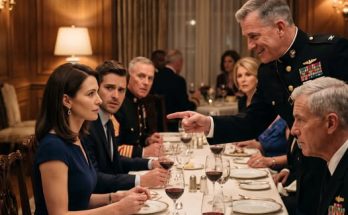
For several seconds after Colonel Coleman demanded proof, the only sound at the table was the faint scrape of my fork against porcelain. I chewed, swallowed, and reached for my water. I could feel Ethan staring at me from my left and Natalie staring at Coleman from across the table. Admiral Brooks had become absolutely motionless.
Coleman waited.
So did everyone else.
Finally, he said, “Well?”
I looked at him. “The vegetables are good.”
Natalie coughed into her napkin.
Coleman’s face tightened.
“Are you going to answer?”
“No.”
The simplicity of it seemed to unsettle him more than anger would have.
“No?”
“That’s correct.”
“Why not?”
I set down my glass.
“Because you are not entitled to the information.”
A thin smile appeared.
“I’m not asking for classified material.”
“You don’t know what you’re asking for.”
“An aircraft type is hardly classified.”
“Sometimes context matters more than a noun.”
“I’ve had security clearances.”
“Past tense.”
Captain Reed lowered his head, hiding what looked suspiciously like a smile.
Coleman noticed.
“This is ridiculous.”
“No,” I said. “This is a birthday dinner.”
William’s mouth moved almost imperceptibly.
I could not tell whether he was suppressing amusement or displeasure.
Coleman leaned back.
“All right. Forget current assignments. Historical. Name an aircraft you’ve flown at any point in your career.”
“I decline.”
“A squadron.”
“No.”
“A deployment area.”
“No.”
“Your training command.”
“No.”
“Claire,” Ethan said softly.
I turned toward him.
His anger had shifted.
He was no longer angry only at Coleman.
There was confusion in his face too.
That hurt more.
Ethan knew I flew. He knew my work mattered. He had seen me leave before dawn, come home exhausted, study technical material at our kitchen table, cancel dinners because duty schedules changed.
But I realized in that moment how many blank spaces I had allowed to remain.
Coleman had found them.
Now he was using those empty spaces as leverage.
Ethan spoke quietly.
“You don’t have to answer him.”
“I know.”
He nodded.
Yet the question remained in his eyes.
Why won’t you?
I turned back to Coleman.
He had seen Ethan’s uncertainty too.
Of course he had.
It encouraged him.
“That’s what I find strange,” Coleman said. “People who’ve actually done something usually don’t mind giving basic details.”
Captain Reed put down his fork.
“Richard, enough.”
Coleman ignored him.
“I’m not asking for mission plans. I’m asking the kind of questions pilots ask each other every day.”
“Pilots ask,” I said. “You’re demanding.”
“Because you refuse everything.”
“That is still my right.”
He shook his head.
“Not if you expect people to believe you.”
The sentence landed differently.
Not because it wounded me.
Because it clarified him completely.
“Believe me about what?”
“That you’re an operational Navy pilot.”
“I never asked for your belief.”
Coleman blinked.
I continued.
“You asked what I do. I answered. Everything after that was your need, not mine.”
His mouth opened, then closed.
Natalie leaned her forearms on the table.
“That,” she said, “was extremely clear.”
“Natalie,” Margaret murmured.
“Sorry.”
She was not sorry.
Coleman looked toward William.
“Bill, are you hearing this?”
William lifted his wineglass.
“I have excellent hearing.”
“You don’t think this is odd?”
“What precisely?”
“A person claims military aviation experience and refuses the simplest verification.”
William considered him.
“I think Claire has answered every question she intended to answer.”
“That’s not what I asked.”
“I know.”
Coleman stared at him.
Something moved across his expression—irritation first, then suspicion.
He glanced from William to me.
“You know her record.”
William said nothing.
The silence changed the room.
Coleman saw it.
So did Ethan.
My stomach tightened.
This was what I had feared months earlier.
Not exposure exactly.
Recognition.
Once someone realized William knew more than he was saying, every unanswered question acquired weight.
Coleman leaned toward him.
“You do.”
William placed his glass down.
“This is my birthday, Richard.”
“That means yes.”
“It means I would prefer to eat before Margaret concludes none of us deserve dessert.”
Margaret gave him a cool look. “I reached that conclusion twenty minutes ago.”
A few people laughed.
The tension loosened for half a breath.
Coleman would not release it.
He looked at me.
“How do you know Admiral Brooks?”
“Through Ethan.”
“No other connection?”
“No.”
“Then how does he know about you?”
“You’ll have to ask him.”
“I just did.”
“And he chose not to answer.”
Coleman exhaled through his nose.
“This is absurd.”
I picked up my fork again.
He stared at me as if refusing to be provoked were itself a provocation.
“Flight hours,” he said suddenly.
I did not look up.
“Richard,” Reed warned.
“How many?”
I continued eating.
“Two thousand?”
Nothing.
“Three?”
Nothing.
“Carrier landings?”
Nothing.
“Night traps?”
Nothing.
“Combat sorties?”
I looked at him.
“Are you finished?”
“Are you?”
“With dinner? No.”
Natalie made a choking sound and covered it by drinking water.
Coleman’s hand tightened around his glass.
“You’re enjoying this.”
“No.”
I meant it.
Nothing about the evening pleased me.
I had come because William Brooks had respected my privacy for months. I had wanted to celebrate the quiet dignity I had seen in him.
Instead I was sitting beneath warm lights with an old memory pressing against the edges of my vision while a stranger tried to make me open it for entertainment.
Coleman shook his head.
“You know, in my career, people earned credibility.”
“So did they in mine.”
“Then demonstrate it.”
“To you?”
“Yes.”
The word came too quickly.
That was the heart of it.
I rested my hands in my lap.
“Why?”
Coleman frowned.
“Why what?”
“Why should your satisfaction matter to my record?”
“It isn’t about satisfaction.”
“It clearly is.”
“I’m trying to establish whether you are what you say.”
“Again—why?”
“Because we’re sitting at a table full of people who served.”
I glanced around.
Captain Reed looked embarrassed.
Margaret looked furious.
Natalie looked ready to throw a bread roll.
Ethan looked torn between protecting me and demanding explanations of his own.
William looked tired.
Not of me.
Of Coleman.
I returned my gaze to the colonel.
“And has anyone else appointed you to verify them?”
Coleman’s cheeks reddened.
“You’re twisting this.”
“No. I’m slowing it down.”
He went silent.
That had always been one of my strengths in a cockpit.
When pressure increased, I became quieter.
Some pilots filled difficult moments with words. I reduced mine. I wanted only useful information moving through the aircraft.
Altitude.
Fuel.
Wind.
Position.
Options.
Noise could kill people.
Panic could too.
The memory surfaced again before I could prevent it.
Black Atlantic beneath us.
Rain striking the windshield hard enough to sound like gravel.
A crewman behind me calling an updated fuel number.
Someone else reading coordinates.
Two officers somewhere below, nearly invisible in the storm.
A voice from command recommending we hold.
Not ordering.
Advising.
The distinction had mattered.
I pushed the memory away.
Coleman was saying something.
“What?”
He gave a short laugh.
“I asked where you trained.”
“Initially?”
“Yes.”
“I trained in several places.”
“Pensacola?”
Ethan looked sharply at me.
Coleman saw it.
“How did I guess?”
“Many naval aviators pass through Pensacola.”
“Exactly.”
His smile returned.
“So there’s one fact.”
I studied him.
“You believe you extracted that?”
“What would you call it?”
“Geography.”
Reed rubbed his forehead.
“Richard, for the love of God.”
Coleman pointed toward me.
“She’s playing games.”
“No,” Reed said. “She’s been telling you no for an hour. You keep pretending the word means try again.”
That landed.
Coleman looked around the table and seemed to discover, perhaps for the first time, that he was losing the room.
He turned toward Ethan.
“You really don’t find this strange?”
Ethan’s eyes hardened.
“What I find strange is a sixty-something-year-old man demanding my girlfriend submit her résumé between the main course and dessert.”
“I’m trying to help you.”
“Help me?”
“Make sure you know who you’re dating.”
The temperature inside me dropped.
Ethan stared at him.
“Be very careful.”
Coleman raised both hands.
“I’m not insulting anyone.”
“You’ve done almost nothing else tonight.”
“I’m saying relationships require honesty.”
The irony was unbearable because part of me agreed with the sentence, if not the man saying it.
Ethan knew there were limits around my service.
He had honored them.
But had I used his decency to avoid telling him things that mattered?
That was a question for later.
Not for Coleman.
Not here.
I touched Ethan’s wrist.
He looked at me.
“I’m okay.”
“No, you’re not.”
His voice was barely audible.
I considered denying it.
Instead I said, “I will be.”
That changed something in his face.
He nodded and sat back.
Coleman watched the exchange.
Maybe he mistook restraint for weakness again.
Maybe the evening had become too important to his pride.
Whatever the reason, he made the choice that finally exhausted my patience.
“All right,” he said. “Let’s make it simple.”
Nobody answered.
He looked straight at me.
“What’s your call sign?”
My fingers stopped against the stem of my water glass.
Across the table, William Brooks’s expression changed.
Only slightly.
But I saw it.
So did Captain Reed.
Coleman did not.
“What?” he asked. “Every military pilot has one.”
“That’s not exactly how it works,” Reed said.
“You know what I mean.”
Coleman looked at me.
“Call sign.”
I said nothing.
The word reached somewhere deeper than his earlier questions had.
Call signs could be jokes.
Insults.
Accidents.
Stories compressed into a single word.
Mine had become something else.
Lantern.
I had not heard it spoken casually in months.
In certain rooms, saying it meant nothing.
In others, it changed faces.
Meridian had ensured that.
Coleman leaned forward.
“Surely that isn’t classified.”
I looked at him.
“No.”
“Then tell us.”
“No.”
He laughed once in disbelief.
“Why?”
I could have said because I did not want to.
That should have been sufficient.
Instead, perhaps because I was tired, I told him something closer to the truth.
“Because some names belong to the people who earned the story behind them. They are not party tricks.”
Coleman blinked.
Then he smiled.
Wrong choice.
“Well, that’s convenient.”
Ethan pushed his chair backward.
This time he got halfway up.
“Enough.”
Several conversations at neighboring tables had gone quiet.
Coleman looked up at him.
“Sit down.”
“You do not tell me to sit down.”
“Ethan.”
William’s voice cut through the room.
Ethan stopped.
His father did not raise his voice.
He never needed to.
William looked first at Ethan.
Then at me.
Then at Coleman.
For the first time all evening, the retired four-star admiral looked less like a father hosting a birthday dinner and more like the officer whose decisions had once moved ships and aircraft across oceans.
Coleman seemed to feel it too.
He straightened.
William slowly placed his fork beside his plate.
The small metallic click against china silenced everyone around us.
He folded his hands.
Then he looked directly at me.
Not at Coleman.
Not at Ethan.
At me.
In his eyes was the same question he had been asking without words since the first night we met.
Do you want this door opened?
My pulse slowed.
William waited.
He could have announced what he knew.
He could have named the report.
He could have embarrassed Coleman with one sentence.
He did none of those things.
Instead, in a calm voice that carried to every corner of the room, Admiral William Brooks asked me one question.
“Claire, what is your call sign?”
Click here to continue reading: PART 4: When Admiral Brooks Asked the Same Question, I Finally Understood Why His Version of It Was Nothing Like Coleman’s Demand
The Quiet Detail in Ethan’s Family Dinner Invitation That Told Me His Father Had Already Recognized Something I Never Discussed
Part 3 of 16